
After a last-minute decision to skip Madeira and pull a non-stop leg from Galicia, we find ourselves somewhat dazed to be suddenly in the Canaries—practically the tropics! We’re taking the time for a bit of island-hopping before the series of family visits in Tenerife.
The full photo album here.
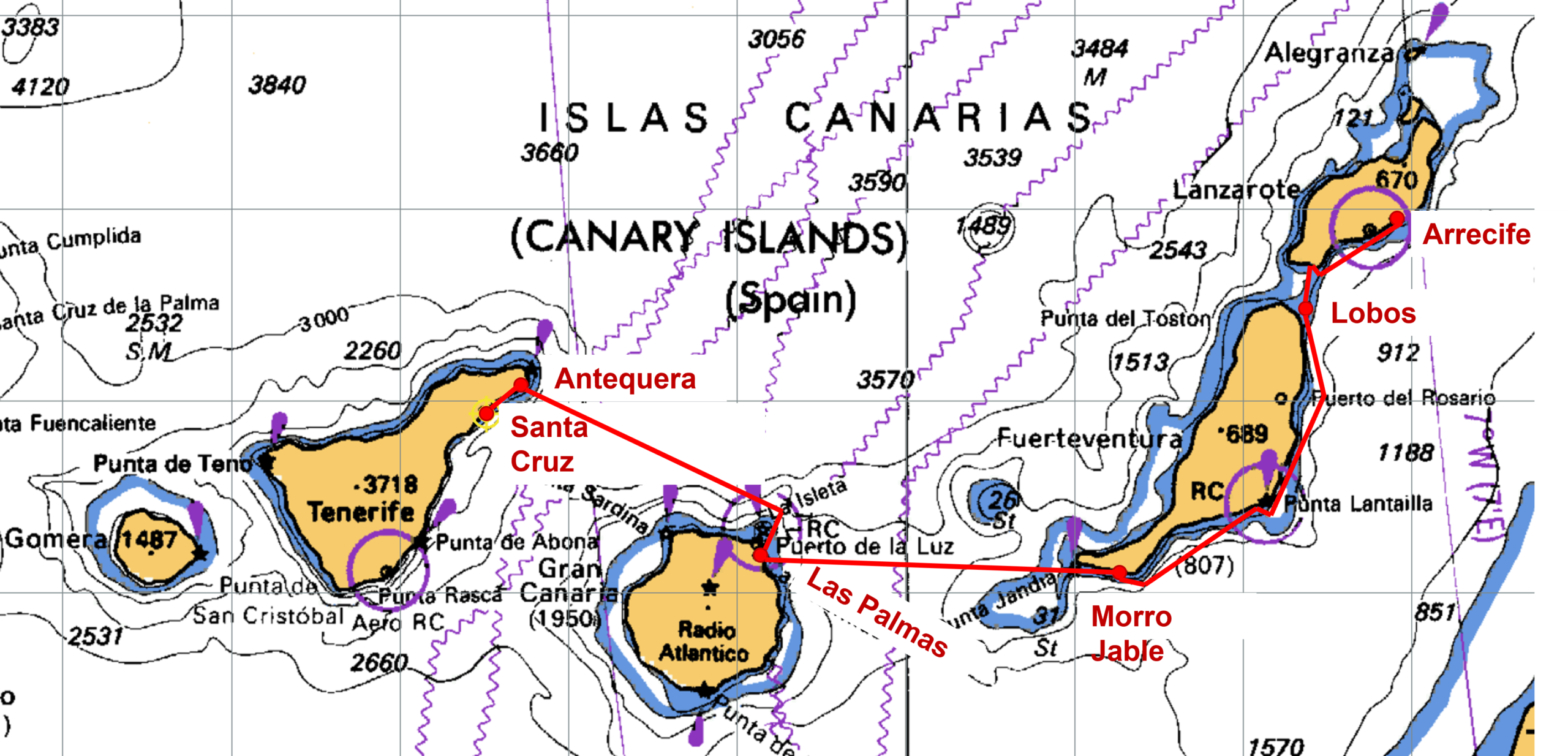
218 nautical miles sailed– 7301 NM in total on UtPåTur
27 to 30 March: Stopover in Arrecife
After a long passage from Vigo and a 5:00 am arrival, we were considering a lazy morning… but no. We have an appointment with the harbour office at 9:00 am sharp to be assigned our permanent berth. It is only after one final mooring manoeuvre in 18 knots of wind that we can finally relax and realise where we’ve actually landed.
Our first steps lead us to the immediate surroundings of the harbour. We came here 15 years ago with Saltimbanque; we had taken an unofficial mooring buoy and were landing with the tender on a derelict pontoon in an abandoned. Our only neighbours were an Italian and a Uruguayan on an extended stopover. Nothing of that pseudo-squat atmosphere remains. But where are we? Besides the state-of-the-art marina (just think, you open the pontoon gates with your smartphone!), a string of tourist shops: at the end of the quay is the new cruise ship terminal! They arrive like clockwork at 9:00 am and depart at 6:00 pm… It is another world!
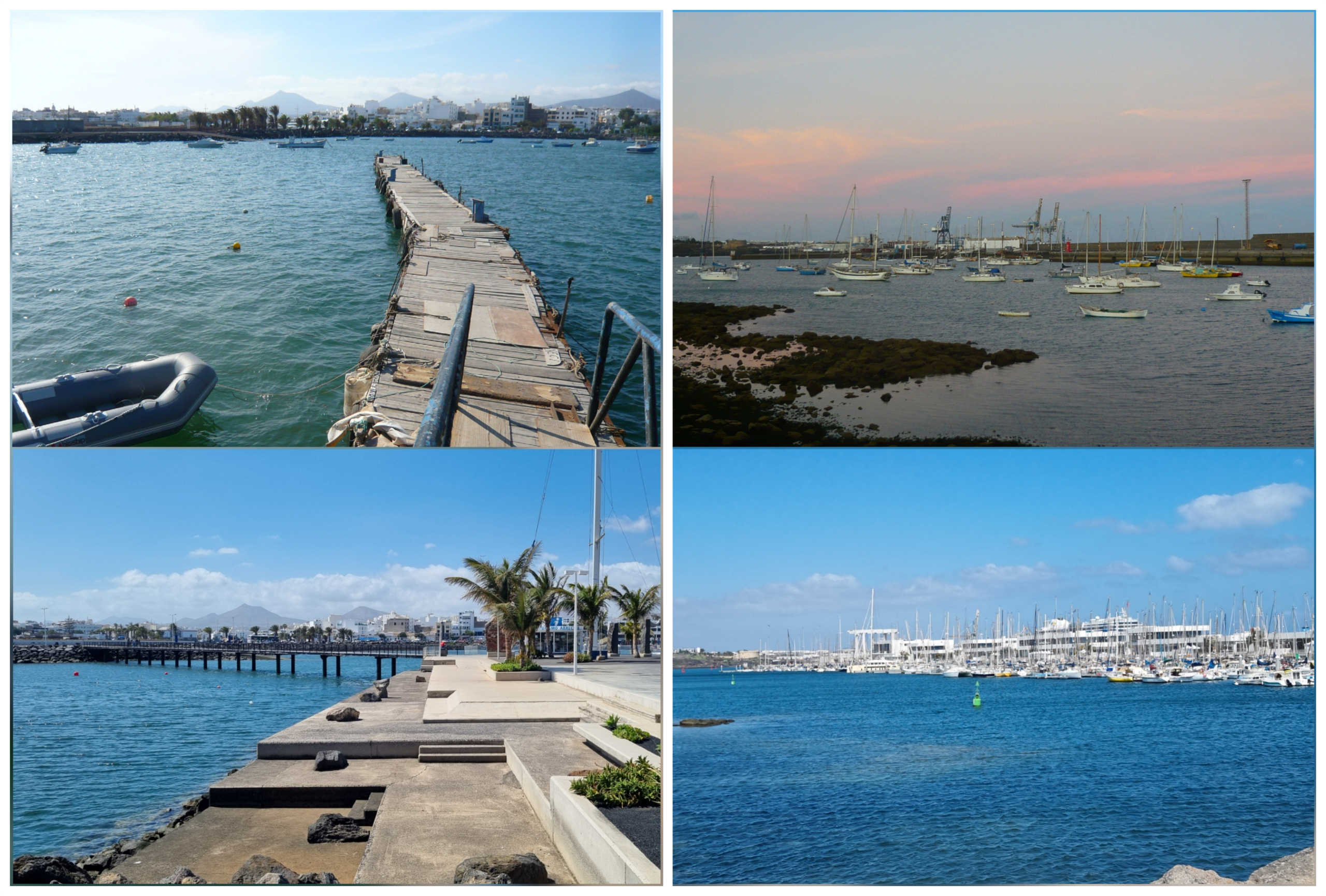
The top pictures were taken exactly at the same place as the bottom ones, 15 years apart
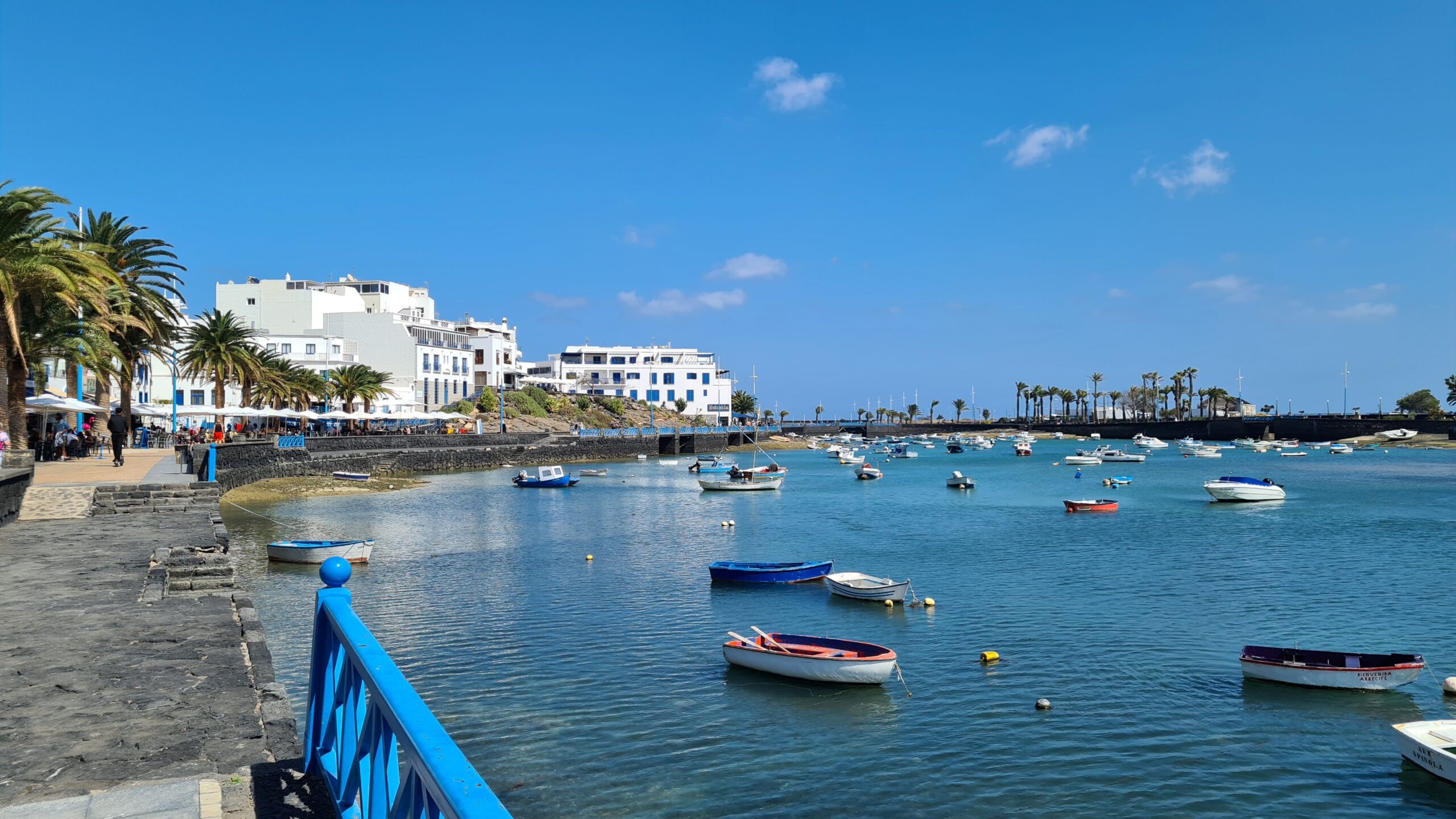
The new promenade along the Arrecife lagoon
The town also has been given a makeover; looking its best for all these tourists! It must be admitted that everything has been re-done with taste and the promenade laid out around the lagoon is most pleasant. At the water’s edge, we recognize with nostalgia the hotel that had at the time provided us with Wi-Fi, and the beach on which we used to take our “saltimbanque” shower… trip down memory lane…
We treat ourselves to a cold beer with a view of the lagoon to celebrate our arrival… 2 euros a pint, this time we are truly far from Norway… We admire the pretty little white houses on the black lava, and these palm trees everywhere! Not a single deciduous tree left, no more slate roofs… no more roofs at all for that matter, just terraces on top of the square houses. It almost never rains here anyway; this time we are truly far from Brittany!
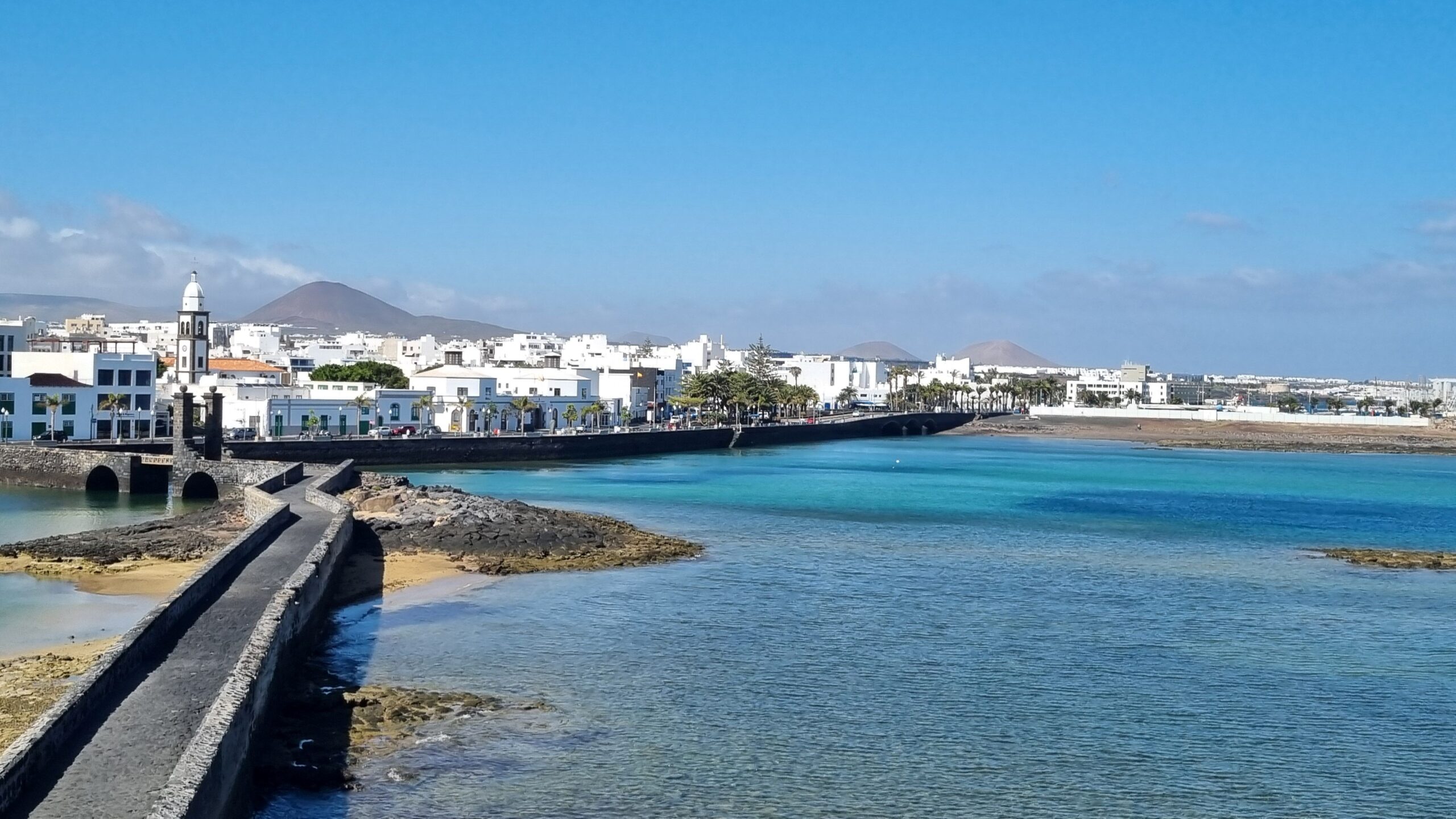
This time we are truly far from continental Europe!
But what amazes us the most is the sun: after searching for it for weeks, we sail barely 7 days and it is suddenly summer! This time the hot water bottles are buried deep into the locker where they join the woolly hats, gloves, and warm pyjamas. It is brutally sunny, 23 degrees – but very bearable with the wind, and above all it is very dry… We continue our boat-drying workshop, this time it is the forward cabin which finds itself in pieces on the deck!
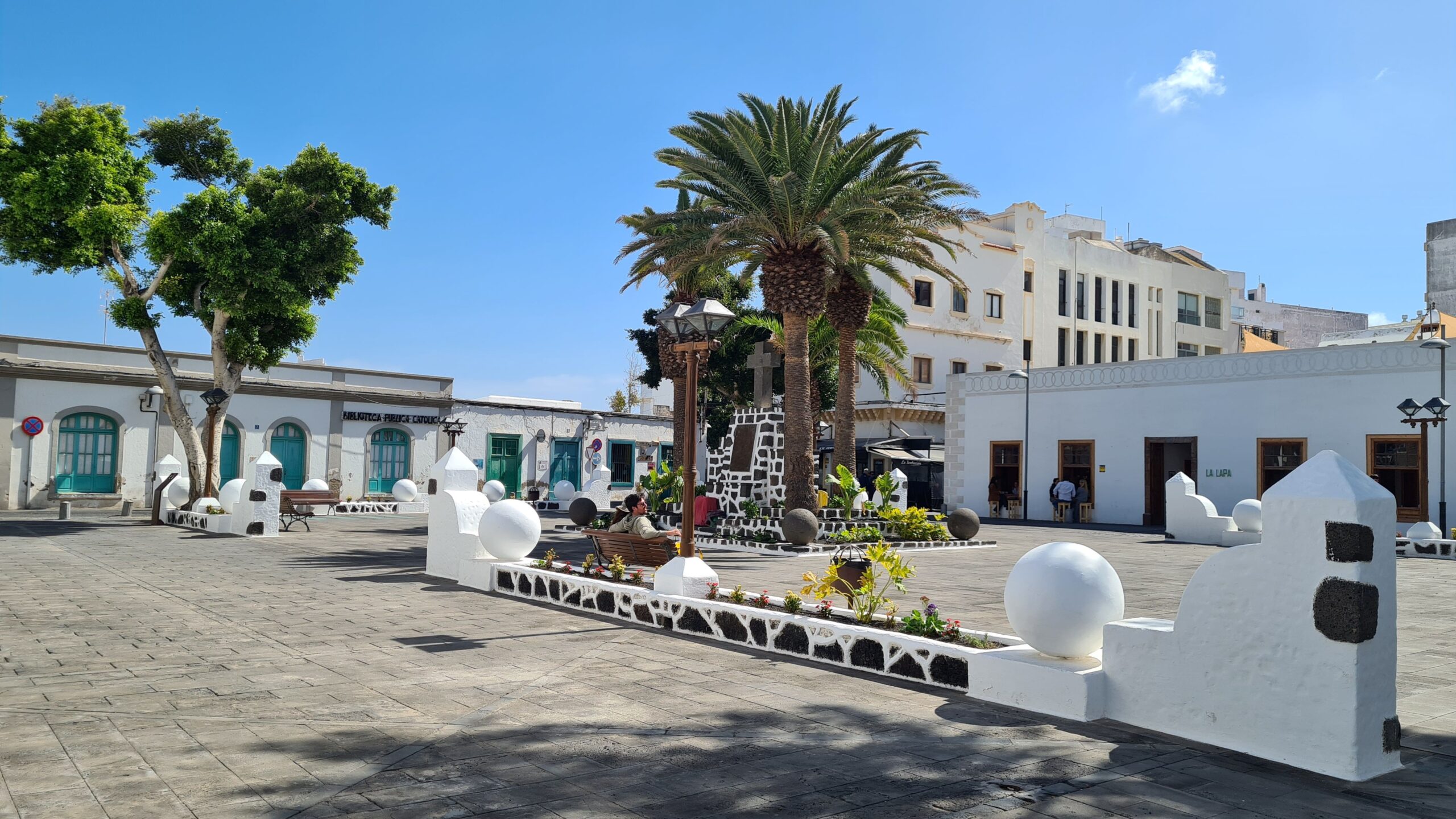
In the center of Arrecife, we are slowly getting used to this new climate…
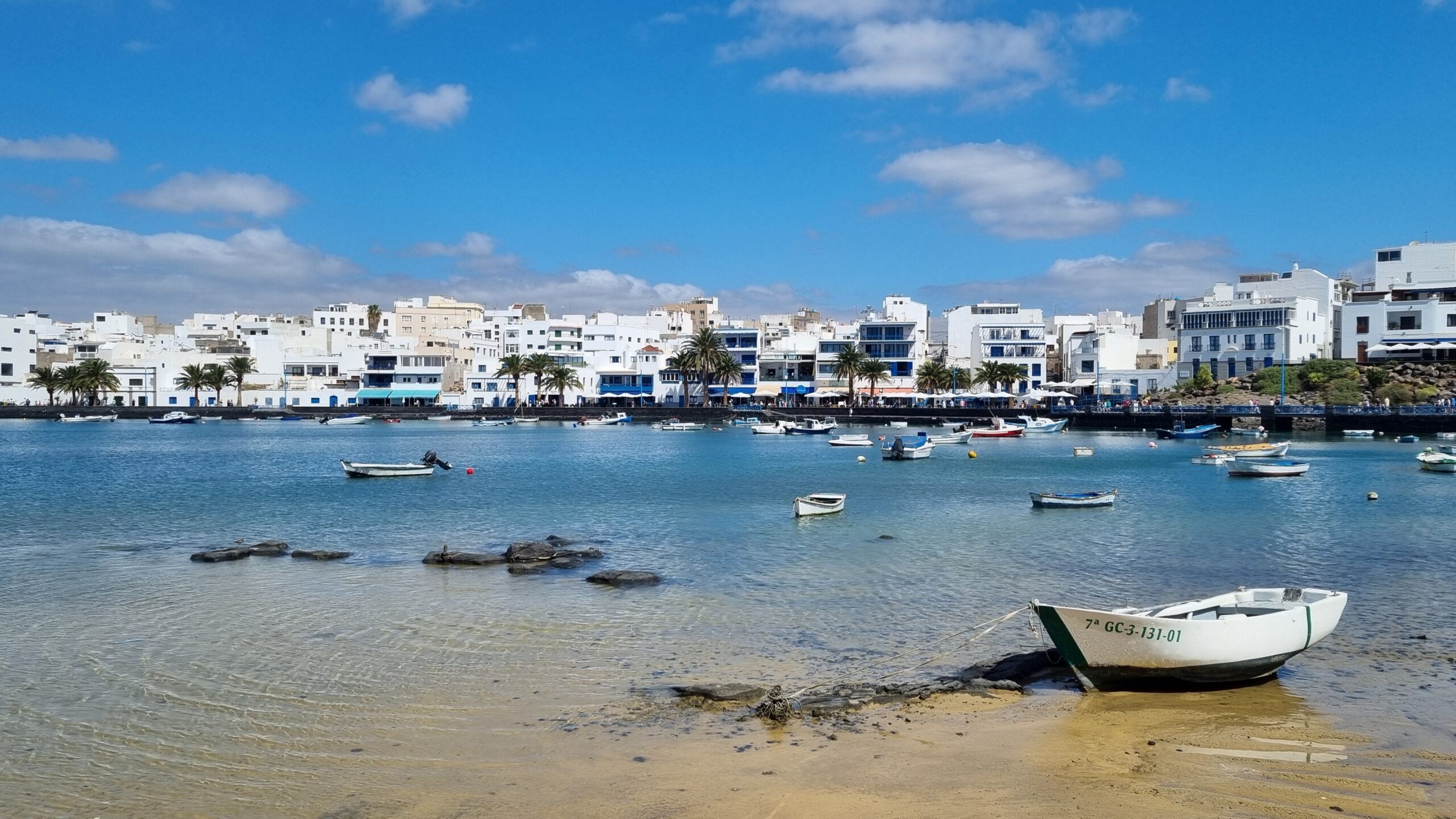
…still so sunny and blue!
We also take advantage of the stopover to maintain the boat: new transom shower head, various checks after the crossing, and restarting the watermaker (which works much better with the new pressure gauge installed this winter).
On the other hand, the incomprehensible water leak has returned… Yes indeed, same as in Måløy and Fredagshølet, the one that floods the tins… Fortunately in its fresh-water version, but this time it occurred before we put the watermaker into service, which de facto exonerates our number one suspect … Still no idea where the water can possibly come from, the plot is thickening…
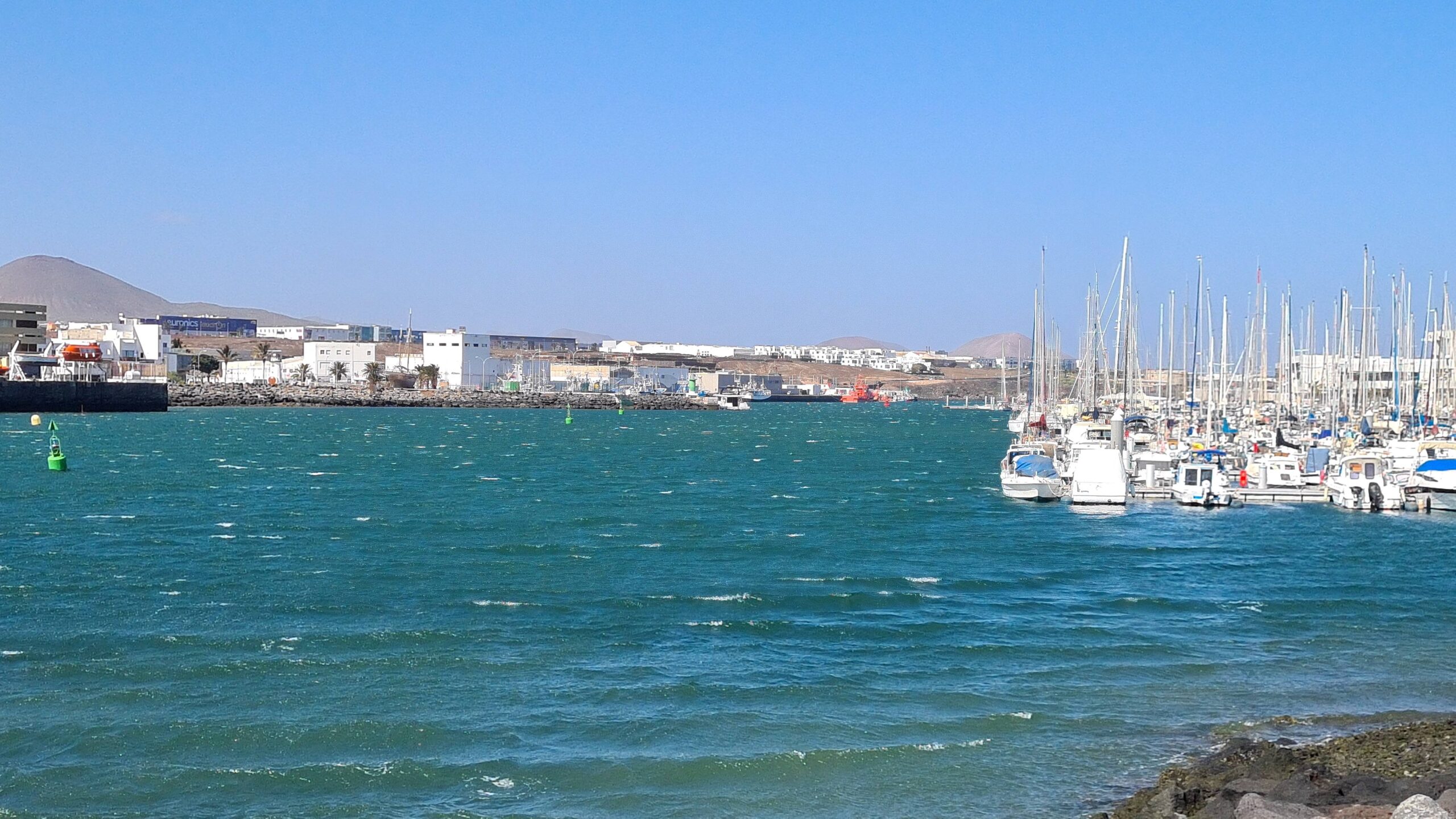
The expected strong winds have arrived…
As predicted the wind increases as the days go by, until exceeding 40 knots in gusts on the last day… In the late afternoon, the sky is covered with a strange orange cloud: it is a calima episode, Sahara sand is blown here by the Sirocco, that strong Easterly wind prevailing these days. Reddish colours, hazy light, surreal…
31 March to 1 April: Arrecife – Lobos – Morro Jable (88NM)
We have a few days left before our families expect us in Santa Cruz de Tenerife. It’s the opportunity to visit the archipelago a bit!
We leave at dawn (something to do with the day billing period starting at 8:00 am…) in a moderate North-Easterly wind. We hoist the sails and begin a quiet leg along the South of Lanzarote. It is only when day breaks that we realise the extent of the disaster: the deck is covered in red sand, all the lines in particular are all impregnated. But the most spectacular is the rigging: the shrouds disappear under the Sahara dust and (more of a problem) the mainsail slides badly along its track as the ball-bearing cars are all congested… We will have to clean all that as soon as possible…
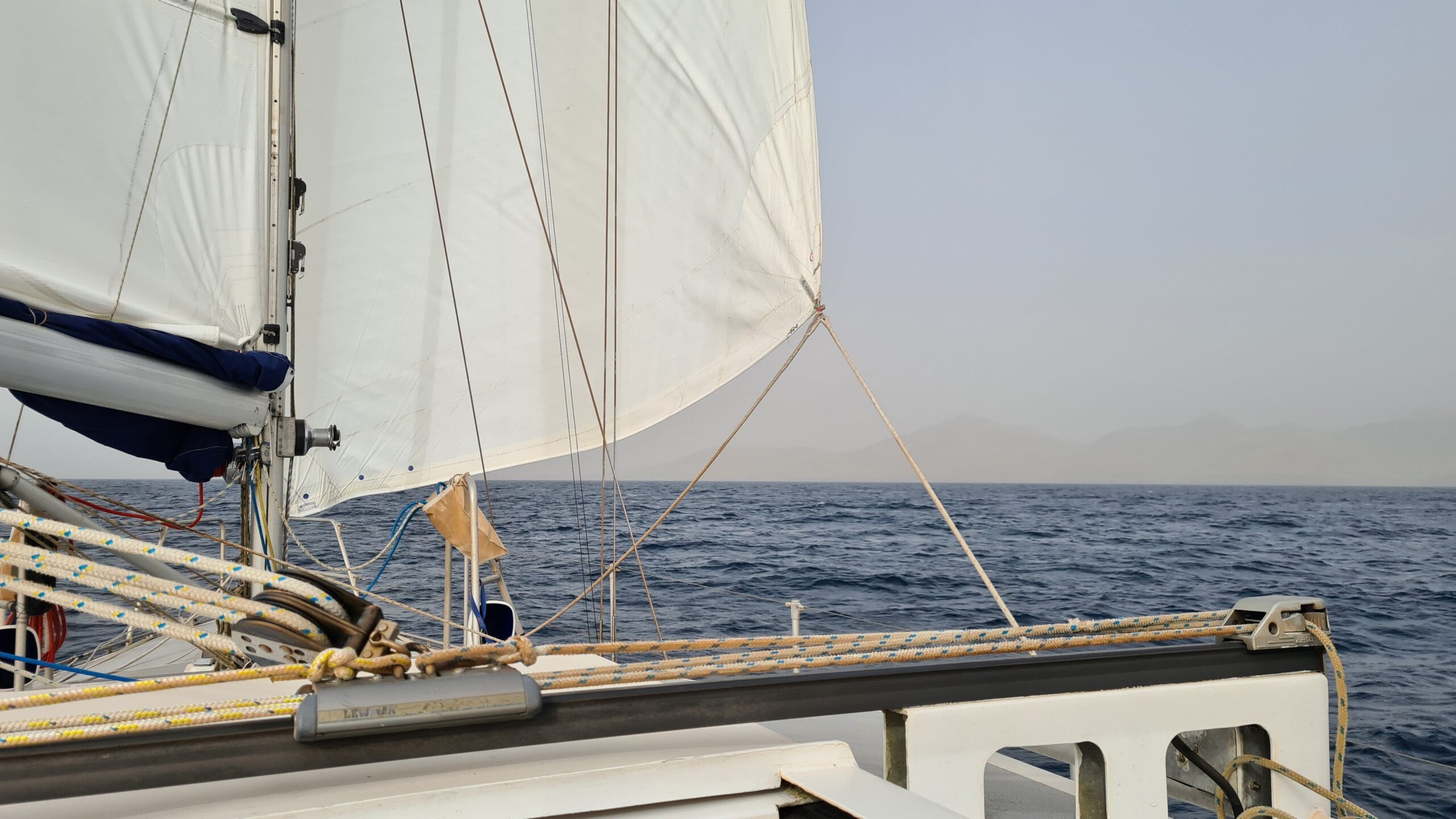
UtPåTur covered in Saharan dust, close to the coast of Lanzarote
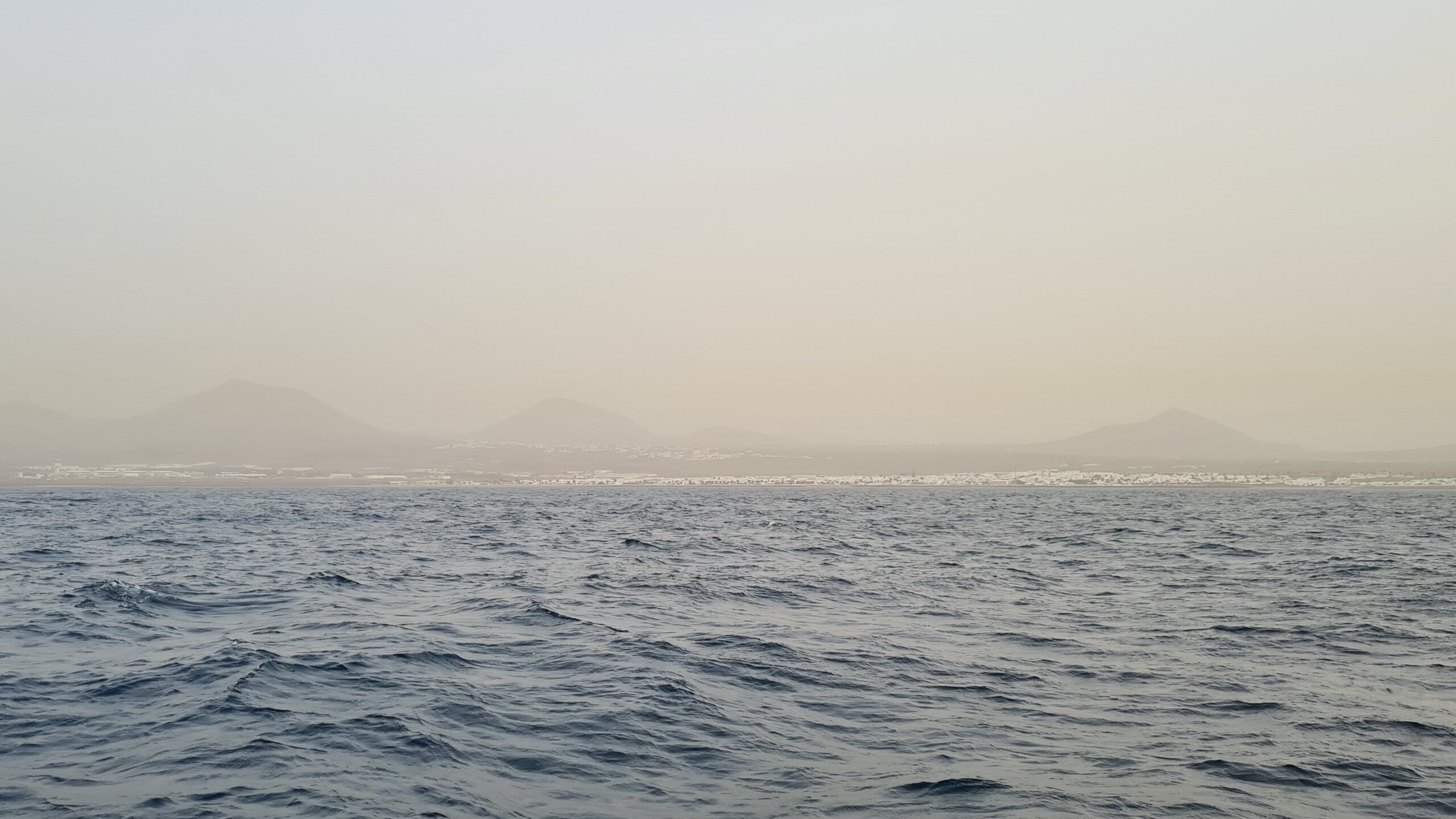
The coast is magnificent… or so they say…
The visibility is very limited. We had planned to skirt the islands and admire the landscape, it is a bit disappointing… Well, at least we have a nice anchorage to look forward to… Have we told you the water temperature is over 20 degrees?
Just as we are approaching the bay we had identified at Punta de Papagayo, in the South-West of Lanzarote, the wind begins to rise significantly… It is a frequent phenomenon in the Canaries which are very high islands: the capes, mountains, and straits accelerate the wind which can suddenly take on 20 knots. We try to approach anyway but the gusts become more and more powerful, 25-30 knots: not the most peaceful conditions for anchoring, we decide to go try our luck elsewhere.
It will be the island of Lobos, just North of Fuerteventura. The wind there is more stable, however the shelter from the swell is next to null… Not easy, anchoring in the area… We console ourselves with the colour of the water, which is incredibly blue, one would think oneself in the West Indies! The anchor falls just behind the mooring buoys of the charter catamarans (one would think oneself in the West Indies…), Laure finds her tropical reflexes and jumps instantly into the water to check that the anchor is clear and well set, before we pull on it with the engine to bury it well into the white sand.
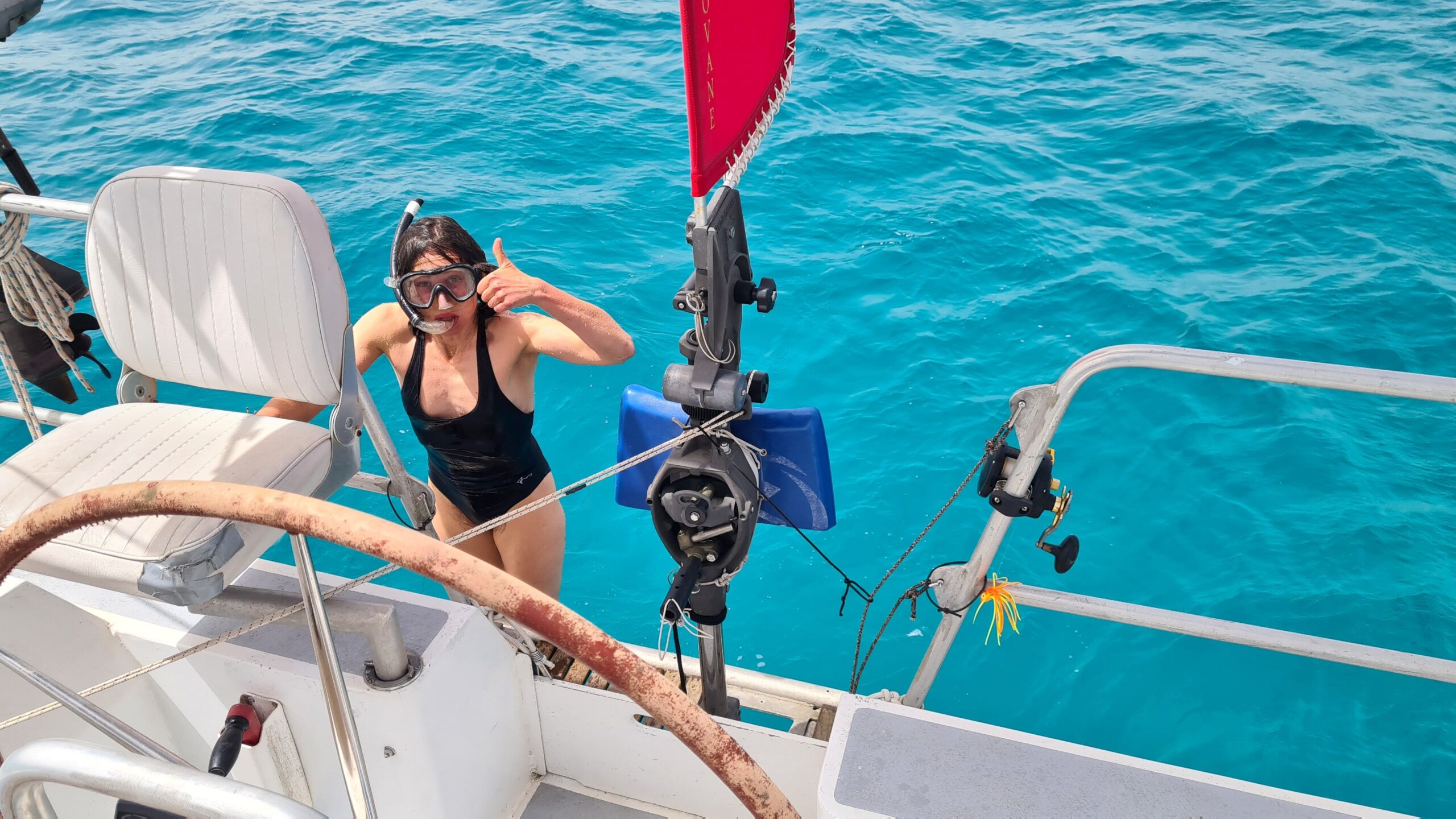
Anchor is clear!
It has been so long since we have anchored in warm weather and transparent sea… Northern Europe is very beautiful, but the tropics, it has its charm too all the same… The end of the day is spent between swimming and a little trip in the tender; we even manage to restart the outboard motor! Still, the swell is too strong to allow us to go ashore.
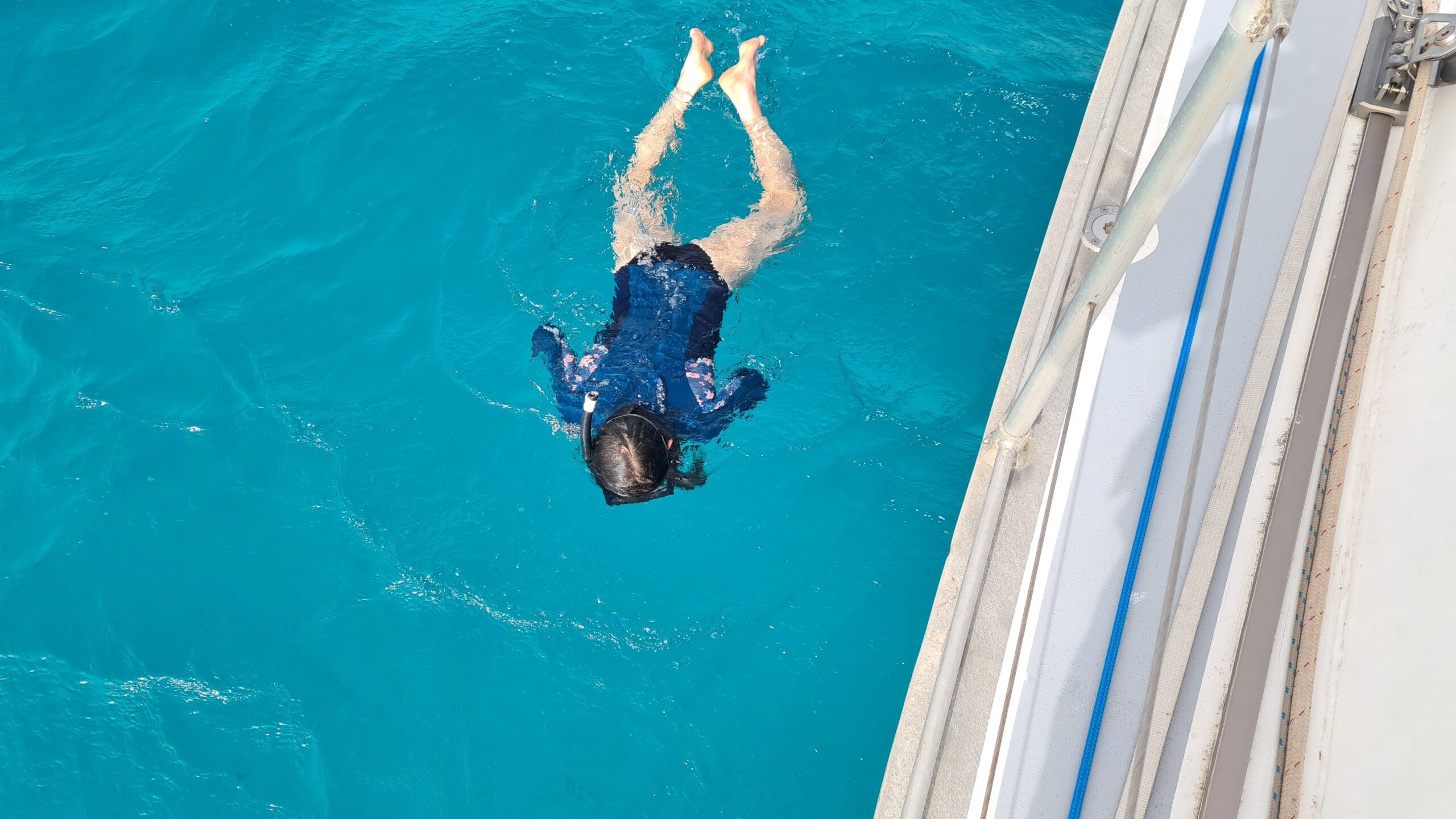
The first real swimm of the year for Laure
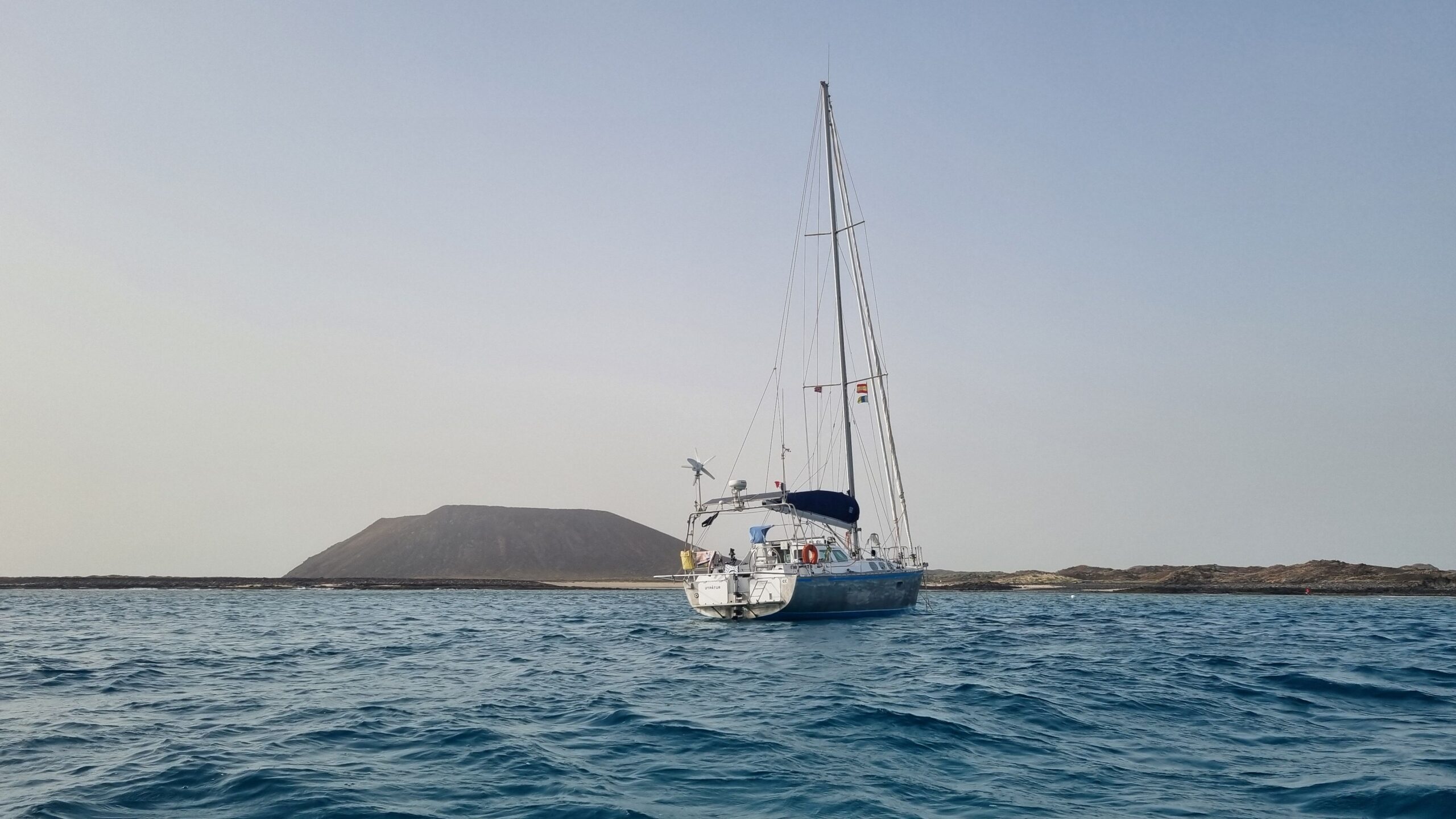
UtPåTur facing a small Canarian volcano
The next day we continue our discovery of the eastern islands by skirting the East coast of Fuerteventura. The wind is quite weak and the visibility improves slowly; we have ample time to admire this extremely arid island. Not a tree in sight, sand, volcanic scoria, a road, nothing, a lot of nothing, it is quite impressive! A familiar vision however: three Northern Gannets flying in a line! But what are they doing in this landscape?
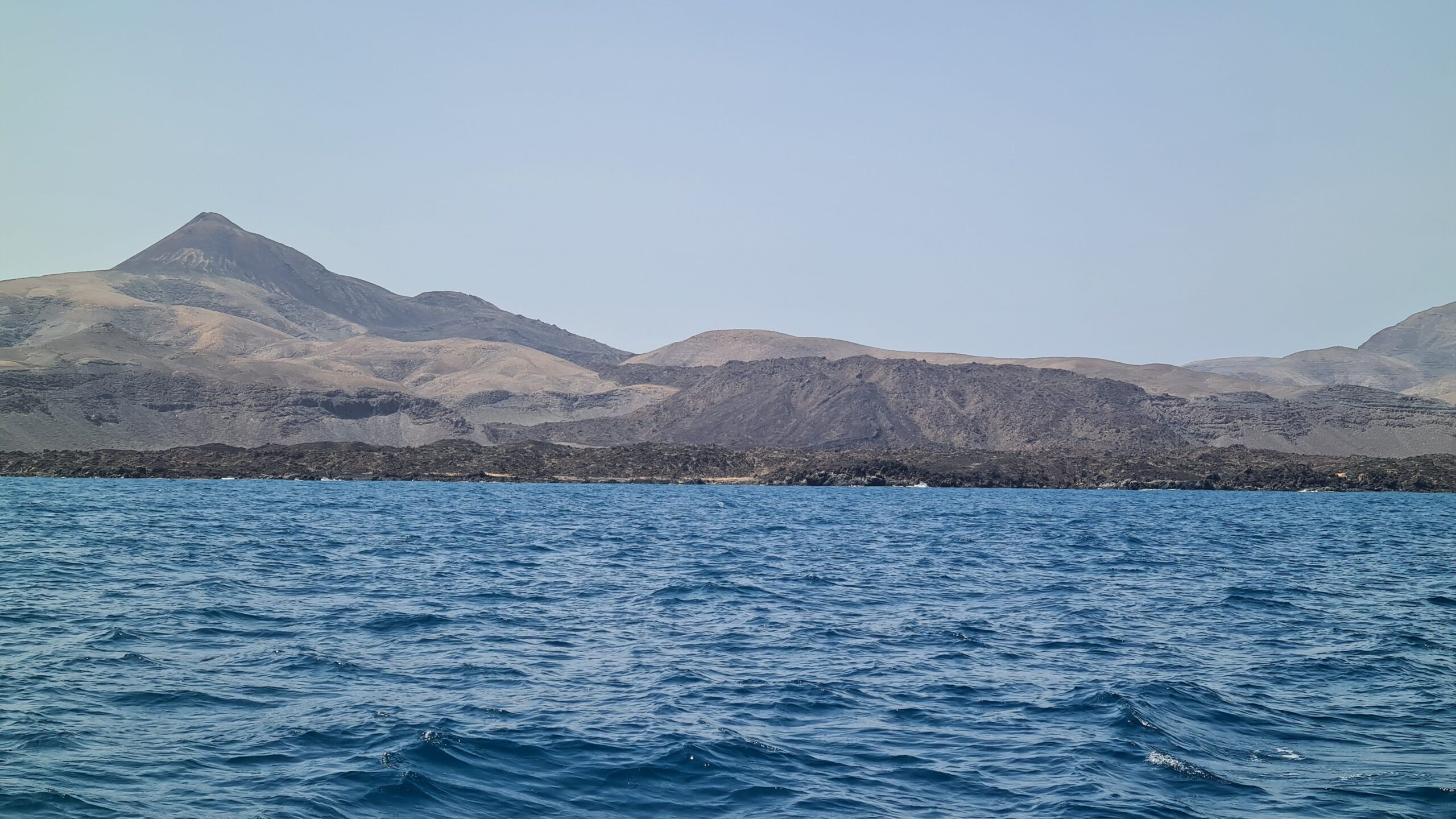
Harsh landscape off Fuerteventura
To add to the change of scenery, the conversations in Arabic are continuous – and animated – on VHF channel 16, it sounds like a football match day. It must be said that from here, the Moroccan port of Tarfaya is closer (100 km) than Las Palmas in Gran Canaria! The proximity of this coast has always been felt on the eastern islands for that matter, whether architecturally or through the raids of Berber (and European) pirates which dominated the history from the 16th to the 18th centuries.
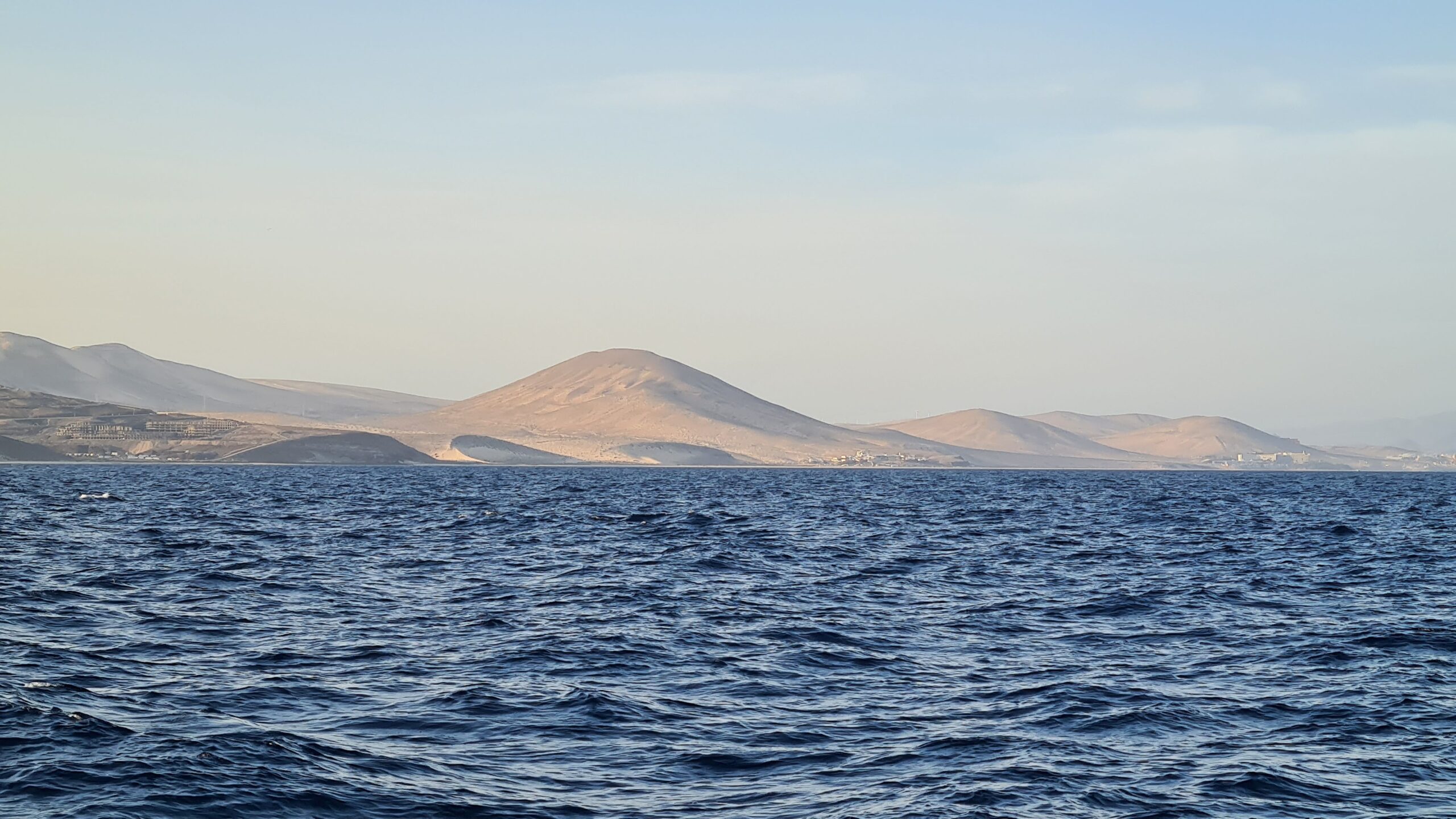
The famous sand dunes South of Fuerteventura
Once again the anchorage we are aiming for (Las Playitas), supposed to be protected from the North-Easterly winds which are very calm today, is not a safe option: 25 knots of Easterly are blowing right into it! These local effects are exhausting… No other choice than to continue another 25 miles to the Morro Jable anchorage at the very south of the island.
So yes, we cheat a bit with the engine to arrive before the dark of night, which allows us to anchor at the foot of the cliff without hitting either the buoy that marks the pipeline or the multiple mooring buoys hanging around the area. No wind this time but an anchorage wide open to the swell, we are starting to get tired of being permanently rocked that way. One bright note though: the shearwaters which begin to squawk in the cliff by the boat at nightfall. They are cousins to the cagarros of the Azores and they too sing like chatty ducks who would have abused the helium. We are all moved to hear this sound again…
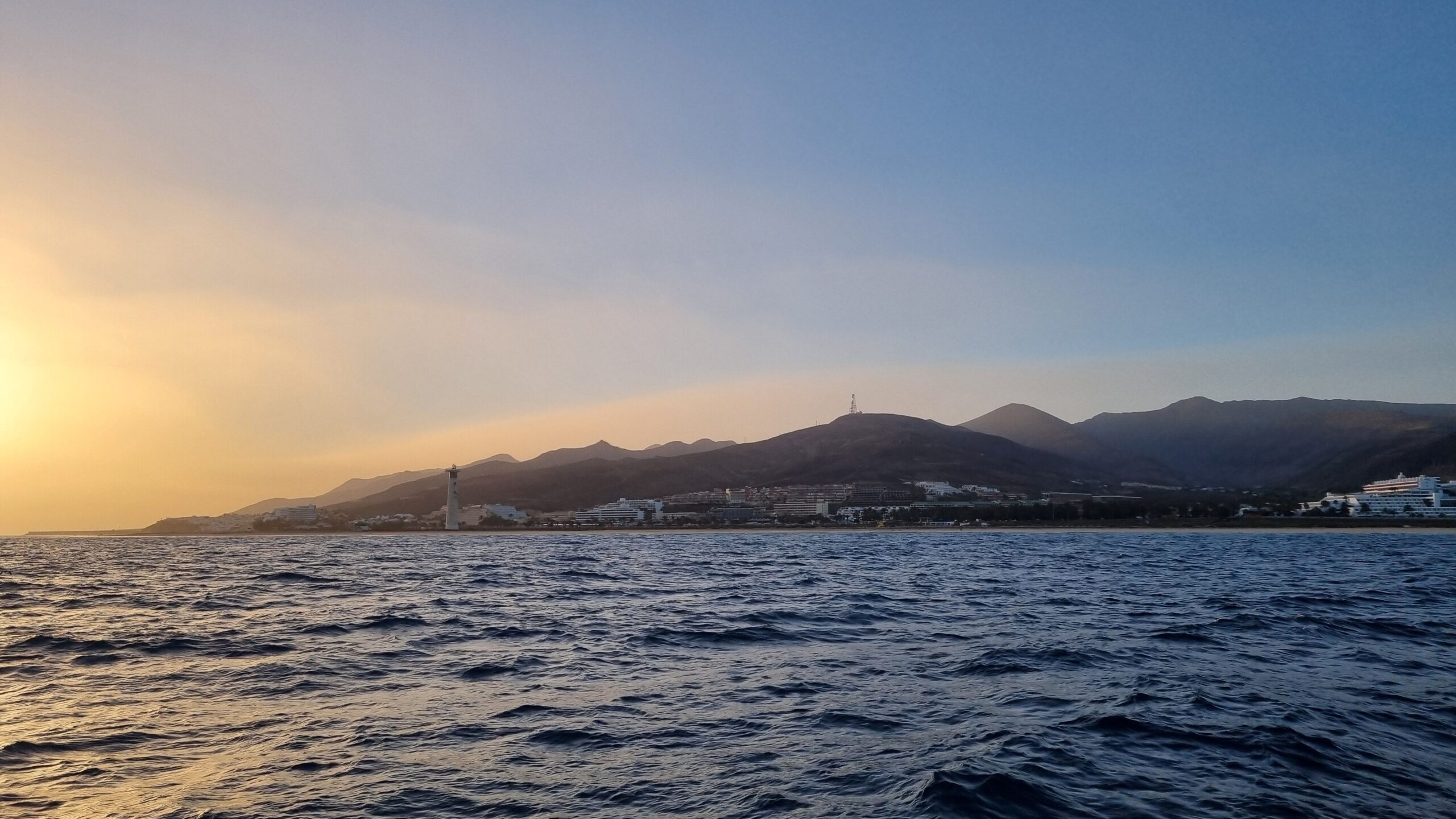
Arriving to Morro Jable, at the southern tip of the island
2-3 April: Morro Jable – Las Palmas (59NM)
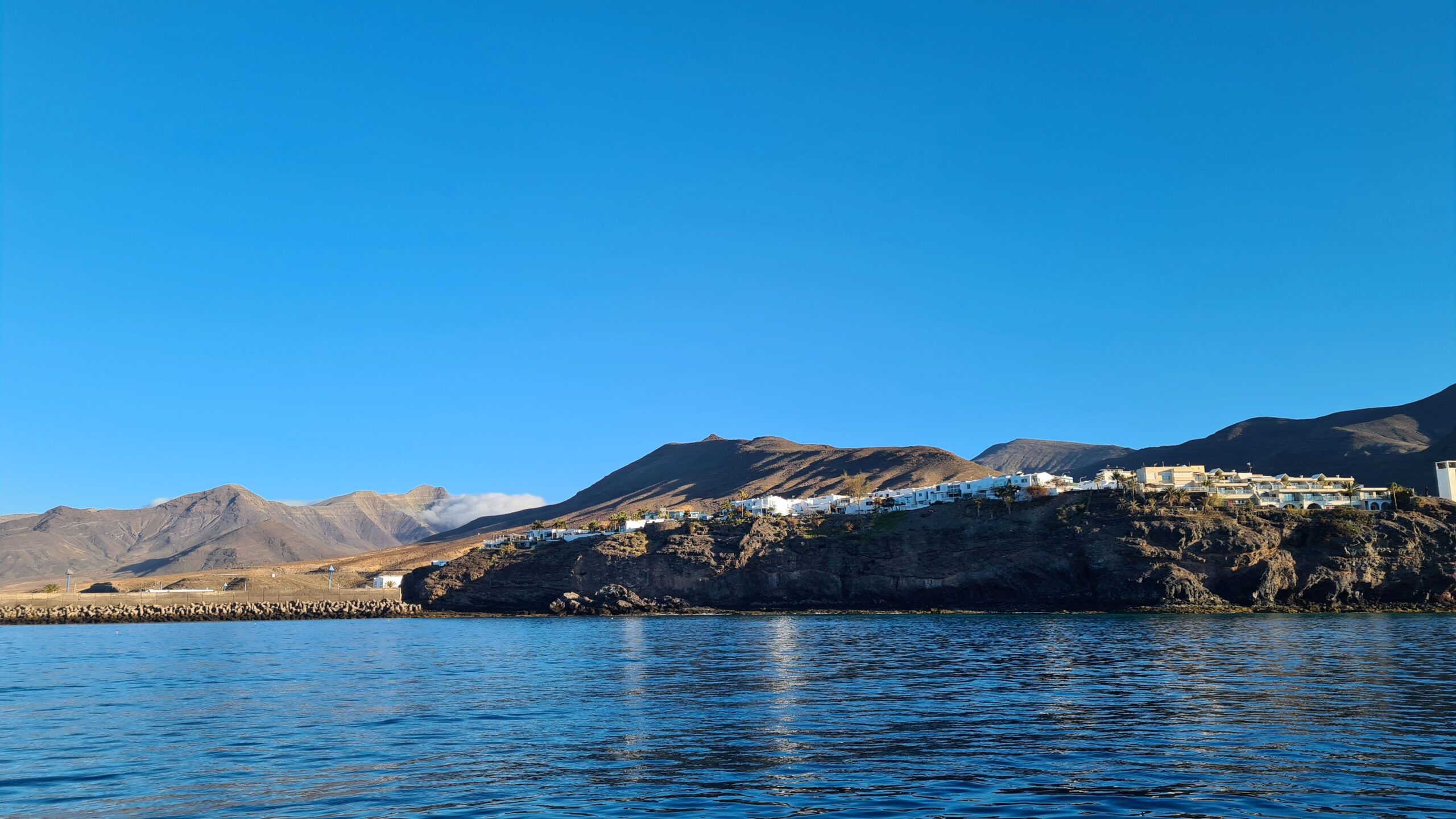
Leaving the anchorage, in less than a mile there will be 25 knots of wind…
Simple route today: we clear Fuerteventura and its last local gust (this goes very well under two reefs and the staysail), then we dash towards the island of Gran Canaria on a reach in the trade winds.
Ah what bliss these trades…. Stable, regular, without surprises, and the sea of such a unique blue… We fly along, in T-shirts in the sun, surrounded by shearwaters and dolphins, it is the sailor’s paradise! Only one negative: the fishing line remains stubbornly empty… At least, at 40 degrees of latitude further North, the pollack and cod were plentiful…
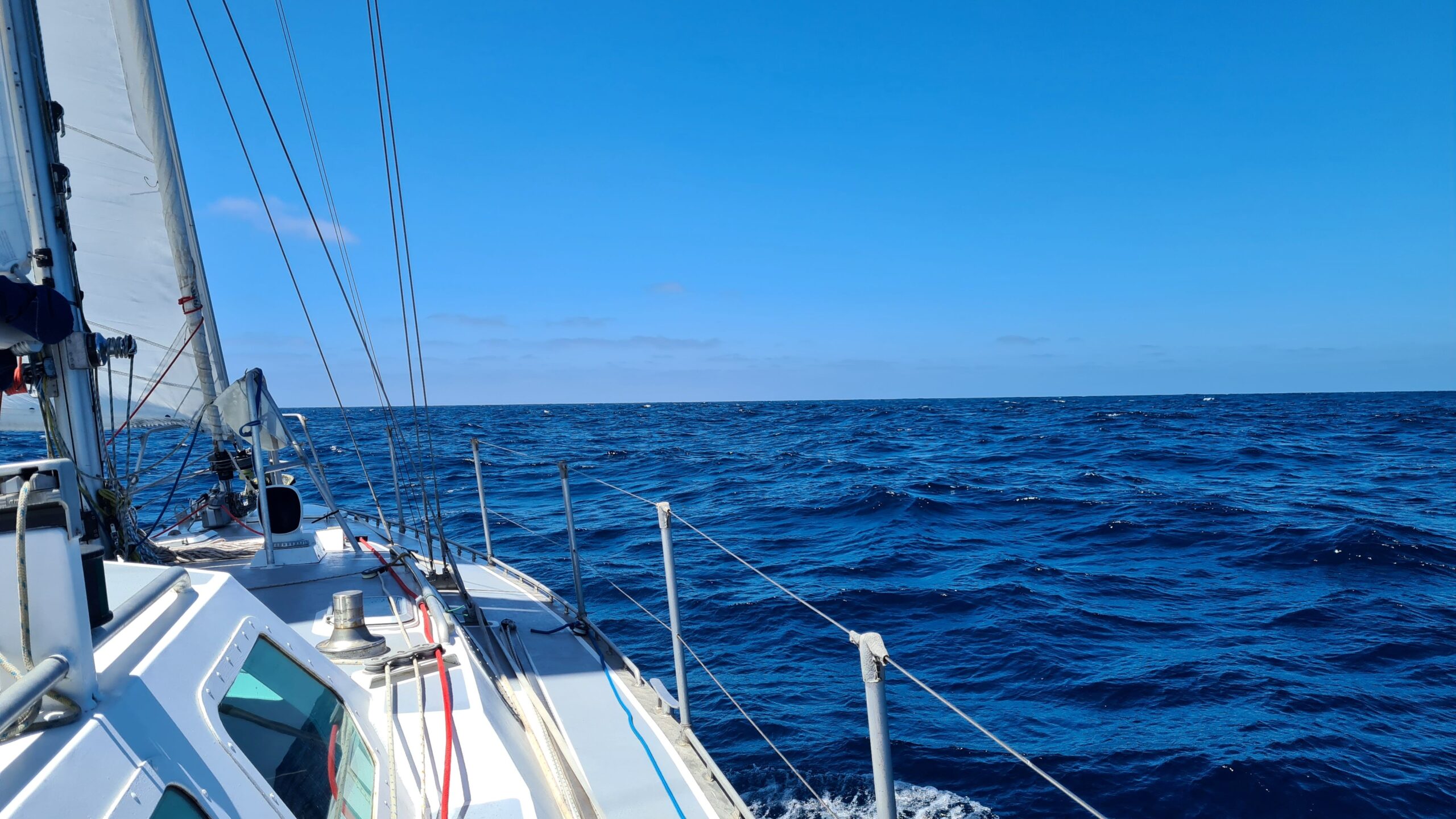
The trade winds… can we ever get tired of them?
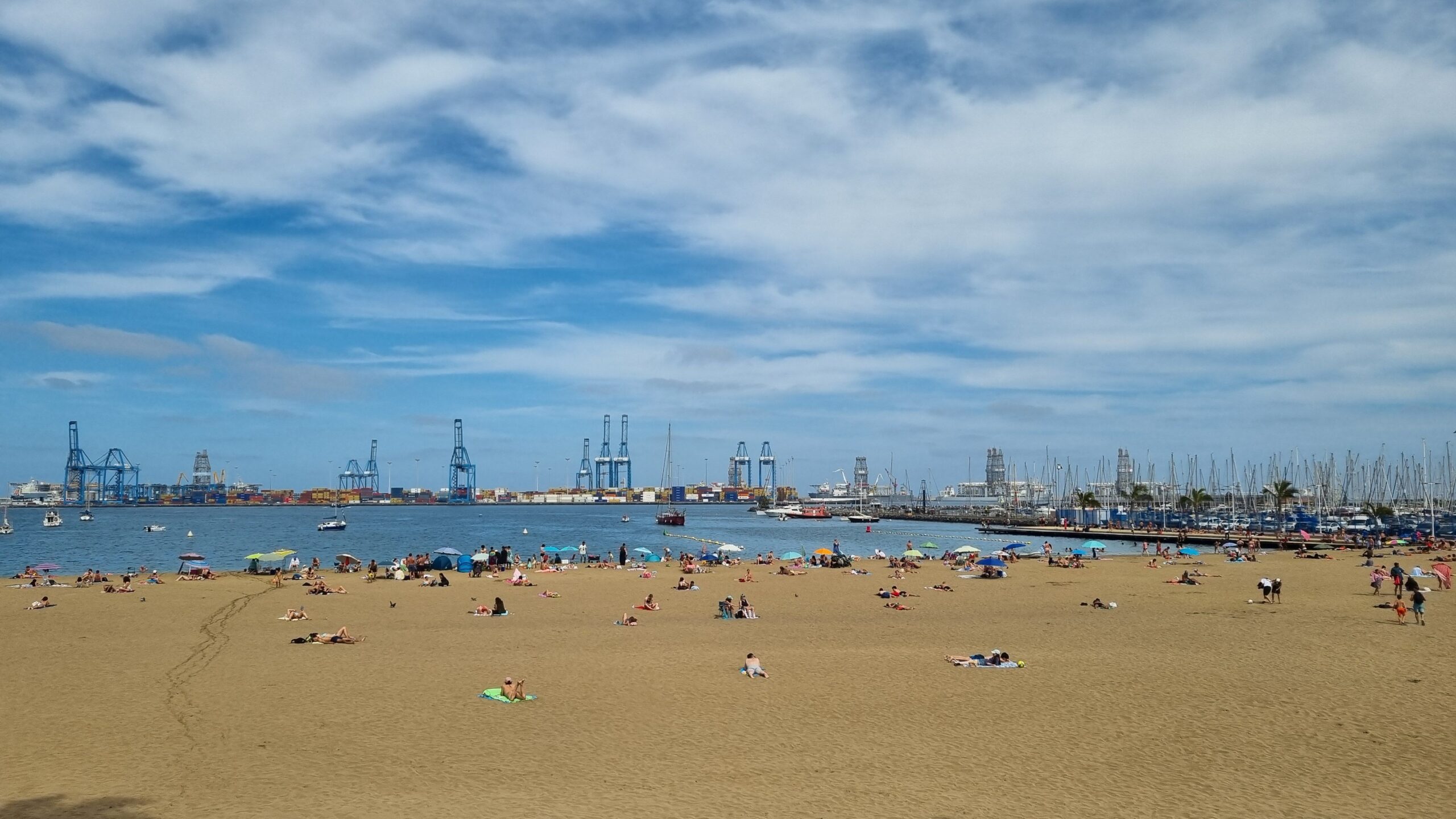
Las Palmas anchorage… forbidden from mid-March to mid-September…
Nine hours of blissful sailing later, we arrive at Las Palmas. The city is still as sprawling as in our memories, and what’s more it is forbidden to anchor there in this season. Never mind, the port is not expensive at all and we will be more at ease leaving the boat to go explore the interior of the island.
We take the bus for Gáldar at the North-West tip of the island. Besides a charming little village, one finds there the cueva pintada, the remains of a Guanche village (the pre-Hispanic civilisation of the Canaries of Berber origin) as well as a cave with unique rock paintings. These stone-age-like artefacts are actually very recent (13th century), but it must be said that in the absence of ore, the Guanches did not dispose of any metal before the arrival of the Spaniards. Not surprising that they were so easily massacred or deported during the conquest: the population finally authorised to remain on the island after the installation of the Castilians is estimated at 200 individuals…
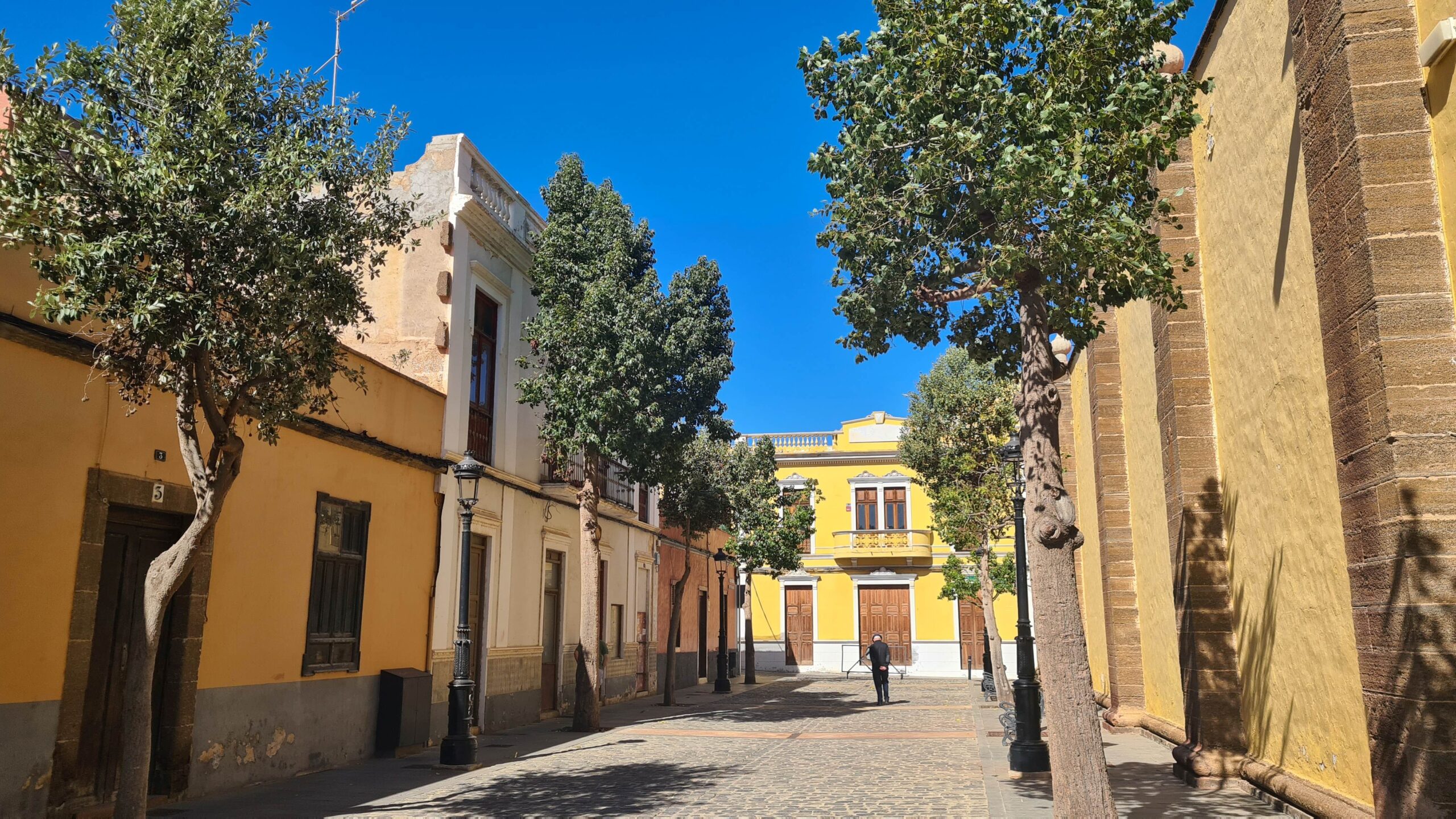
Gàldar, much more colorful than the black and white villages of Lanzarote
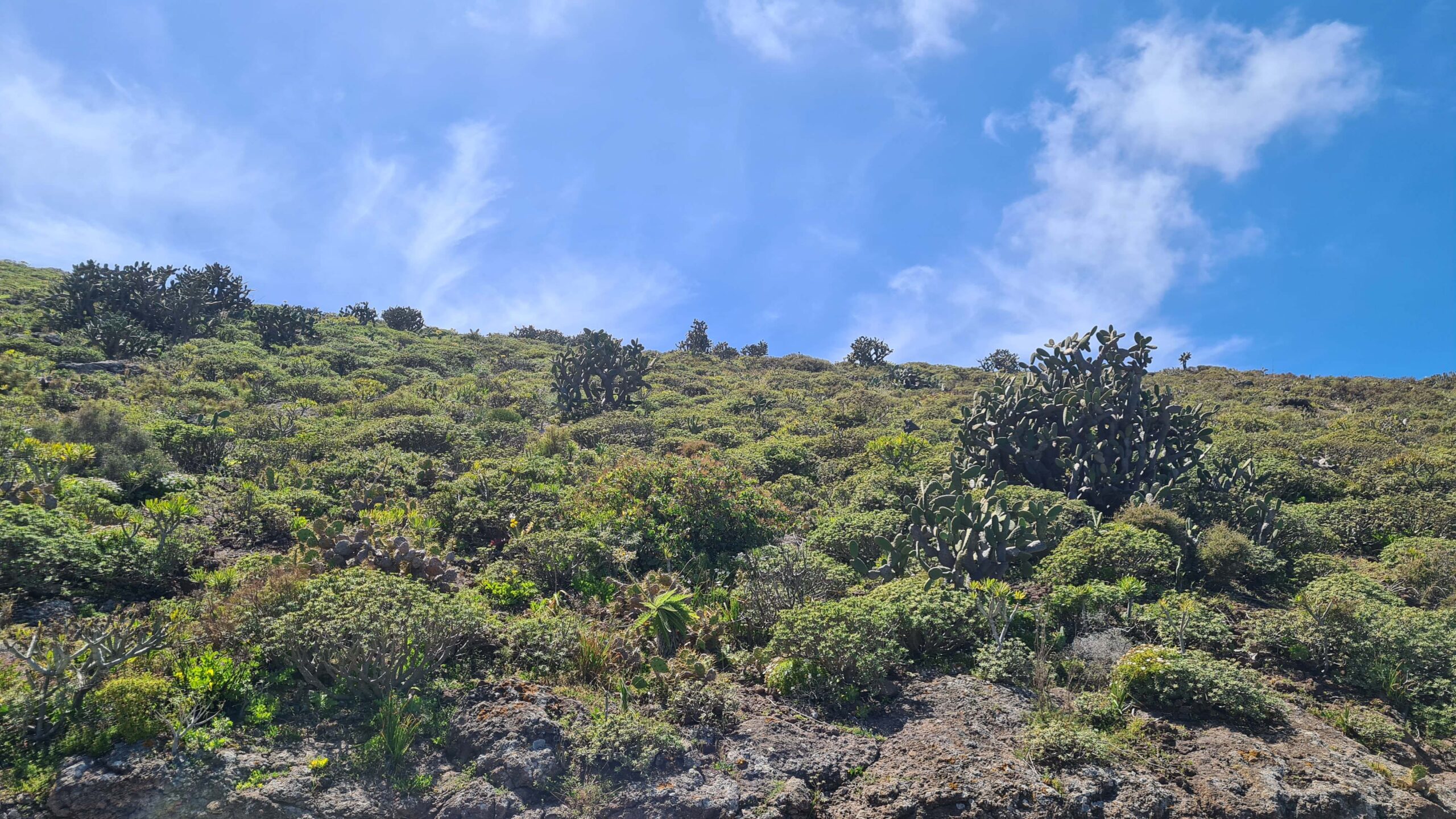
Cacti, euphorbias and agaves are now the most common plants… we must have sailed quite a few milles!
On the way back, the bus drops us in the middle of nowhere at Llano Alegre. From there we continue on foot the little road which winds along the mountain. Gran Canaria is less arid than its eastern cousins, and even if the soil is just as volcanic, the vegetation flourishes. Besides the countless banana plantations, one finds numerous cacti, euphorbias, agaves, succulents, and even a few eucalyptus! It is indeed the only plant that is somewhat familiar to us…
At the top of the mountain, the cenobio de valerón. The Guanches carved multiple silos there into the hillsides, transforming the cliff into a veritable Swiss cheese! It is thought that they were using these cavities to store grain and beans (either for private use or in a community deposit system), sheltered from the bad weather, pirate attacks or other threats. Very impressive in any case!
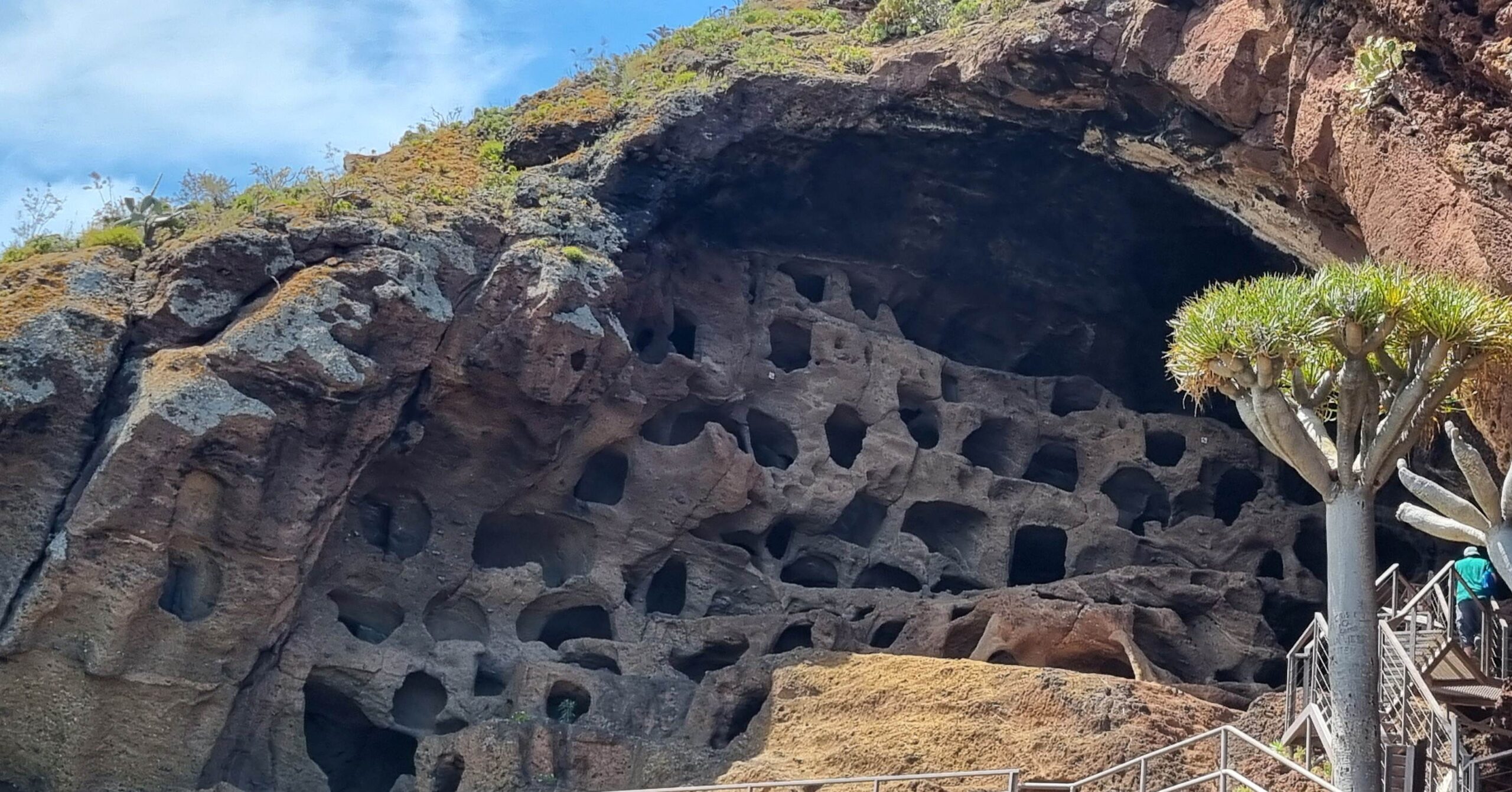
The cave silos, as well as a dragon tree, the iconic tree of Macaronesia
Back at the boat, it’s washing time! Both the deck and the mast are flushed with water, and Laure spends two hours up attempting to clean the dust which has become encrusted everywhere in the shrouds and the mainsail track… Sahara sand, it sticks!
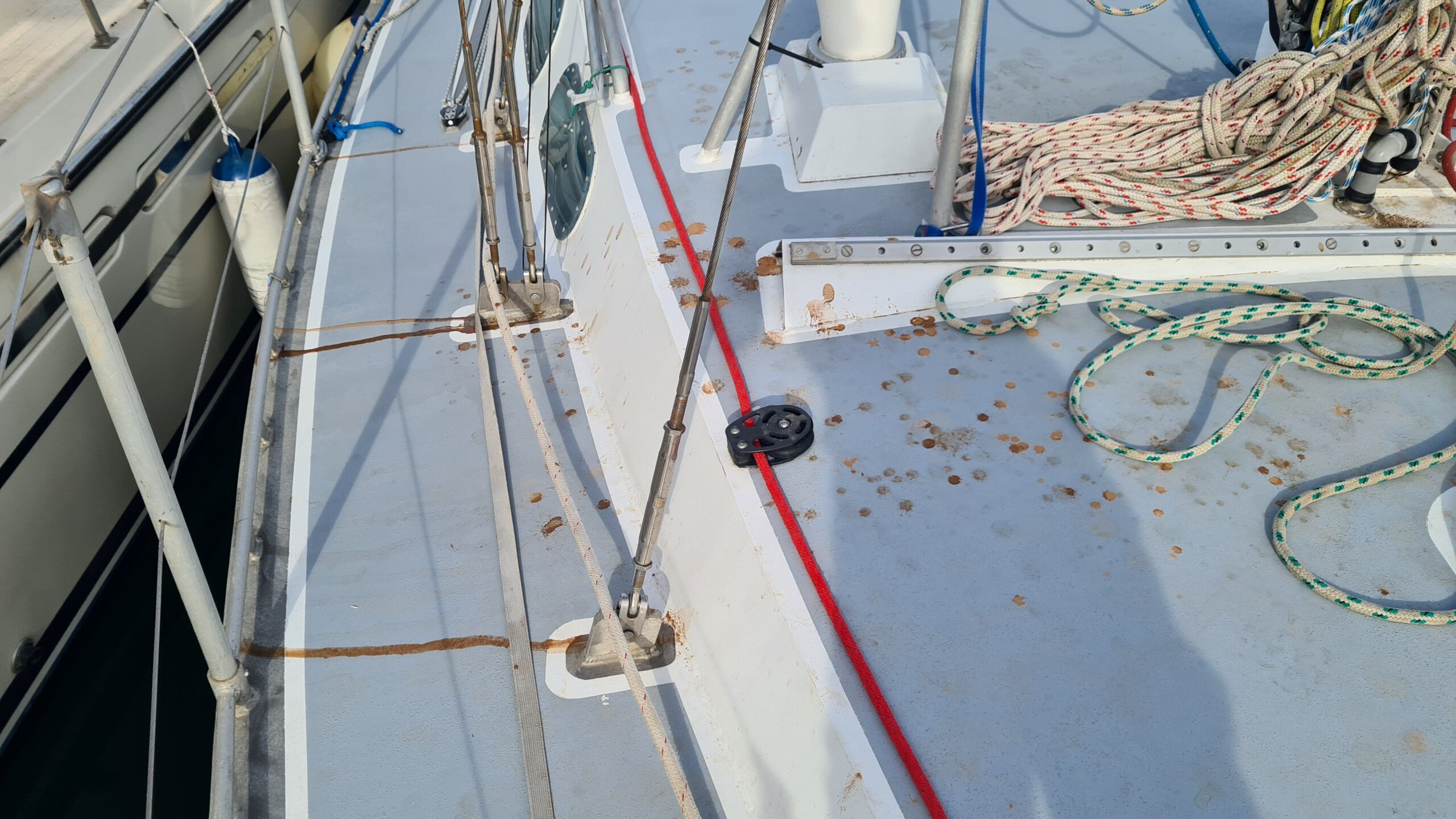
Now that we’ve washed the mast, we can wash the deck again…
4-6 April: Las Palmas – Baia de Antequera – Santa Cruz (71NM)
A pod of dolphins as the seabed rises off Tenerife
We continue our journey to reach our final destination: Tenerife. The sailing from Las Palmas is not very fast in a weakening trade wind, but very pleasant. Except at the end of our fishing line, the waters are teeming with life! The depths become abyssal (3500 metres) between the islands, and each drop-off creates upward currents rich in food of all sizes. On the surface, this translates to clouds of shearwaters, as well as numerous cetaceans.
We see dolphin, just as usual: today they are in a particularly joyous mood and join us in synchronised leaps of five! Laure spots the first flying fish of this voyage – tropics, here we come… There are also beautiful pink Portuguese Man o’ Wars. But the star of the day remains without contest the fin whale which came to sound at two boat-lengths from the boat… We even heaved-to to be sure not to run into it! It was huge (about twenty metres) and really close to us…
Fin whale approaching!
We arrive in sight of the anchorage at the North of the island of Tenerife. On this Easter weekend, it is packed and located in the usual wind acceleration area at the tip of the island. The gusts remain reasonable however and we find a little place to drop the anchor. Just in time before a big thundery squall explodes above our heads. Mmmmm rain, what was that again?
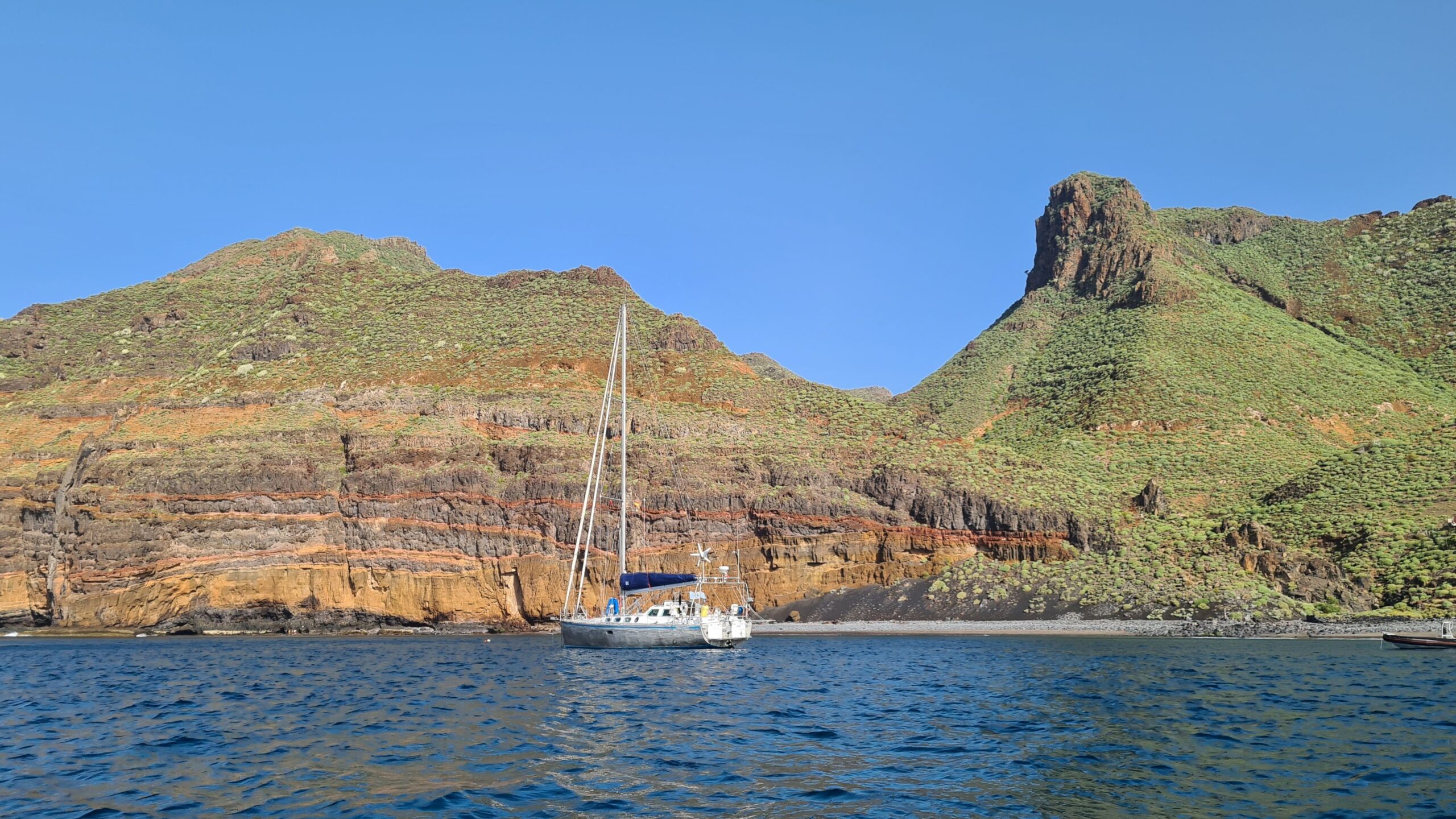
The superb anchorage of Antequera…
Once the gusts have calmed a bit and the squall dispersed, we can lift our eyes up to the surrounding landscape. The anchorage is just incredible: we are at the foot of lava cliffs 500 metres high, red and black, dotted with bushes and brilliant green cacti… It is the first time we find an anchorage at least as pretty as those we were able to explore in Northern Norway, that’s how grandiose it is!
The wind is now light enough so that we do not have to fear katabatic gusts (reputed violent here), and we can stay a whole day enjoying this exceptional environment. Swimming, snorkelling, drinks on a neighbouring local boat, and a first: we inflate our paddle board (or SUP). Lighter than the dinghy, it allows us to play around the anchorage, and Laure uses it to land in the swell on the beach. It is admittedly a wet solution but one that sometimes goes where the dinghy cannot!
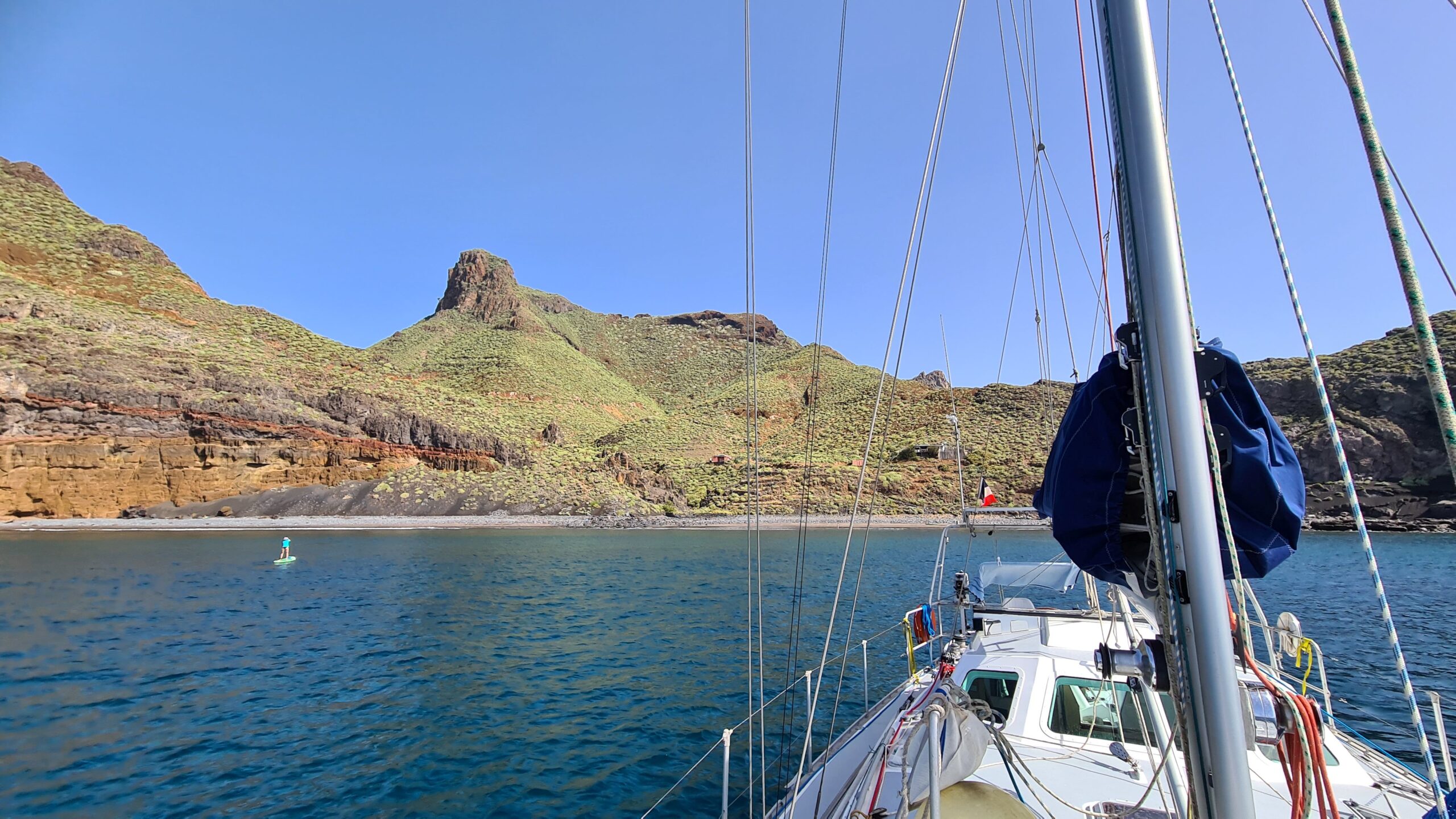
Laure “stand-up paddling” towards the beach
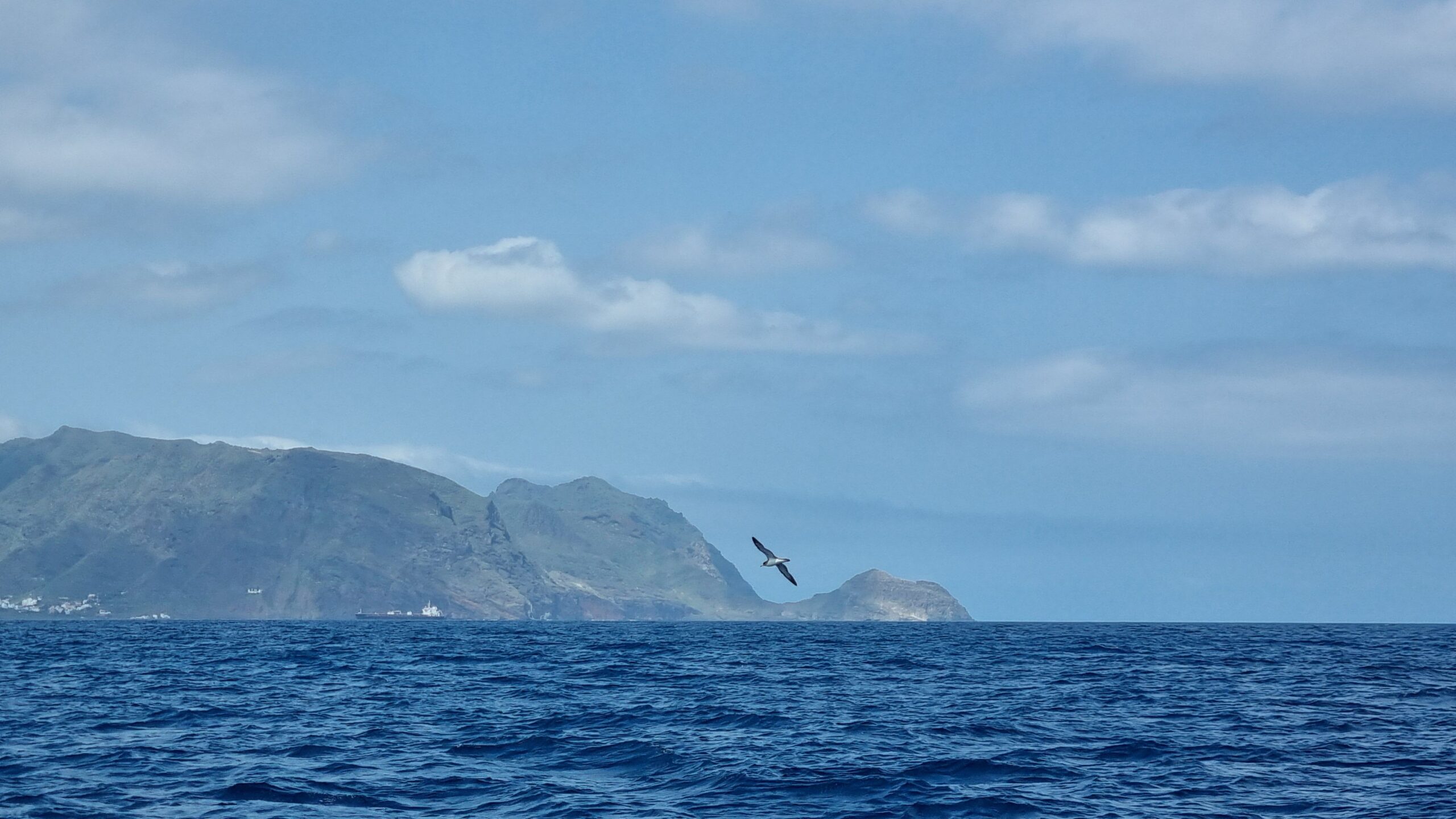
Shearwater flying off the northern tip of Tenerife
The lull is not going to last: after one last swim the next morning, we set course for the port of Santa Cruz de Tenerife, a few miles to the South. Site effects being what they are, we beat against an improbable little South-Westerly wind, go figure…
This port has not changed since our passage with Saltimbanque and we look around for our boat-buddies of the time: Ster Vraz and Taoz … memories… But no friend this time, UtPåTur takes up her quarters for an extended stopover: we have planned to stay here over a month!
7-8 April: Stopover in Santa Cruz
We have 48 hours left before welcoming our first guests. That leaves us time to find our marks in the city and to work a bit on the boat.
Main mission: make a cover for the tender. The PVC does not like UVs at all and we are therefore covering it with an oilcloth, a very pretty marine-themed tablecloth with seahorses and starfish (we found it in Vigo after having done the rounds of all the Chinese bazaars of Galicia). We hope that it is going to hold long enough even with the tender exposed to the wind in the davits…
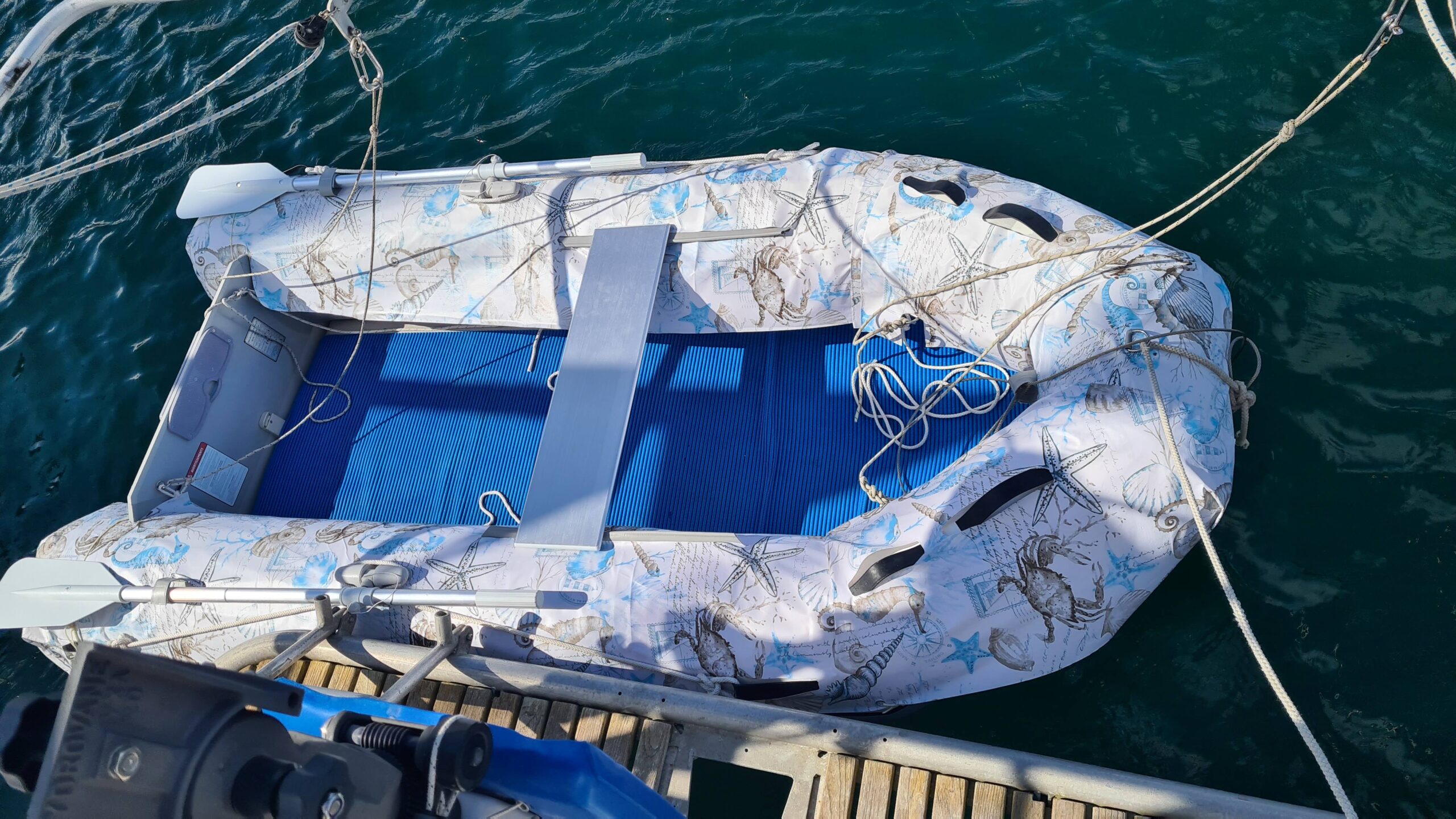
Our tender, now well protected from the tropical sun!
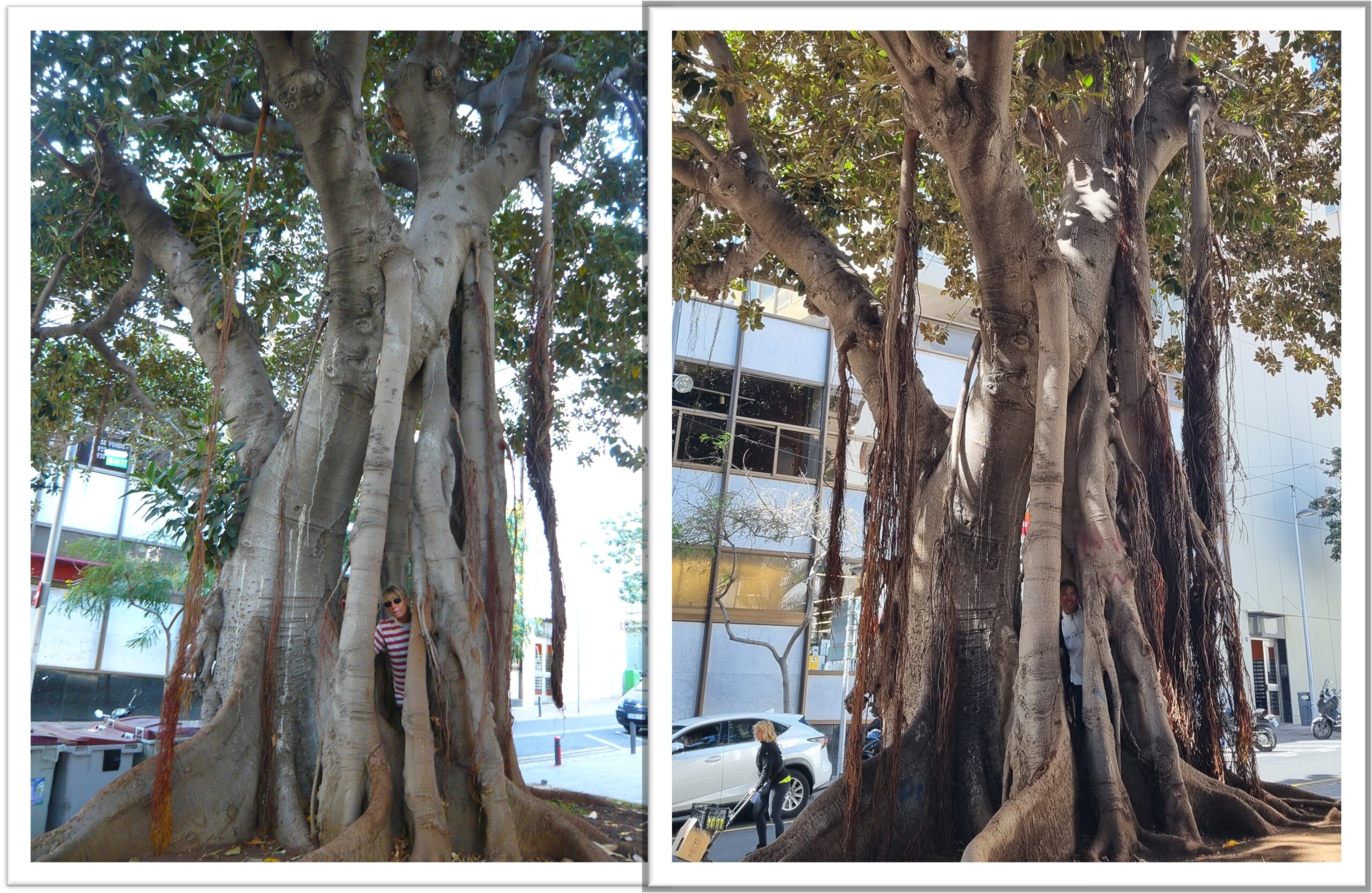
A stroll in Santa Cruz, we found the crazy fig tree from 15 years ago!
We also have a respectable to-do-list to prepare the boat for the next stages: the route towards Cape Verde, then the transatlantic towards Brazil. In particular filling up diesel and tinned food. We must also finalise our stock of spare parts (propeller blade bearings, 12-30V converter for Starlink, mosquito netting fabric…), and repair or change what has broken lately (MP3 player, waterproof camera, kitchen tap etc.) The Canaries are the last well-stocked place before thousands of miles…
But now, it is holiday time! We will spend the next few weeks with our parents, brother and sister and nephews, who will finally have the opportunity to see our beautiful boat before it flees to the other end of the world!
 PDF