
After a long family stopover in Tenerife, we get back underway through the Canary Islands before positioning ourselves at the far southwestern tip, ready for our next passage…
The full photo album here.
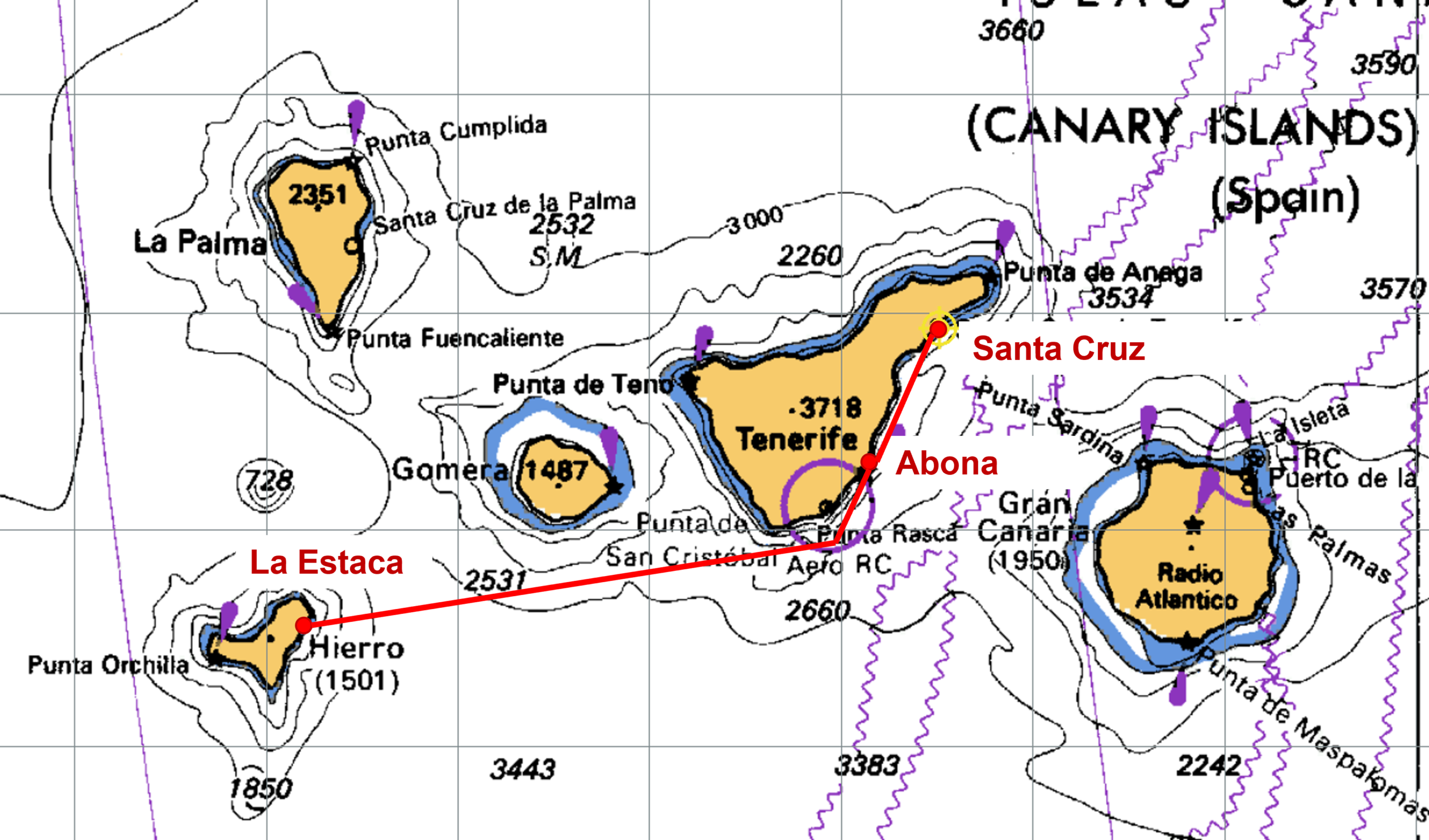
146 nautical miles sailed– 7447 NM in total on UtPåTur
9 April to 7 May: Tenerife with Family (33M)
We had spotted the opportunity months ago: this year, on our route south, we could time things to be in the Canaries during the French spring school holidays. It would mean our brothers, sisters, and 5-year-old nephews could see the boat for the first time… and probably the last time for a good while…all in an exotic yet reasonably accessible setting. Upon hearing the plan, our parents cried: “Hey, we want to come too!” So, flights were booked, a berth reserved, and off we went for a month of family sightseeing on the island of Tenerife.
Tenerife is the largest of the Canary Islands and offers a diverse mix of activities, landscapes—and weather conditions—which we tour extensively during this extended stopover.
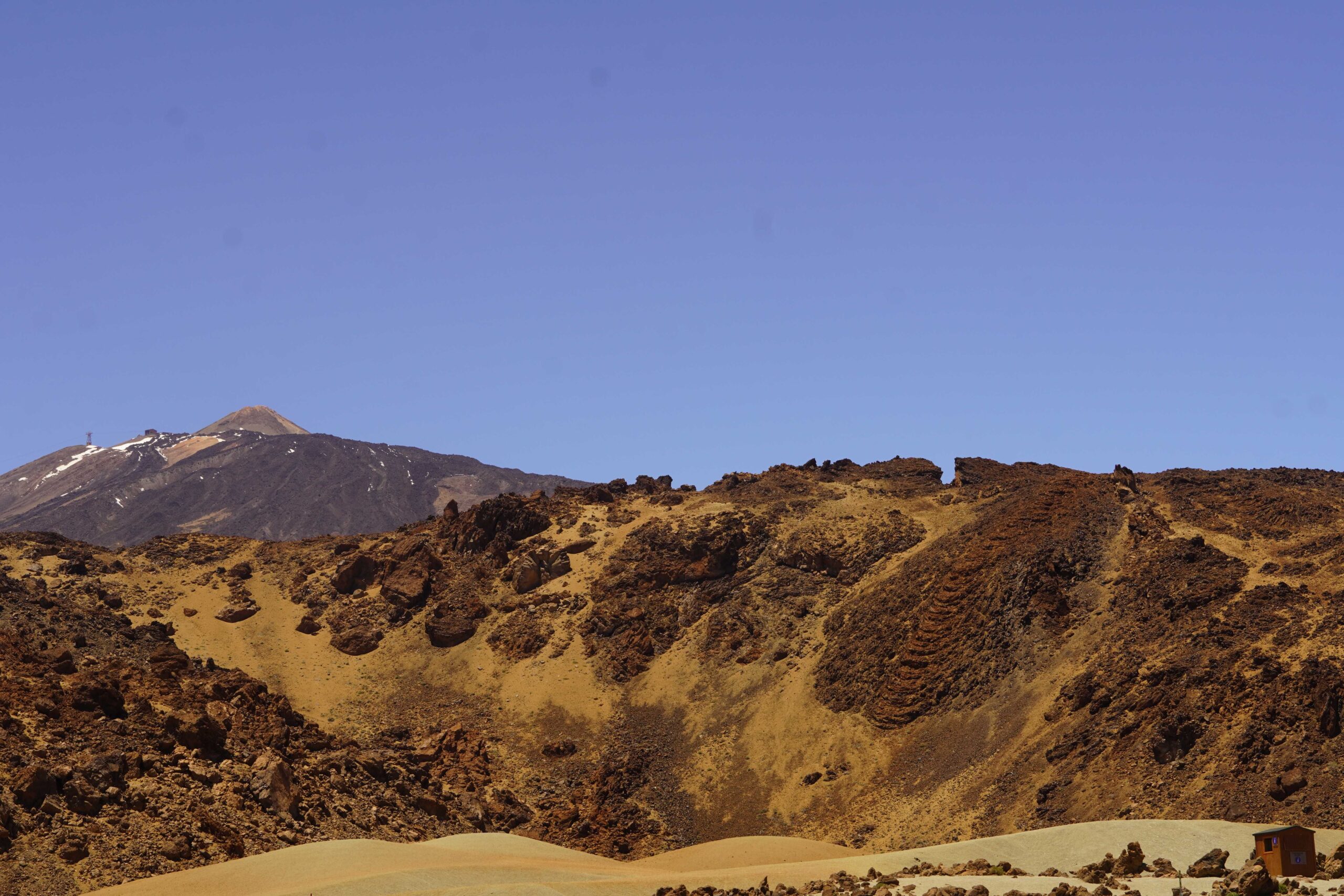
View of the summit of Mount Teide from the lava fields of Las Cañadas
The star of the island remains, without a doubt, the Teide volcano. Standing at 3,715 metres, it is Spain’s highest peak. There is no question of venturing that high with young children, but walks at around 2,000 metres altitude, inside the ancient crater of Las Cañadas, offer an extraordinary experience: multicoloured lava (yellow, black, green, red, purple…), spectacular rock formations, and stunning views of the summit.
During the climb, the vegetation shifts from humid pine and eucalyptus forests to sparse, arid bushes, which bloom more and more as spring advances. Near the most recent lava flows, the rock is bare—a chaotic, lunar landscape of stones that is even used for training robots sent to explore Mars…
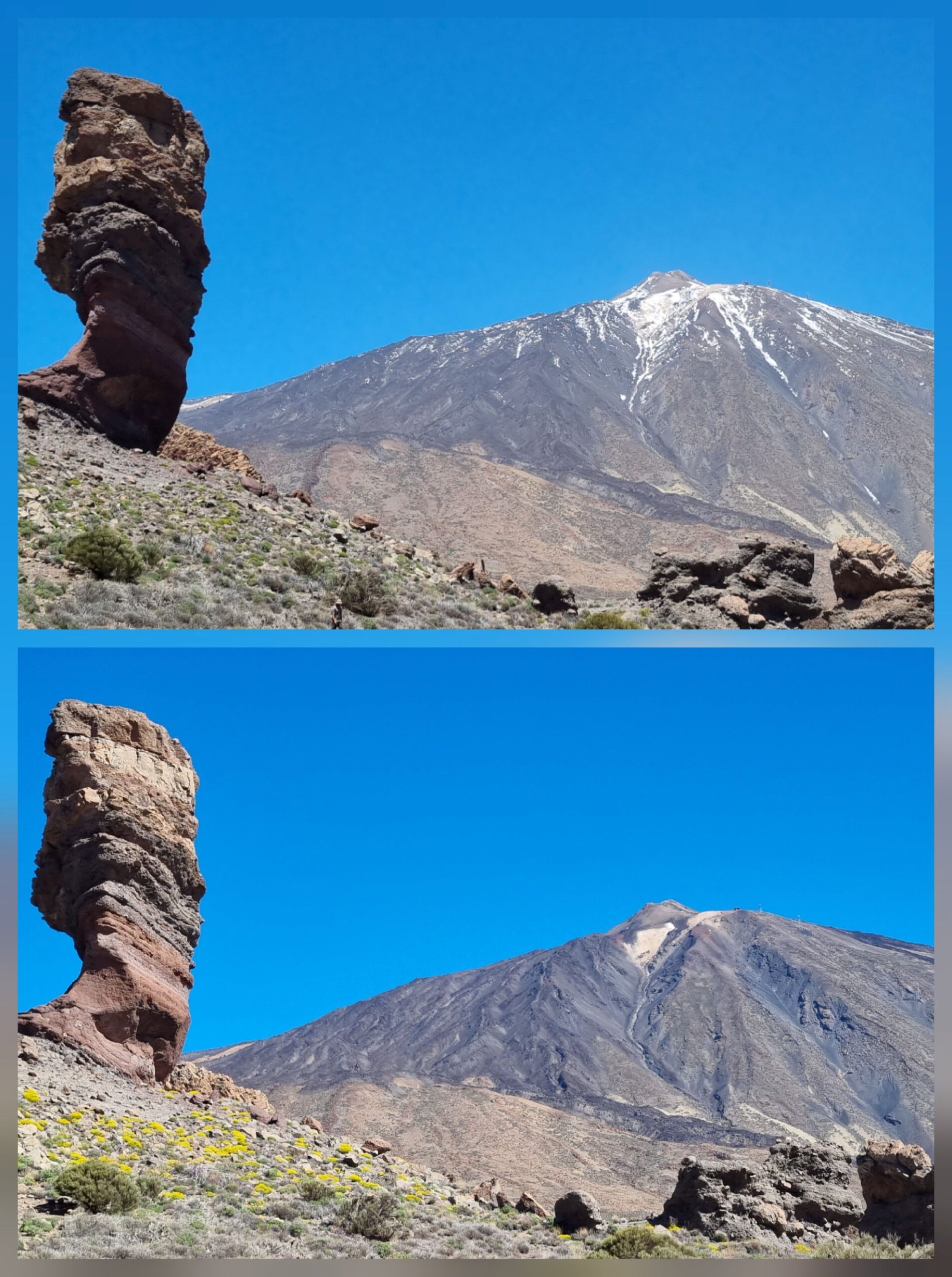
As the season progresses, the snow melts and the plants bloom.
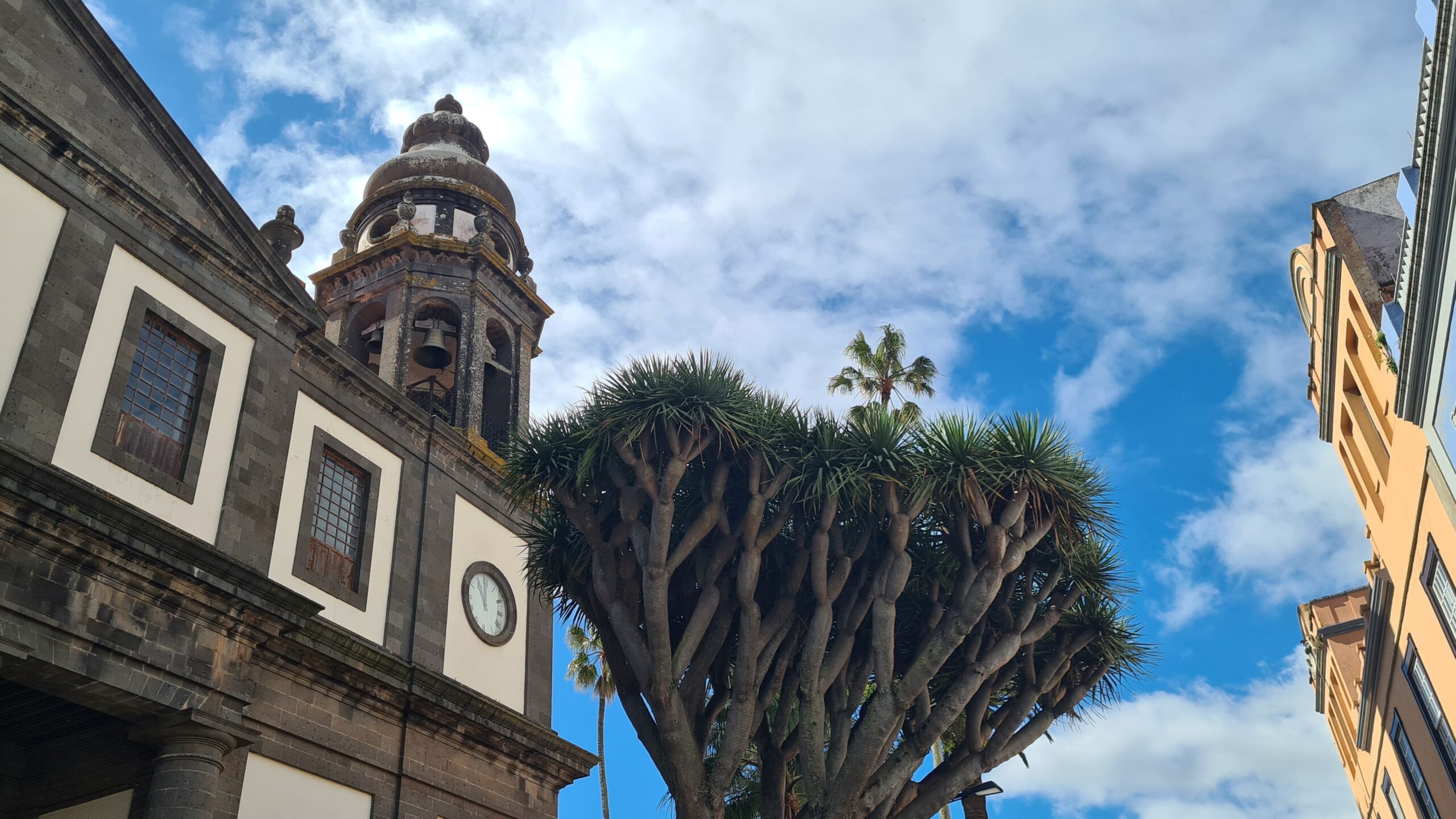
A church made of volcanic stone, a dragon tree, a palm tree, typical enough!
Below the giant volcano, nestled among numerous concrete hyper-touristic resorts, you find a few pretty historic towns like La Laguna, Vilaflor, Icod de los Vinos, or Garachico. The 17th and 18th-century buildings, constructed from solid volcanic stone and adorned with magnificent wooden balconies, are surprisingly modern and always surrounded by the islands’ lush exotic trees. Most of the historic towns sit high up, where moisture from the trade-wind clouds historically allowed for the cultivation of sugarcane, then vineyards, and finally bananas.
La Orotava is another well-preserved historic town. It is also famous for the gigantic images of multicoloured volcanic sand that carpet its streets during the Corpus Christi festival in June. We are lucky enough to see the start of the preparations for these huge sand carpets. It is truly impressive, though we do hope for their sake that there isn’t a gust of wind in the coming weeks…
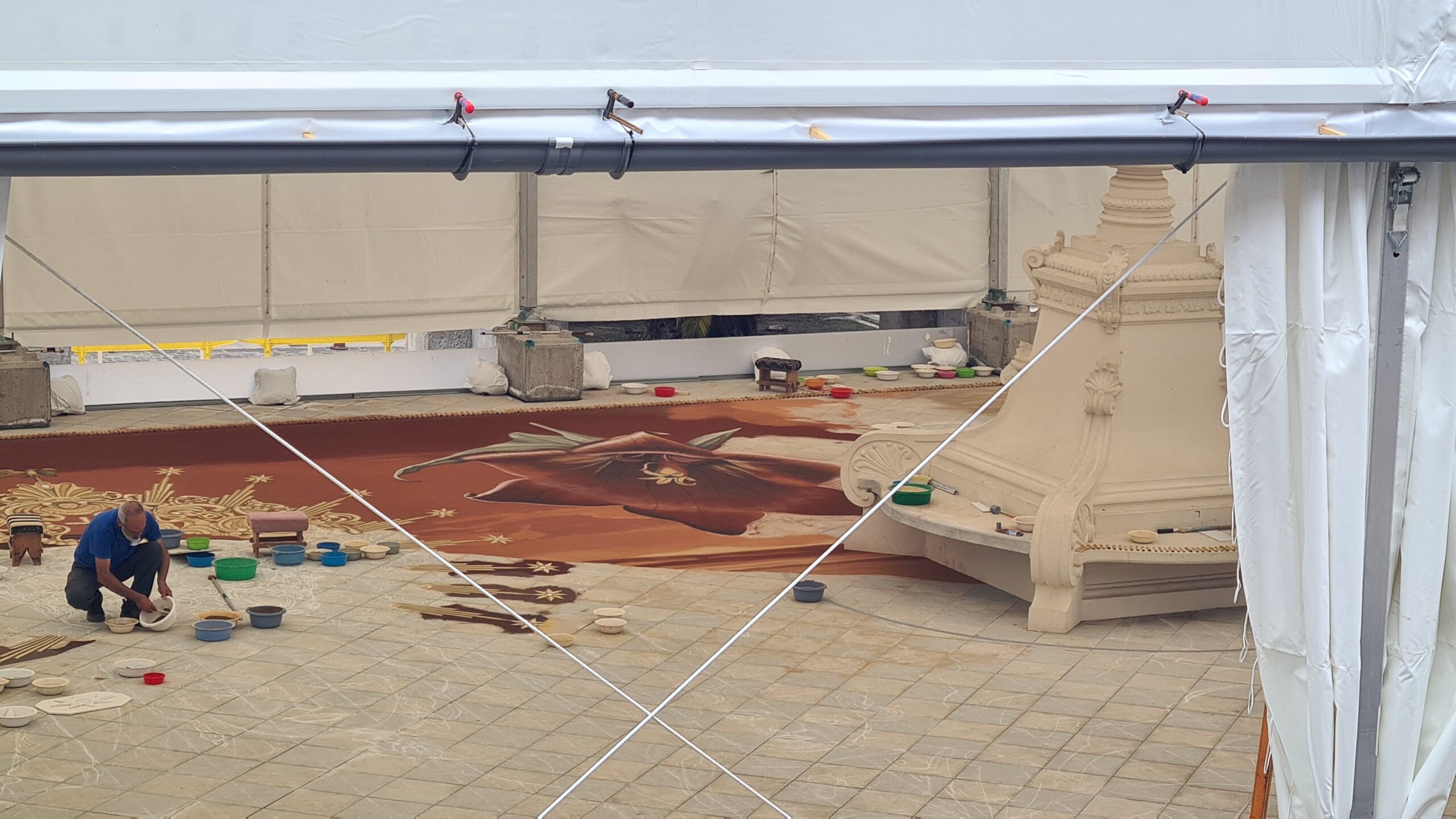
The immense sand carpets of La Orotava are currently being prepared.
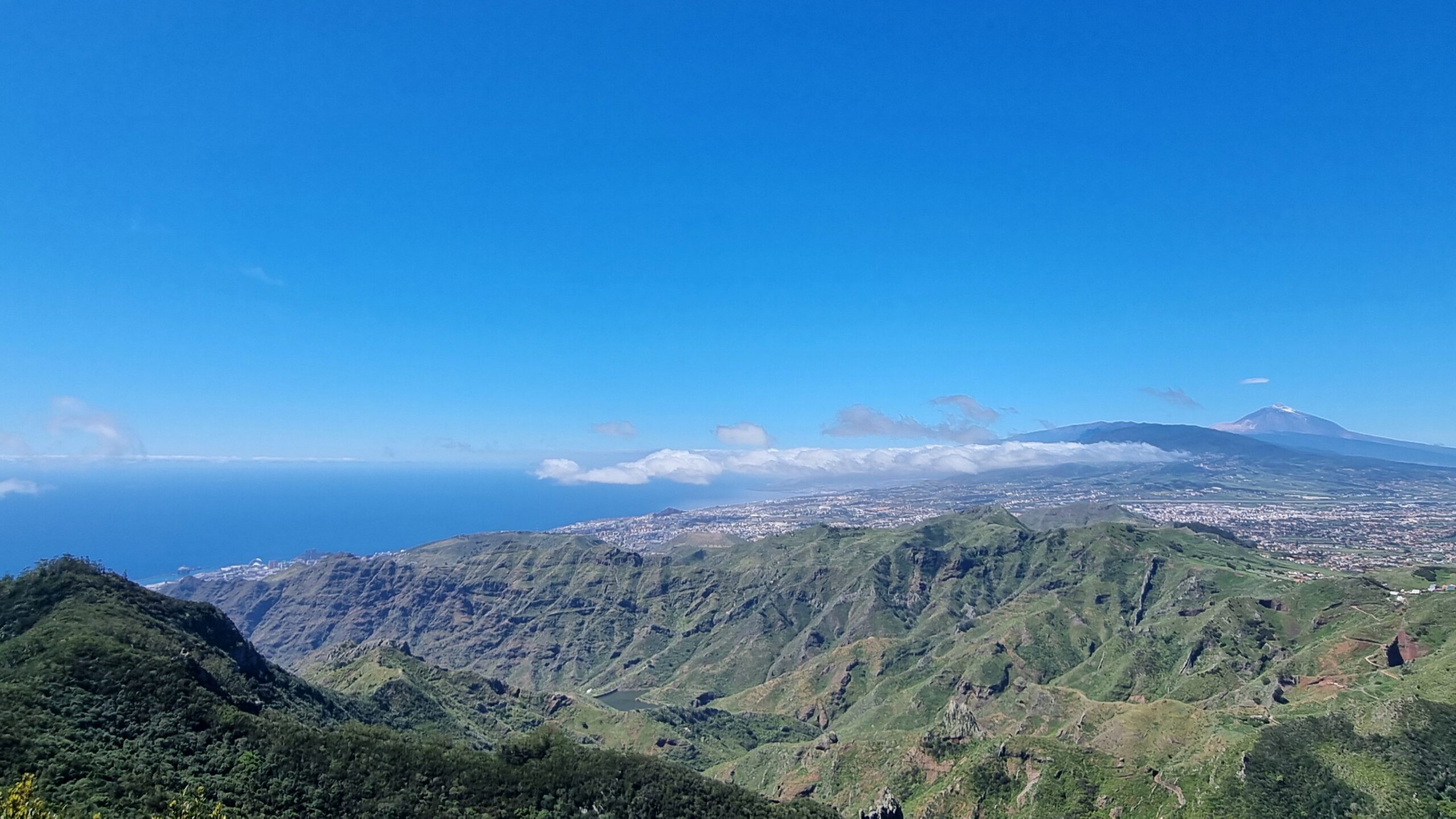
Rare unobstructed view of Teide from the peaks of Anaga
In the north of the island, the Anaga massif offers great hiking opportunities in the primary forest of laurel and giant heather, usually in “mist-spray” mode… Because it isn’t always that sunny in this month of April… Rain is very frequent on the northern coast, which is exposed to the trade winds; the air rarely tops 22 degrees and the water peaks at 20. Mind you, it’s nothing truly unpleasant, and the island’s topography means it never rains everywhere at once! It doesn’t stop us from having a great time with our families at the beach, the zoo, the botanical garden – and there’s always the museum for when conditions turn too wet…
While we scour the island in every direction by car, UtPåTur patiently waits for us at the marina in Santa Cruz de Tenerife. It is the low season and apart from a few Europeans who overwintered here and are preparing to head back to mainland Europe for the summer, we don’t meet any other cruisers. Yet the harbour is lovely, right in the centre of this town we really like with its pedestrian streets, its market, and its abundance of exotic plants. On the quayside, you bump into locals out for a stroll, kids on rollerblades, and teenagers filming TikTok videos with a backdrop of masts…
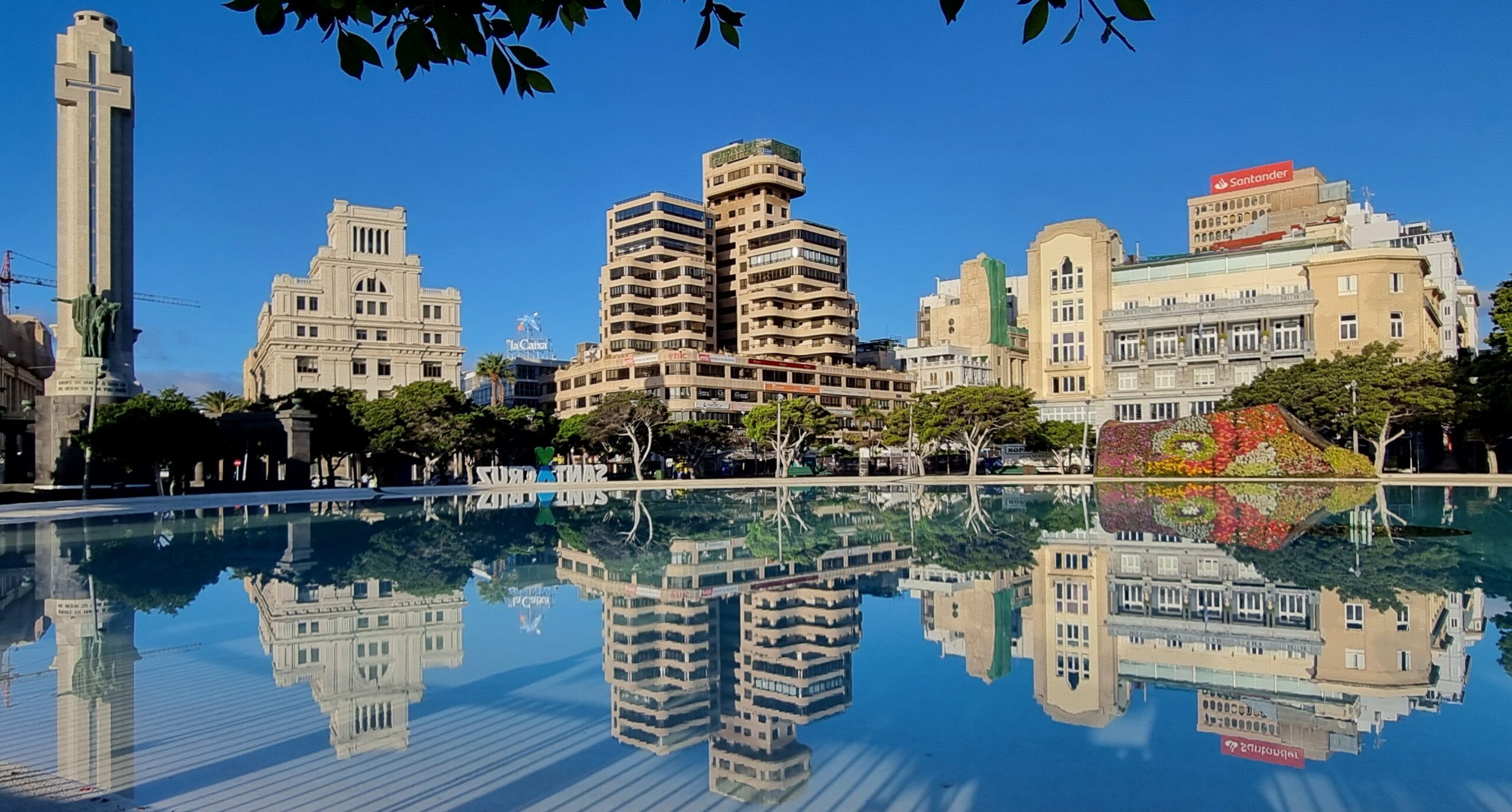
Plaza de España on a calm morning
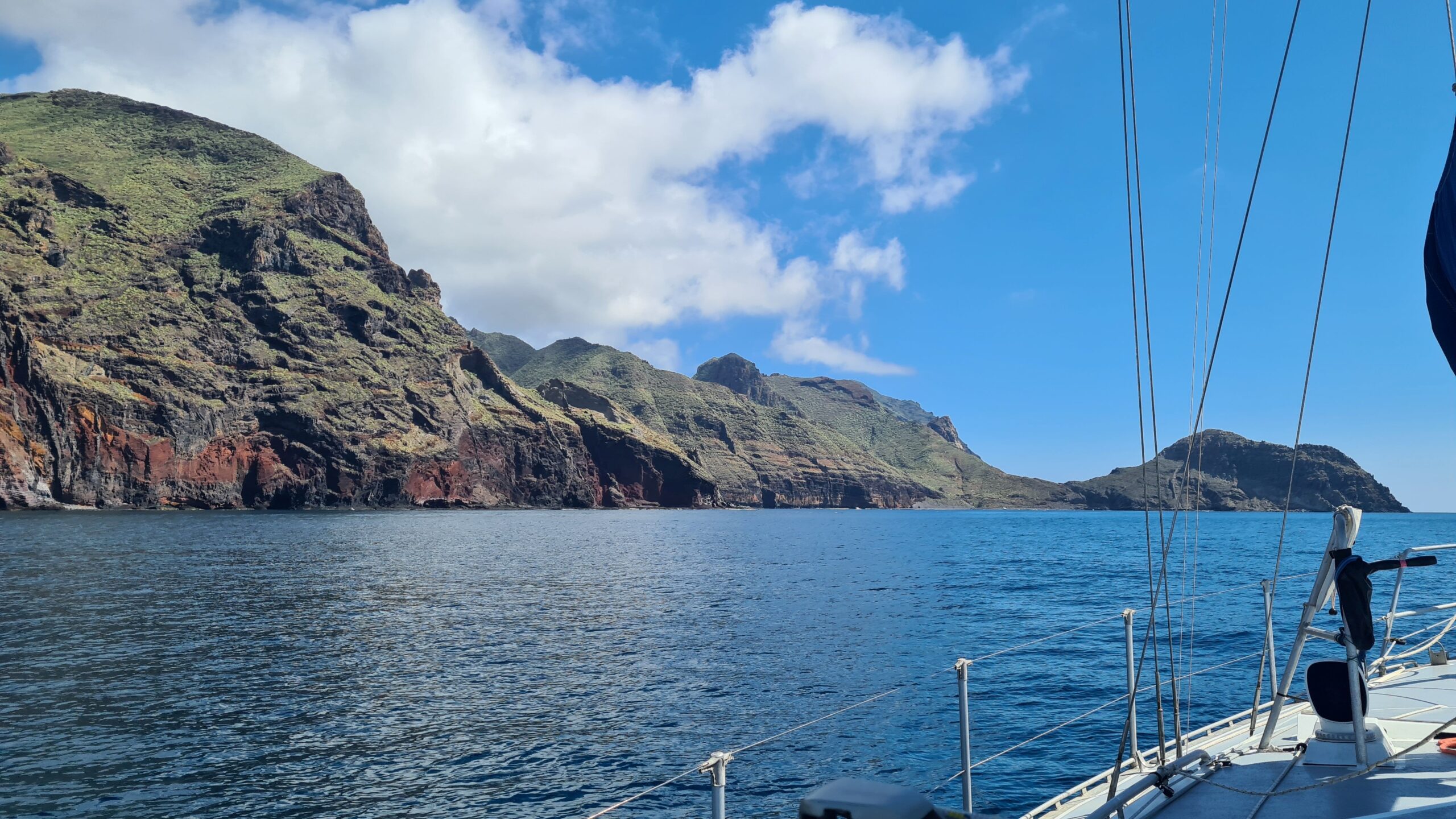
Back to the Antequera anchorage for a nice lunch with Laure’s parents
Our nephews finally get to come aboard and experience our boat for real. Now that they’ve scrambled all over her, explored every nook and cranny, and even done a trip out to sea (sadly cut very short for one of them due to rough weather), we hope they will find it easier to picture us on our adventures!
And what about us? In a way, we are on “boat holidays” during the day, but we are still living on board and occasionally head out to sea for a few hours with our families. We keep up with the maintenance with added seriousness given that Santa Cruz is the last stop where it is easy to source spare parts before Brazil… and even then! No major jobs on the list this time, but a multitude of small details to monitor, fix, or improve—the usual routine! In no particular order: repairing the micro-leak of coolant on a water heater hose (the one identified in Spain), maintaining the interior woodwork which is showing scratches and mold here and there, repairing the cooker grate which is coming unsoldered, refreshing our old Cape Verde courtesy flag which was looking a bit worse for wear, making a mosquito screen for the companionway door, debugging the charting software (OpenCPN) which stopped working entirely after the latest update, changing the galley tap spout (which after months of agony finally kicked the bucket for good), making exterior netting for fruit and vegetable storage, etc., etc. It goes to show that on a boat you need to know every trade (plumber, mechanic, sailmaker, IT expert). This time, we acquire a new one: tour guide!
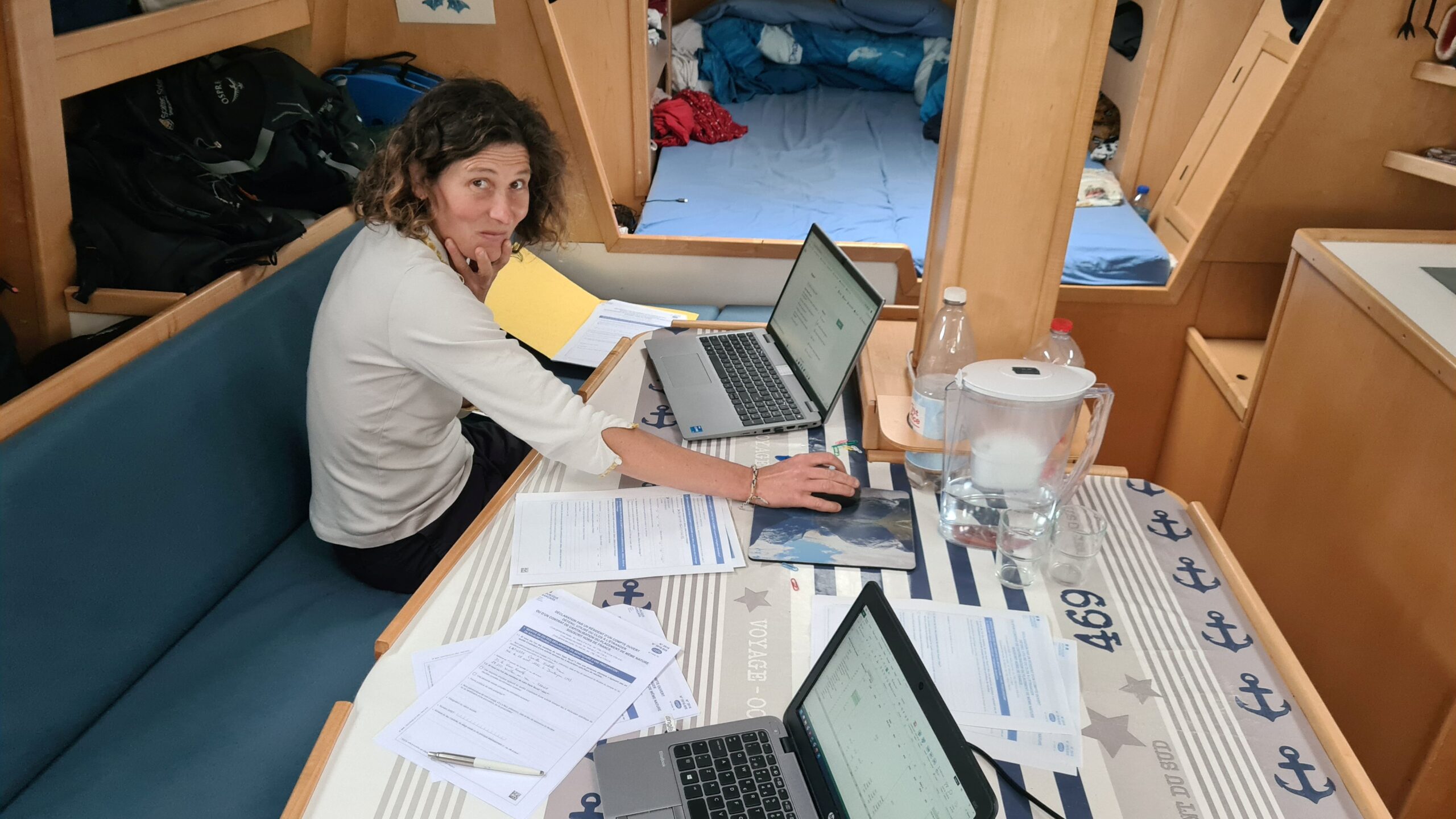
Another necessary but time-consuming activity is filing our taxes! And it’s much simpler in Norway than in France…
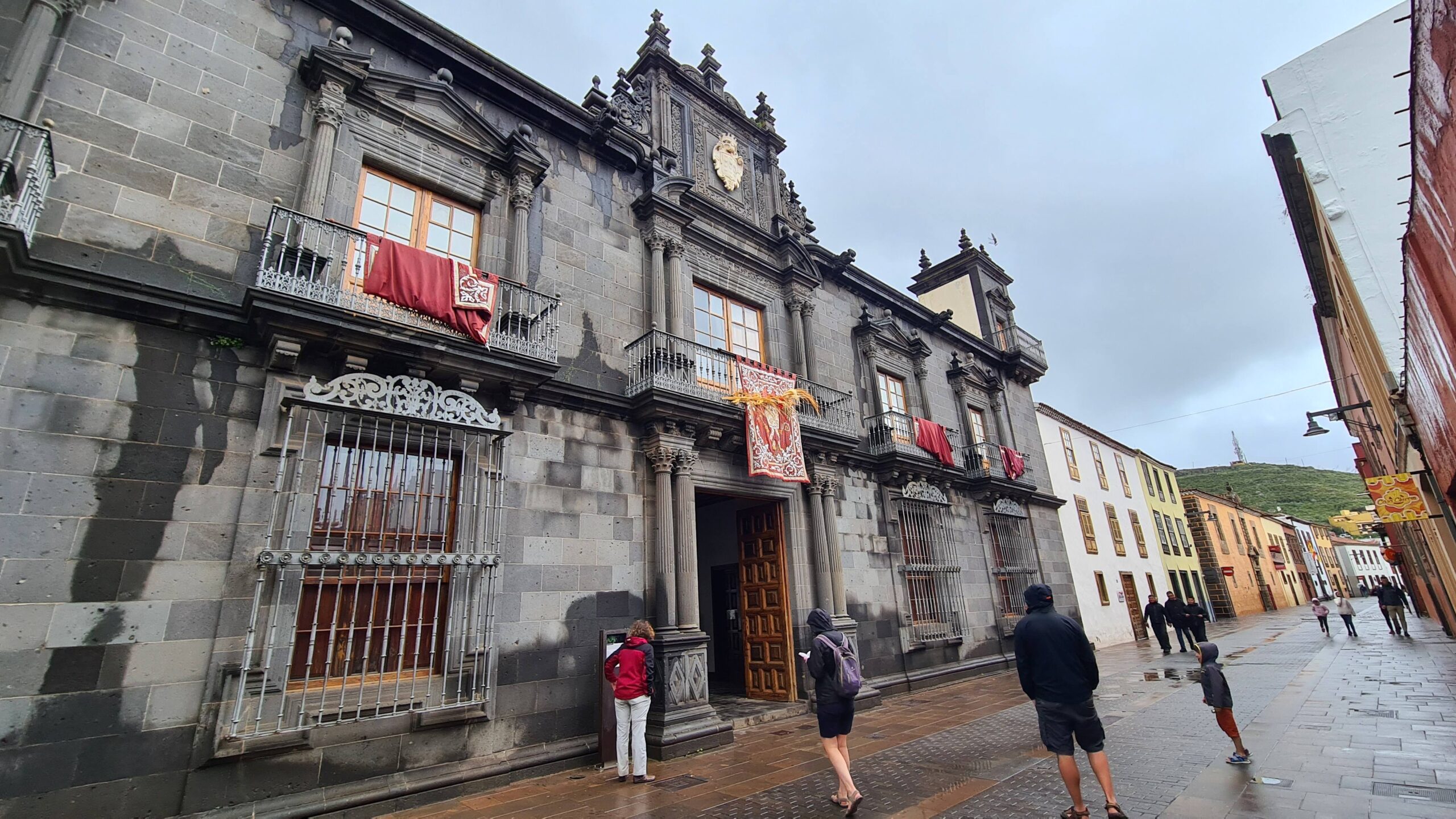
Game: Find the tourists at La Laguna. (Answer: They’re the only ones wearing shorts!)
It is rare for us to stay in the same place for so long. After a few days, little habits form: the city maps now useless are put away, we have our favourite greengrocer at the market, we chuckle at tourists heading up to La Laguna without a jumper when it’s always cold there, we know the slightest details of the mountain profile visible from the cockpit… in a way, we feel at home…
A surprising thing is that we stay long enough to notice the change of season, despite the near-tropical latitude: while it was damp, very windy, and sometimes downright chilly in April, the average temperature jumps several degrees in early May and the weather turns to blue skies! The vegetation—now completely familiar to us—takes advantage of these mild conditions and flowers burst out before our eyes: purple jacarandas, dragon trees, African tulip trees, birds of paradise, and the famous tajinastes so typical of the Canaries! Only the flamboyant trees are in seed and will remain so for the duration of our stay.
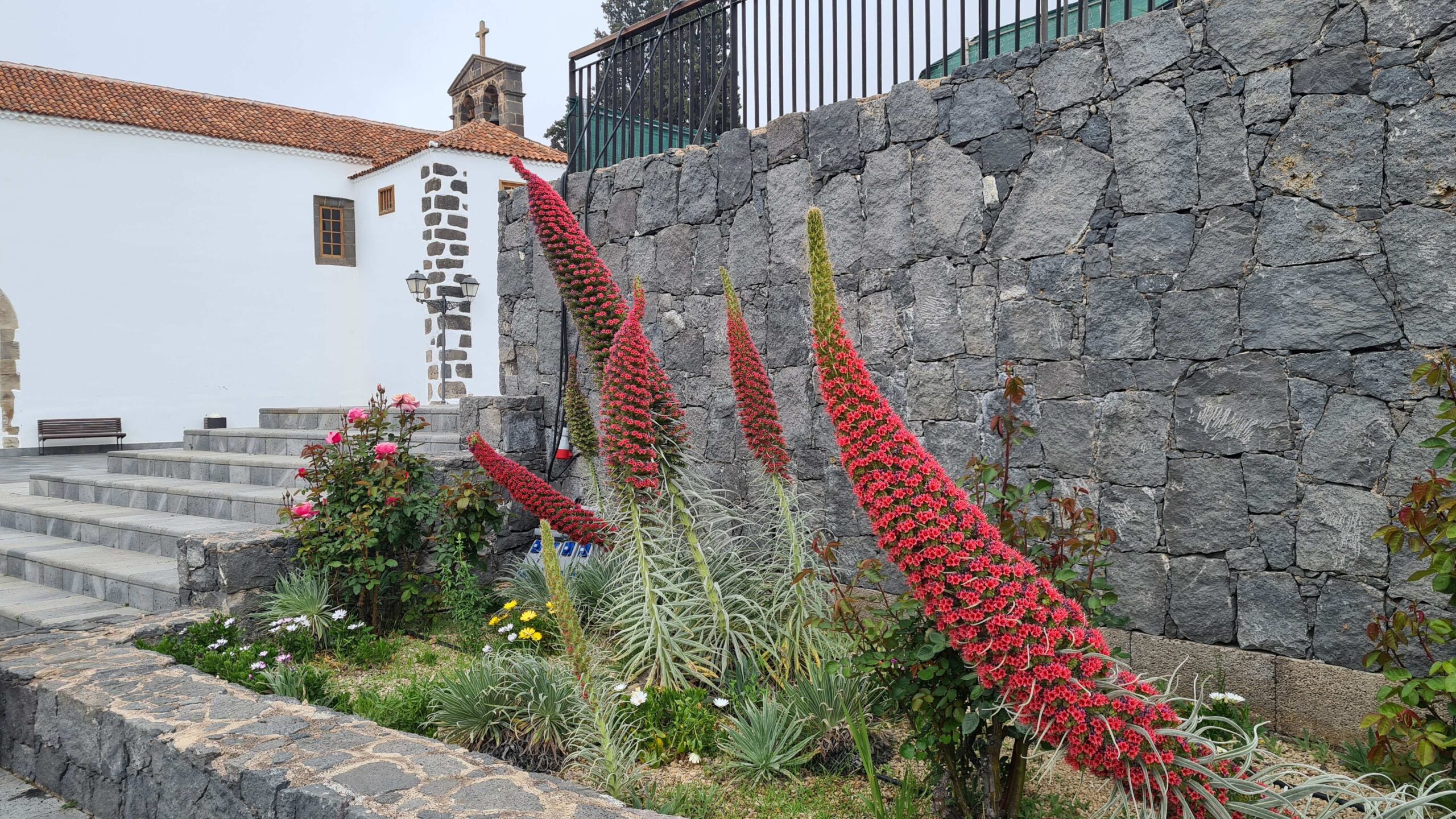
Early May, the tajinastes bloom (here in Vilaflor)
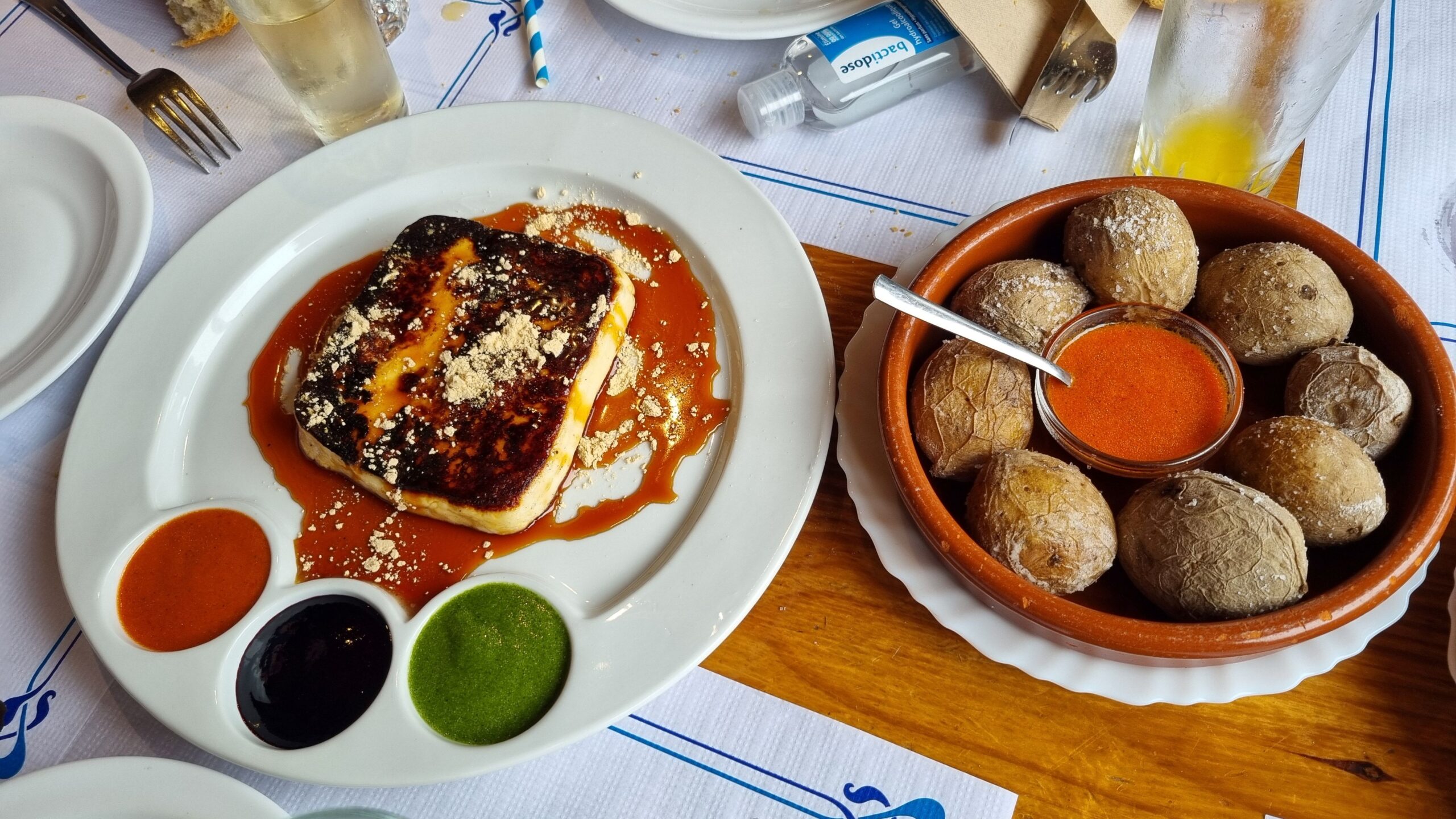
Wrinkled potatoes and toasted cheese, accompanied by green and red mojo sauces
The local gastronomy also becomes our everyday fare: papayas and especially chirimoyas (our favourite fruit, discovered during a trip to Chile), wrinkled potatoes with salt and red or green mojo sauces, almogrote (garlic goat’s cheese), octopus in every shape and form, vieja (a small parrotfish), cherne (the local wreckfish) à la plancha, and of course gofio. A traditional ingredient in Canarian cuisine since the Guanches, the gofio consists of toasted maize and barley flour mixed with varying amounts of liquid and other sweet or savoury ingredients. In summary, with toasted barley some people make flour while others make whisky! Funnily enough, exactly a year ago, we were in Islay…
This month of shore-based “holidays” turns out to be packed and when the last plane takes off—on Laure’s birthday—we have only one desire: to put to sea again, with the bilges crammed with victuals and all tanks topped up!
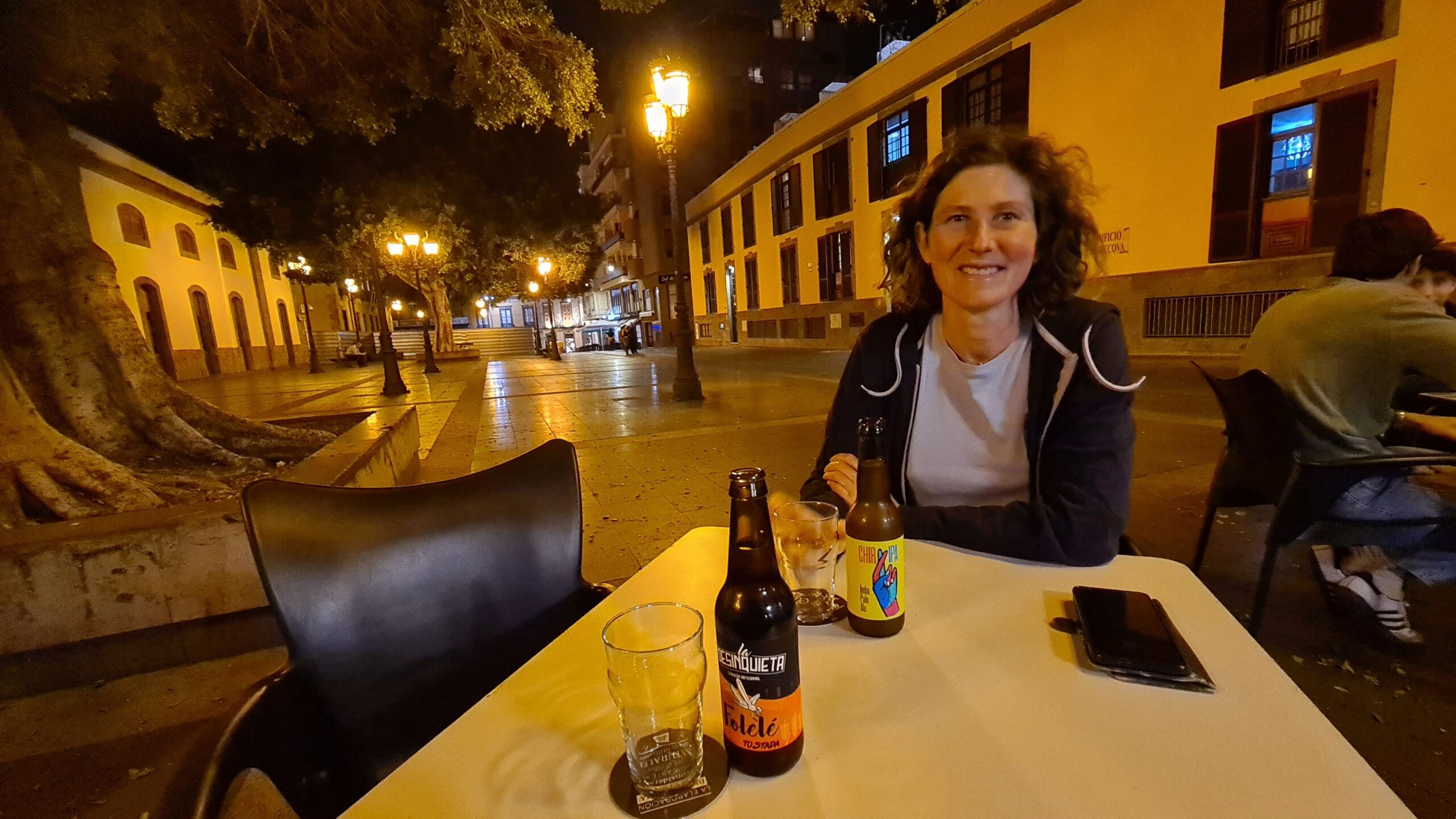
We’re enjoying Santa Cruz all to ourselves for one last evening.
8–11 May: Santa Cruz – Abona – El Hierro (113M)
Hard to get out of bed this morning; we are pretty exhausted after this month of intensive socialising… But the harbour regulations are strict: we must leave before noon. So, departure at 11:30 AM in very light wind. The Azores High has gone for a wander, leaving us with a small low-pressure system generating a westerly wind, from which we are perfectly sheltered by the island!
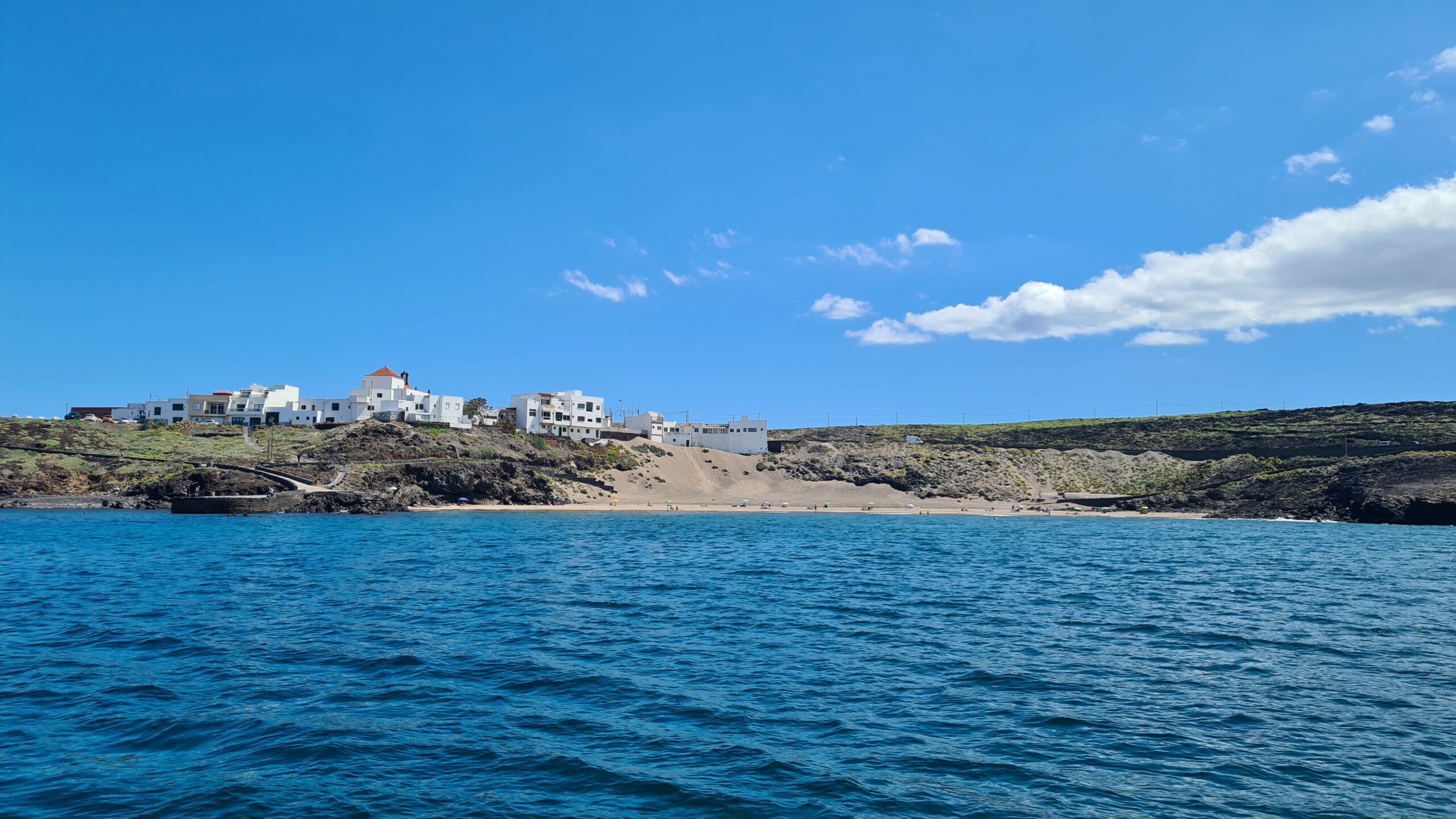
Anchored by the Abona beach
Motoring through crowds of flying fish we reach the anchorage at Abona Bay, which has a rather nice environment: a few beautiful white houses, flawless sand under a perfectly blue sea. A setting that should make for great drone footage…
We are right in the middle of shooting when suddenly the screen reads: “Warning: loss of signal with aircraft.” What?! Yes, total loss of communication: the controller Laure is holding in her hand has suddenly died and refuses to restart. Nothing doing, it is completely dead, and so we can no longer fly the drone back! We’ve lost it mid-air in a fraction of a second, betrayed by electronics… Well, no, it’s not completely lost yet: in this scenario, it’s supposed to hover as soon as signal is lost, then attempt to land when its battery runs low. We can’t see the device which was very high at the time of the incident but we know its last position, so we hop into the dinghy to try to spot it, hear it, and recover it during its emergency landing. But it’s a wild goose chase; the sky remains empty… Time passes and it becomes obvious that the batteries are now spent… It’s a wreck we will continue searching for on the shore and then on the seabed for a long time, to no avail…
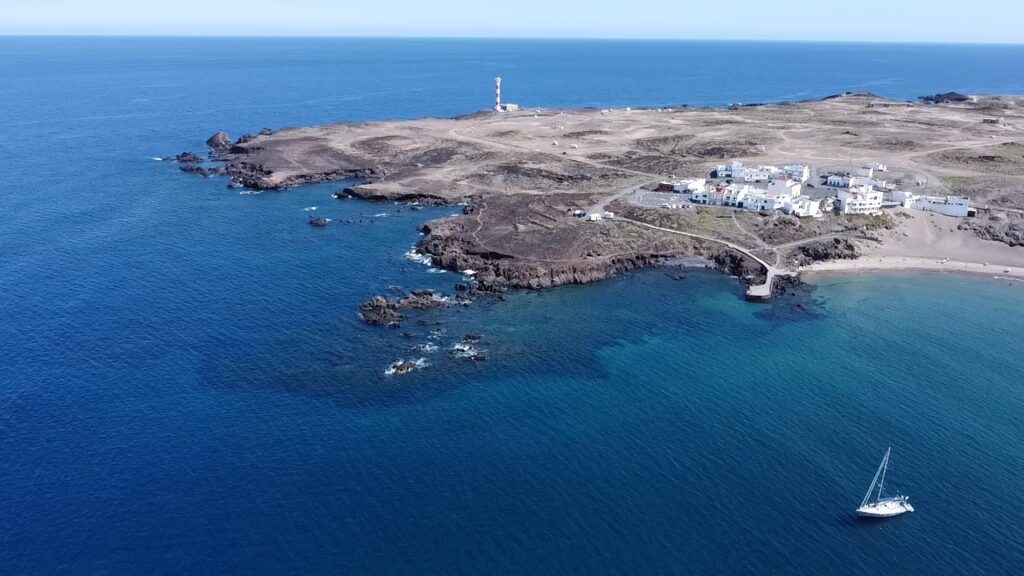
The very last picture taken by our late drone…
Crew morale is not very high after this mishap. Especially since we are already worried about our mainsail which still jams a lot since the Lanzarote sandstorm… Never mind, it’s getting too late to fiddle with it tonight. A distracted glance at the weather forecast predicts wind right in our faces tomorrow on the way to Hierro—brilliant—and we turn in at an anchorage that has suddenly become very rolly…
Clang, clang, clang. A halyard keeps slapping against the mast with this rolling keeping us awake. Laure loses patience and goes out to try and sort it. She comes back with a question: “Guess what I found on the foredeck?”, then pulls from behind her back… the drone!! We cannot believe it!! This little creature decided to return to its initial GPS take-off position to land, the boat hadn’t swung too far on her anchor to still be there and the drone managed all by itself to land on deck without hitting a single shroud, halyard (not to mention the mast) and without sliding overboard in the ambient rolling! It is statistically improbable, yet here it is, back home, without a scratch! We are somewhat reconciled with electronics now! Okay, the controller is still dead, but at least we haven’t left any litter in nature. What a story…
Morale is a bit better upon waking, but we are still quite tired. We smear the mast track with candle wax, which seems to solve the mainsail problem for now—phew! We decide, however, to stay an extra day at anchor to rest and reconnect with our boat life (nothing like swimming with tropical fish and then having drinks in the cockpit for that!) and postpone our long sail until tomorrow’s more favourable conditions.
It was forecast rather light winds in the morning, so we are surprised to be woken up by 12–15 knots of wind—from the southeast, no less. We decide to weigh anchor immediately and make the most of the wind while it lasts! Conditions are indeed excellent as we pass off the port of Granadilla, where evacuation operations are underway on the cruise ship Hondius, which has been struck by an outbreak of Hantavirus.
Pilot whales lazing on the surface
A calm spell catches us at the southwestern tip of Tenerife, but we keep steerageway until we reach the windier zone in the channel with La Gomera. To pass the time in the light airs, there is nothing better than watching a pod of pilot whales basking in the sun on this glassy sea! They, on the other hand, are not at all interested in our presence…
The night goes by peacefully, between a few very manageable squalls along the islands and an improbably friendly little southwest wind in their lee. We’re even going to arrive at night at this rate! We are in no hurry and slow down for a few hours to wait for sunrise. Good choice—the spectacle is dazzling! Ahead, El Hierro lights up: all bristling with lava and cacti. Behind us, the silhouettes of La Gomera and the perfect pyramid of Mount Teide in the rising sun. The sea is covered with shearwaters slowly waking up; four playful dolphins complete the welcoming committee. El Hierro, it’s a sure thing: we love you already!
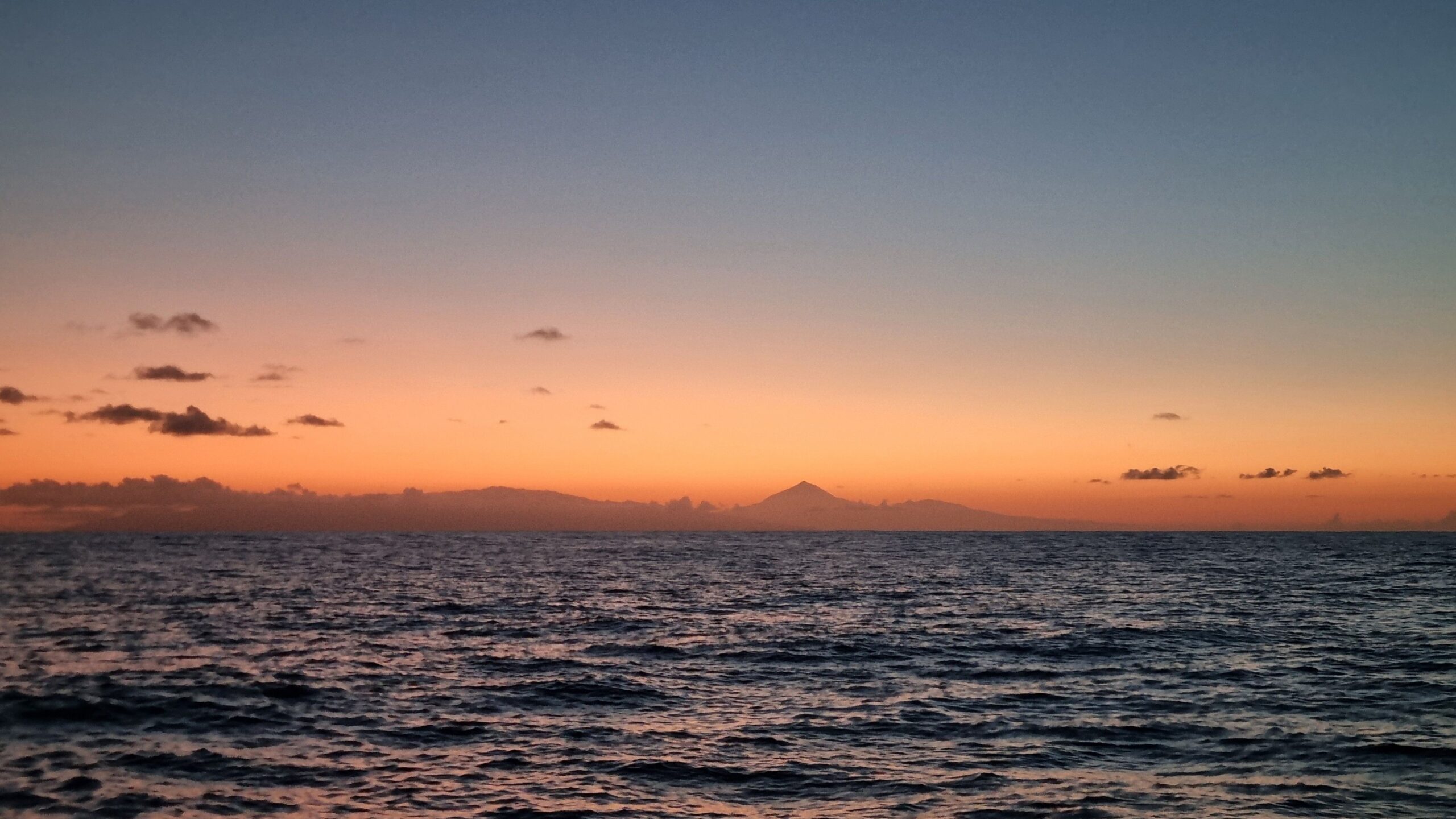
Sunrise over Teide, 130km behind us (yes, it’s a big mountain!)
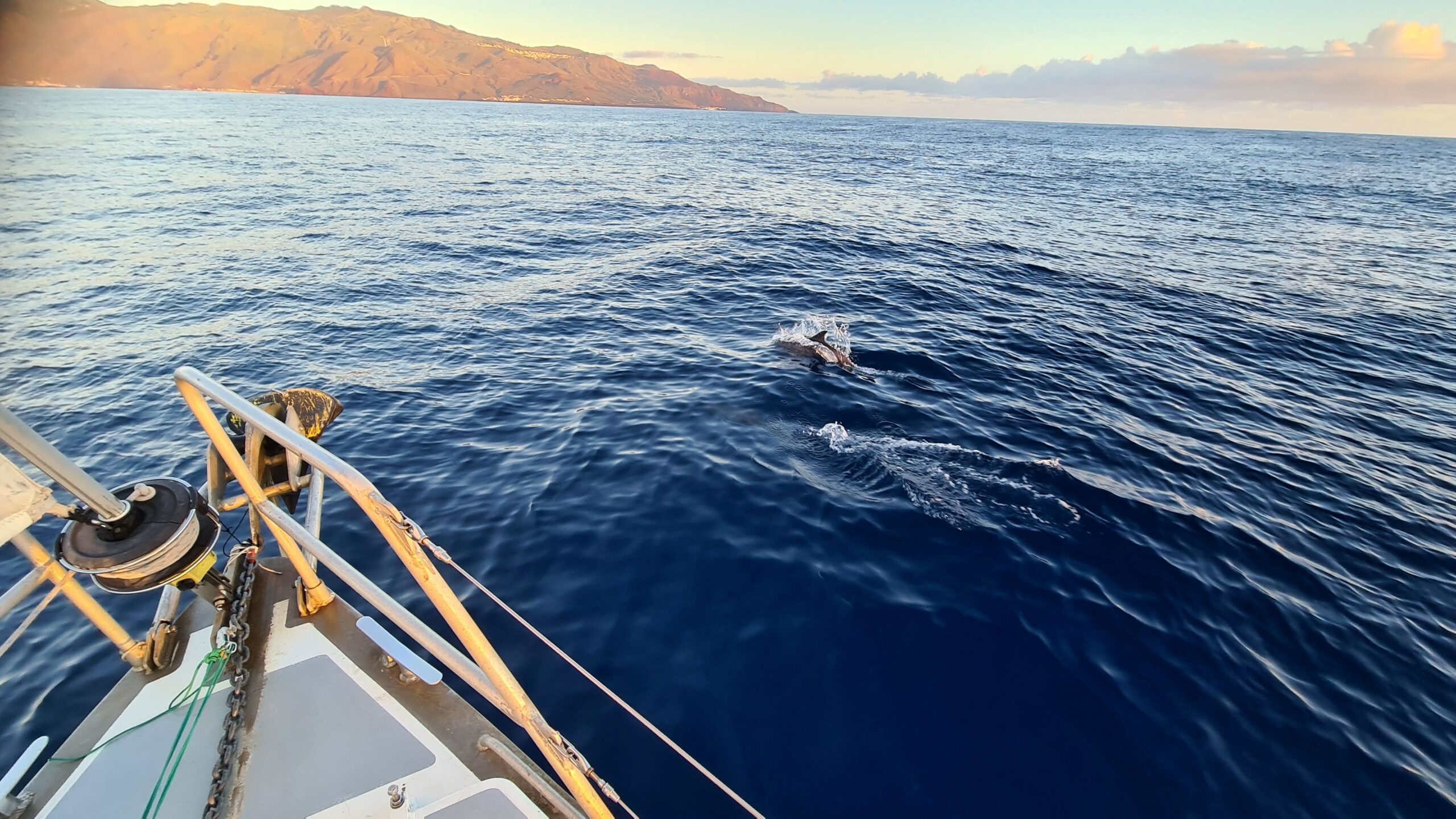
The welcoming committee while approaching El Hierro
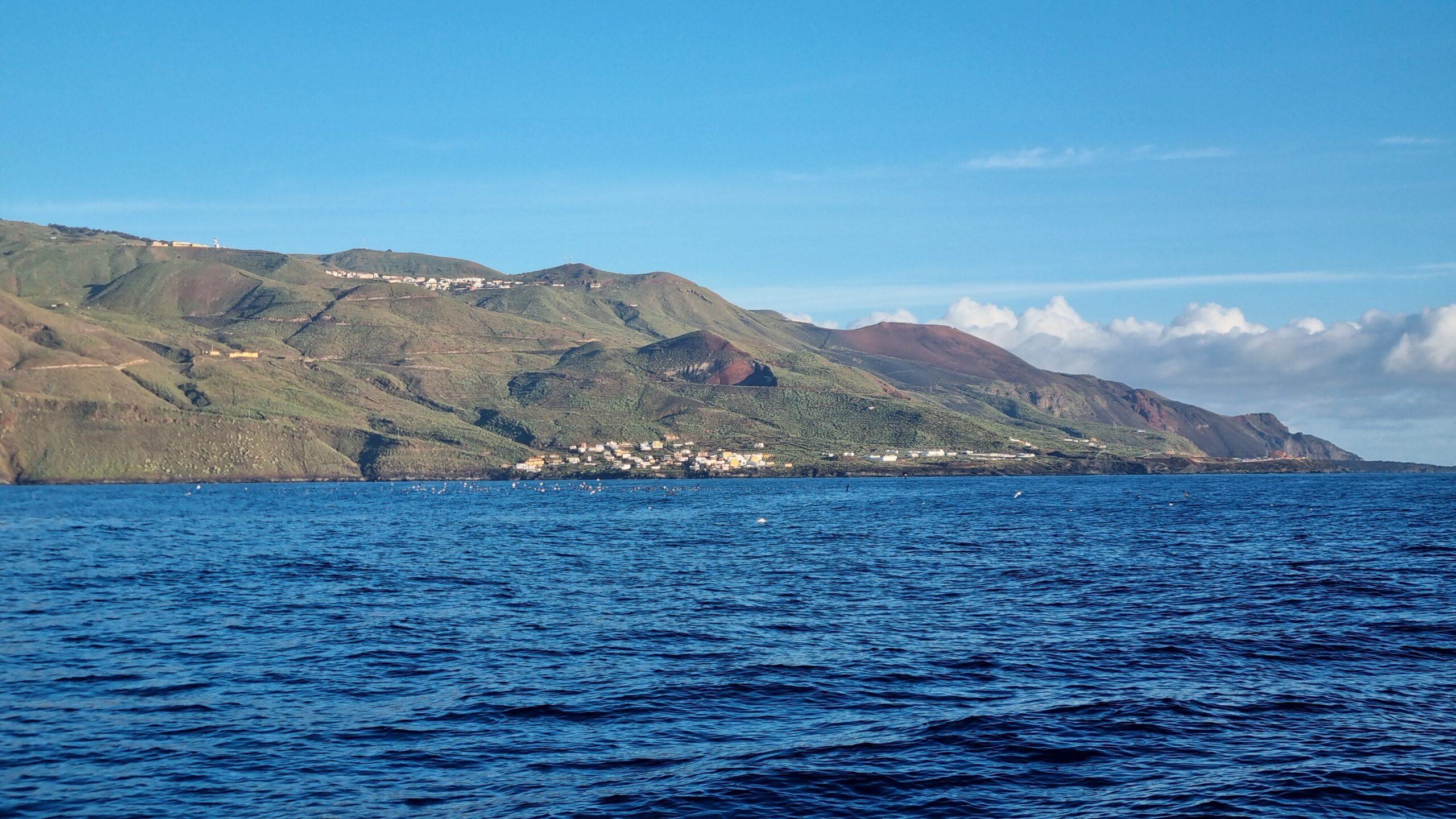
Northern El Hierro: the capital Valverde perched high above and the seaside village of La Caleta
11–15 May: Stopover in El Hierro
The smallest island in the Canaries (270 km², the size of Stord, or three times that of Belle-Île), El Hierro is completely untouched by mass tourism and home to barely 11,000 inhabitants (half as many as Stord and twice as many as Belle-Île). The contrast with bustling Tenerife is striking…
In the harbour, three-quarters empty, a brand-new mountain bike casually leaning against the railing without any lock immediately sets our minds at ease regarding the security of the place. Apart from the katabatic gusts that can whistle violently across the pontoons— the harbour being located in the island’s acceleration zone and under the lee of a 500-metre-high cliff—it is absolute peace. A few cars pass on the road at the time of the daily ferry; otherwise we don’t see a soul. Only fish proliferate here in the hyper-transparent water of the harbour: wrasse, parrotfish, damselfish, and even a huge school of barracudas circling insistently around the boat…
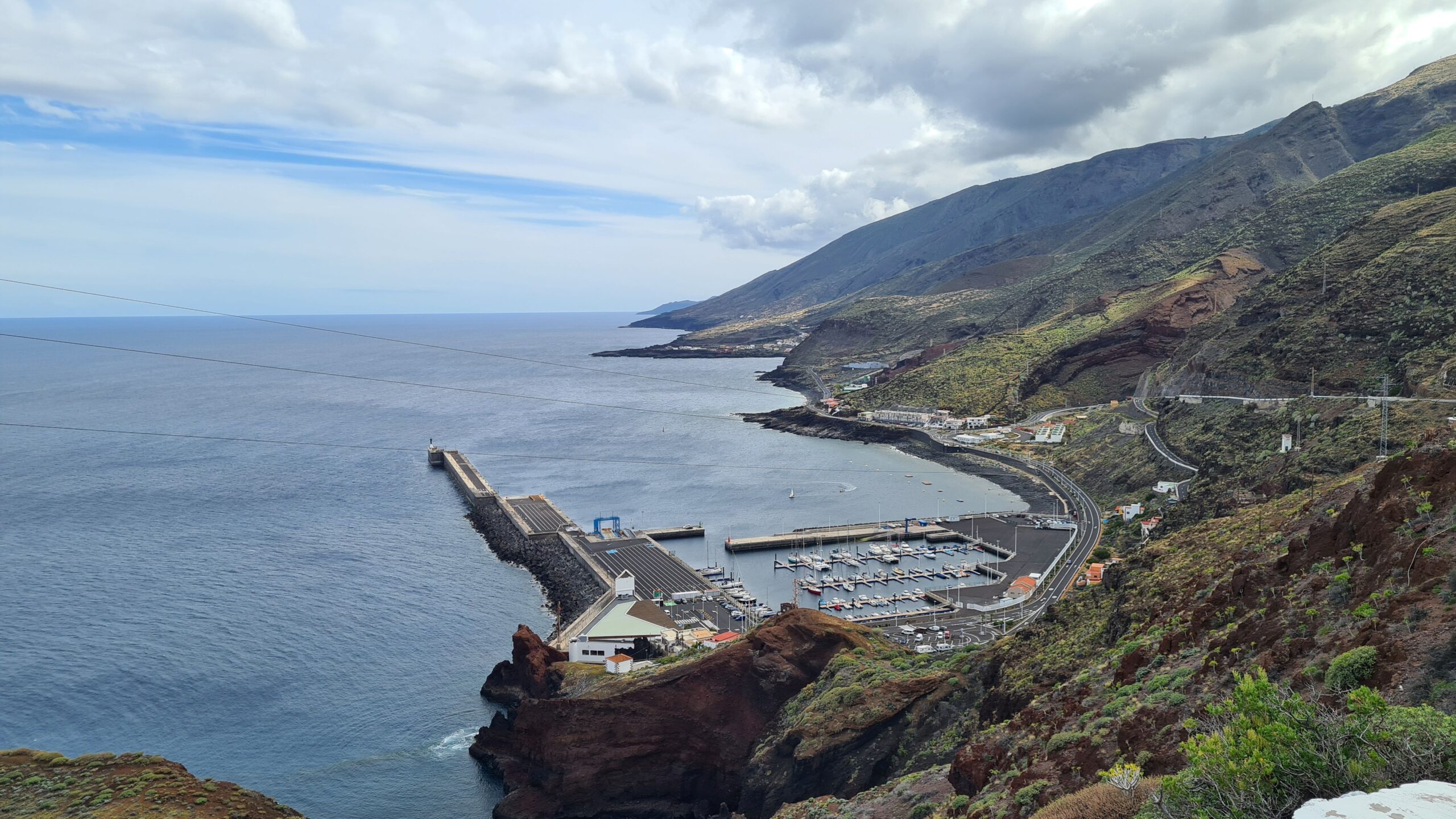
The port of La Estaca, nestled at the foot of the cliffs
The island is known for its hiking trails, finally an opportunity to go for a big walk with a bit of elevation gain! We set off from the boat and start climbing. The island despite its small size peaks at 1500 metres altitude, making it one of the steepest in the world. It certainly stretches the legs! On the cliff face grow numerous nopal cacti, in flower and fruit (the famous prickly pears), more classic Canary euphorbias just as flowery, agaves, and… thistles! The colours, contrasting with the dark lava, are fantastic…
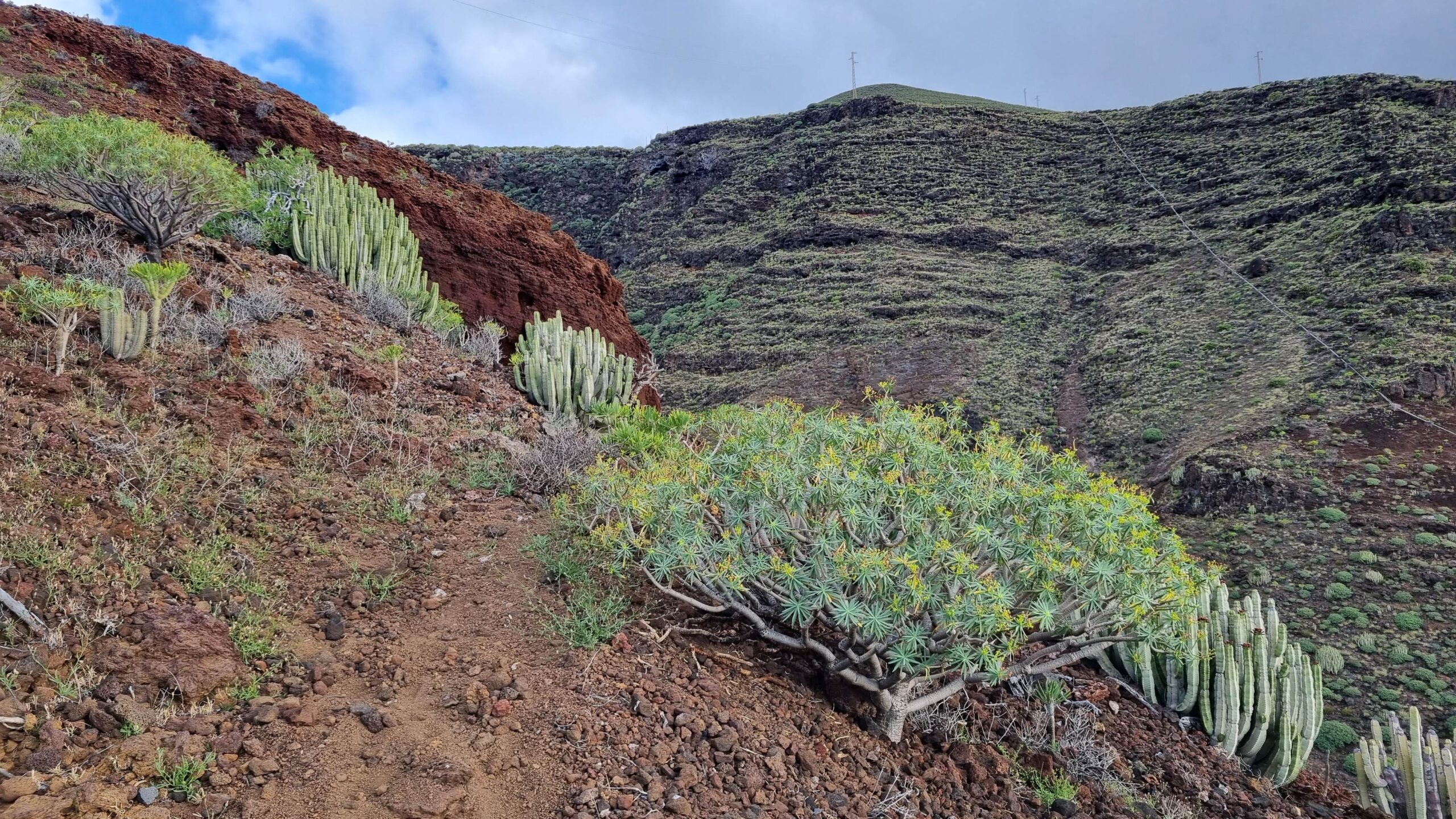
Lower levels are the realm of the euphorbias
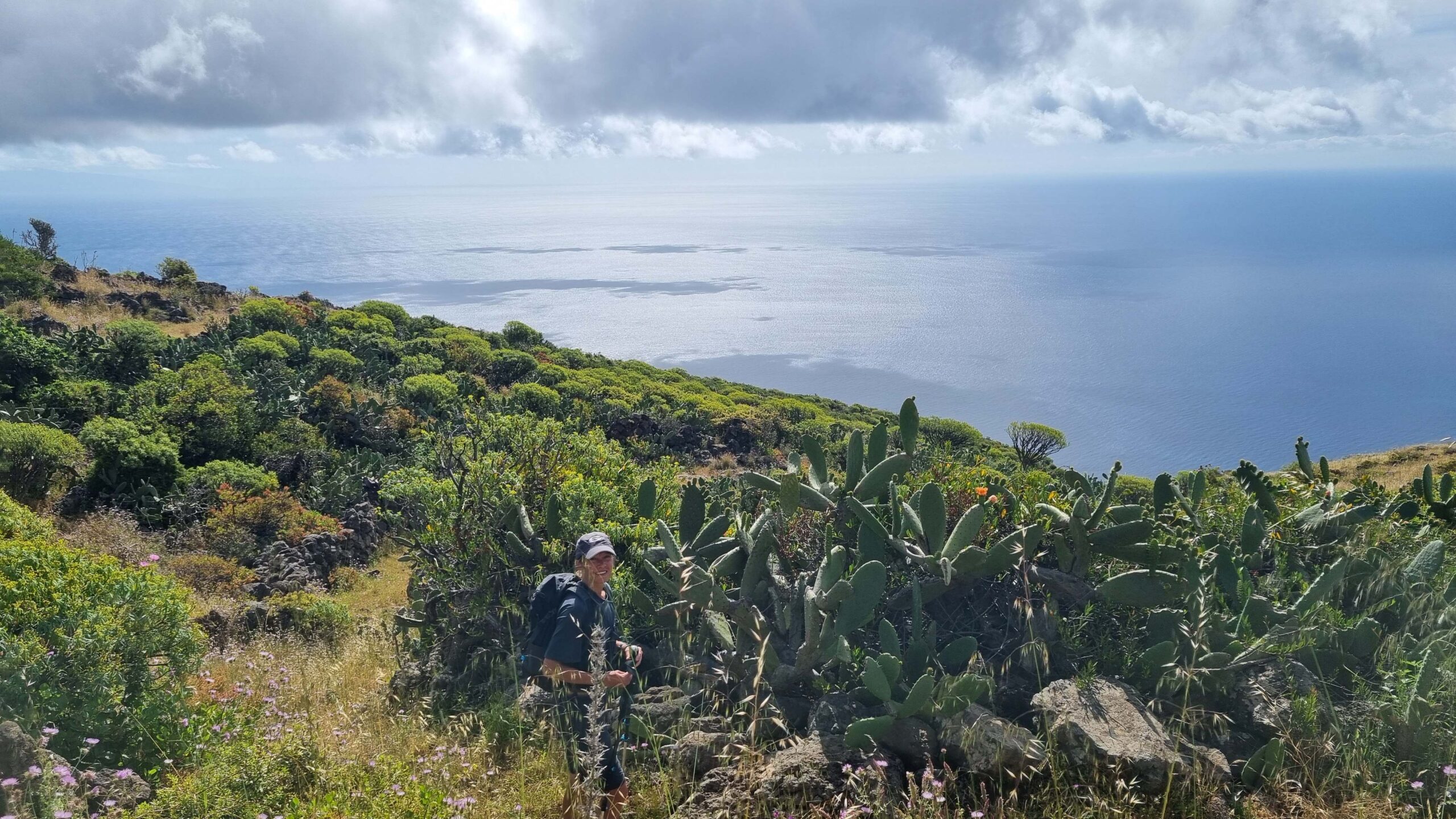
Higher up, we find nopal cacti, grass, and thistles.
1,200 metres higher up, we find a landscape of alpine pastures covered in green grass and hundreds of mostly mauve flowers. A few laurels and tree heaths typical of the islands’ high humid forests complete the landscape. Some trees here have the unique ability to capture moisture from the trade winds with their needles and channel it into the ground, from where the inhabitants have for centuries recovered it through a system of wells and then more sophisticated galleries. And all this just for us: we won’t cross paths with a single hiker all day! El Hierro is sooooo quiet…
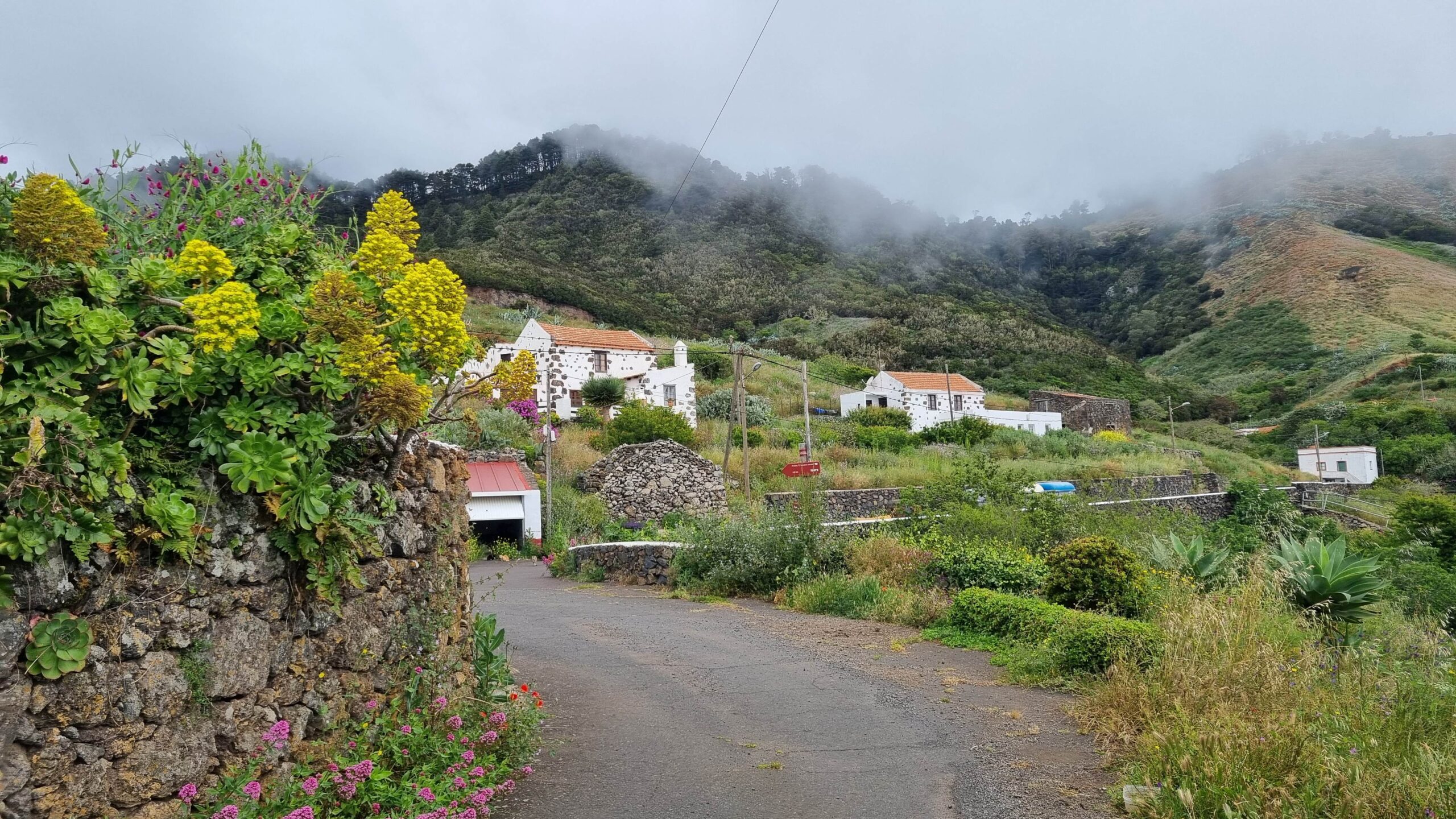
A village in the heights of El Hierro, which almost reminds us of the Azores!
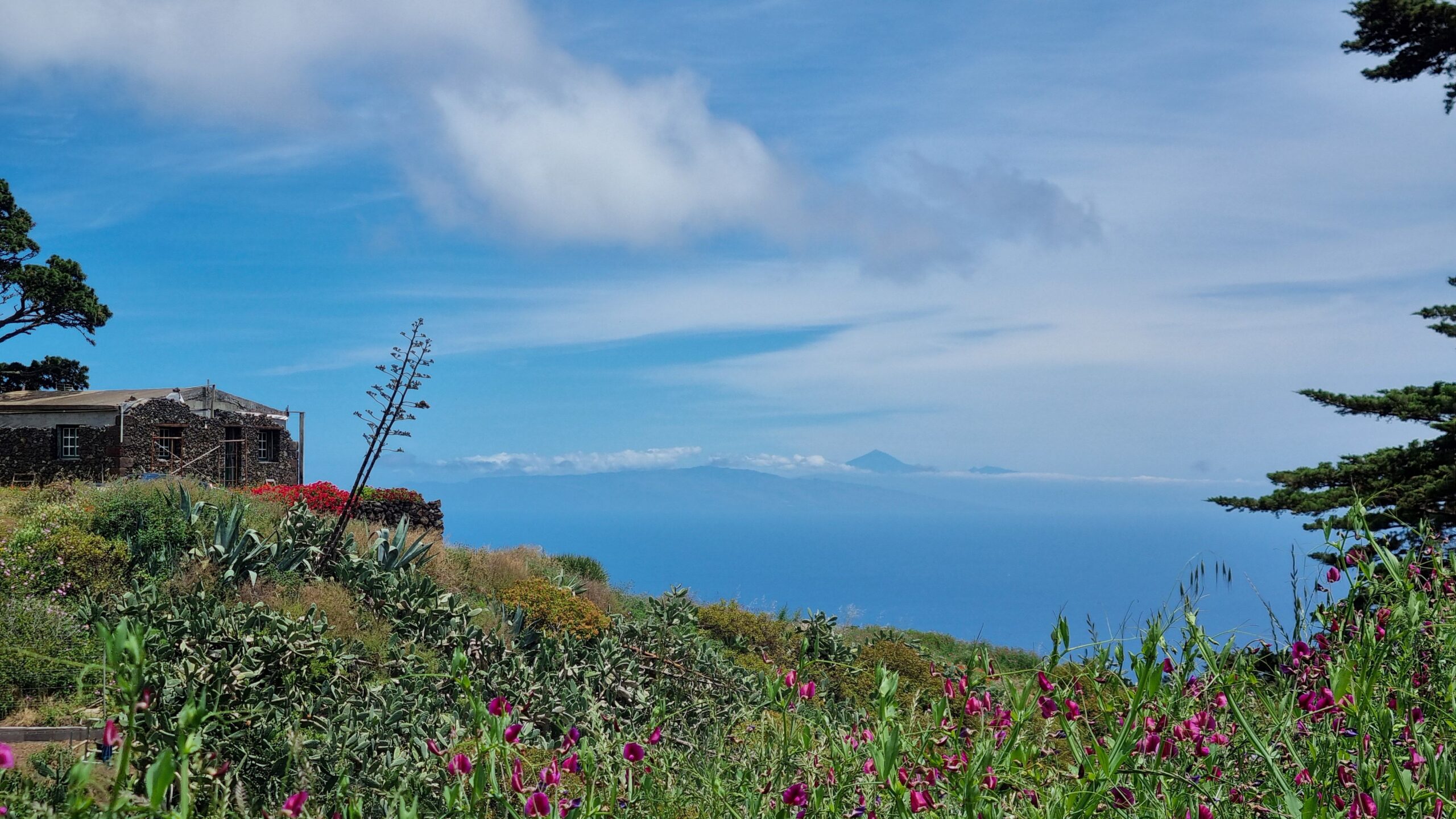
Agaves, wildflowers, pine trees and a view of the rest of the Canary Islands archipelago…
On the way down, we pass five 2MW wind turbines and a small water reservoir. Visits to the plant itself weren’t possible this week, but the communication manager kindly receives us in her office to answer all our questions. Since 2014, the majority of electricity consumption has been provided by this hydro-wind system, a pioneer of its kind: in addition to direct consumption, excess wind energy is used to pump desalinated water up into the reservoir, which then feeds the hydroelectric turbines as needed. Designed to cover 70% of power needs of the island, the plant uses a traditional diesel generator as baseload… when you know the island is completely isolated (no supply cable) and that 40% of needs correspond to the desalination of drinking water, you understand the vital nature of energy independence. A future expansion, based on photovoltaics (self-consumption and agro-voltaics), is underway to reach 100% local production capacity. A fascinating example of a system that takes into account all needs (water and energy) and relies on local assets (wind, sun, elevation) to ensure autonomous renewable energy production!
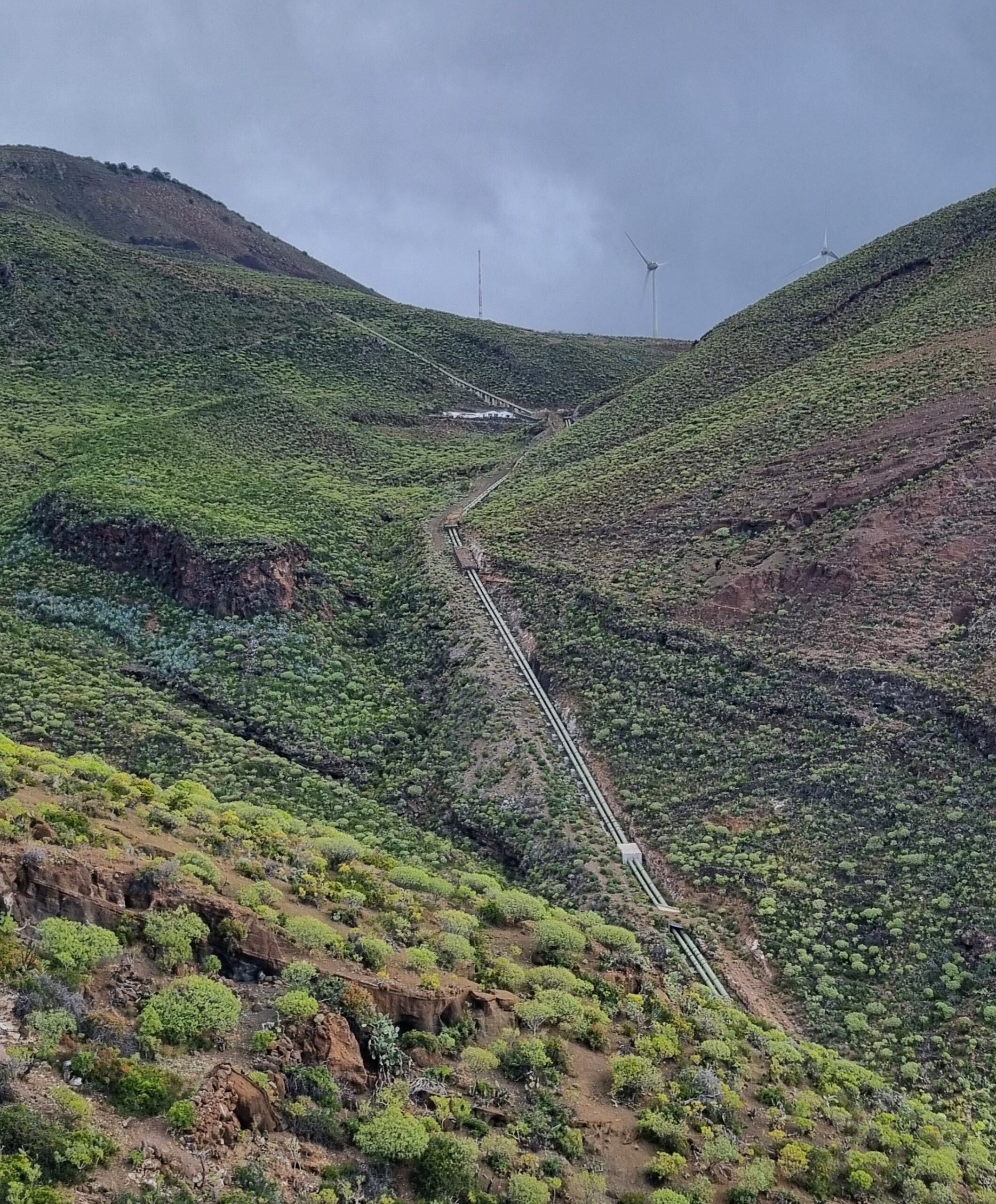
The hydro-wind power plant
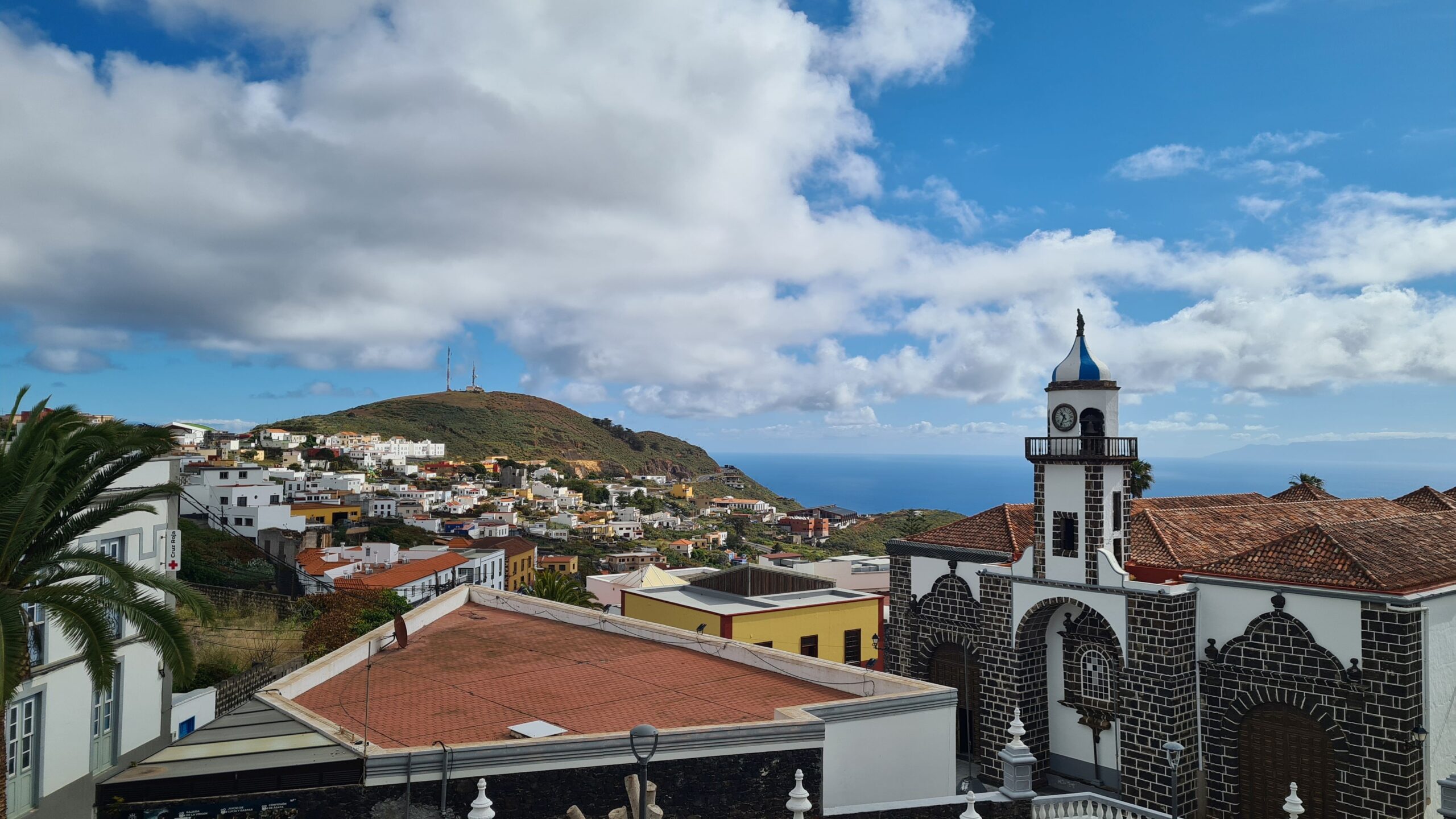
The “megacity” of Valverde
The path crosses through Valverde, the island’s capital. Situated at 600 metres altitude, it is a large village often swept by the trade winds. Its three streets organised around the historic volcanic stone church (we are still in the Canaries after all) contain a café, two or three shops, a few administrative buildings and two tiny supermarkets. Good that we did our provisioning in Tenerife before leaving…
Back to the boat via the seaside resort of La Caleta. The only inhabitants we met with there were those of a colony of periwinkles which ended up in our stomachs!
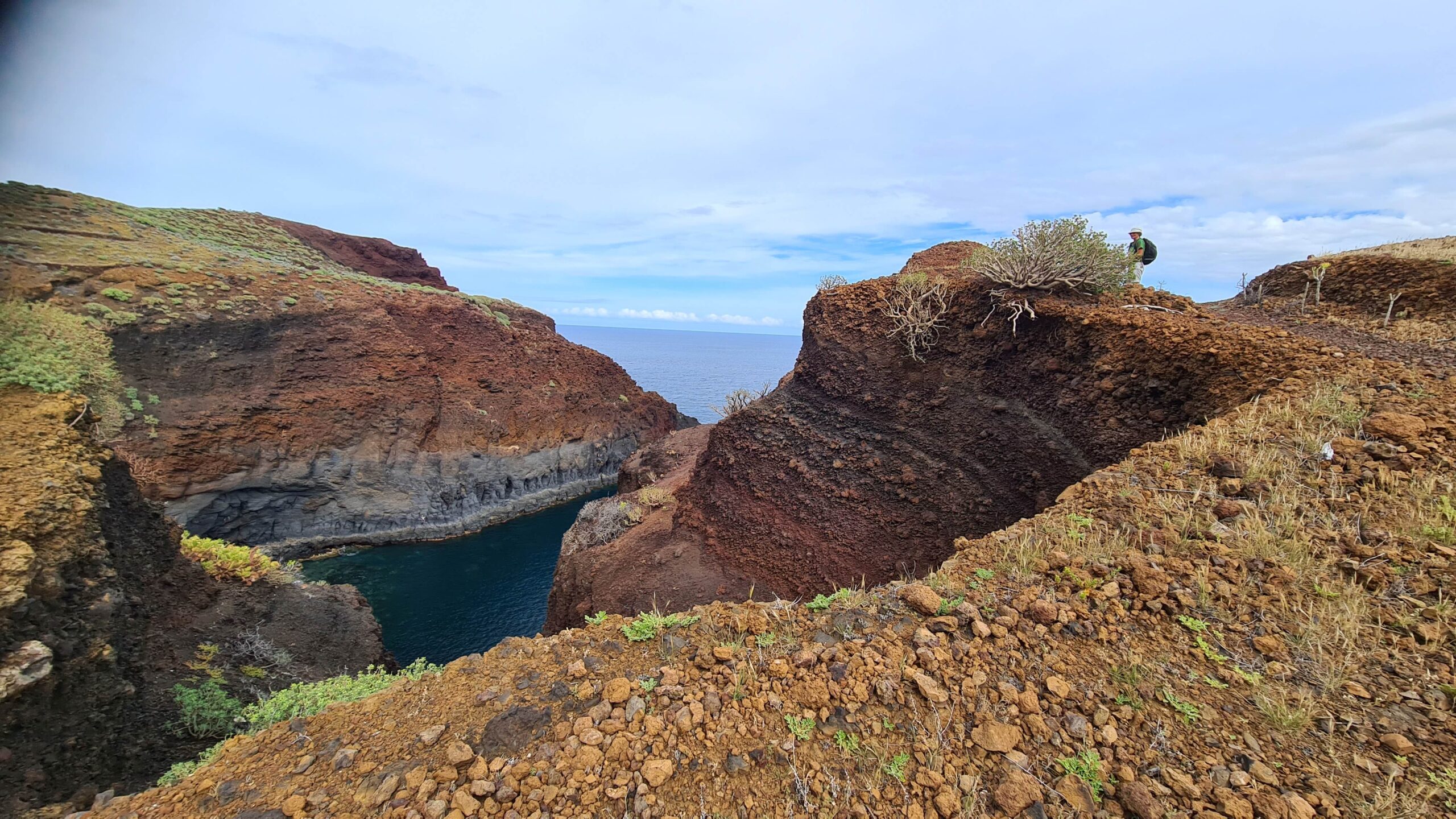
Lava cliffs close to the harbour
Small as the island may be, we still hire a car for two days to give it an exhaustive tour. Along the large northwestern bay of the island, named El Golfo, the landscapes rival each other in beauty—all black volcanic rock and bright yellow little flowers.
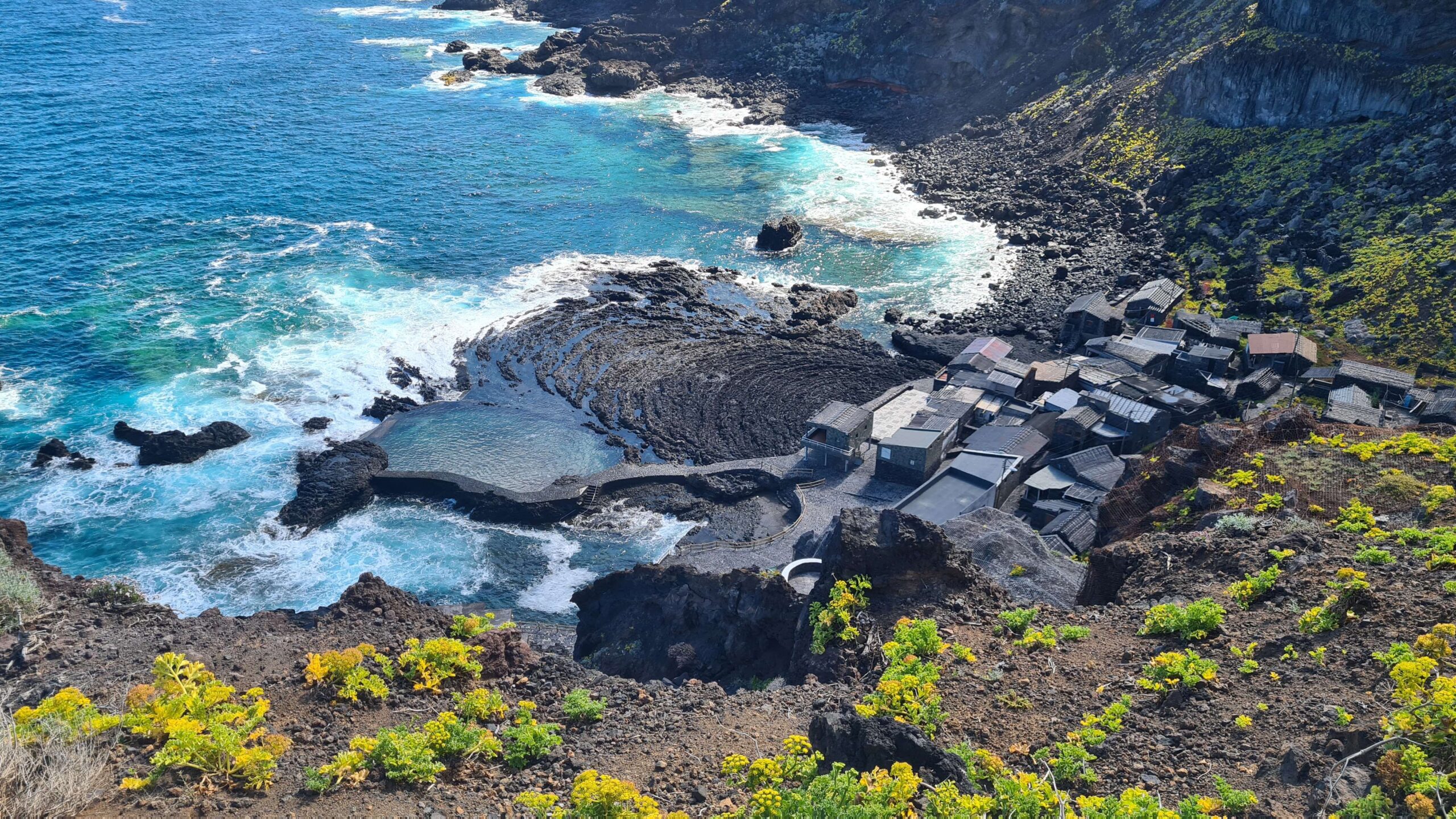
Pozo de la Calcosas, village built over a lava flow
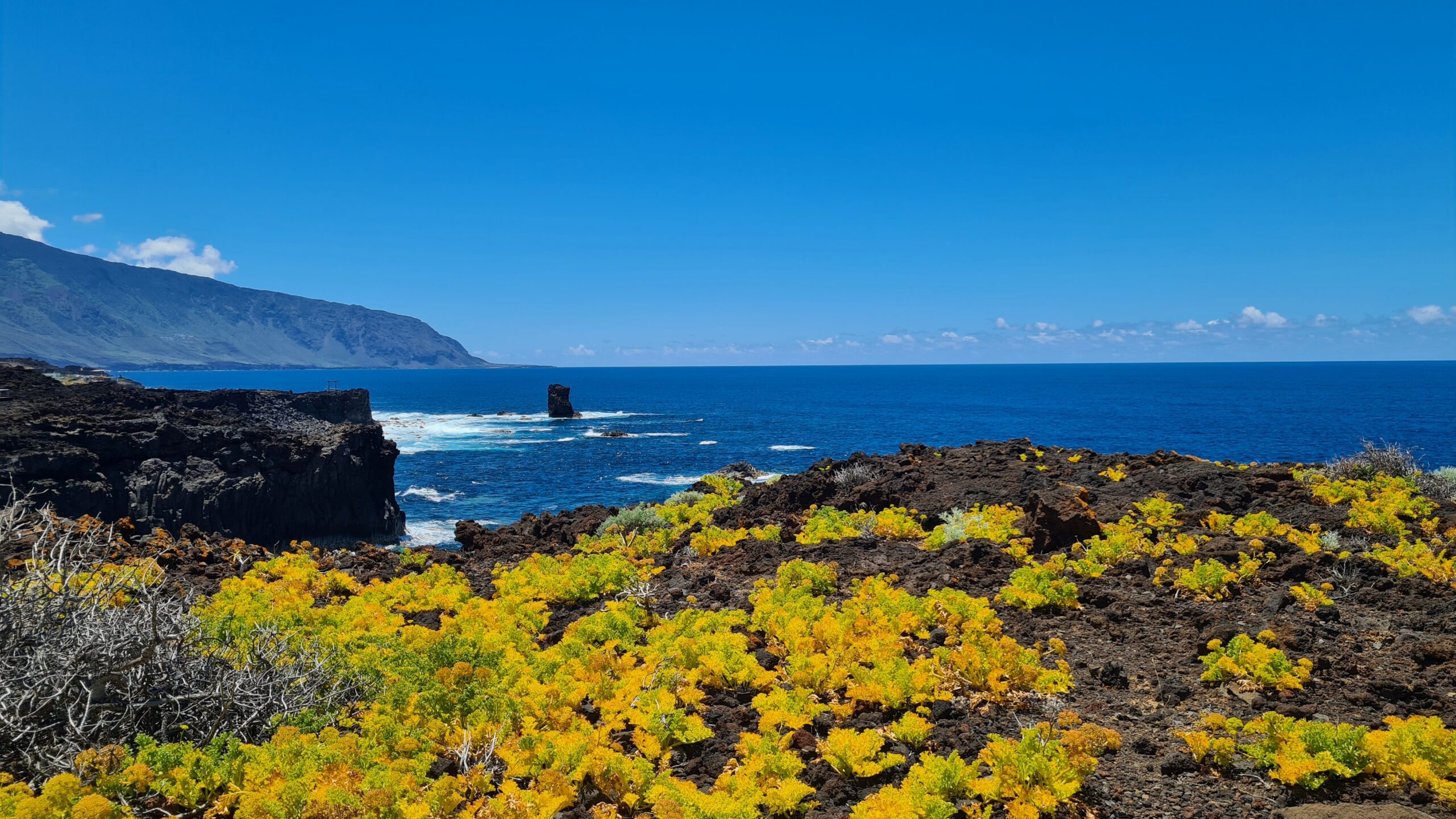
El Golfo, North West shores of El Hierro
And when vegetation doesn’t grow, the turquoise water takes care of the splashes of colour, like this superb natural pool under an arch where we cool off a bit.
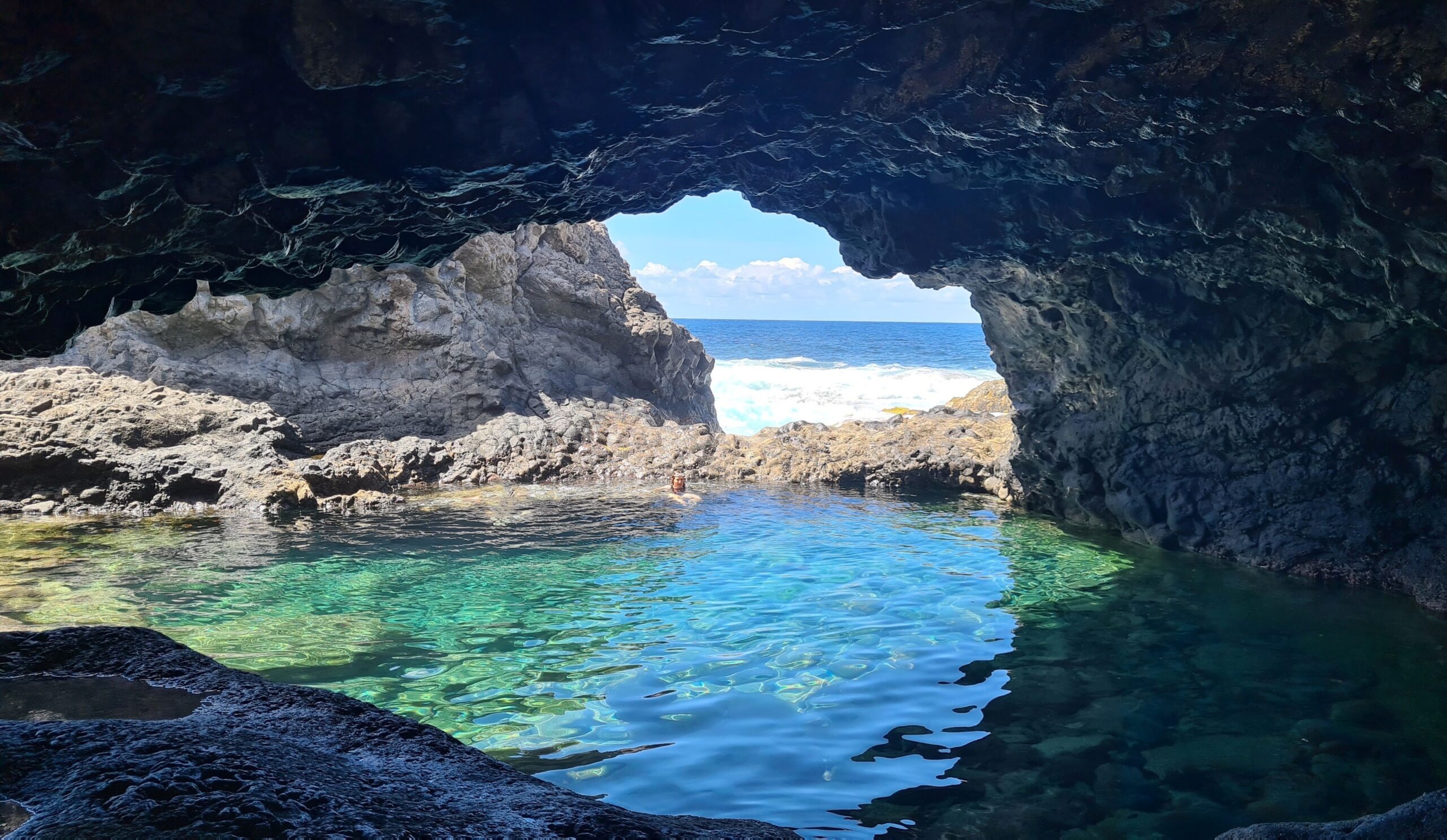
What a beautiful swimming-cave (Charco Azul)
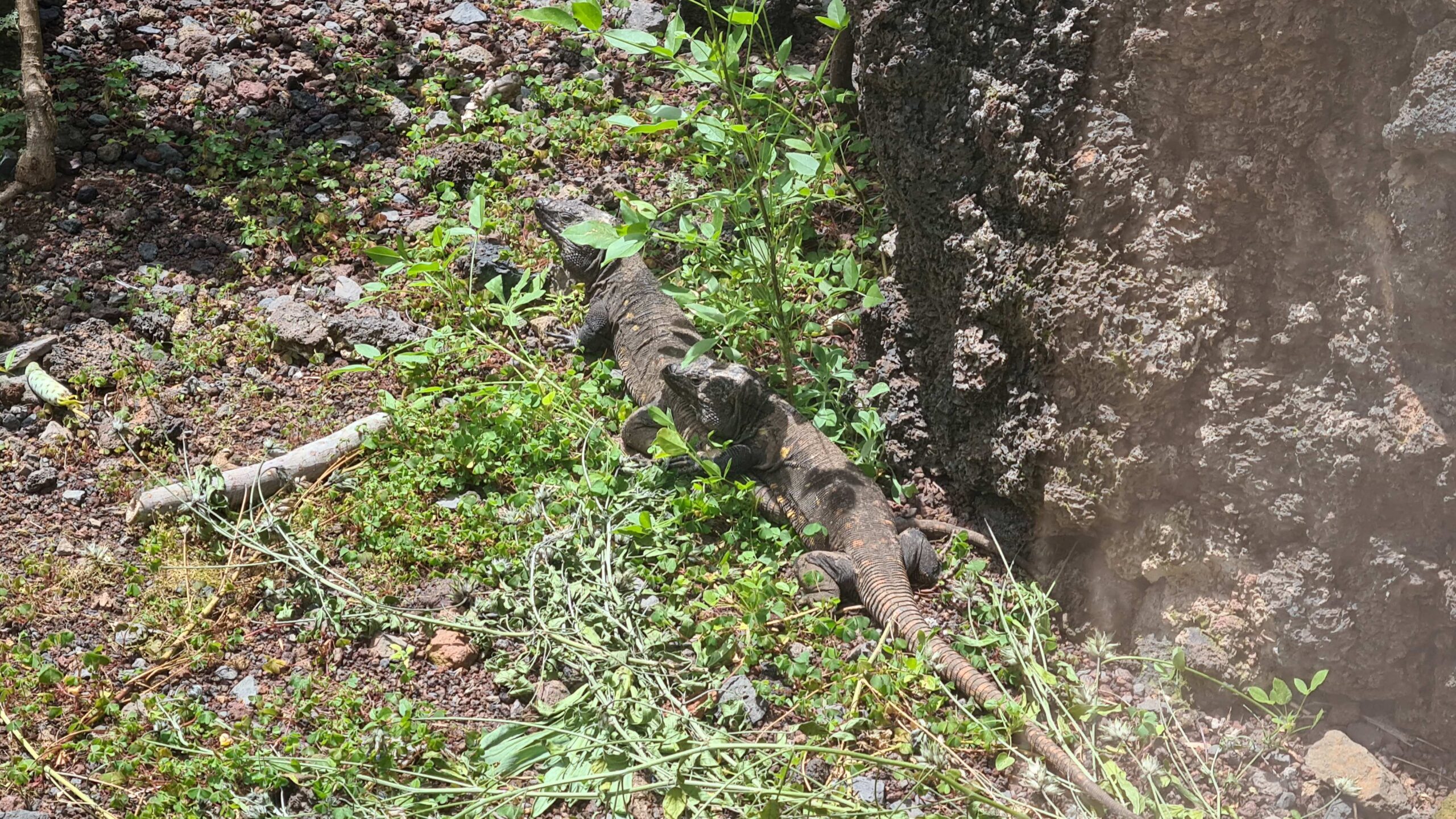
Big lizards
We mustn’t forget to cultivate ourselves, which we do at the Guinea Eco-museum and conservation centre for the island’s giant lizards. They were thought to have died out, but no: these charming, very placid reptiles over 75cm long are still alive and regularly reintroduced into the wild.
The middle of the island is mountainous and catches the trade-wind clouds. There you often find overcast and damp weather and the classic laurel and heather forests. Of other hikers, however, still no sign.
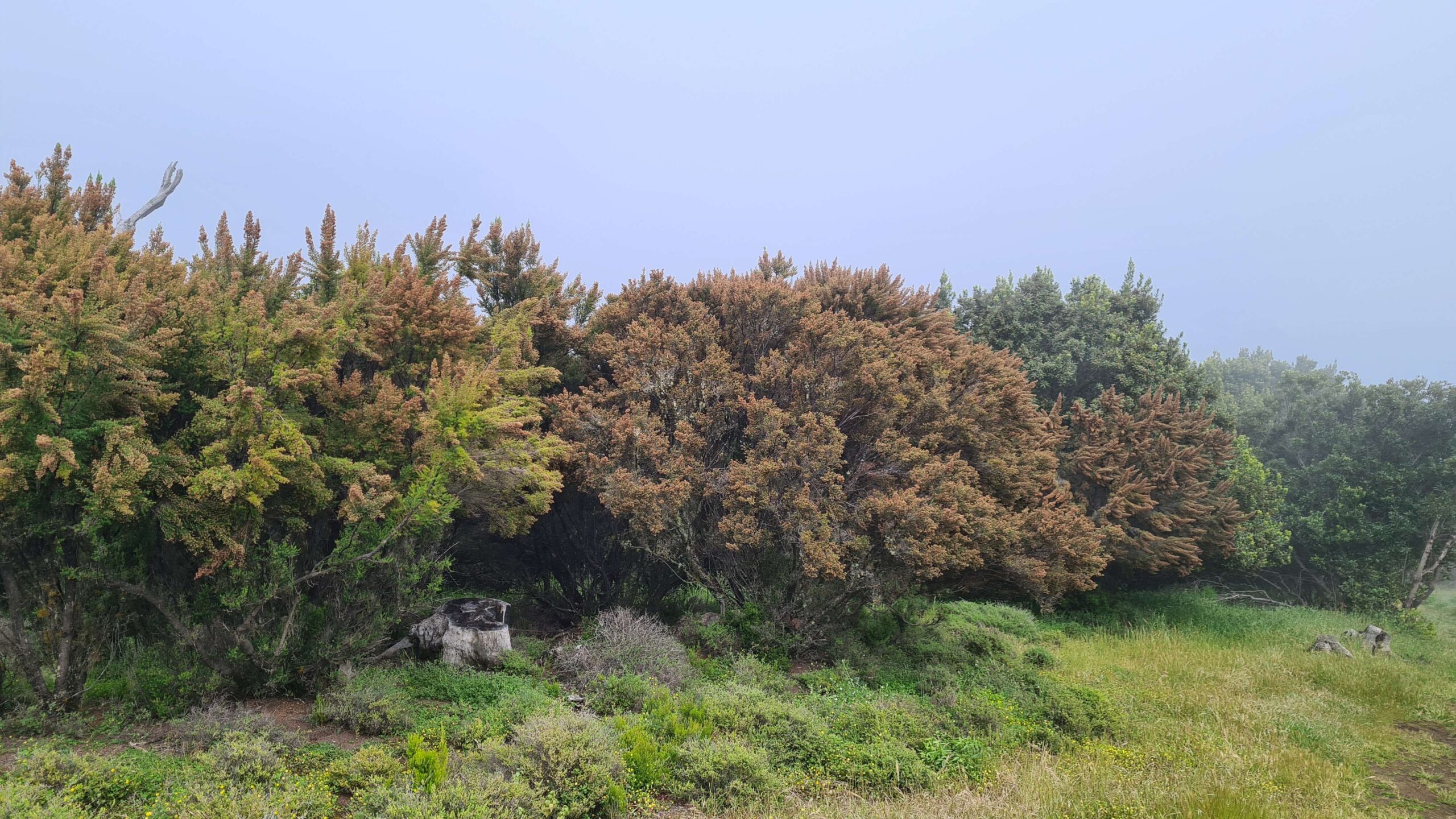
Treesize heathers on the island’s heights
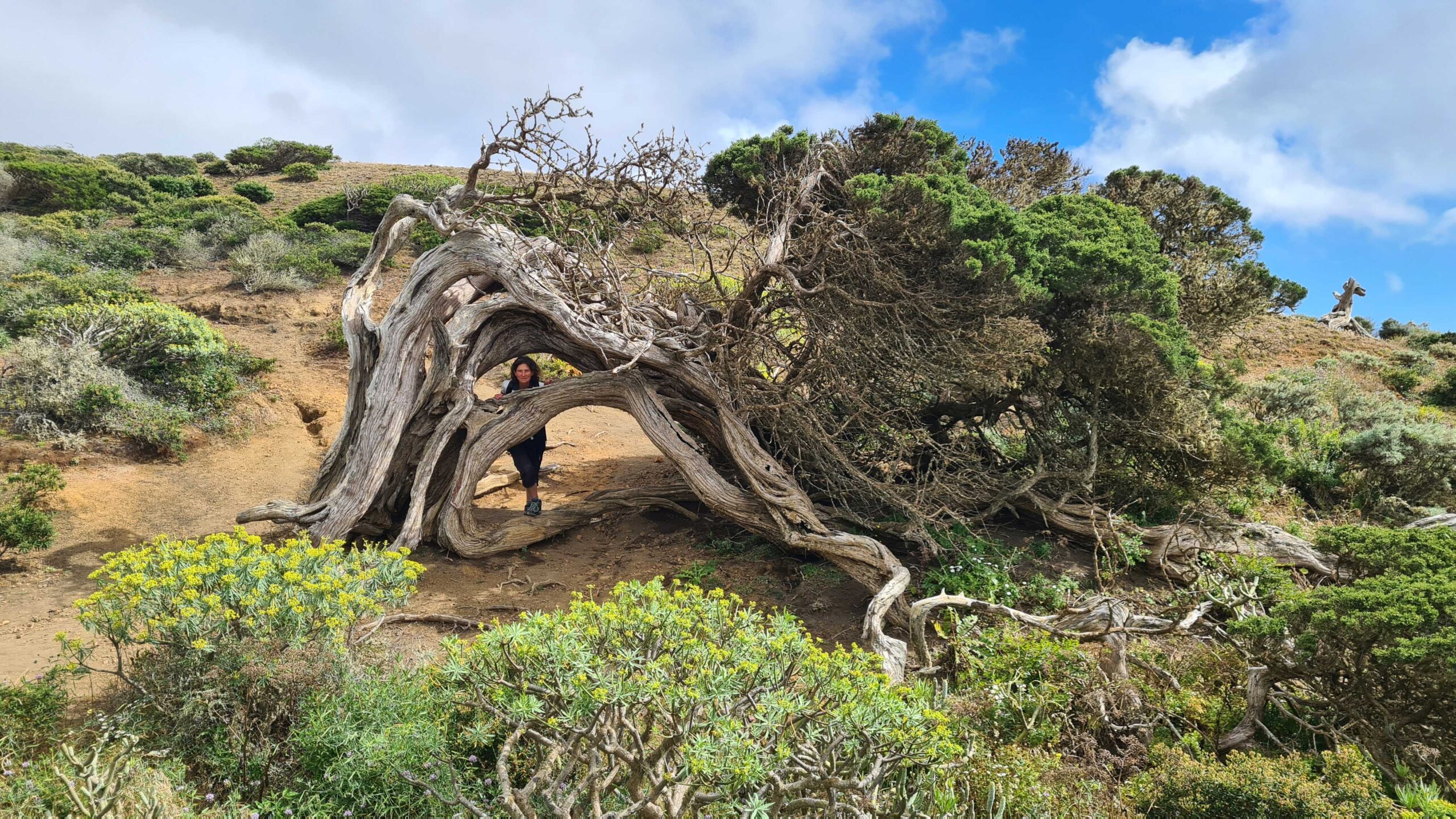
Juniper tortured by the trade winds
On the southwestern part, it is juniper that grows—or rather, tries to do so—buffeted by the violent gusts of the trade winds accelerated by the terrain. While the trunks sometimes stay straight, the branches are systematically bent backwards, giving these trees ghostly silhouettes that have become one of the symbols of the island.
To finish, a quick trip to La Restinga at the far south. There used to be a few pontoons for visiting yachts in the past, but the harbour was destroyed by a storm and has been more or less undergoing works ever since. We take the opportunity to do some snorkeling from the neighbouring bay of Tacoron, which is teeming with life. We even see a pufferfish! And we realise with disappointment that we have lost just about all our breath-holding capacity… we blame it on the water temperature (only 22°C), which has a better chance of improving than our advanced age, and promise ourselves to train seriously!
To top off this splendid final Canarian and European leg, we spend a very nice evening on board with Sophie and Clément, two young sailors/divers who are doing a 5-month Macaronesian loop on board their Ovni 385. The first drinks with fellow cruisers since meeting Foundation in Port-Haliguen back in February. Cruising out of season is lonely…
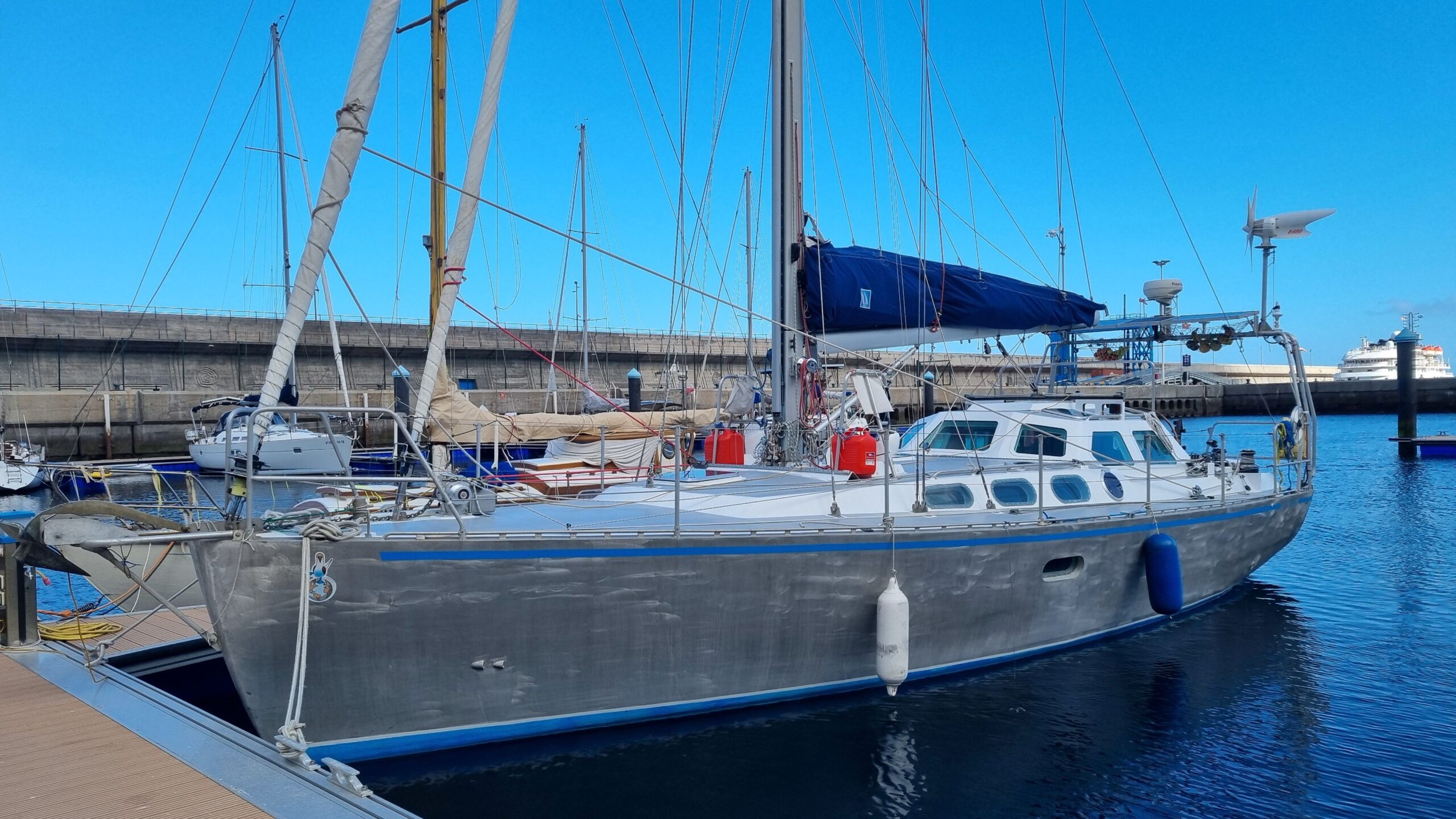
UtPåTur is ready to explore further south!
So, there we go, we’ve given the island a good tour, done the laundry (by hand this time, no washing machine for 5km around), filled the fridge and the fruits net, consulted the weather forecast, and we are ready for the next leg, ever further towards the south-west…
 PDF