
From Fernando de Noronha to Salvador de Bahia via Recife: our first real encounter with this vast and fascinating country that is Brazil. We are properly far from Europe…
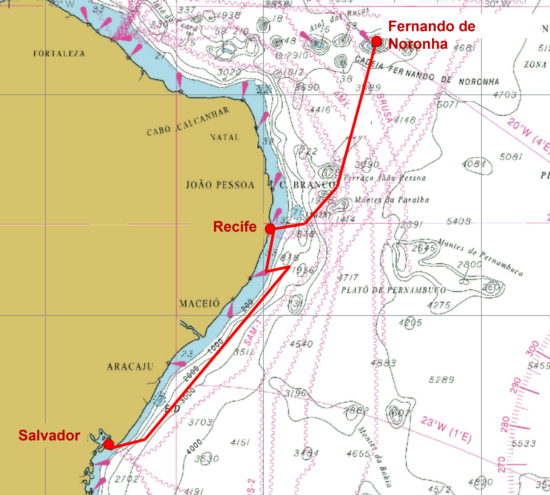
793 nautical miles sailed– 10944 NM in total on UtPåTur
The full photo album here.
30th June – 2nd July: Stopover in Fernando de Noronha
Fernando de Noronha is one of Brazil’s crown jewels. Stunning landscapes, rich and protected wildlife—the entire island is set up for tourists, who are summoned to pay an eye-watering daily tax to help preserve this magnificent, fragile ecosystem.
We know the stopover is going to be pricey, so we’ve planned to stay just three days: time split between exploring, boat maintenance, and giving the crew some rest after 12 days at sea.
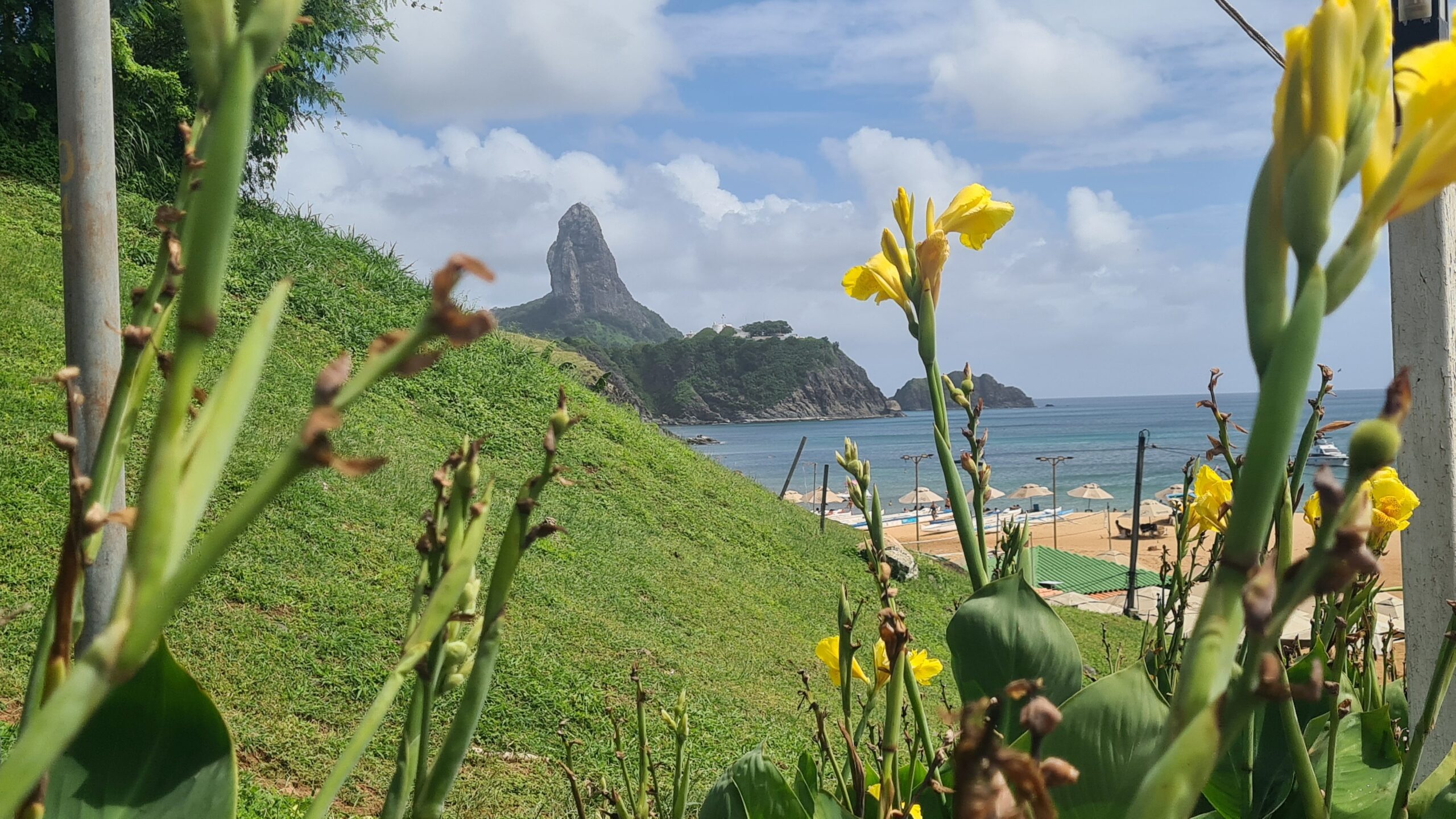
Access to the little paradise of Fernando de Noronha has a price tag…
[Exploring]
Our first steps ashore take us from the landing stage to the top of the beach, home to the harbourmaster’s office. We need to clear into Brazil and meet, in that order, the port captain, local representatives of the Navy, and the federal police who can stamp our passports. There’s no customs office in Noronha: the boat’s entry will be registered once we reach the mainland. Everything moves at a leisurely pace, but in high spirits. Sipping our complimentary coffee from the harbour office, we take in our new surroundings.
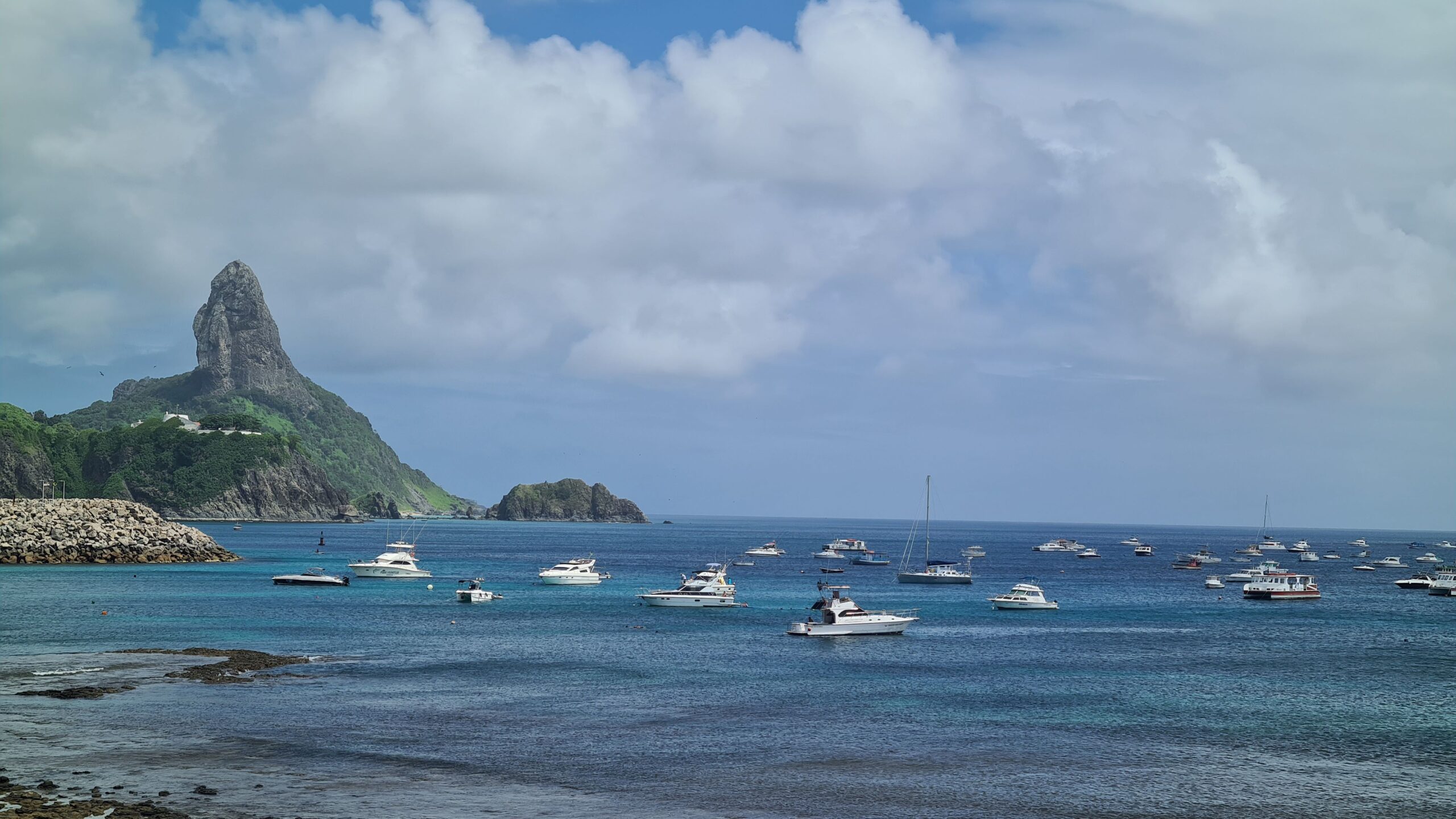
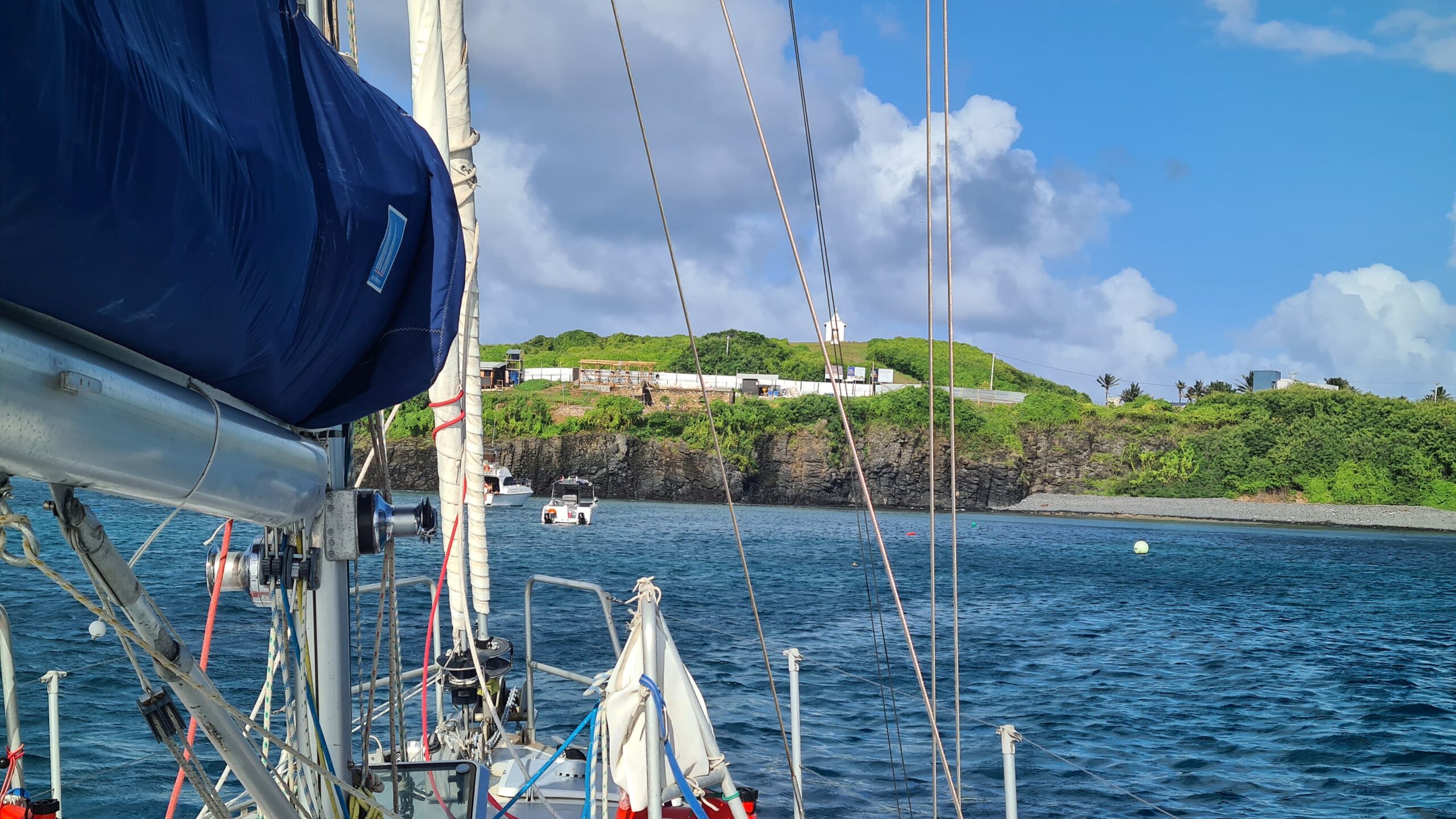
UtPåTur is the only sailing boat on the anchorage, we must be off-season…
First observation: we are the only cruising yacht here. The other craft at anchor are exclusively for local tourism—diving, sea fishing, island tours—making the place look like a sort of Disneyland for deep-pocketed Brazilians. The beach below is gorgeous, dotted with parasols and sun loungers, lined with little beach bars, and populated by tourists of varying shades of tan and wearing varying amounts of clothing. Thong bikinis seem to be very much in fashion here! A damp, red-dirt track runs past a few more shops before heading into the island’s interior. A rain squall passes over; the scorching sun comes back—the classic equatorial climate you’d expect at 3° South!
[Crew Rest]
Once all officially stamped in, we treat ourselves to a fresh green coconut at a beach hut— it tastes like a proper arrival in Brazil!
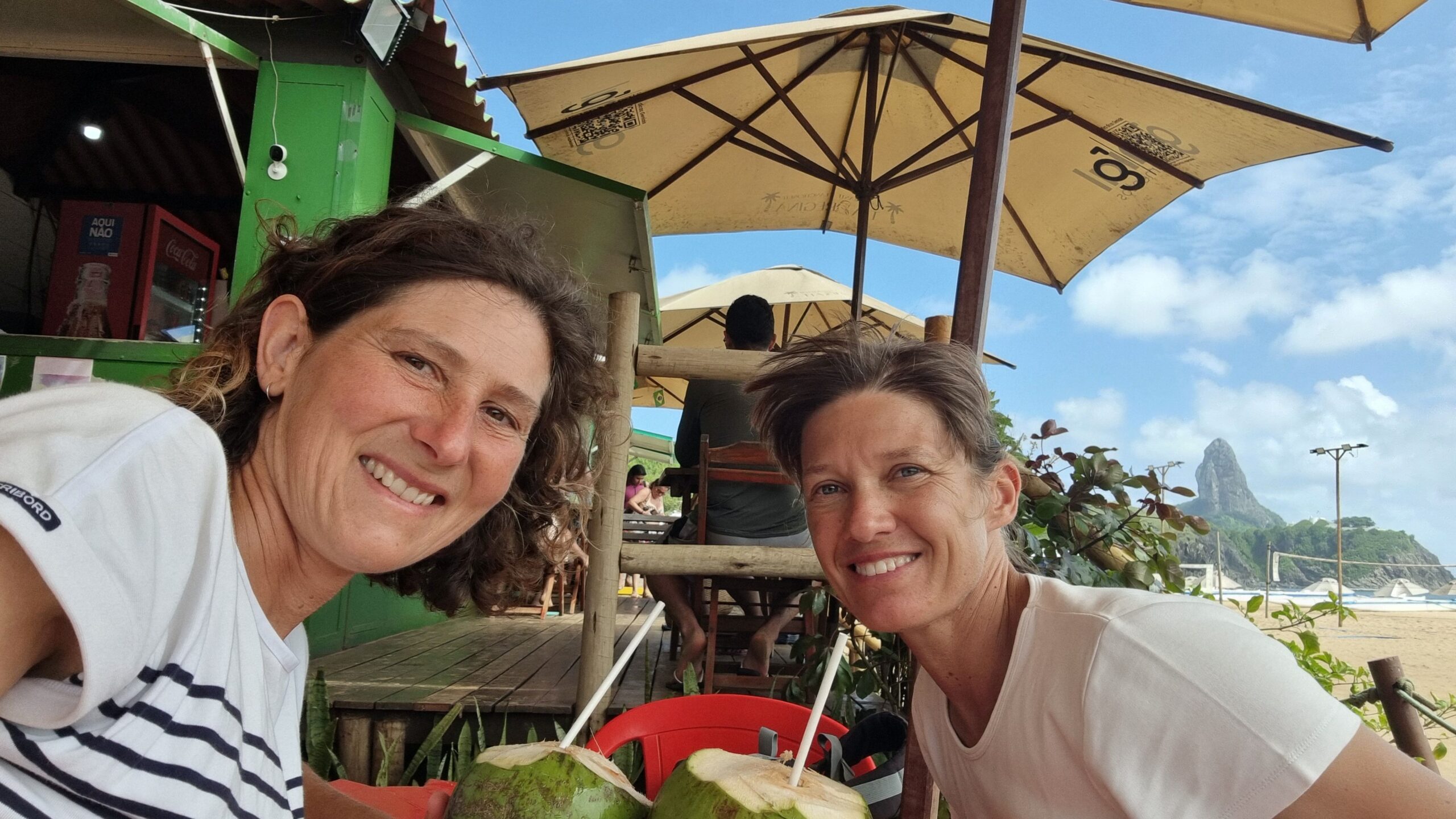
Green coconut on a Brazilian beach, check!
[Boat Maintenance]
We scoot back on board to tinker quietly with the boat and enjoy life at our lovely anchorage. Aside from a few minor points to fix after the transatlantic (a leaky hatch, tightening a cleat, cleaning a winch), we mainly want to inspect our Mast of Damocles, as we’re now calling our rig. First lower shroud we peer at: one strand has a weird reflection compared to the others. Suspicious… we poke it with a fingernail and—bingo!—it shifts inside the swage. Same story down at the bottom fitting: our port aft lower shroud is also damaged.
Nice rigging, a shame it is so fragile…
That’s the third lower shroud to break in six months—hardly normal for a rig that’s only four years old. This time we’re not looking for an excuse, like we’re sailing the boat wrong or tuning the mast badly: we simply have a serious quality issue with the rigging! Which also means that all stays made at the same time are compromised, and we’ll have to replace the lot before we even think about continuing our voyage… Right then… But there’s zero marine infrastructure before Salvador de Bahia—700 miles upwind—so now, we need to figure out how to reach the South American mainland in one piece.
The broken lower shroud is on the port side, where the easterly wind hits us most of the time. So, we swap our two aft lower shrouds around to put the intact wire on the windward side, where it’ll work the hardest, especially close-hauled. The operation isn’t technically difficult, but with the endless squalls passing through, it eats up the entire morning… Good thing the anchorage isn’t rolling too badly right now!
[Exploring]
We do our best to forget our woes for an afternoon and set off for a wander. We quickly leave the island’s single paved road behind to follow secondary tracks: red dirt and massive muddy puddles that only a buggy could possibly tackle. The vegetation is lush without being a dense jungle. Besides coconut palms, we spot oleander-like bushes, strangler figs, and heaps of trees we’ve never seen before!
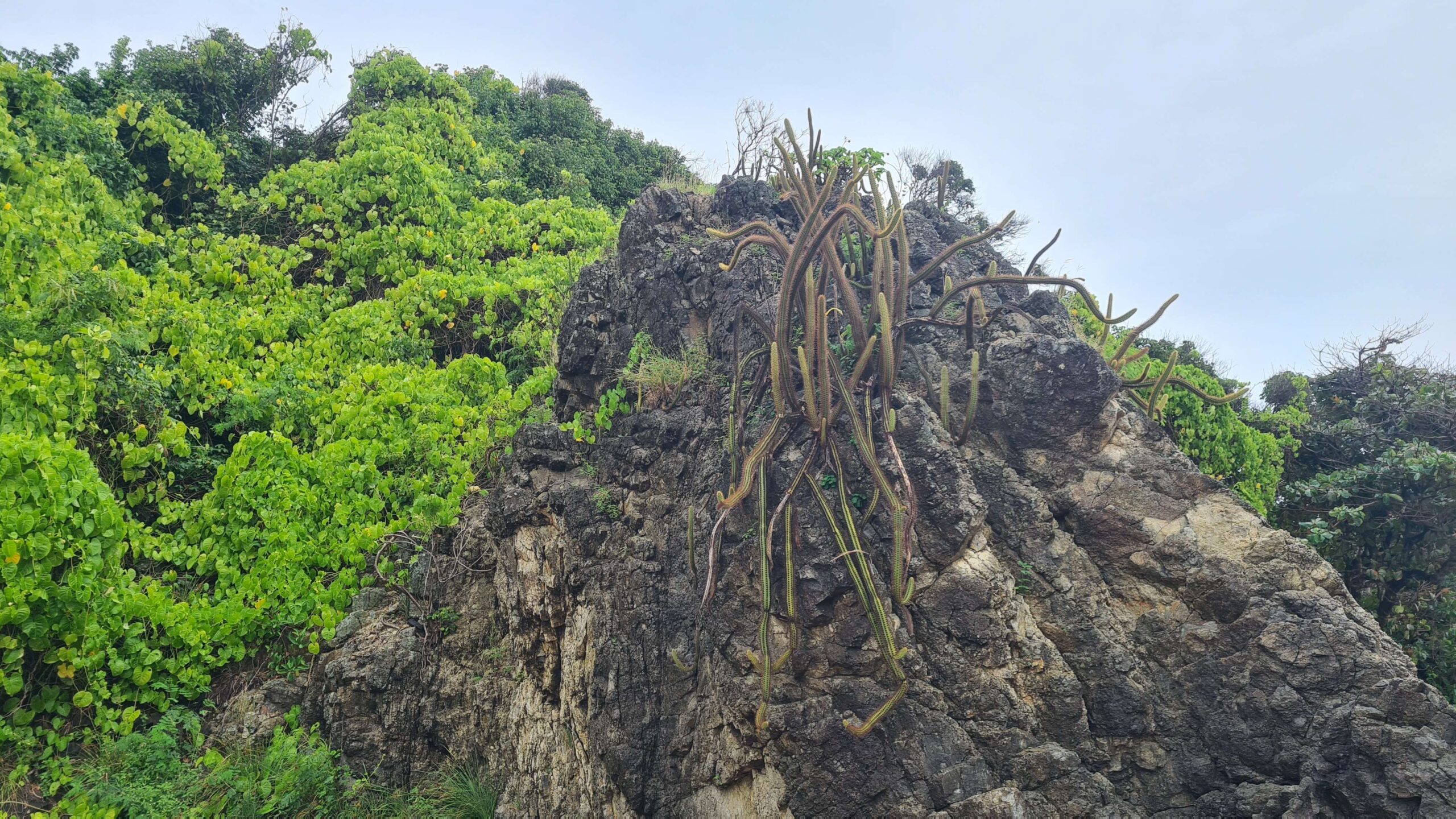
This strange cactus is endemic to Fernando de Noronha
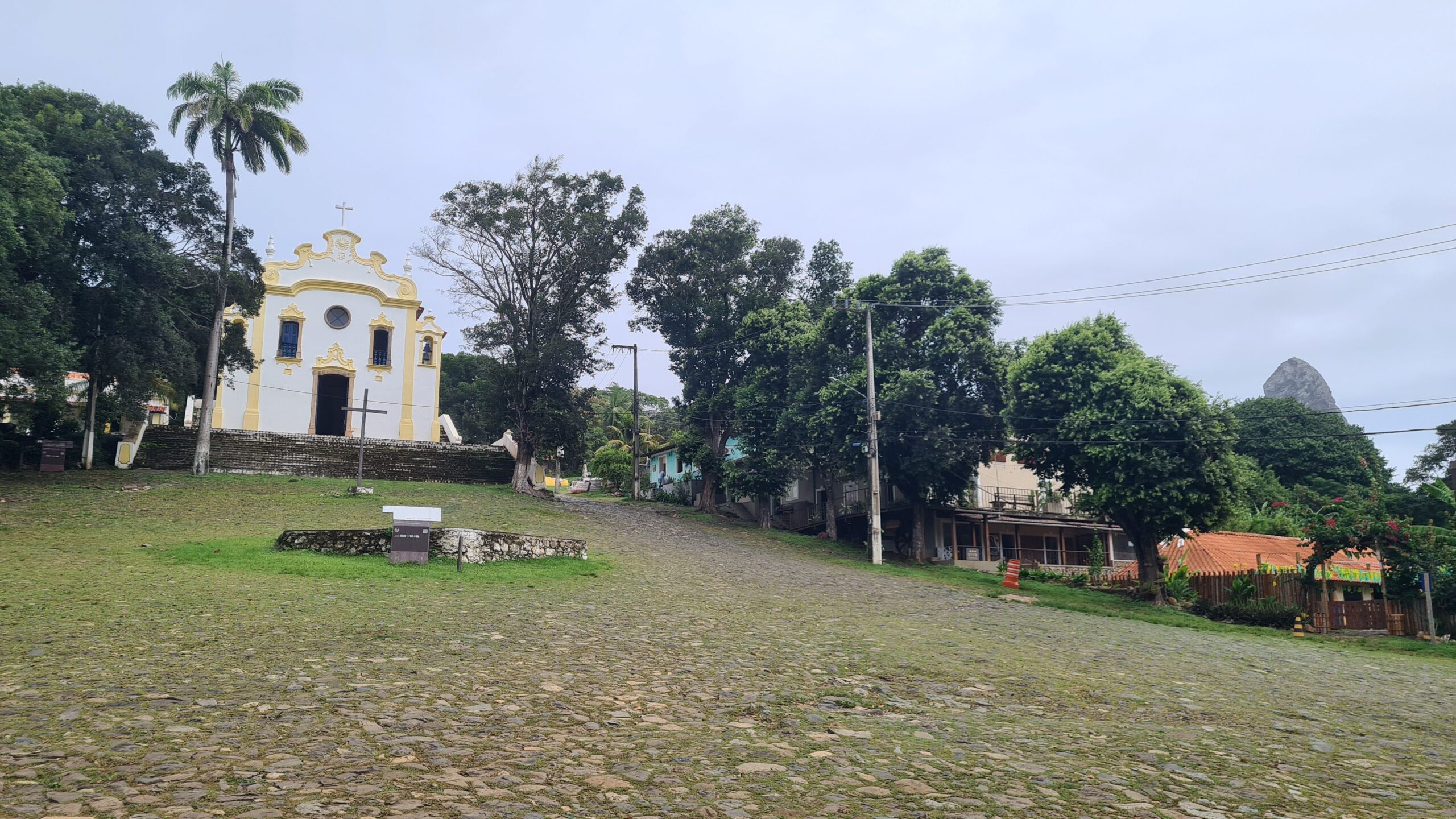
The main sqaure on Villa dos Remedios
Our feet carry us to the capital, Vila dos Remédios. The historic centre is rather peculiar in that there aren’t really any streets: buildings like the church are just appearing straight out of the grass! Civilization is to be found again a hundred yards further in the shape of small guesthouses and eateries. It’s a very pleasant vibe—a million miles from mass tourism!
We carry on towards the coast and the eastern beaches. It has to be said, it is utterly drop-dead gorgeous. Even under a palette of grey skies—courtesy of the tropical squalls lining up today—the orange sand, turquoise sea, and vibrant green foliage are truly something else.
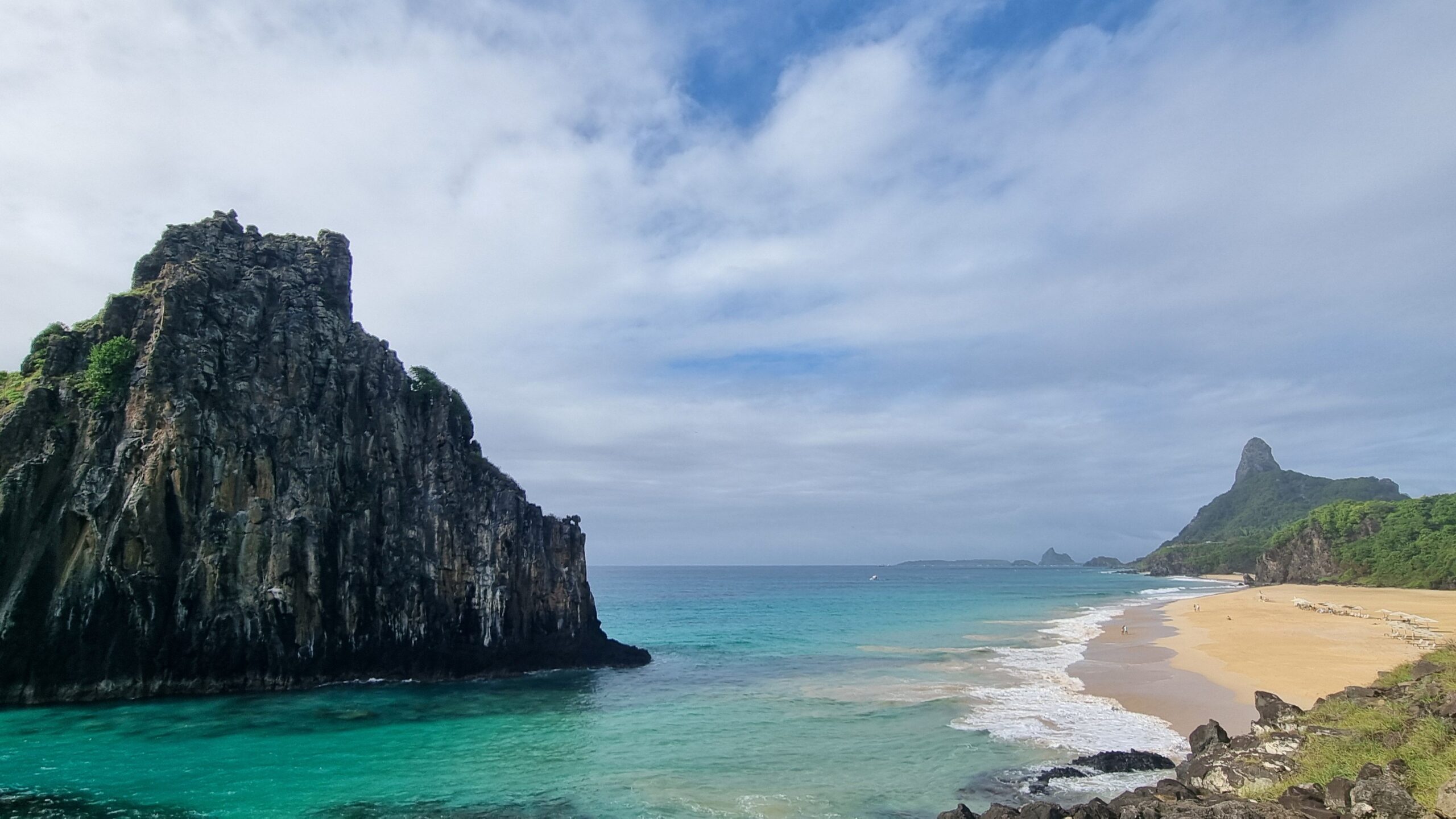
It only needs a ray of light…
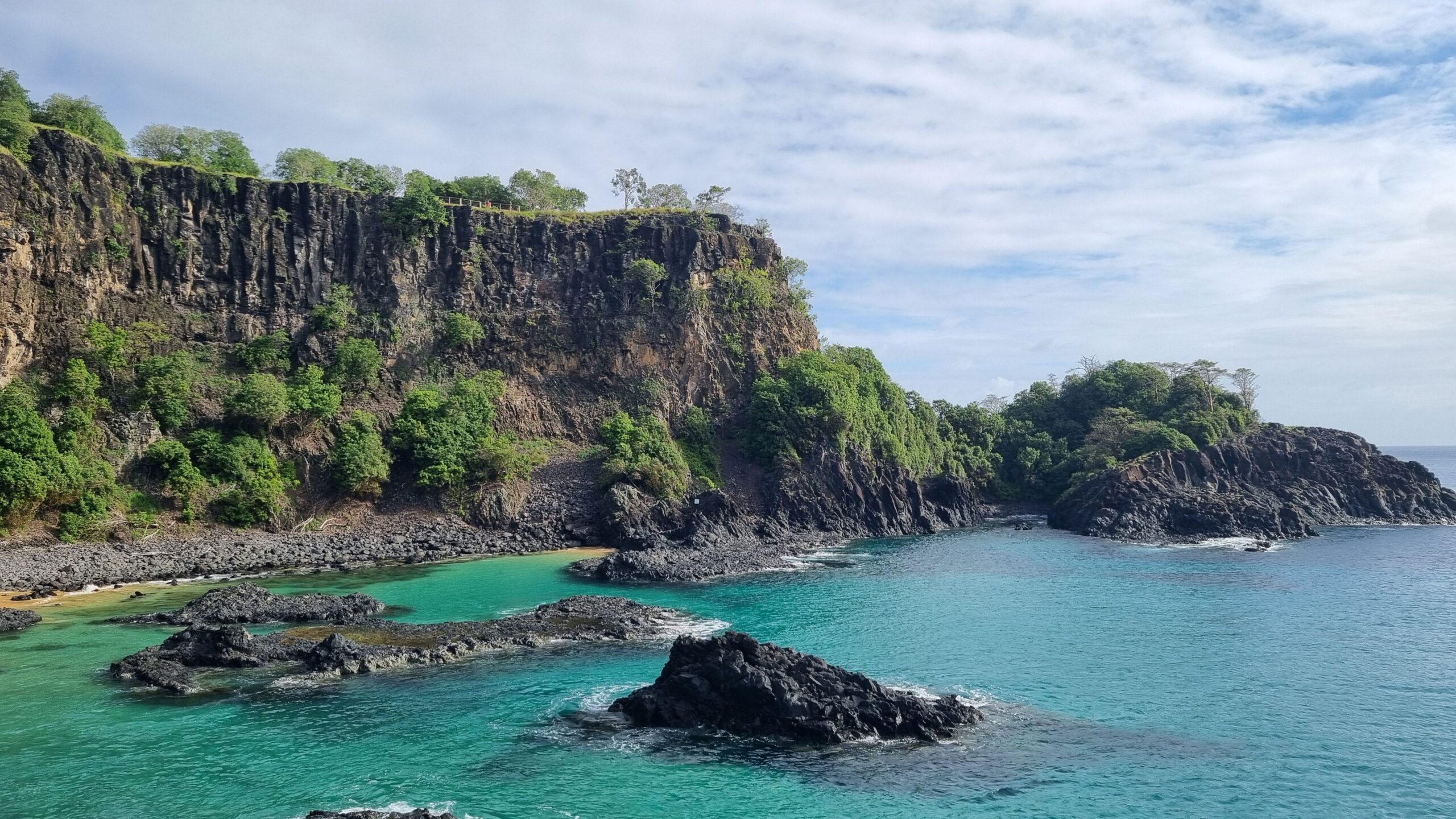
… for the colours to shine bright!
The birds aren’t remotely skittish in this reserve; we manage to get close enough to practically pet the brown boobies. We also spot a small tailless rodent, loads of red-legged pigeons, and some completely flat periwinkles!
Brown boobies within reach
On the way back, we pop into the Projeto Tamar shop, a national initiative which achieved quite a lot for sea turtle conservation in the last decades. We learn a lot about Brazilian turtles and the island’s nesting grounds, although we won’t spot any live ones around.
[Boat Maintenance]
Back on board, we start thinking hard about Phase Two of our “Save the Mast” plan. We’re going to back up both aft lower shrouds with Dyneema—hi-tech line with a higher tensile strength than steel.
The plan is executed the next day. Up at the mast, we loop the Dyneema through a spliced eye at its end—a lark’s head knot, basically—and stop it sliding down with two wire rope grips over the swaged sleeve.
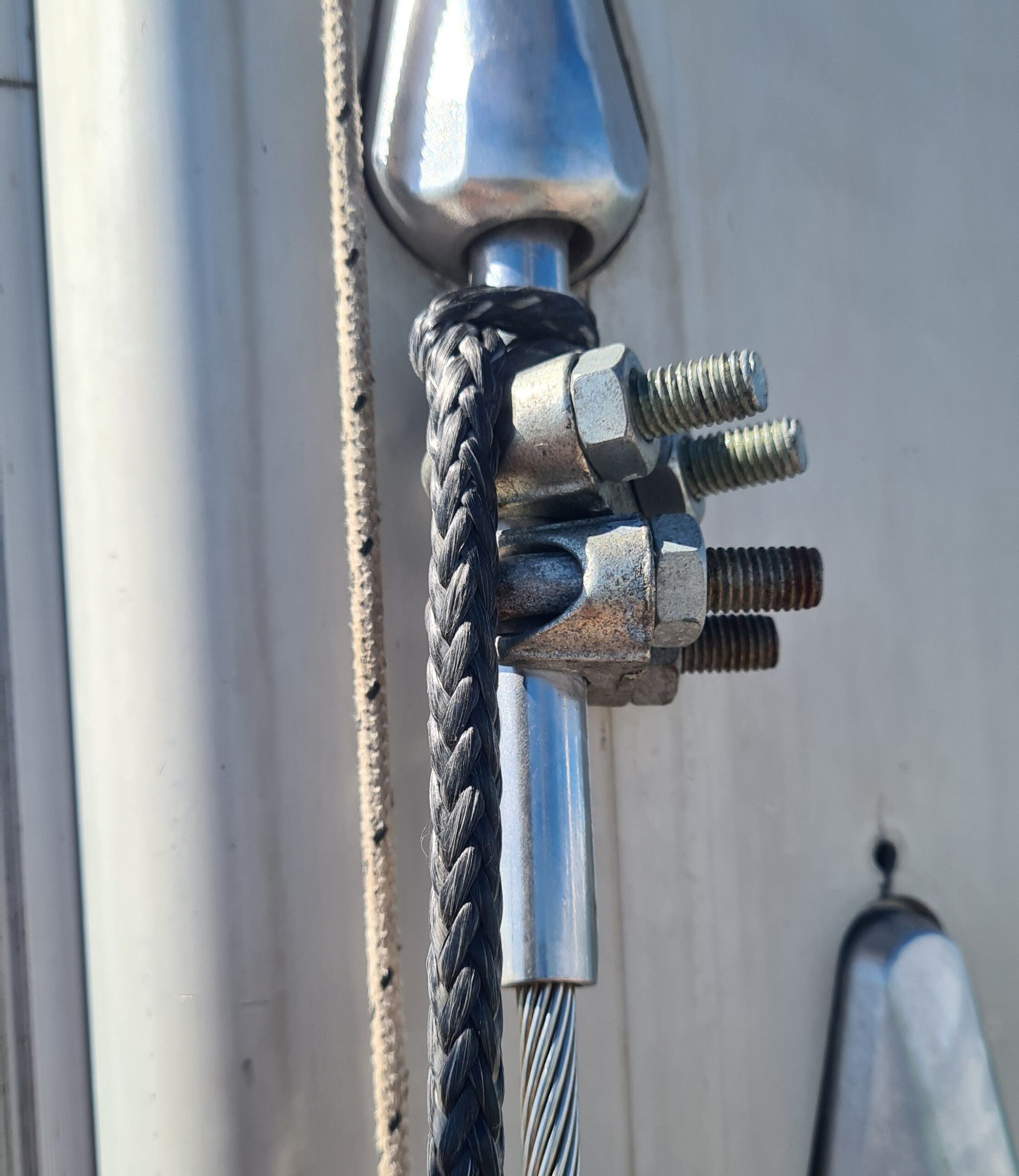
Fixing the Dyneema on the top side of the shroud
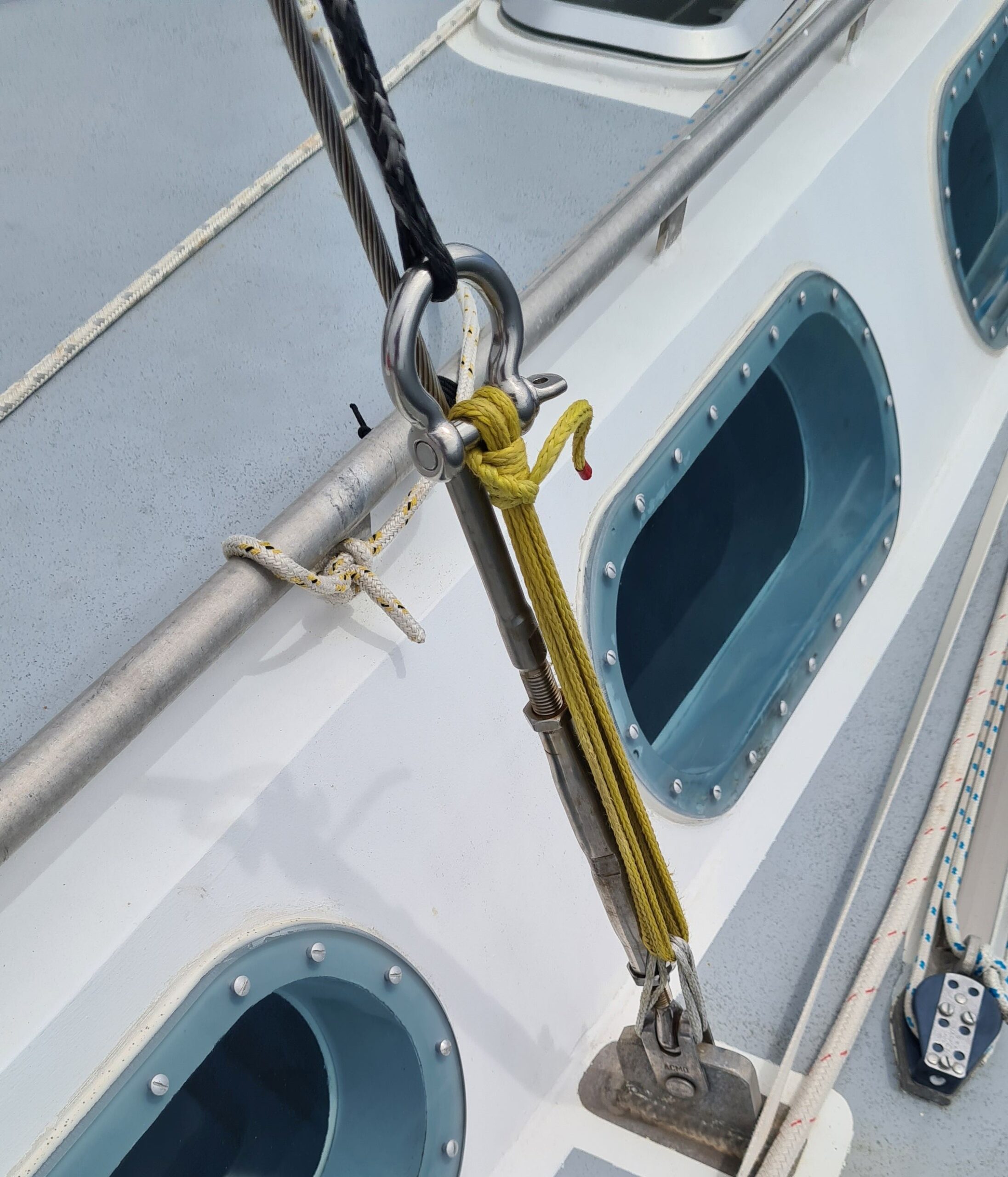
Fixing the Dyneema on the deck side
Down on deck, we rig a lashing between the chainplate and a spliced eye in the Dyneema. On the starboard side, we completely relieve the broken shroud by taking up part of the load with a halyard and then onto the Dyneema. On the port side, we let the intact shroud work on its own, but we have our Dyneema “crutch” rigged and ready to take over just in case… We’ve even packed heavy-duty ratchet truck straps if we need to haul the Dyneema even tighter. With this, we’re properly set up to handle any worsening situation at sea.
A massive thank-you to Guillaume and Amélie from Salamansa for sharing their experience with a similar headache, as well as to Jean-François and Sylvie André for their unfailing technical and moral support!
[Exploring]
After all that mast wrangling, we’ve thoroughly earned a dive. No need for a wetsuit; the water is a delicious 28°C! We swim over to the port breakwater straight from the boat, hoping to find some nice fish, and we are not disappointed. Enormous parrotfish, shoals of wrasse, sergeant majors, surgeonfish, damselfish, angelfish—it’s an absolute fiesta! Easily one of our best dives ever. We spend nearly an hour soaking in this utterly magical water…
The water is as beautiful as the shore here
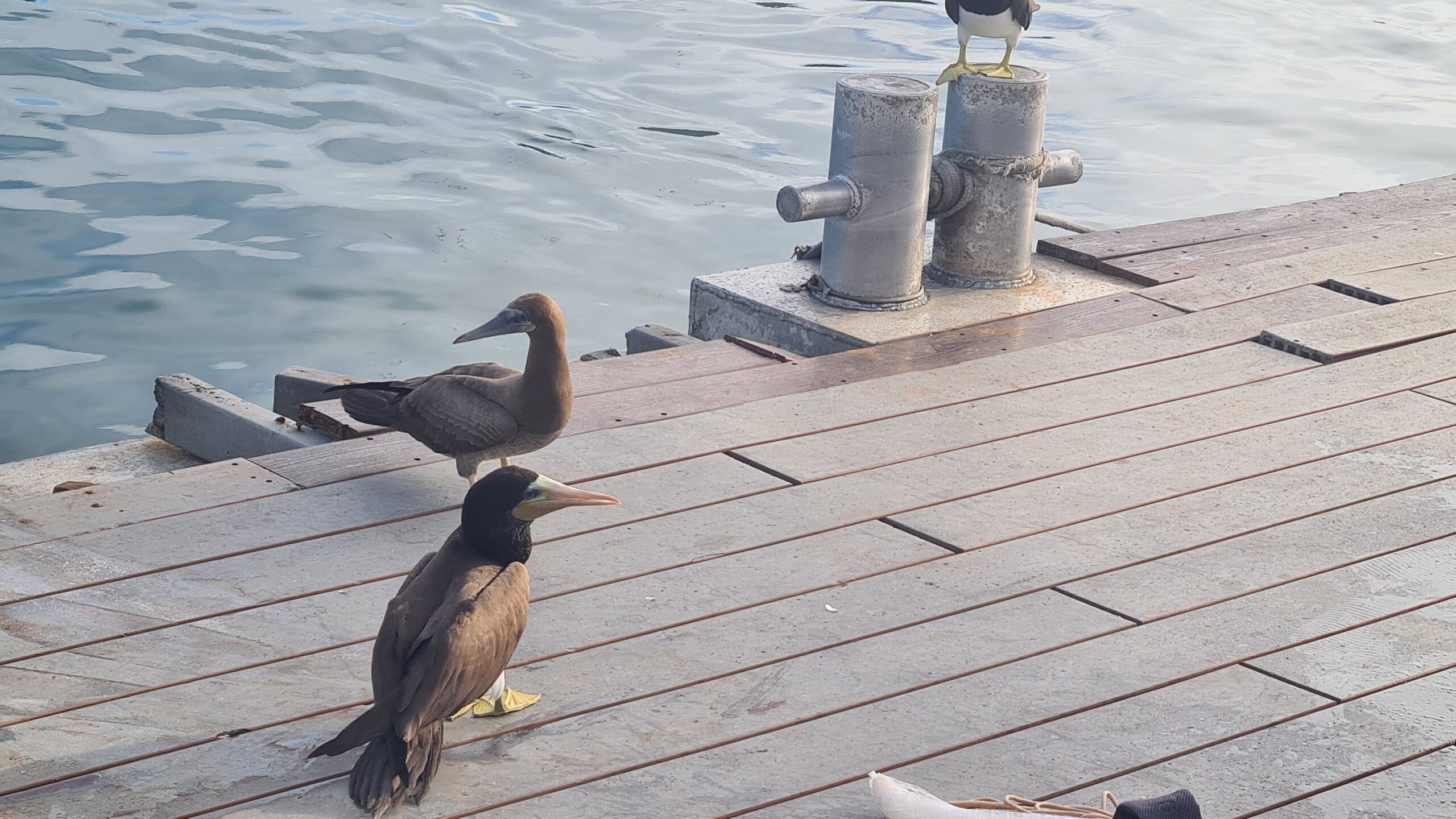
Nice ones, the brown boobies kept an eye on our dinghy during our trip ashore!
Then it’s time to head back ashore for our outbound clearance and to hunt down fresh groceries. The shelves are practically bare—the last delivery from the Recife cargo ship has already been picked clean. We manage to scrape by with a few wrinkled peppers, some courgettes, and okra; two papayas and a handful of apples complete the catch. But best of all, we find frozen pizzas—allowing us to honour our crucial pre-passage tradition and guarantee fair winds!
[Crew Rest]
Oops, we knew we were forgetting something… but as the old saying goes: long-distance cruising is just repairing your boat in the most beautiful places in the world! In the end, the stay turned out cheaper than we feared: €75 for two passengers, two paid days and one free. We could have stayed an extra day, but the weather forecast shows southerly winds smacking us right in the face in a few days, nudging us to get back out there tomorrow.
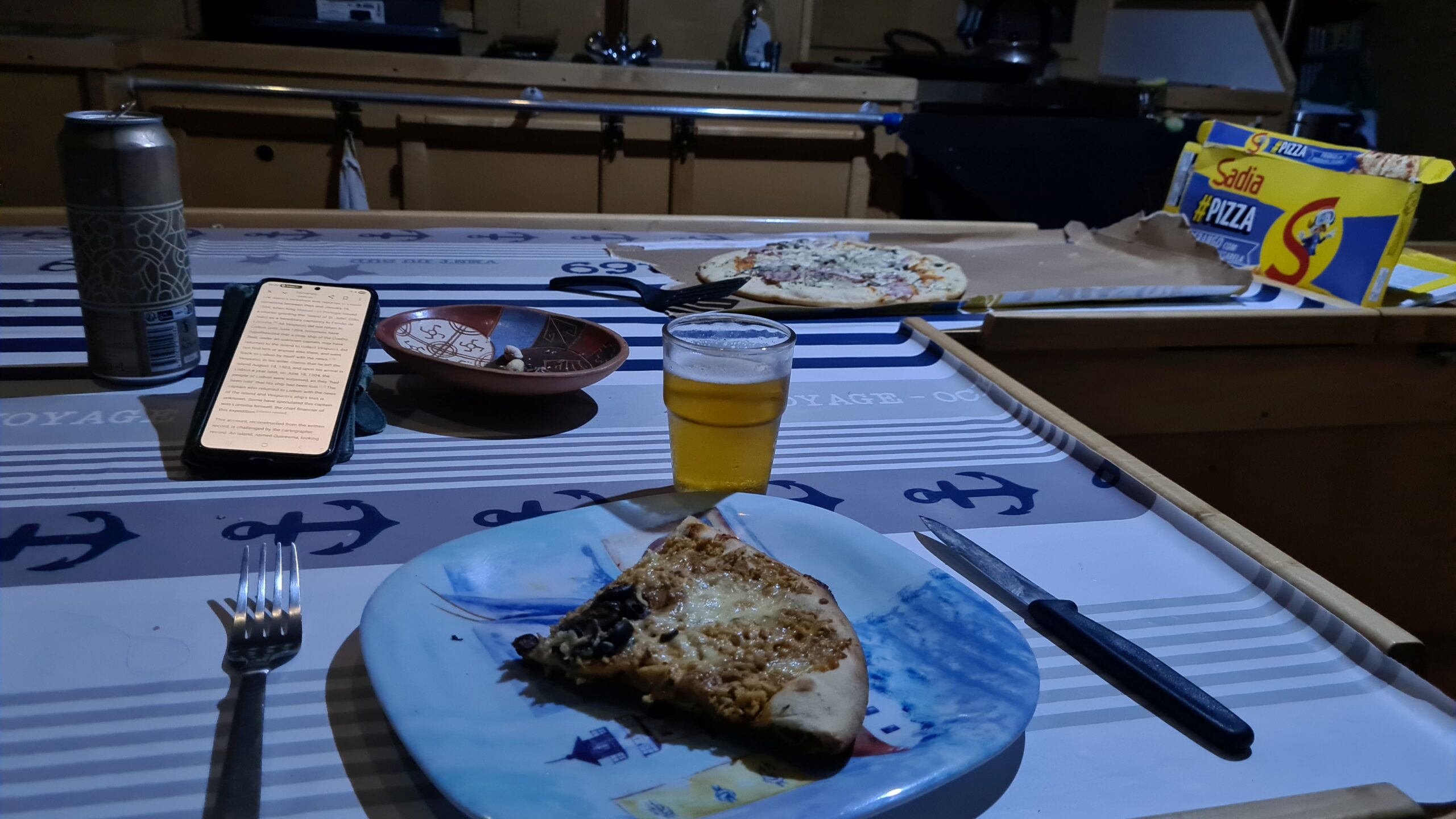
Our traditional pizza prior to any crossing
3rd-6th July: Noronha – Recife (351NM)
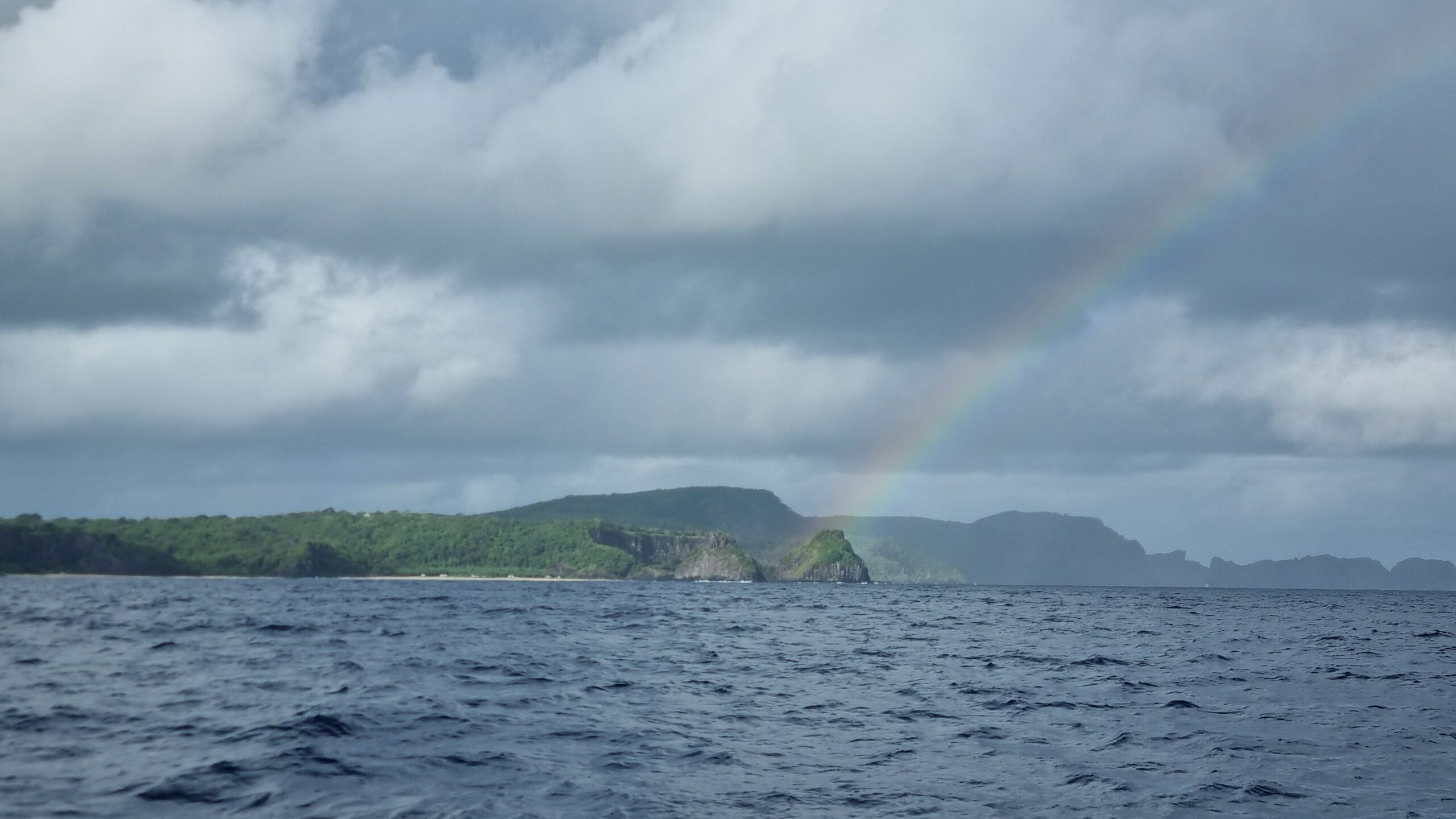
We set off in squally weather…
We leave Noronha at dawn, heading for Salvador – the promised land where we’ll finally be able to catch our breath. The wind is forecast easterly then south-easterly, so we’re hoping to make the whole trip on our “good” tack. The serious business starts the moment we clear the southern tip of the island—less than an hour after setting off: a heavy southerly swell, wind more south-east than east, and, above all, huge grey clouds packed with bad intentions.
The first squall approaches. We drop the mainsail to three reefs, on top of the staysail: no way are we getting caught out by massive gusts with our Mast of Damocles above our heads. Good call, too—the wind surges to 35 knots inside the curtain of torrential rain. Then, once the squall passes, it completely collapses to under 10 knots, leaving us bobbing around in the swell which hasn’t eased up one bit.
Just as we shake out some canvas to move forward again, the next squall rolls in. 38 knots. This time, we drop the mainsail altogether as a precaution at the height of the deluge. 30 minutes later, we have to hoist it all again… only to pull all the reefs back in a few minutes after that. And so on, and so forth. And at least during the day, you can actually see the squalls coming! At night, we don’t take our eyes off the radar and anemometer for a second, desperate not to get caught out and to shorten sail in time.
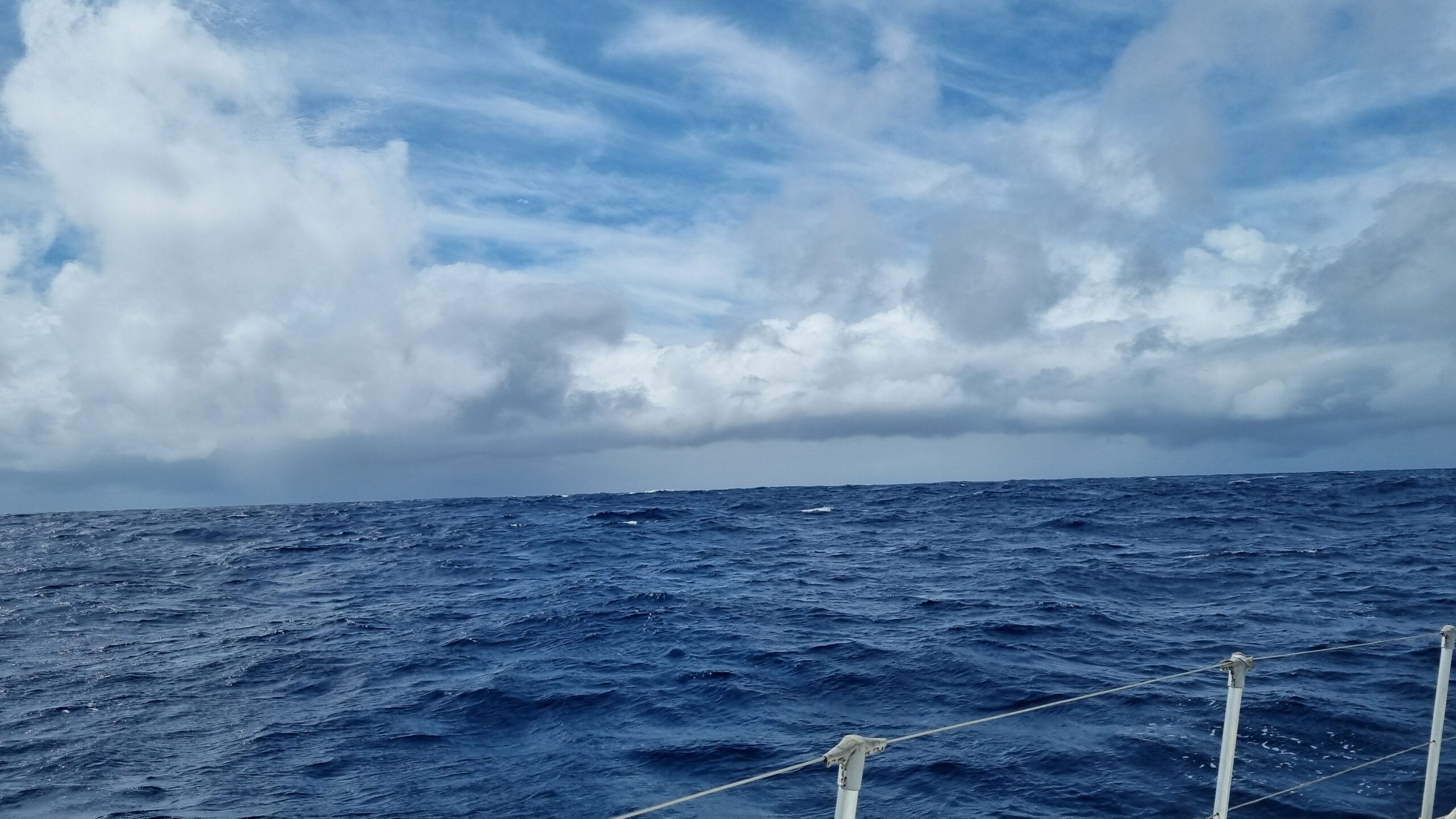
This type of arch-like squall is often very violent
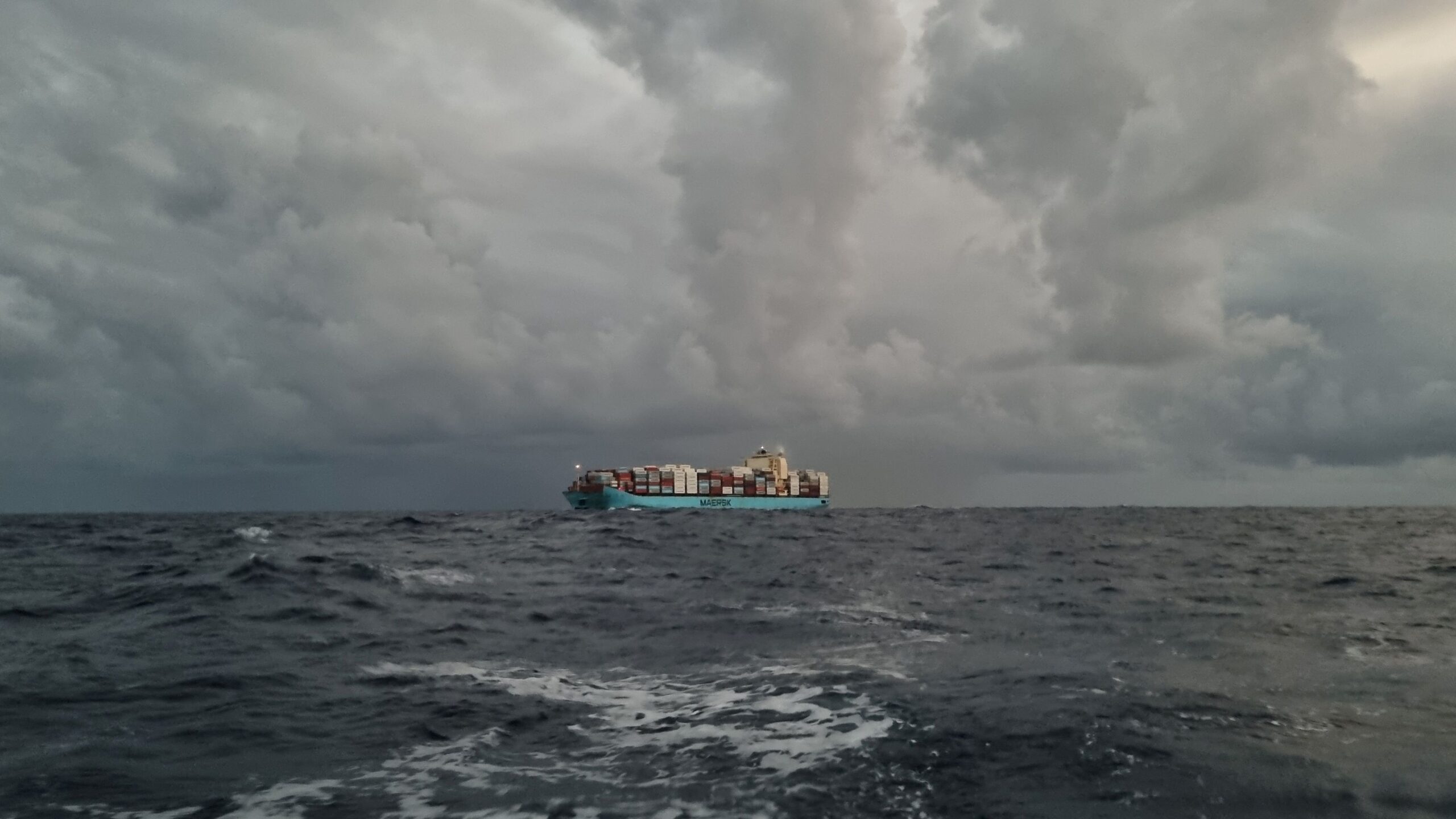
Fortunately, the traffic isn’t very dense because visibility is zero in the rain
This farce goes on for 48 hours. 48 surreal hours during which we sleep, at best, an hour at a time, live permanently soaked (luckily it’s still hot enough), dread losing the mast with every gust, and, to top it all off, make very little headway in the right direction. We are in a state of advanced physical and nervous exhaustion, both of us with aching shoulders from endless winch-grinding.
On the third day, the monster squalls finally turn into rare, friendly trade-wind showers at 25 knots. But the southerly wind arrives right on time, and we haven’t managed to get far enough offshore during the first couple of days. Inevitably, the wind is pushing us towards the coast… we’re going to have to tack and beat into 20 knots of wind on our bad tack, with the broken shroud upwind.
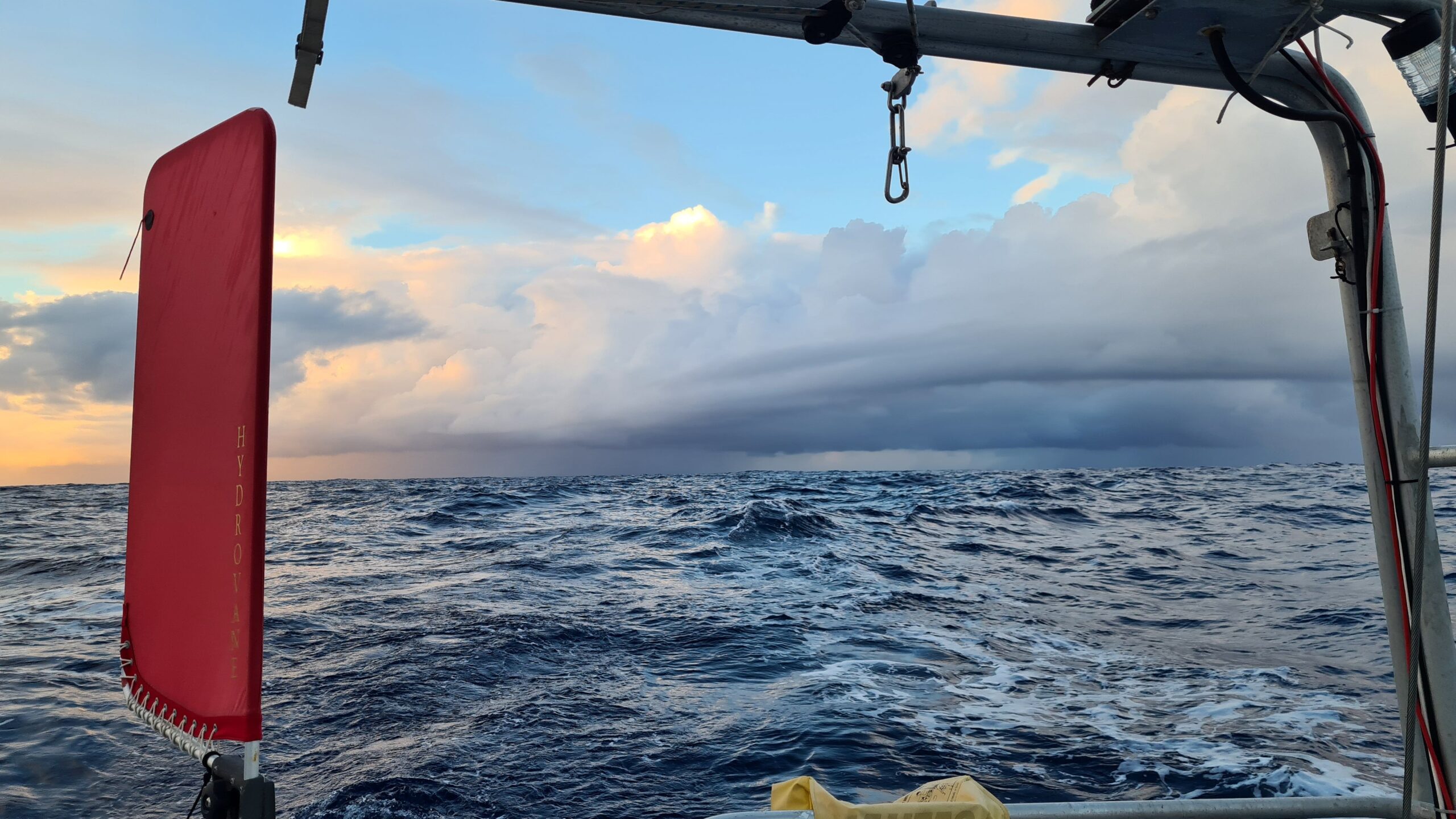
A rather easy squall, and photogenic too!
Or… do we? Do we duck into Recife, which is practically waving at us from the coast? It would feel like a bit of a defeat abandoning the straight run to Salvador—something we hate—and we know full well how hard it’ll be to cast off again once we’re snugly tucked up in a marina. But then again, we could rest, inspect the rig, and wait for a better weather window.
The event that seals the deal: the mainsail halyard winch starts making a deeply concerning noise—and that winch is critical for reefing in squalls. Point the bow at Recife; everyone needs a break. Our first contact with the South American continent will therefore be the imposing wall of high-rises lining the capital of Pernambuco state.
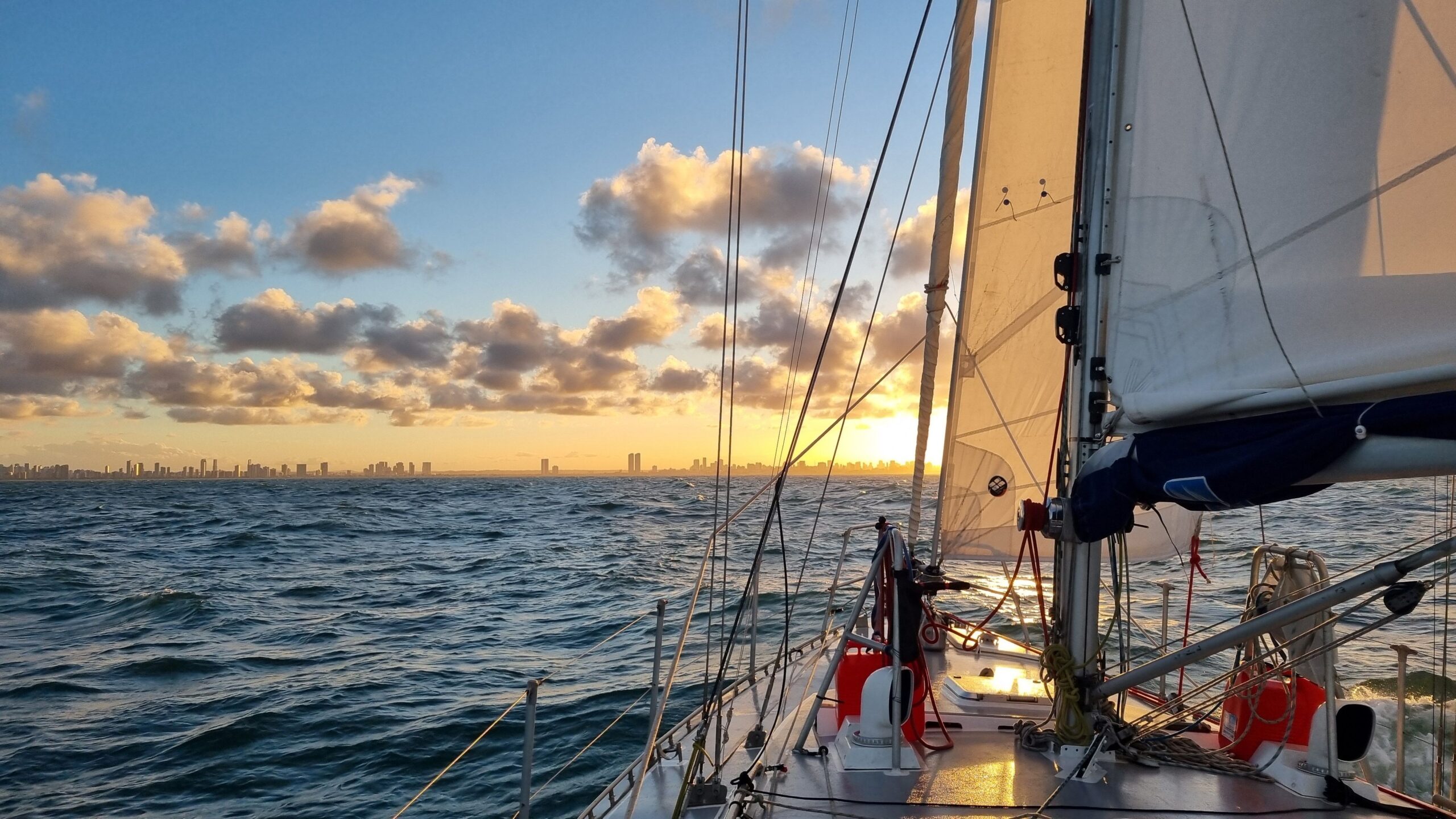
Right under the buildings lies south America !!
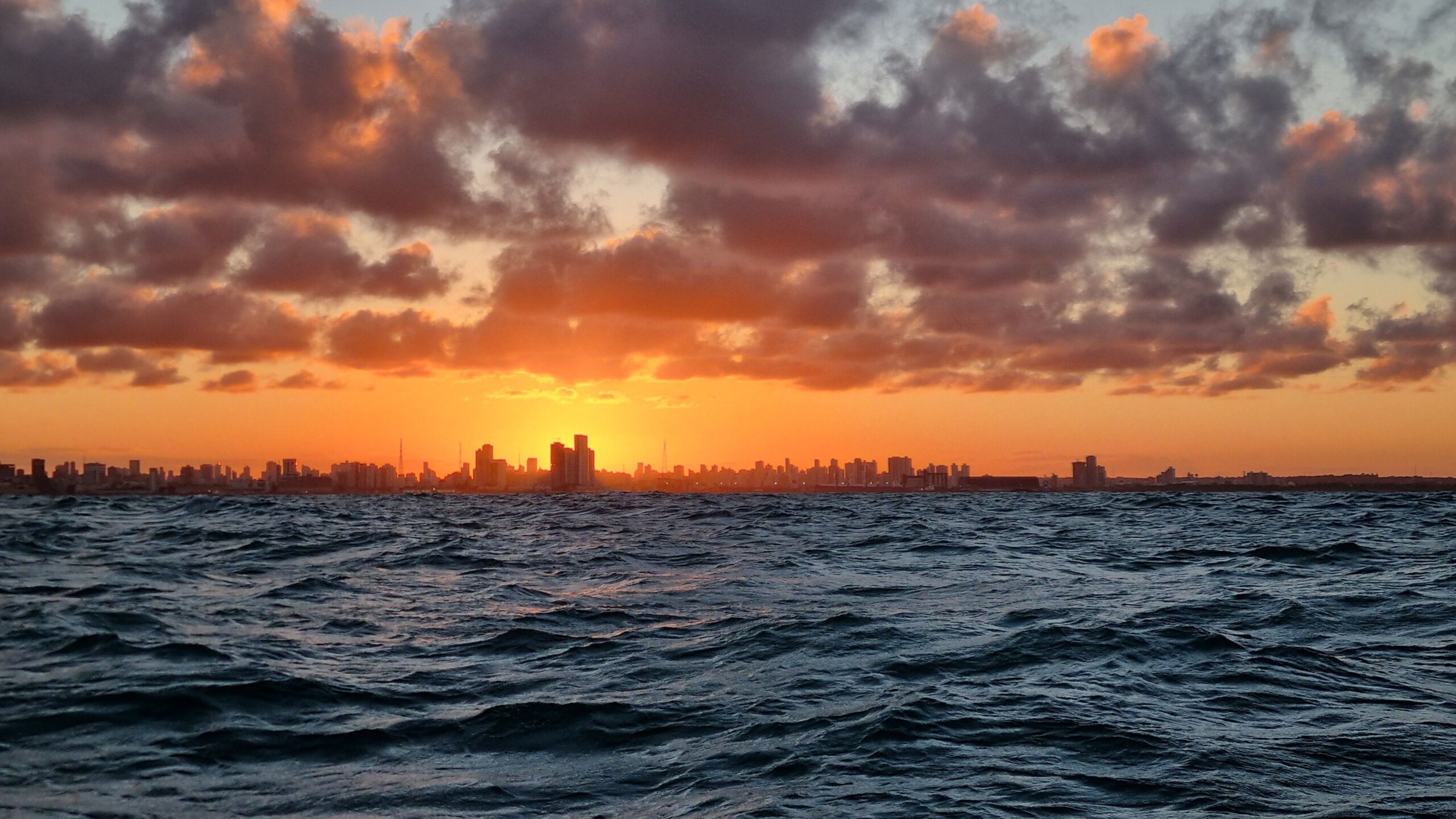
We won’t make it by daylight…
Arriving at sunset in 20-25 knots of wind is quite spectacular, if rather stressful. What a massive relief when the boat is finally tied up at the end of the pontoon—after a botched first attempt, swept along by the river’s current.
The merry gang from the catamaran Le Diwan, whom we met back in Mindelo, are right there to welcome us.
“So, how’s it going?”
“We don’t really know anymore—we’re going to sleep and we’ll tell you tomorrow!”
7th-8th July: Stopover in Recife
The very first thing on our minds when we wake up is our Mast of Damocles. We nervously head on deck to check the state of the rig… what a relief, nothing has budged since Noronha! Phew! We can actually treat this stopover as a simple breather on the way to Salvador.
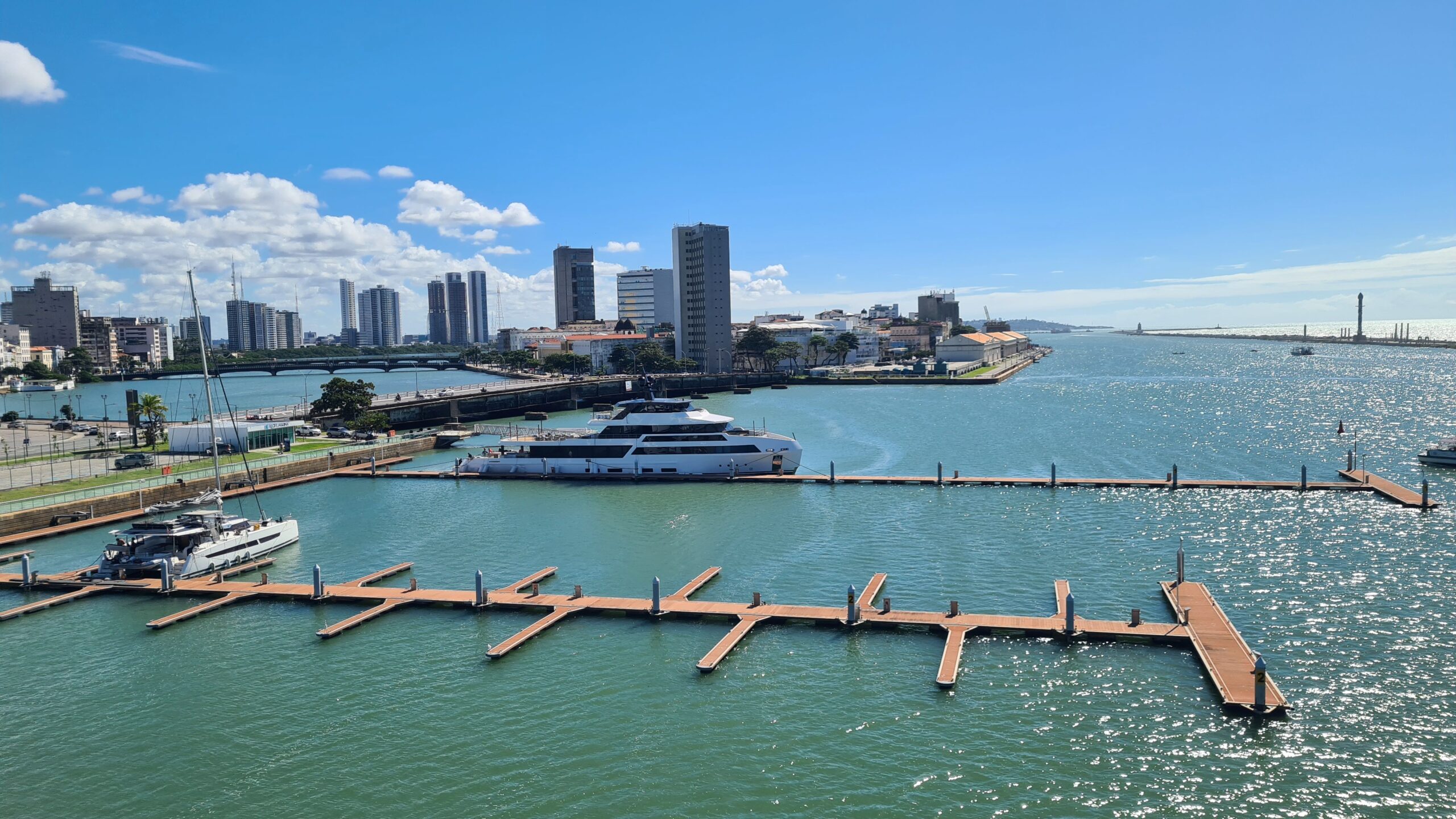
View from the top of the mast overlooking Recife, the catamaran Le Diwan, and the yacht of football player Neymar
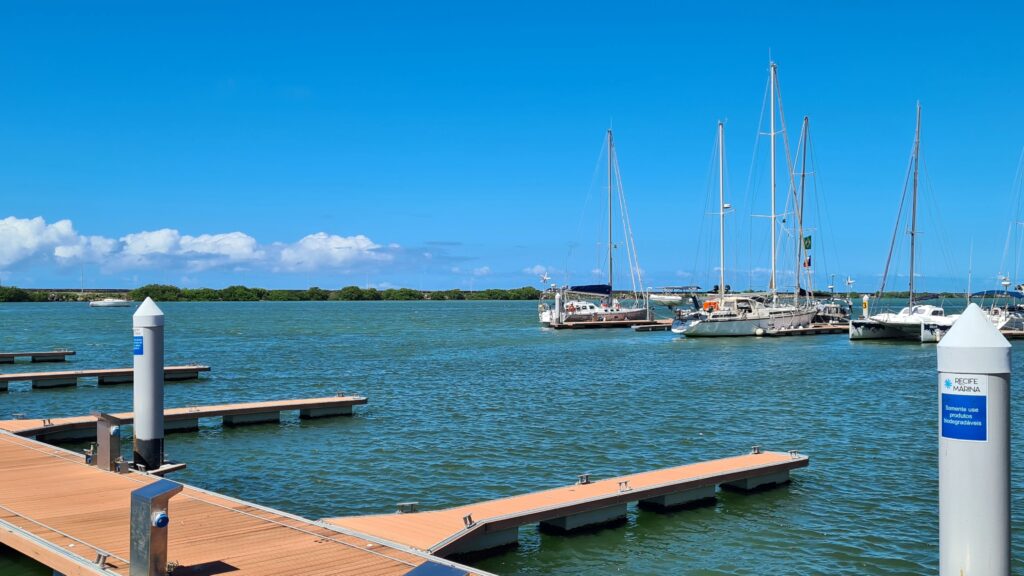
Many vailable berths in Recife in July!
Recife’s brand-new marina is a haven of peace for the shattered sailor arriving from a rough passage. The pontoons are mega comfy, secured by a facial-recognition gate (no less!), and the service is spot on. In particular Sueli, the harbourmaster, takes care of all the paperwork. For us, having already cleared customs in Noronha, there are still formalities with customs to temporarily import the boat into Brazil, plus the standard arrival paperwork for a new port and state. It’s all done online and via WhatsApp—we don’t even have to leave the marina. What luxury, and what a time-saver!!
That leaves us with nothing to do but look after ourselves (massive catch-up sleeps, long hot showers, and even a night out in town with some of the Diwan crew) and after the boat: winch maintenance, nipping up the Dyneema crutch on the starboard side, and fixing the staysail car, which somehow managed to jam itself under the track stop in a way that defies all laws of physics…
It’s also our chance to properly connect with this new country we’ve landed in. Because the tiny island of Fernando de Noronha is a world away from the mainland: the sprawling mega-cities (3.7 million souls in Recife), the stark social inequality and the high crime rates it breeds, and the bustling markets brimming with exotic fruits. The only common denominator is the absolute obsession with football and the ongoing World Cup. Well, formerly ongoing—Brazil has just been knocked out by… Norway. Oops! Having heard the news at sea, we made sure to drop our “owner’s” flag that usually flies under the port spreader; better to pass ourselves off as 100% French for a while…
After enquiring about which streets are safe to walk on—during the day, at least—we venture out of the marina’s bubble. Security in Brazil is no joke. As soon as you hit the city, bulletproof-vested police on every corner offer a stark reminder of the reality of local violence. CCTV cameras keep watch everywhere, getting into the laundrette requires a facial recognition scan, and wealthy businesses and residential blocks barricade themselves behind walls and razor wire. It feels pretty intense and daunting through our naive Norwegian lenses, but this is daily life for people here …
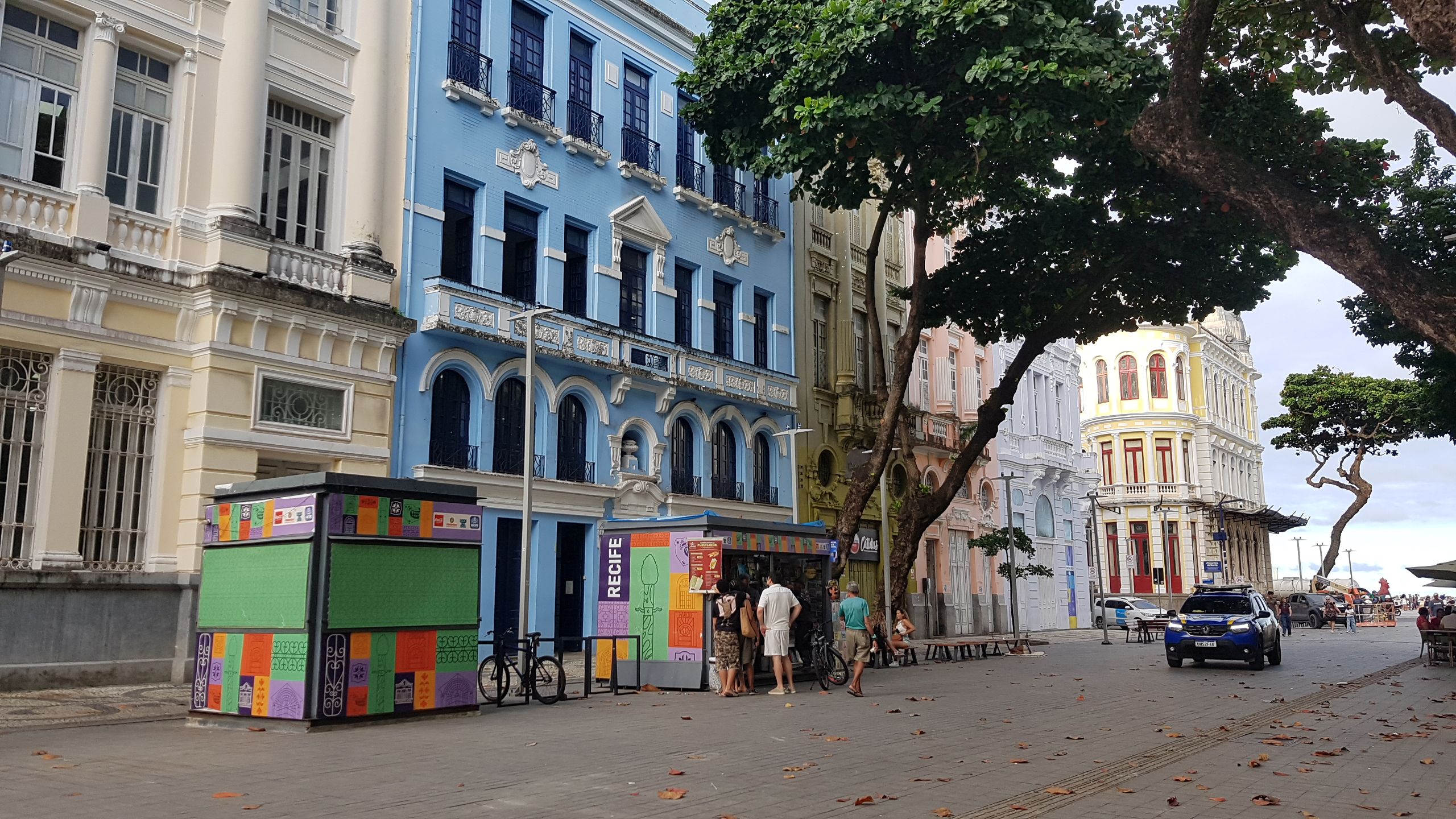
Central Recife street: baroque buildings, large trees and police patrol
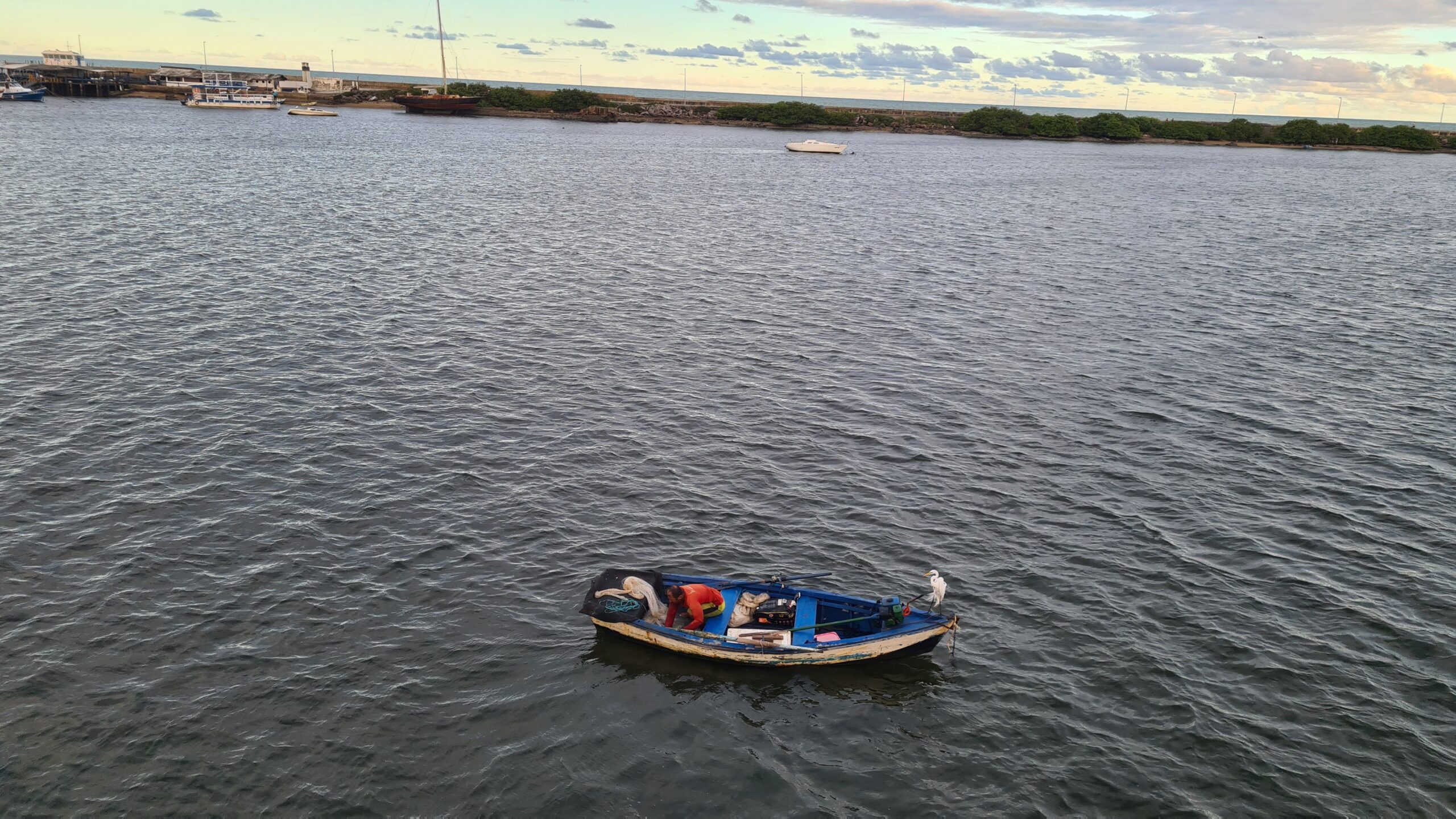
Fisherman on the Recife river, and his heron
Downtown Recife was built around its river, where wooden canoes fish all day long. The three touristy streets show off a few historic buildings—mostly half-run down—and a whole stack of bars and restaurants oozing a rather cosy atmosphere.
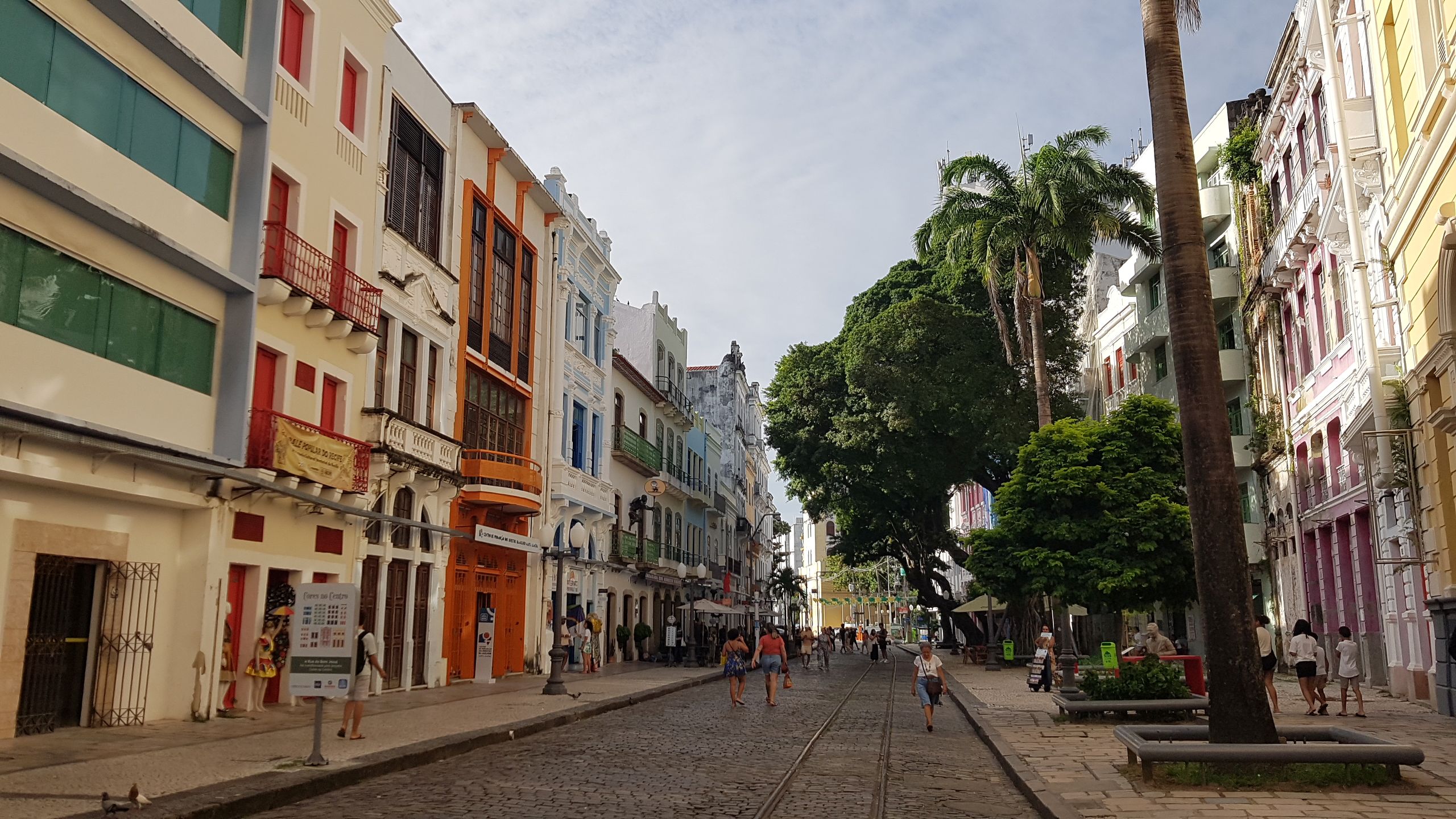
Recife’s bright side: the Rua de Bom Jesus and its very nice bars and restaurants
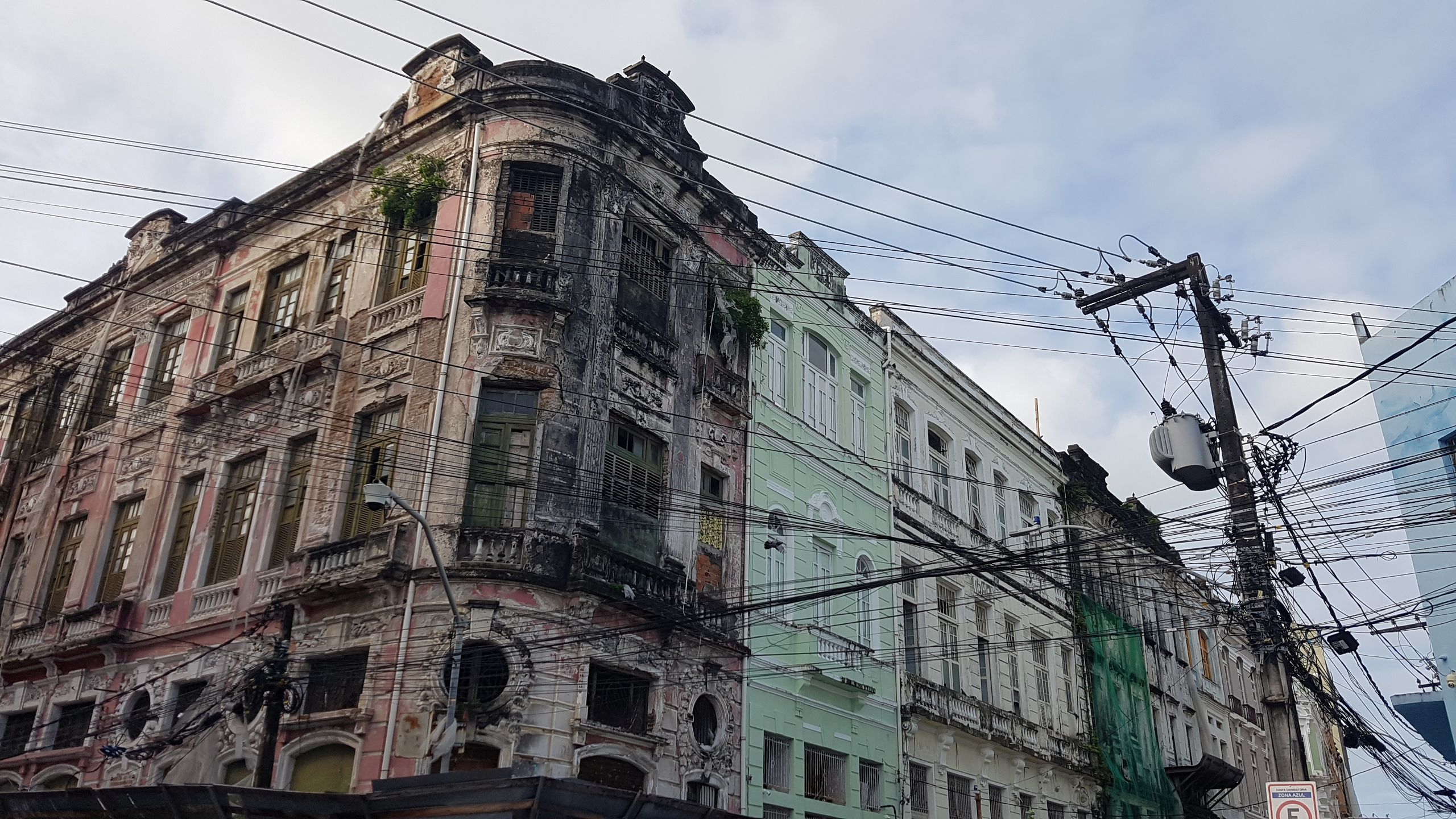
Recife’s other side: dilapidated buildings and dubious power lines
On the other side of a branch of the river, you find the commercial streets. A joyful chaos combining Chinese shops, tiny fruit and veg stalls, a half-closed market, and two proper supermarkets! Ideal for restocking on fresh bits with completely unfamiliar flavours. We don’t dare to try the cupuaçu—which is mostly used for juice—but throw ourselves at the guavas and discover pinhas, a cousin of our beloved custard apples (chirimoyas). And honestly? They’re delicious!
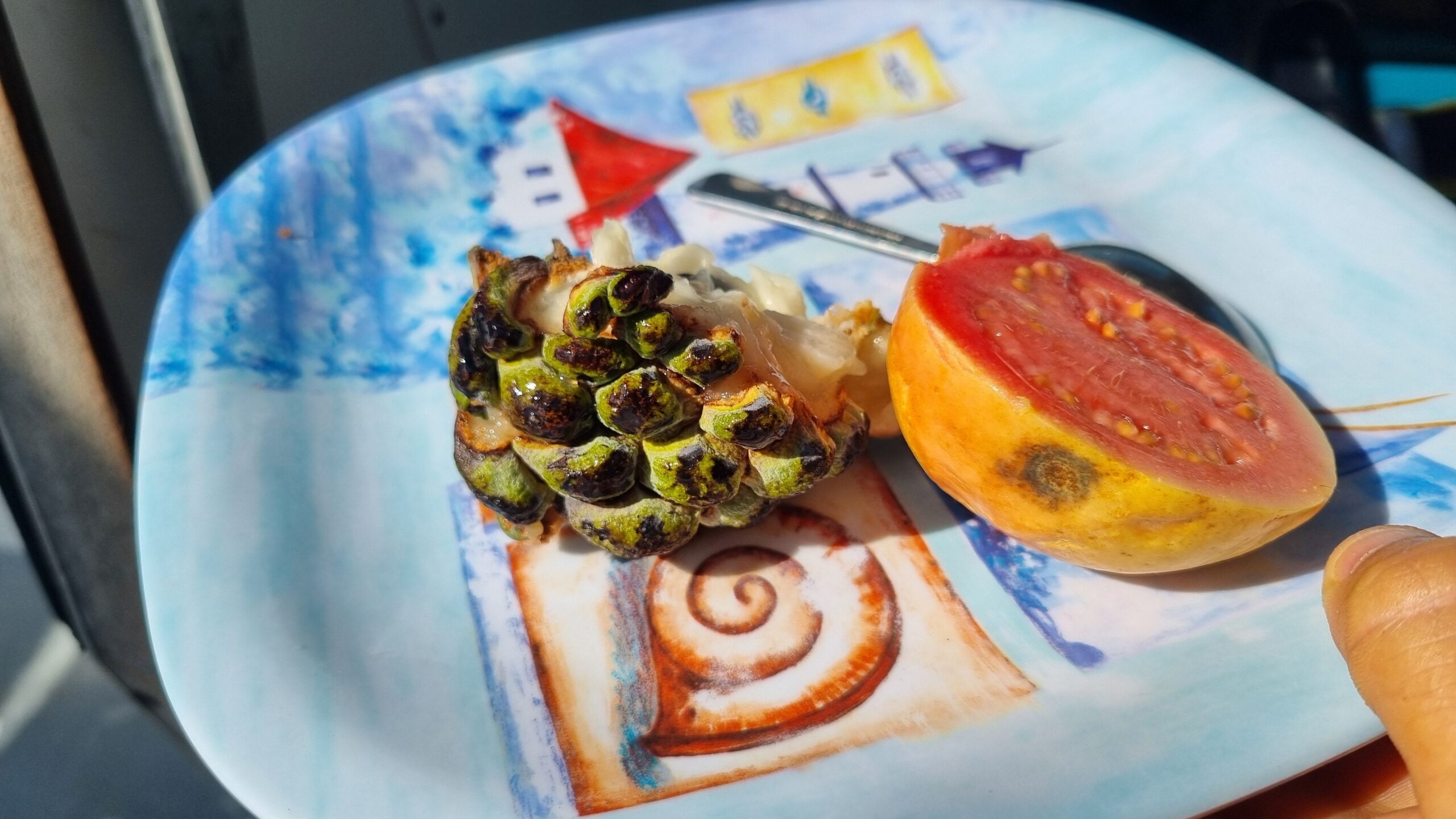
Pinha and guavas now replace our european apples and pears
We could easily hang around Recife for a few more days, but our target remains Salvador and the forecast promises a great six-day window before a cold front brings nasty southerlies. So, after a swift and restorative 48-hour pit stop, we decide to pull up anchor immediately.
9th to 13th July: Recife – Salvador (442NM)
Setting off at slack water under bright sunshine and a gentle 10-knot easterly, the weather is infinitely kinder than on our arrival. The only problem with sailing along the coast is that we’re now slamming straight into the northerly current accelerated by the edge of the continental shelf. After a quick debate, we attempt to dodge it by staying right close inshore, which also avoids us having to tack on our dodgy shroud – and we catch a nice wahoo fish in addition!
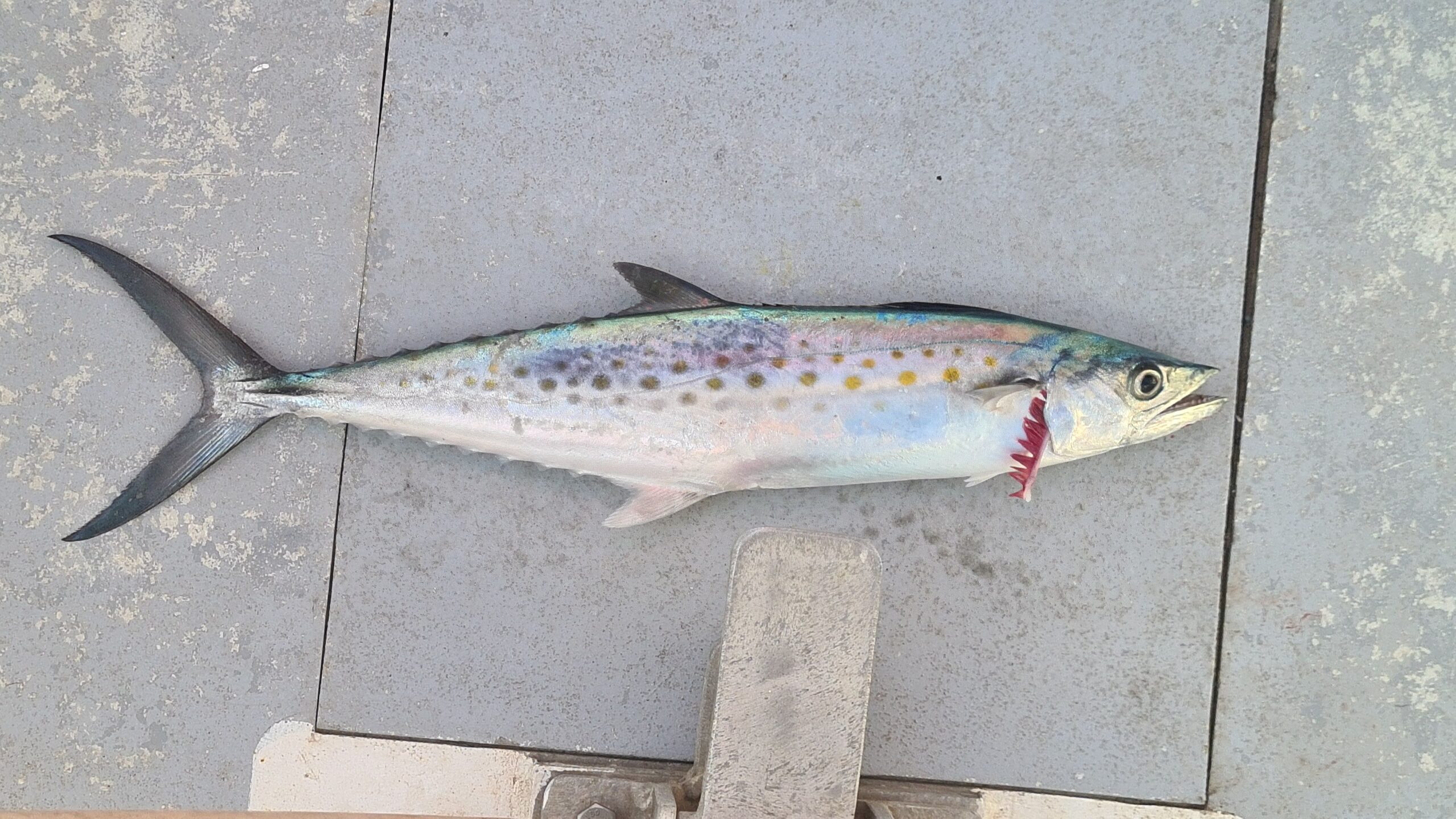
Mmm a delicious spotted wahoo!
This ambitious masterplan collapses less than an hour after nightfall when we tangle ourselves up in two fishing lines one after the other. Thanks to our lifting centreboard and flat bottom, we manage to wriggle free relatively easily, though we have to chop the second line to free a float wedged under the stern platform. So, quick tack, head offshore into deep water—where we’ll face counter-current, sure, but at least it’s clear water! The wind is very moderate and we only face one tiny, totally manageable squall; our broken shroud seems to be holding up.
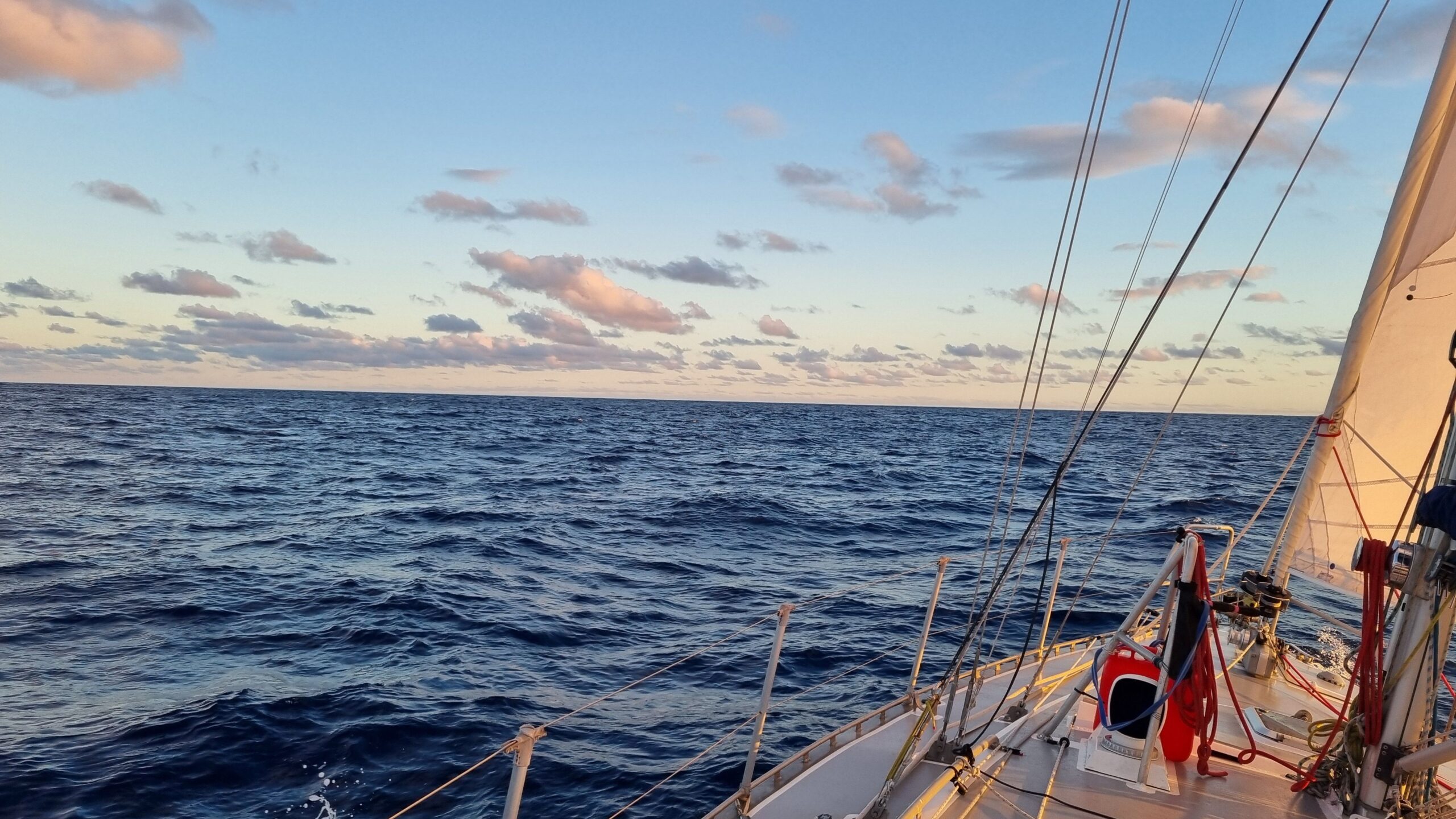
Very moderate wind, beautiful weather and above all… no squall!!
The weather improves even further, if that were even possible: the wind moves round to the beam, the sky is glorious blue, no squalls, flat seas—this passage is shaping up to be absolute bliss! We check the weather update with a light heart… only to discover that the southerly front is now forecast to arrive 30 hours earlier than expected… We had a 48-hour buffer; now we have much less… Shame—it rather spoils our ability to enjoy the sail with a clear mind.
A pod of dolphins comes to say hello and play in the bow wave as a consolation—it’s been ages! They look quite different from the species we’re used to, with a cute little black mark on the tip of their beak; Clymene dolphins, perhaps.
Black-nose dolphins around the bow
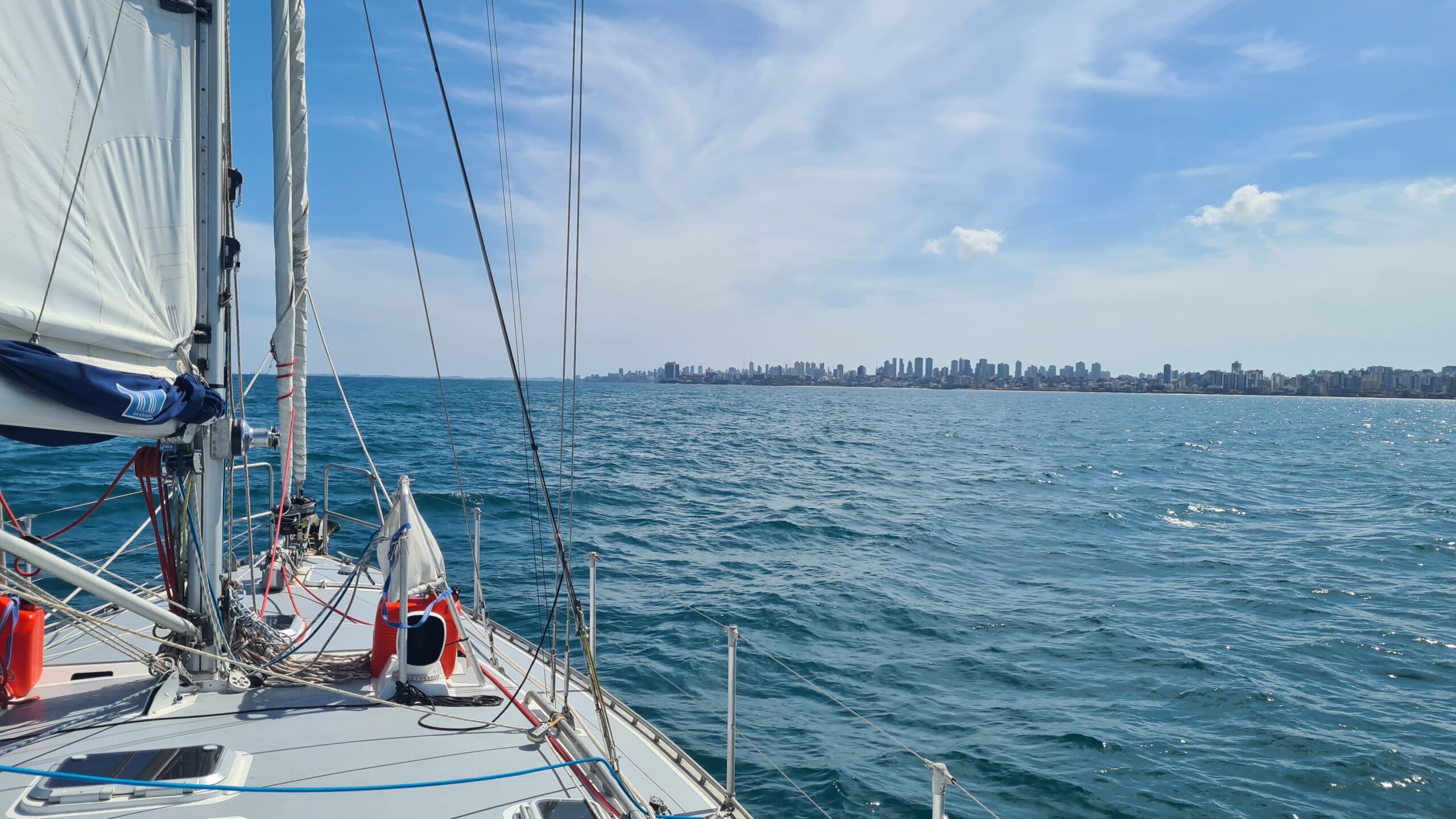
Approaching Salvador, from a distance all Brazilian cities look alike so far!
The weather stays superb and sunny, the wind is rather cooperative—turns out we were right to wait those two days in Recife, despite the frustrating counter-current. By day three, the wind drops right off and shifts dead downwind. We’ve got a front to outrun, so we keep racking up the miles on the engine whenever our speed drops too low. Thanks to this little nudge, we approach Salvador and the famous Bay of All Saints a full 24 hours ahead of the cold front—in broad daylight, and with a favourable tide! Sometimes things actually line up!
The weather is so calm that we take the inshore passage into the bay. We skirt right along the massive city skyline; Laure even recognizes the hotel she stayed at during her last business trip.
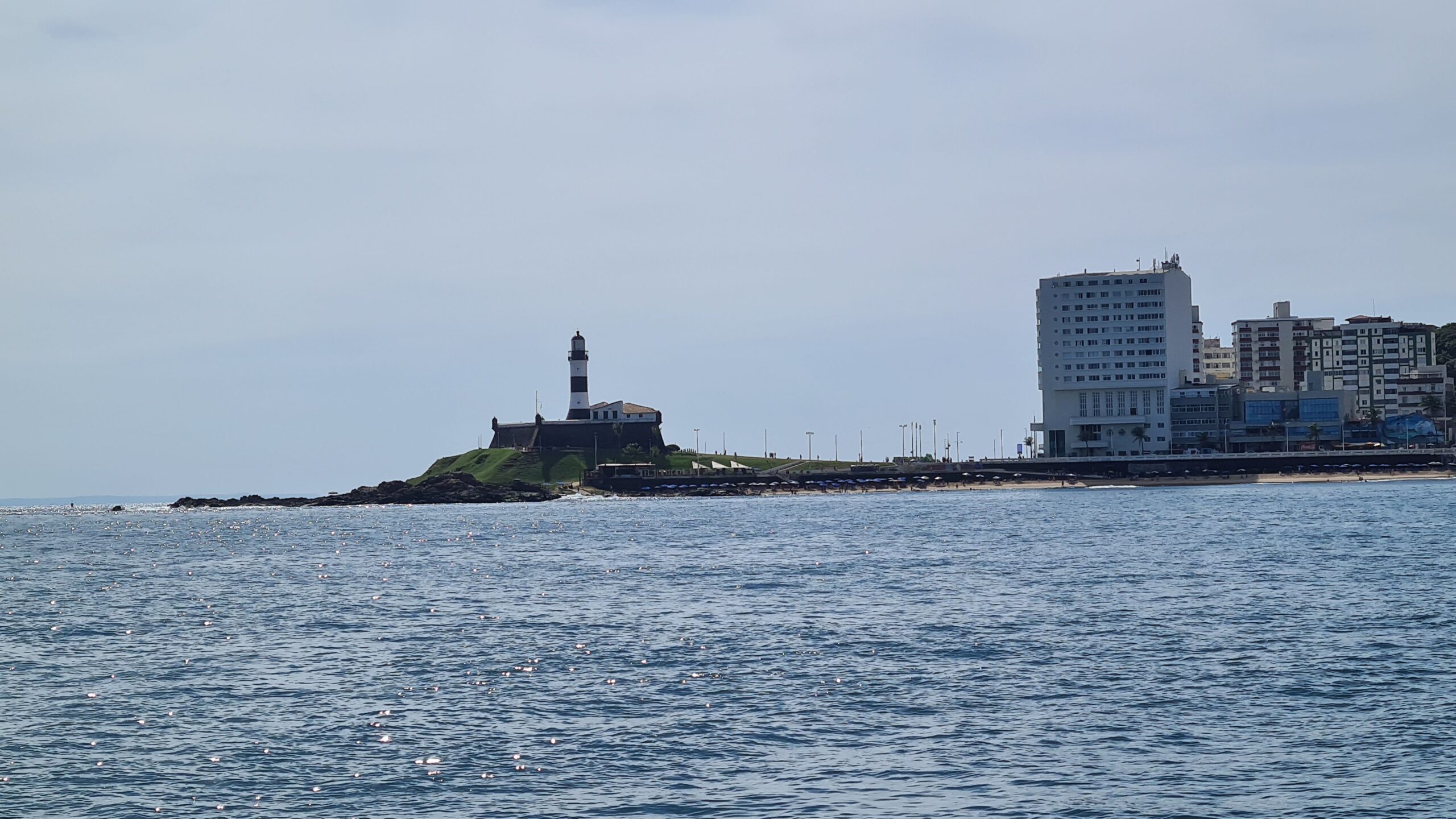
Lighthouse of Barra, the first one of the whole continent!
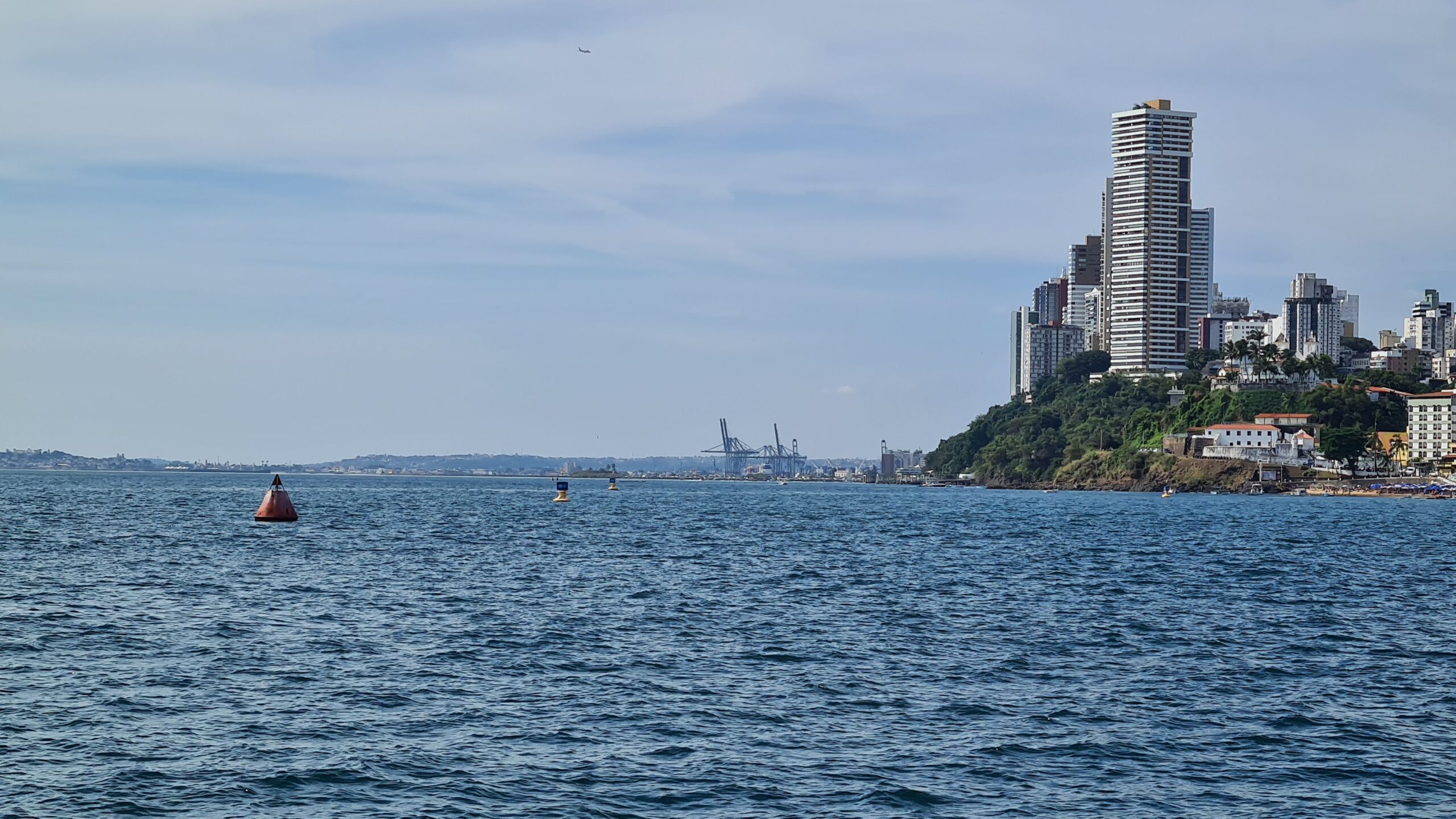
In South America, the red buoys are conical, pretty weird!
A beach, a lighthouse, another beach, a red conical buoy reminding us that buoyage colours are reversed here compared to Europe (red to starboard, green to port—what a bizarre idea…), and then the marina pops up behind the large breakwater.
We berth UtPåTur Mediterranean-style (stern-to the pontoon on a lazy line), directly beneath the famous Lacerda Elevator connecting the waterfront to the historic city centre of Pelourinho. This time, we’ve made it. We’re finally in Salvador de Bahia!!!
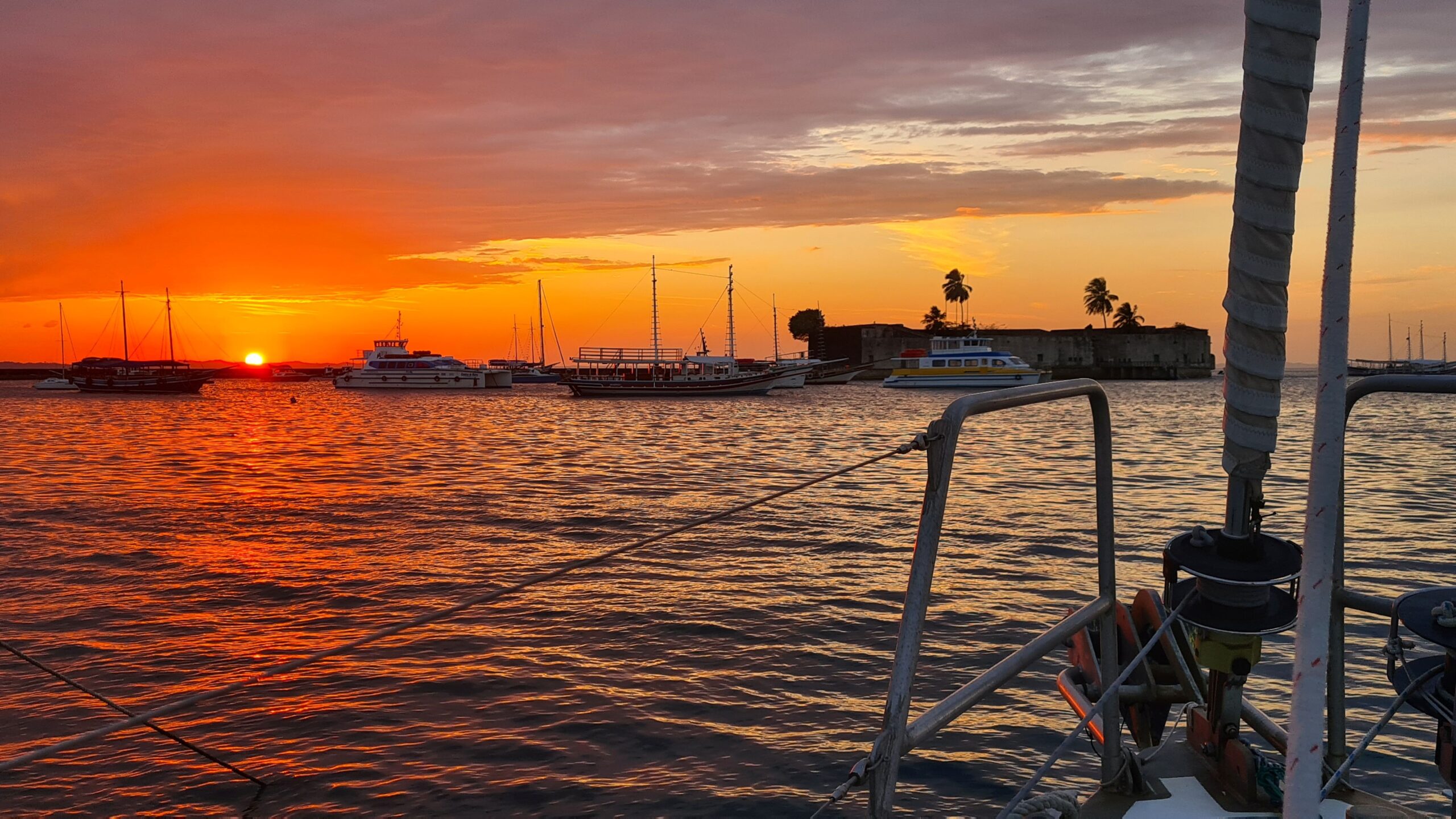
Salvador de Bahia… we made it !!!
 PDF
Wow, I see what you mean: what a challenging leg. Huge respect for making the sensible call (no testosterone junkies in UtpaTur’s crew 😉) and heading into safety. And the chance to experience more of this New World. Good luck with fixing the issues, and I had to smile at the excellent splicing 😊