
It is time for us to leave Europe behind and head south once more, always further south. On the agenda for this passage: crossing the Tropic of Cancer and landfall in a new world with African flavours.
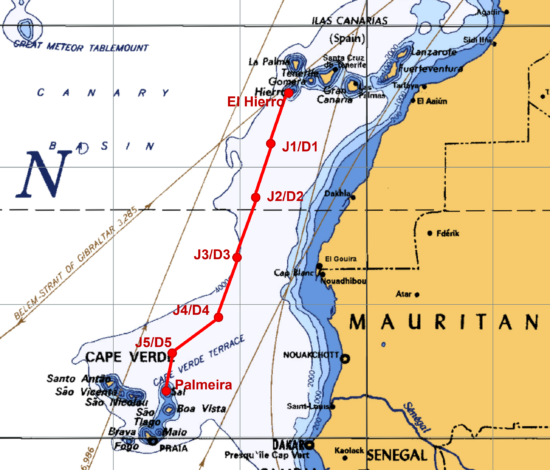
772 nautical milles sailed – 8219 NM in total on UtPåTur
16–17 May: Departure, wind NE force 5–6, rough sea (99 NM)
We don’t really know when to set sail… The North-East trade winds are well-established again, blowing in furious gusts into the tiny harbour of La Estaca. One theory suggests waiting until dawn tomorrow, as local site effects usually ease a bit at daybreak. However, a few hours of lull in the trades are forecast for this afternoon, and it might be wise to take advantage of them to leave the archipelago. But that means dealing with the gusts inside the harbour, which show no sign of moderating, quite the contrary!
We hesitate, we dither, and then we just go for it. Ten minutes after deciding the exact opposite “for good this time”, we change our minds again and cast off our lines at 5:00 pm—an unusual time to start a crossing! We manage to clear the harbour without hitting anything (that wasn’t easy), then prep the boat to face the heavy wind accelerations along the island: 3 reefs in the mainsail and a tiny bit of genoa. The wind can blow all it wants now, we’re ready!
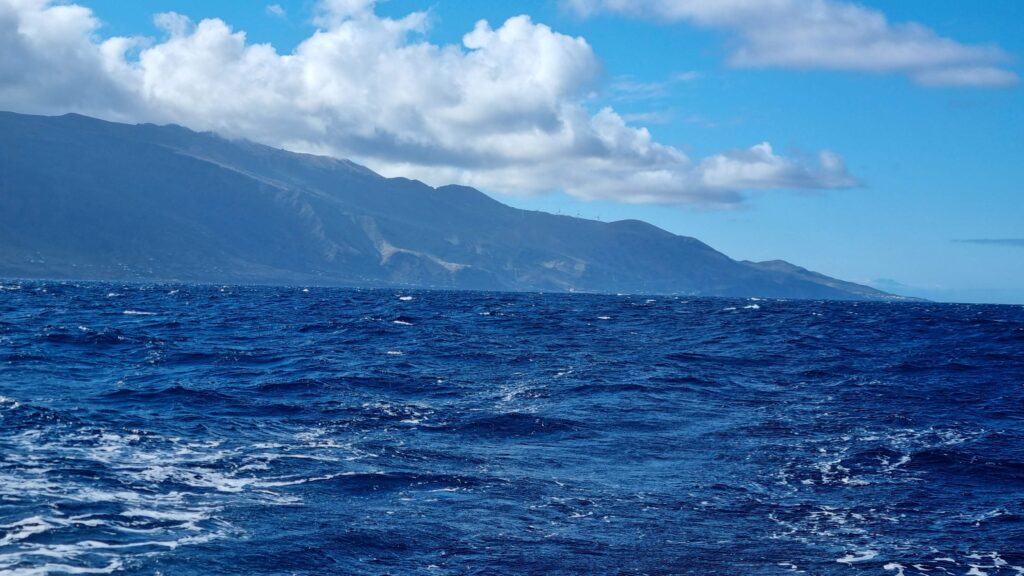
Goodbye El Hierro, a great stop over!
Now let’s head South-South-West
As it turns out, it won’t blow quite that hard, but the sea is pretty wild, and this passage starts in full-on cocktail-shaker mode.
Despite our best efforts to avoid it (we even temporarily head West-North-West to try and steer clear), the lee of Tenerife and the massive Mount Teide ends up swallowing us in the middle of the night. Here we are, utterly becalmed, tossed in every direction by a sea that remains thoroughly unpleasant. After 3 hours without catching a wink of sleep, our resolve breaks down and 30 minutes of motoring gets us clear of the wake of all islands.
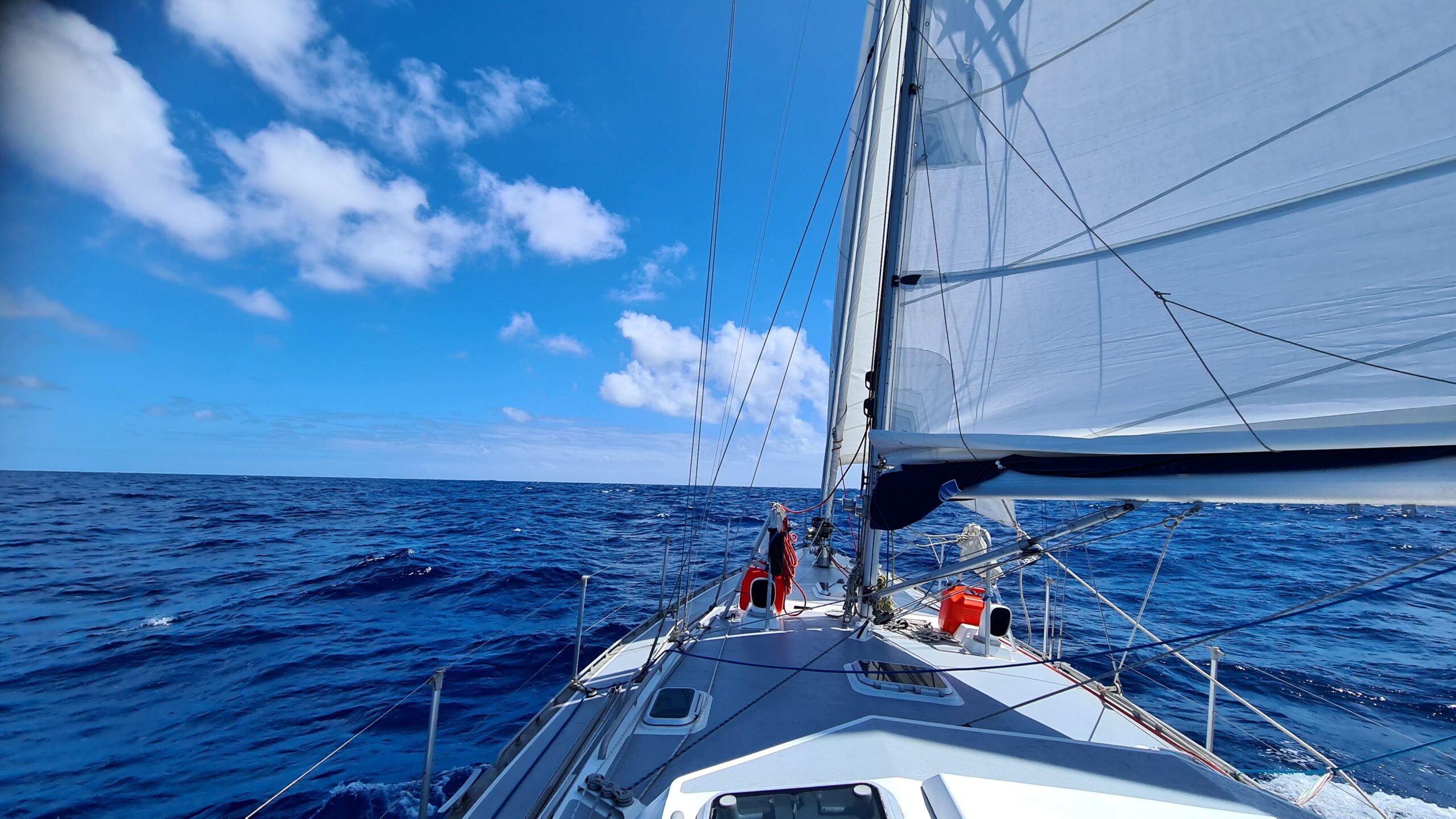
Welcome to the Trade WInds!
By the time we find clean wind again, day has broken over an endless ocean of such a unique, deep blue, right under those classic little trade-wind cumulus clouds. Perfect weather for… catching up on sleep after a very uncomfortable first night!
17–18 May: Wind NE force 5, moderate sea (145 NM)
Today is Norway’s National Day! Yet absolutely nothing in the surrounding scenery reminds us of our second home: dazzling light, heat that’s still bearable in the breeze, flying fish splashing about around the boat, and nothing at the end of the fishing line… To think that 15 years ago we were catching huge mahi-mahi with a piece of frayed string… where have all the fish gone?
We adjust the sails once every 24 hours on average, easy life!
The sea is slowly starting to organize itself, even if the swell isn’t dropping, and the day passes effortlessly on a fast broad reach. We pole out the genoa before nightfall and shape a direct course for Sal. We won’t touch the sails for another 24 hours—what a bliss, downwind sailing in the trade winds…
18–19 May: Wind NE force 5, moderate sea (146 NM)
We have a stowaway! We don’t know exactly when he surreptitiously hopped aboard, but he’s not hiding this morning. Ladies and gents, meet… Pavlov the collared dove! We’ve had passing birds before, mostly pigeons who hitched a lift for a few hours to regain their strength. But Pavlov is different. Pavlov has no intention of leaving. He struts merrily all over the place and, a true pointillist at heart, relentlessly repaints the deck with little green droppings. By late afternoon, he gets closer and closer to us, apparently begging for food. We can’t just let him starve in the cockpit, so we lay out some oat, which he gobbles down in one go, leaving not a single crumb behind. The way he hurls himself at the water we offer is even more dramatic. The poor thing was completely exhausted!!
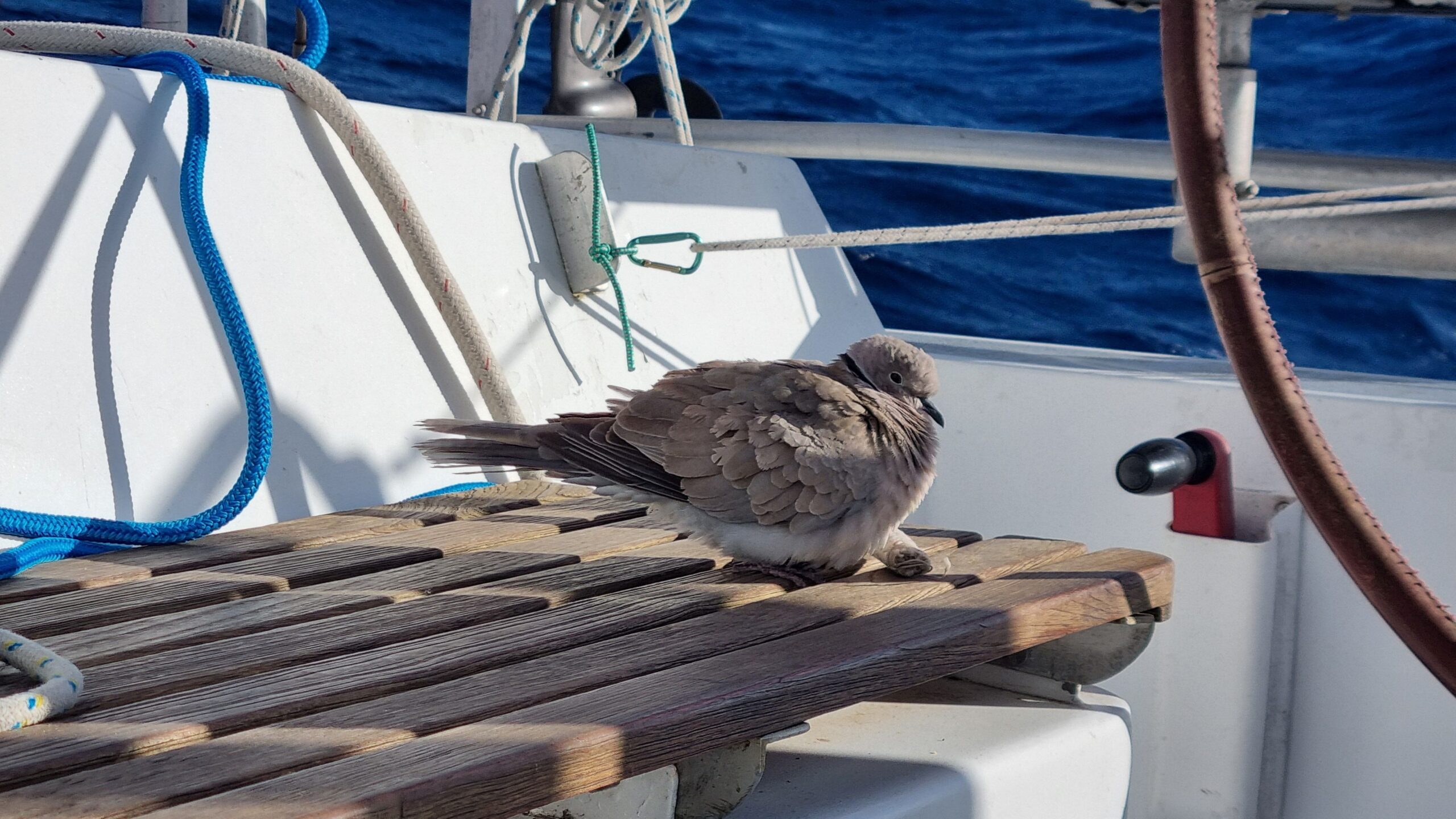
Pavlov the dove has found a less tiring means of transportation than flying
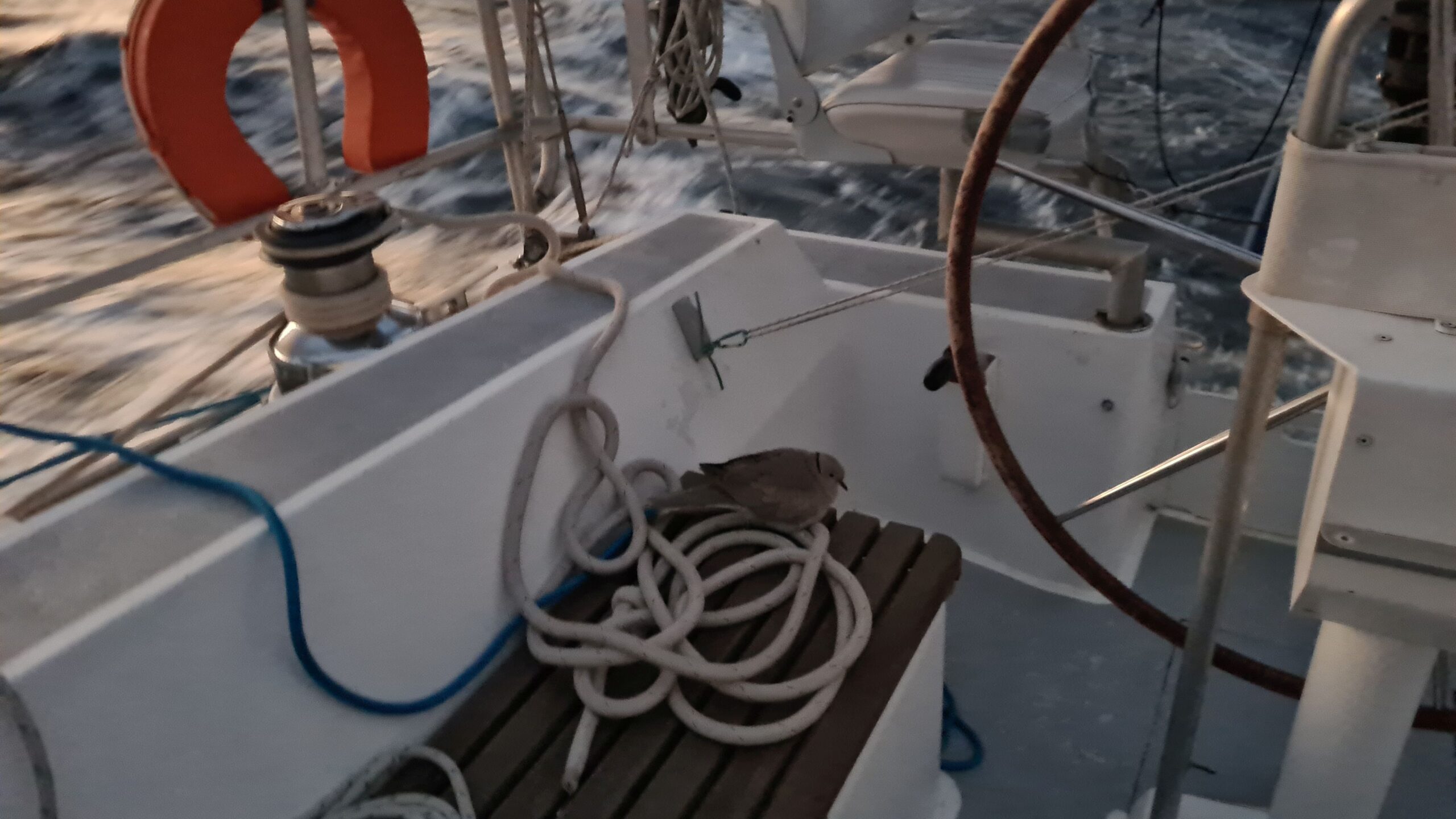
There, I’ll be fine for the night, you don’t really need that piece of string, do you?
Once full, far from looking to resume his journey, Pavlov perches in the cockpit to join us as we are celebrating crossing the Tropic. He then builds himself a cosy little nest in the genoa sheet and settles down comfortably for the night… Very polite, he shows no desire to come into the cabin—phew!
As for us, we drop the pole from the genoa, being very careful about what we touch (Pavlov has been even more prolific since his meal…) and prepare the boat for the wind acceleration forecast tonight around Cape Blanco. The wind picks up a little, but with two cautious reefs in the mainsail, we just have to furl the genoa in and out depending on the gusts (without this disturbing our guest in the slightest, who sleeps like a log just 30 centimetres from the winch!).
19–20 May: Wind NE force 4, slight to moderate sea (141 NM)
In our memories, crossing the Tropic and especially Cape Blanco marked a new weather frontier—the world turning into a stifling oven. For now, there’s none of that: the days are lovely in a rather cool trade wind and the nights are noticeably chillier, requiring even a jumper. It’s between 21 and 25°C below deck, perfect for the night watch from the dog house—just like when we were sailing north of the Arctic Circle, really.
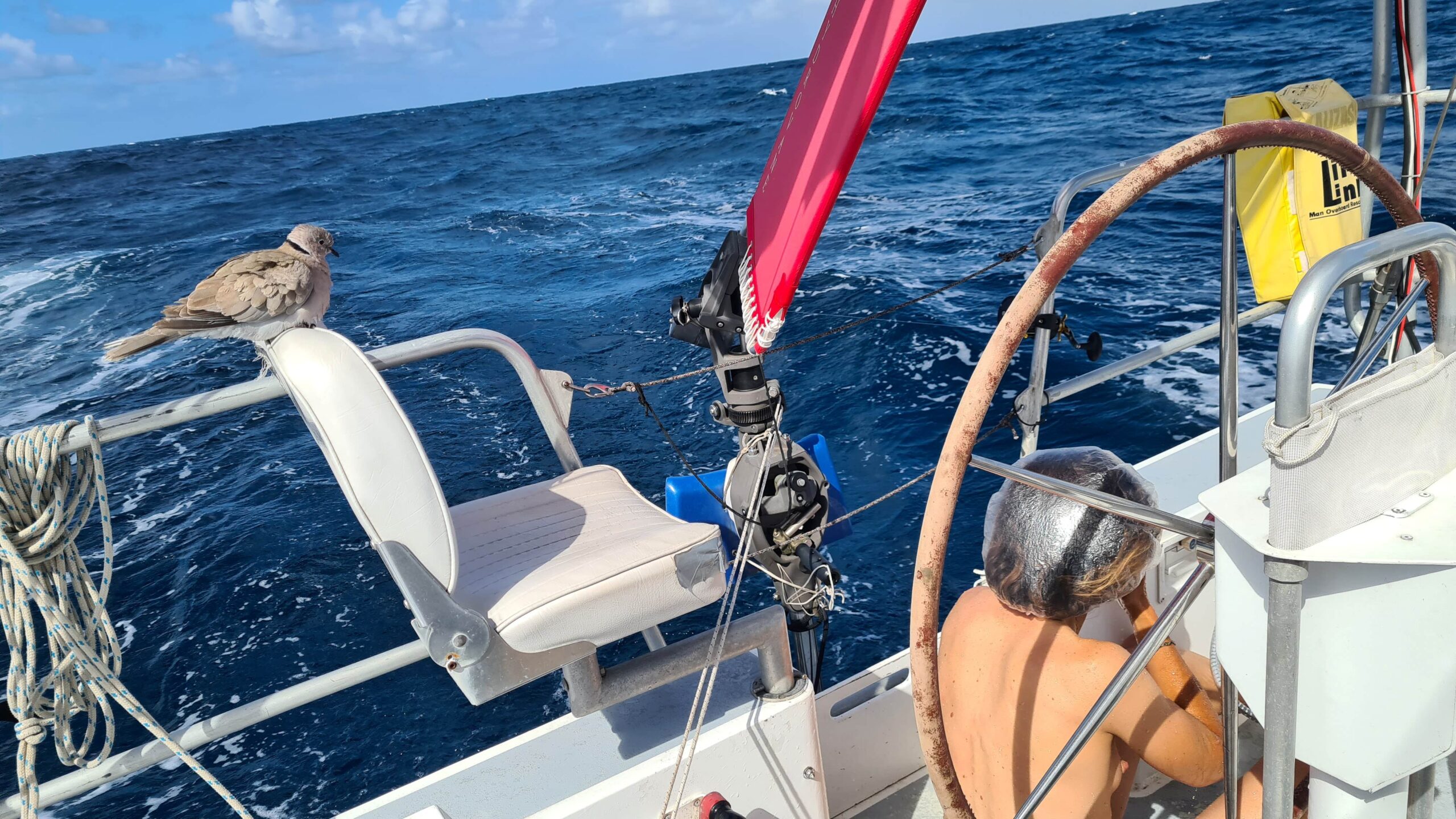
Very pleasant conditions for the cockpit shower
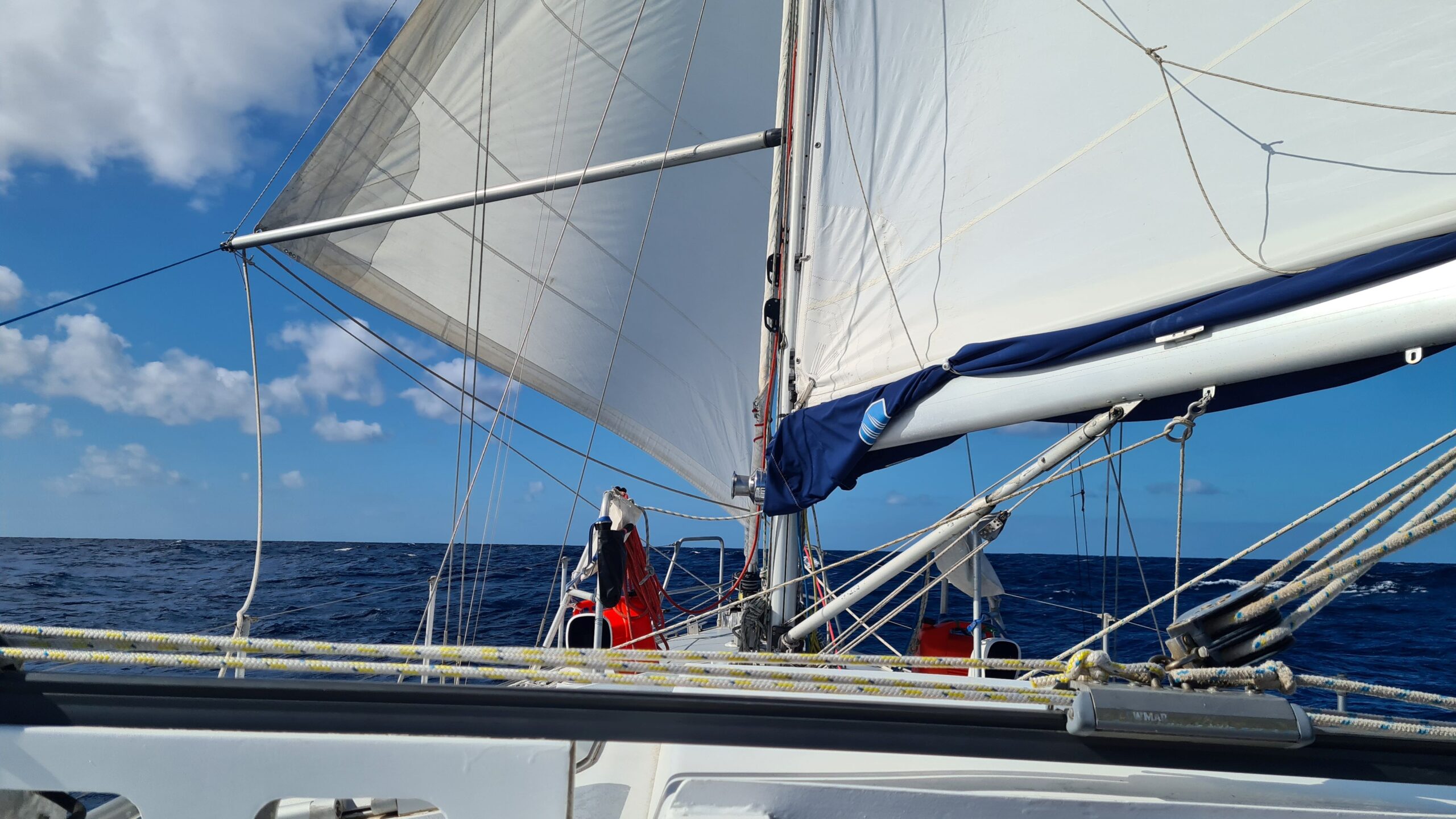
And there we go, we’ve poled out the genoa again!
Another uneventful day. A cargo ship passes on the horizon, the VHF crackles a few times, reminding us that the rest of the world isn’t so far away, and the sea temporarily turns greener before coming back to the deep blue hue so characteristic of the open tropical ocean. The wind drops, and we pole out the genoa again for another 24 hours. The trade winds really are magical…
Life on board is completely effortless, we have plenty of time to rest, write, do some workouts, get (back) into Portuguese—and look after Pavlov. The routine is well established. He now perches on the dinghy davit for his deep night’s sleep. At sunrise, he becomes active and seeks Laure’s attention, who is on watch, to get his morning feed. She also gets the privilege of cleaning up his night’s work, and Pavlov produces a lot of waste while asleep… He has a little saucer of water constantly available, which he knows exactly where to find. During the day, he struts around the deck and especially in the cockpit, comes to see us when he’s bored, stares a lot at his reflection in the porthole – but knows he has to go and perch on his davit so he doesn’t get in the way when we’re handling lines. About an hour before sunset, he requests his evening meal, then quickly tucks himself in for the night! A proper little pet dove! Just a pity we have to spend all our time cleaning up after him…
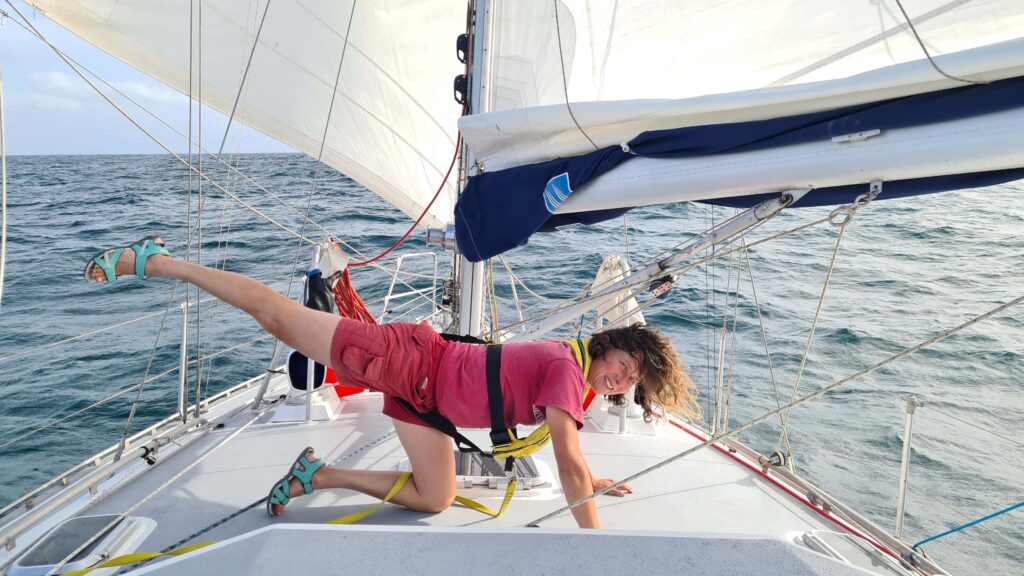
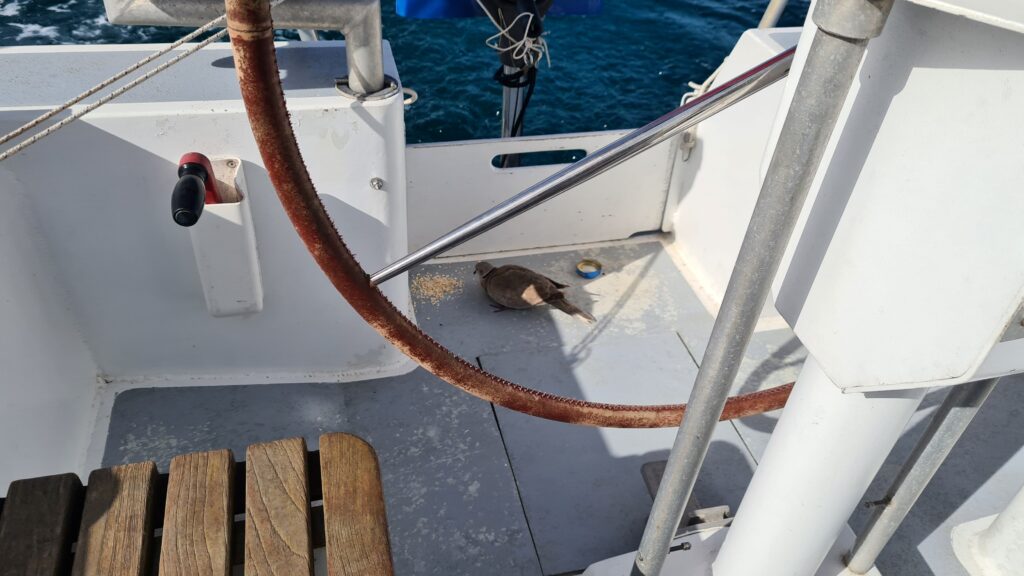
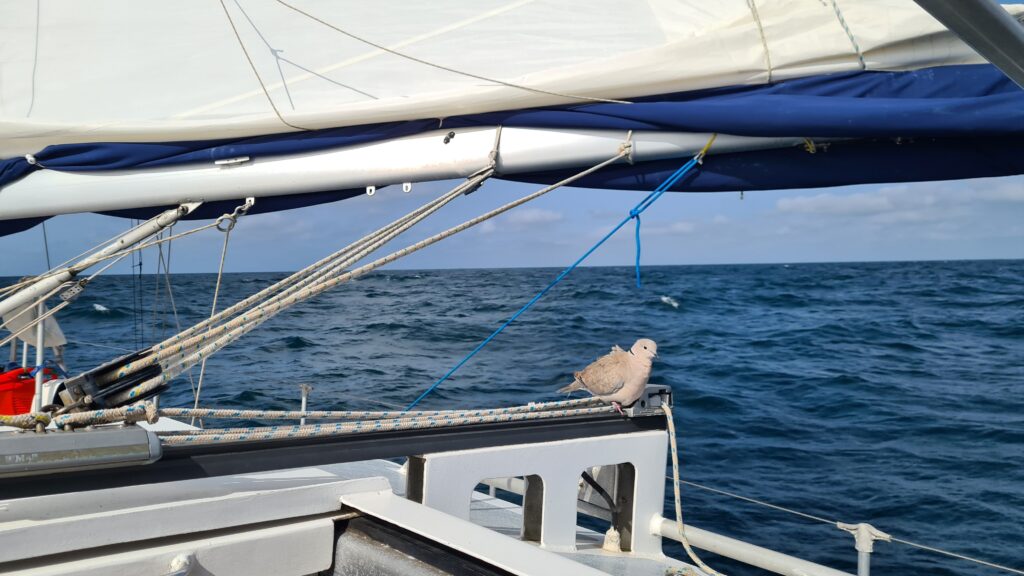
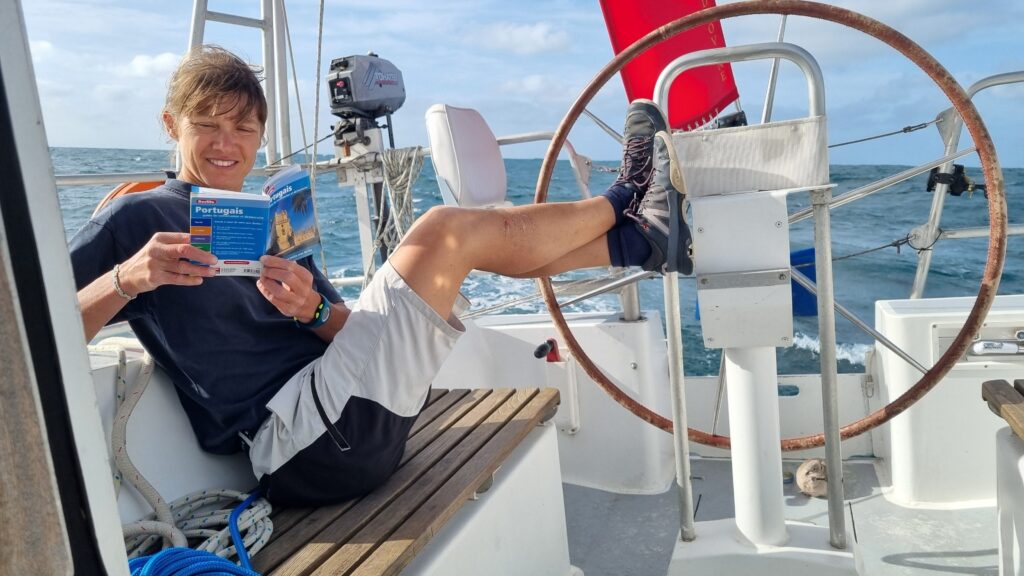
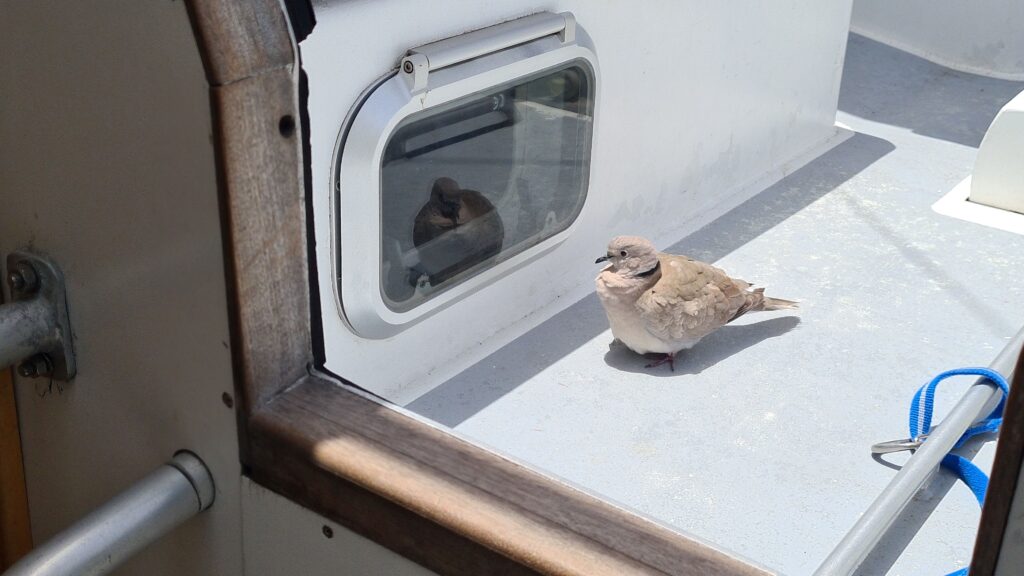
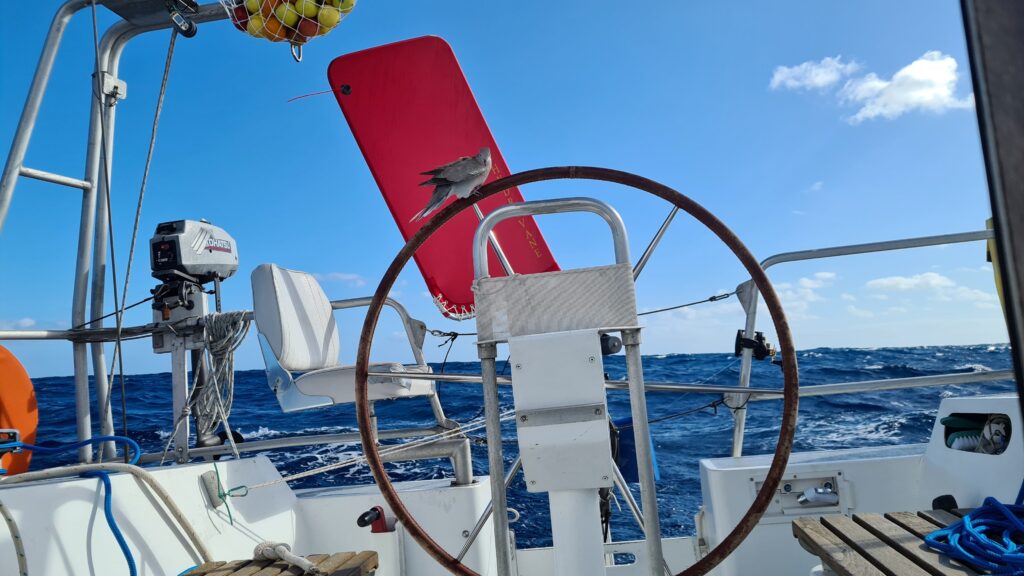
A few snippets of our life on board
20–21 May: Wind NE force 4 to 5, moderate sea (140 NM)
Bad news this morning: the pipe out of the blackwater holding tank (the toilet, basically) is blocked… For the past few months, we’d found a good flushing technique that involved blocking the tank vent while pumping: the pressure build-up helped gravity expel all the unwanted contents. But today, it’s not enough—clearly, we aren’t eating enough fibre… We try running a plumber’s snake through the inside of the tank (thankfully almost empty), to no avail… So out comes the bucket, which never gets blocked!
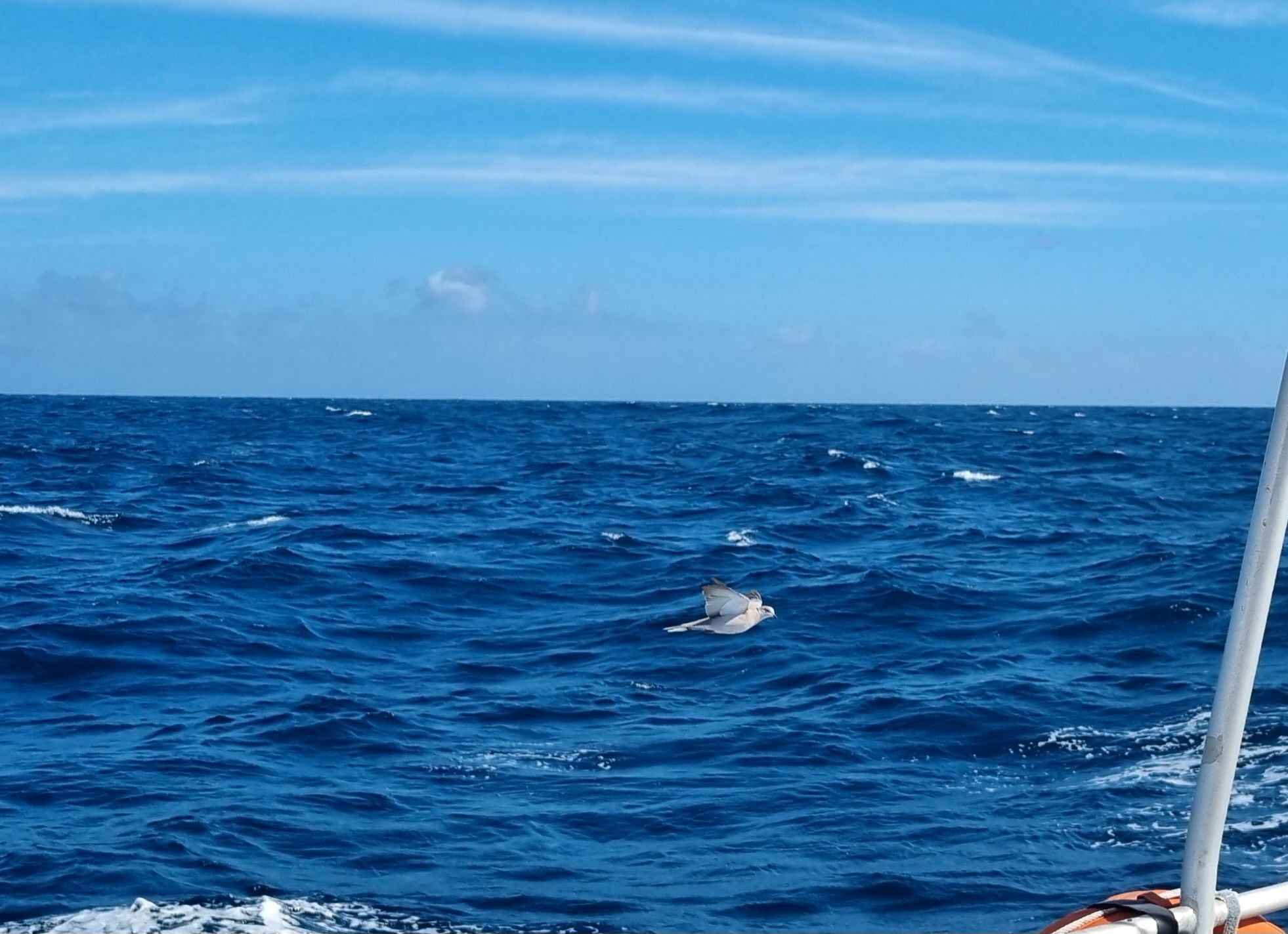
A flying fish? No, only Pavlov stretching his wings.
Apart from this issue, which doesn’t impact our onboard comfort really, the day is particularly delightful. The weather is beautiful, the temperature lovely, the wind (in our backs of course) isn’t too strong, the sea is well-behaved and we see tonnes of flying fish as well as a huge cetacean breaching high out of the water—maybe a sperm whale.
We’re making fast progress and since this morning, our longitude coordinates have become greater than our latitude! That’s because we’ve run a long way south and today, at just over 19° North, the sun passes exactly overhead at noon. From now on, the sun will be to our north at least once a day. Just like last year in Northern Norway in fact, but at midday instead of midnight!
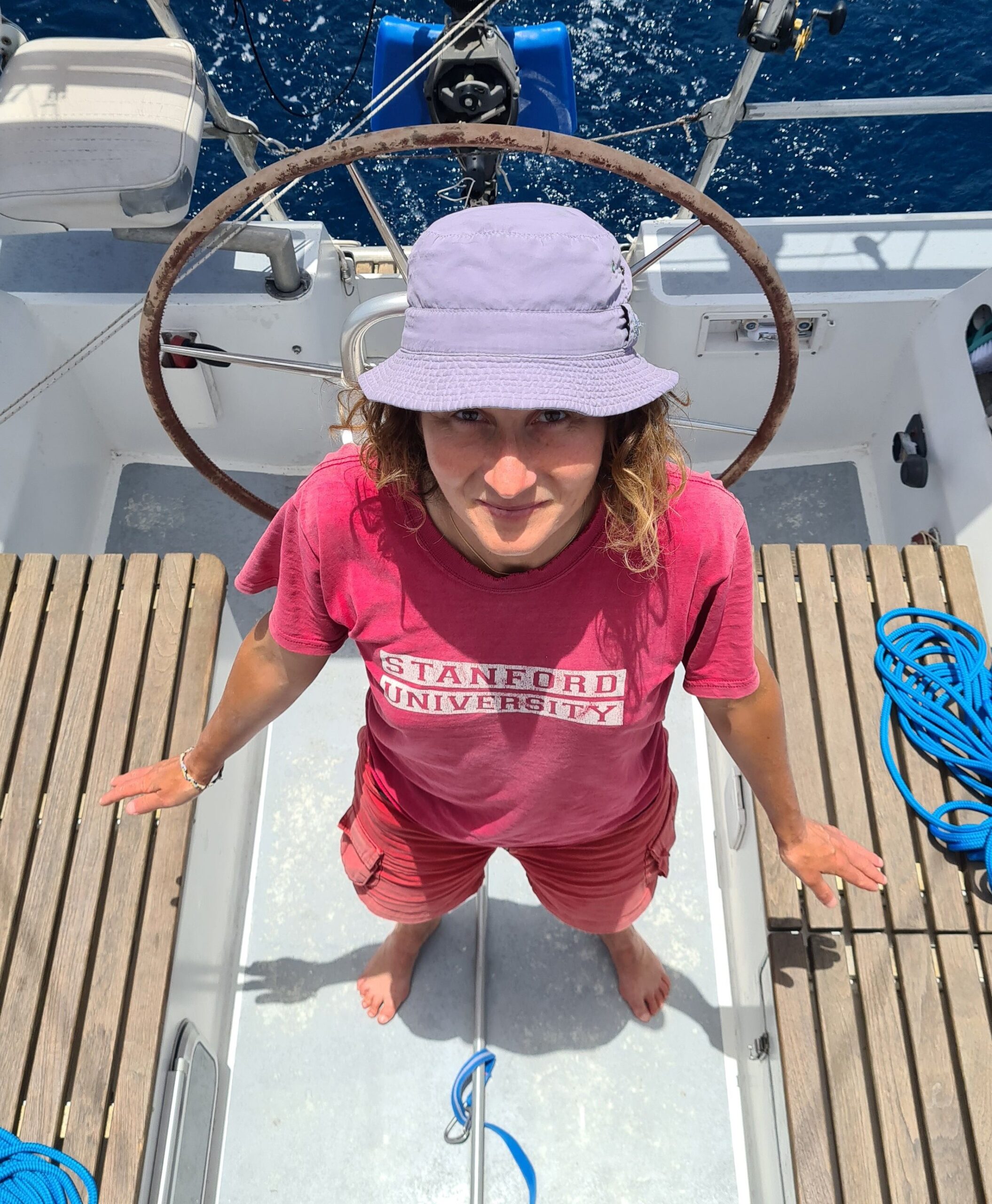
Playing with shadows while the sun is right overhead
In the late afternoon, we hit upon a new idea to try and unblock our holding tank: what if we tried pumping the contents out from the top, like those pump-out stations you find everywhere in Northern Europe? We first try with a hand pump, but no luck. Then we remember we have a vacuum cleaner on board, which is supposedly rated for liquids too. Bingo! The suction is strong enough to dislodge the troublesome blockage, and our heads are working again! Just as well, we have enough droppings to manage as it is with Pavlov…
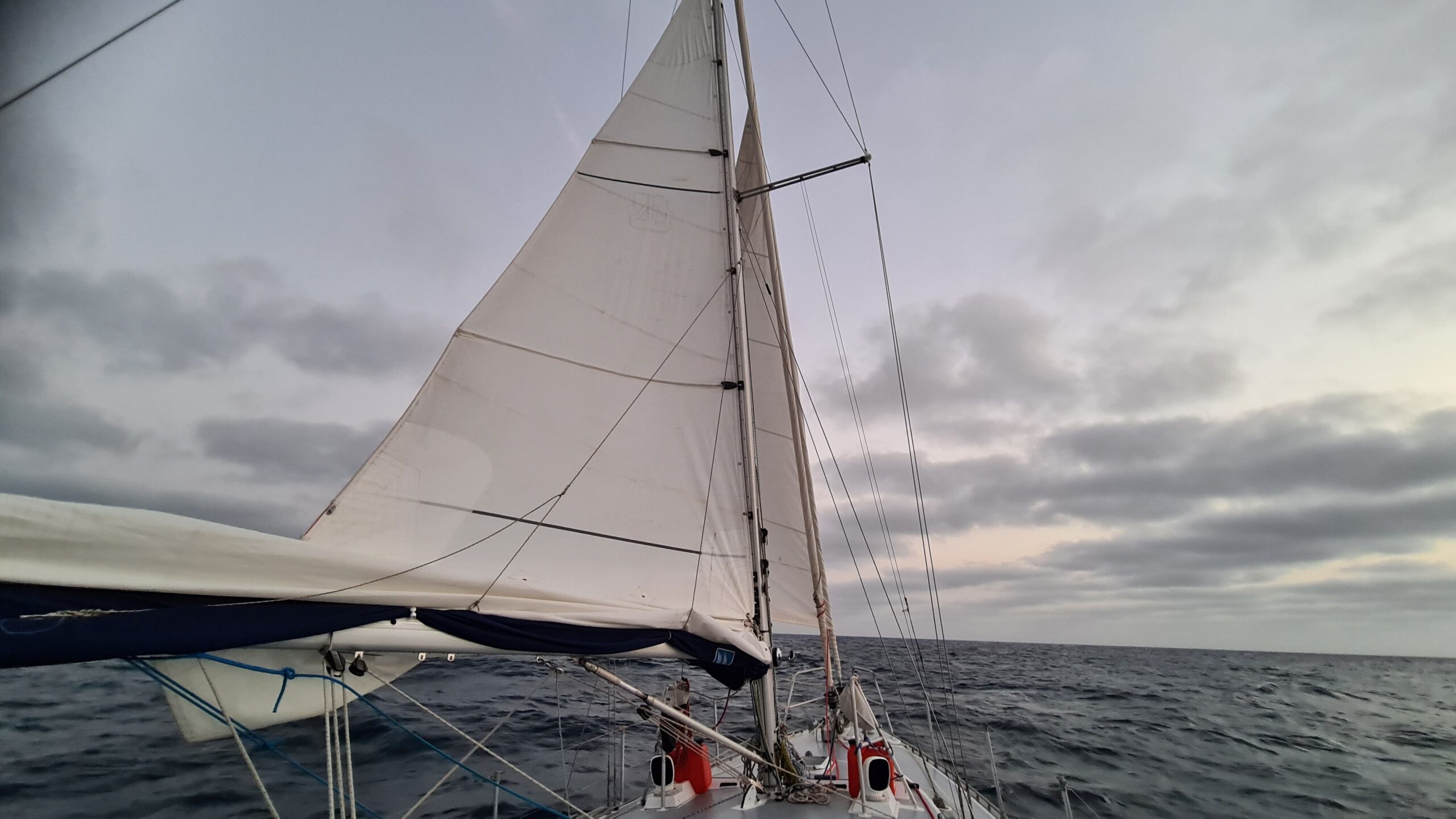
Less and less canvas to try and slow down…
We can now fully focus on our next dilemma: we’re moving too fast! At this rate, we’ll arrive on Thursday evening around 11:00 pm, but entering Palmeira Bay at night is highly discouraged due to the numerous mooring buoys and other hazards scattered around. So, we under-sail UtPÅTur as much as possible to slow her down… with partial success: even with 3 reefs, we’re still logging over 6 knots!
21–22 May: Wind NE force 5–6, moderate to rough sea (101 NM)
A tough final day for this crossing… First of all, it’s completely overcast! Sun, come back, we haven’t had nearly enough tropical sunshine yet! Then, the holding tank blocked up again during the night—our vacuum method clearly didn’t permanently solve the issue. Next, we try to make fresh water with our watermaker, but we can’t draw enough seawater to prime the system. Too much swell, or maybe too much speed… this means we can’t rely on the watermaker on the open ocean, which is to be taken into account for future crossings.
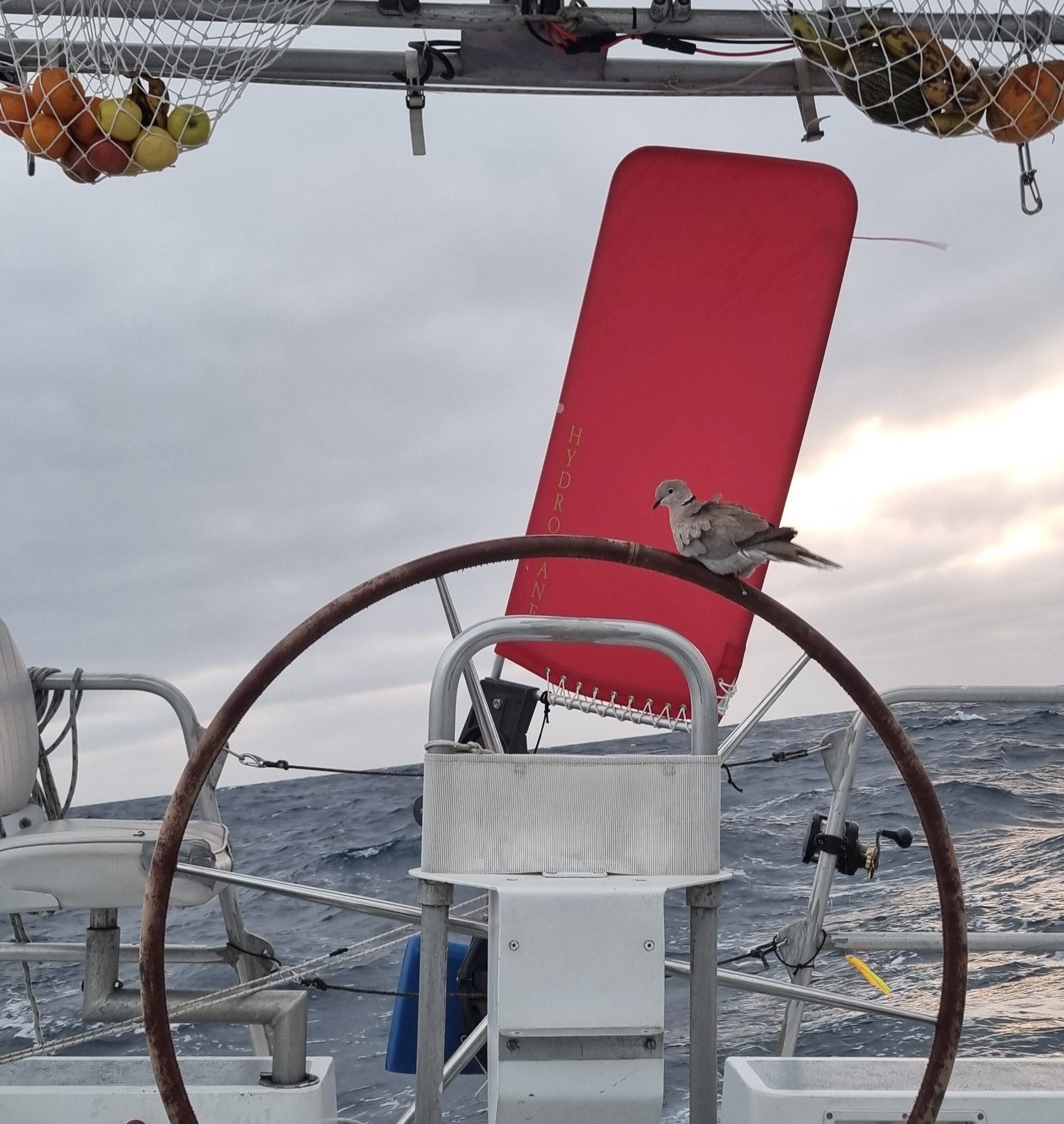
We tried with Pavlov steering to slow down, but it wasn’t enough…
In any case, we are still too quick to arrive by daylight in Sal, even when drastically shortening sail. It’s quite demoralizing to force yourself to slow down and tack off-course just to add extra miles! Finally, at 5:00 pm this Thursday afternoon, 60 miles north of Sal, we heave-to—meaning we set our sails “against the wind” to pretty much stop the boat. With this technique, we drift towards the island at about 3.5 knots.
Thanks to this reduced speed, a miracle finally happens: a fish bites on our line!!! It’s a small mahi-mahi, which will make a delicious dinner. At last!
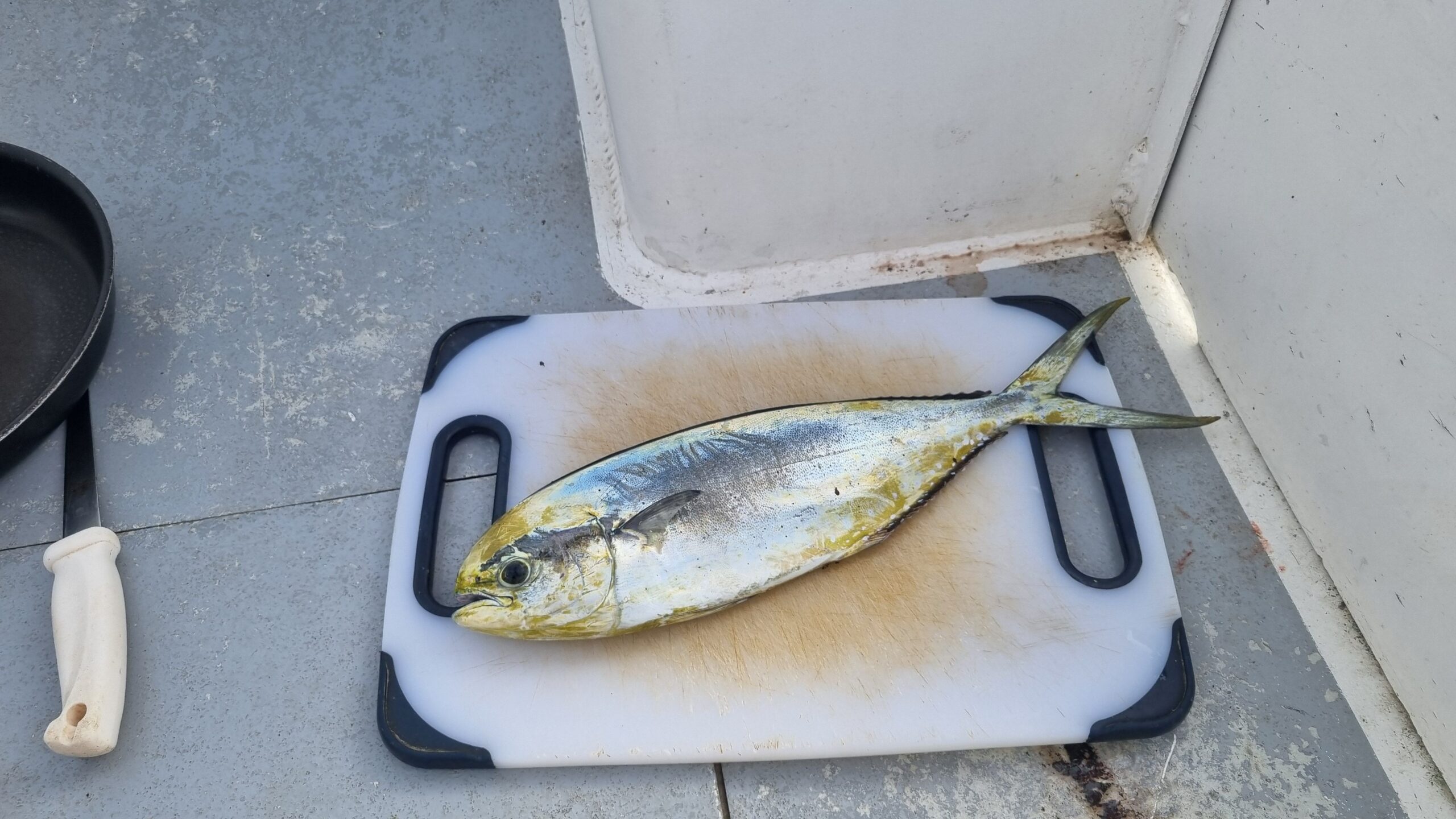
Hooray, a mahi-mahi! It’s already lost its beautiful colors… but not its delicious taste!
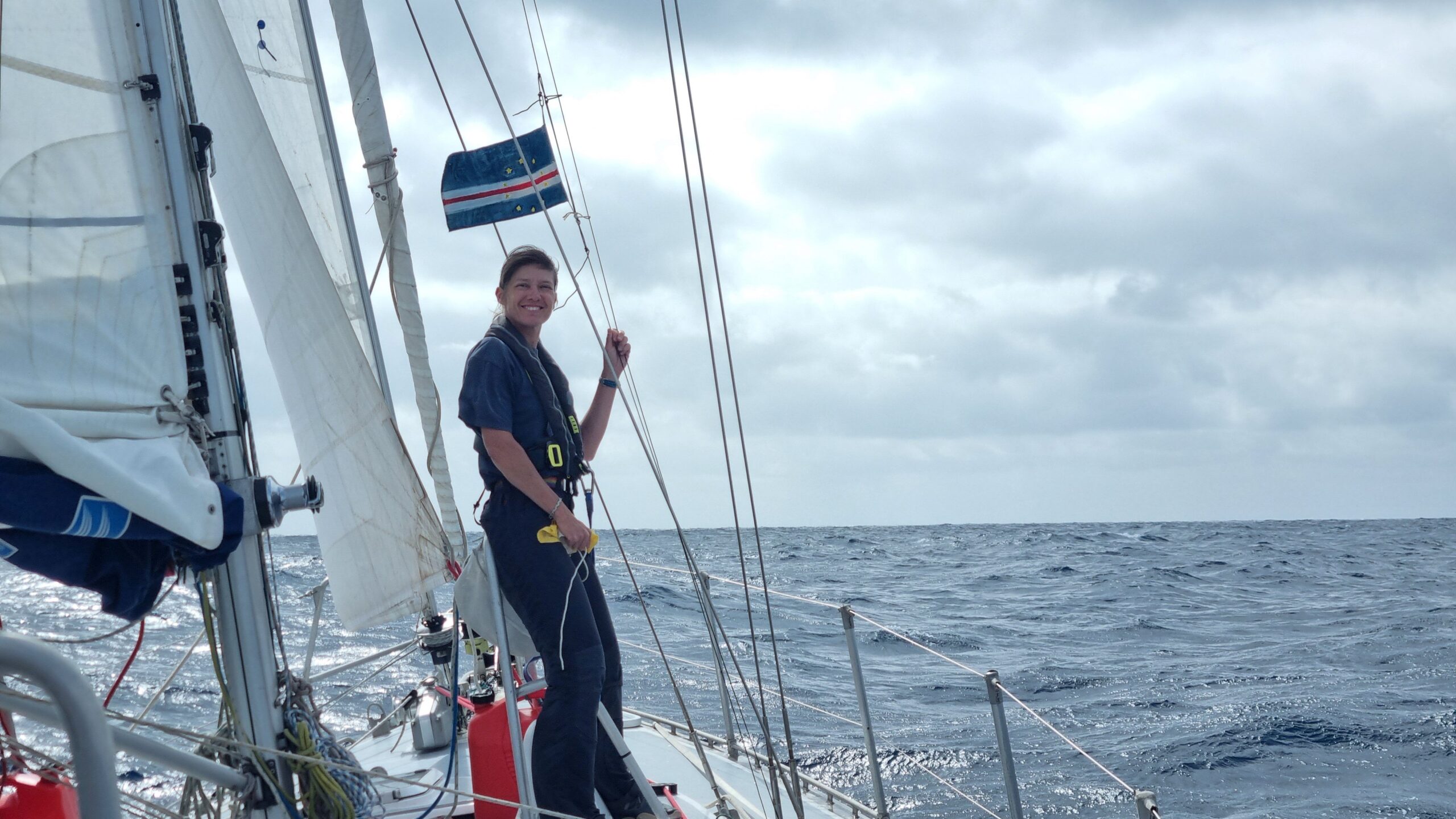
We fly the Cape Verde’s colours!
We also take the opportunity to hoist the Cape Verde courtesy flag, along with the yellow Q flag which we must keep flying until we’ve completed customs and immigration formalities. We hope to arrive right at daybreak.
As we close in on the petit pays we fell so in love with during our first voyage, we’re surprised not to feel more excitement. The fear of being disappointed, no doubt; in 15 years, the place must have changed a lot… and so have we. We haven’t left the safety of Europe in a very long time, and now we’re arriving with a magnificent boat containing all our worldly possessions, which could easily attract unwanted attention… In spite of ourselves, we’re more on our guard and will feel less relaxed than we did aboard tiny little Saltimbanque. Fact is, we still haven’t fully come to terms with owning such a beautiful boat!
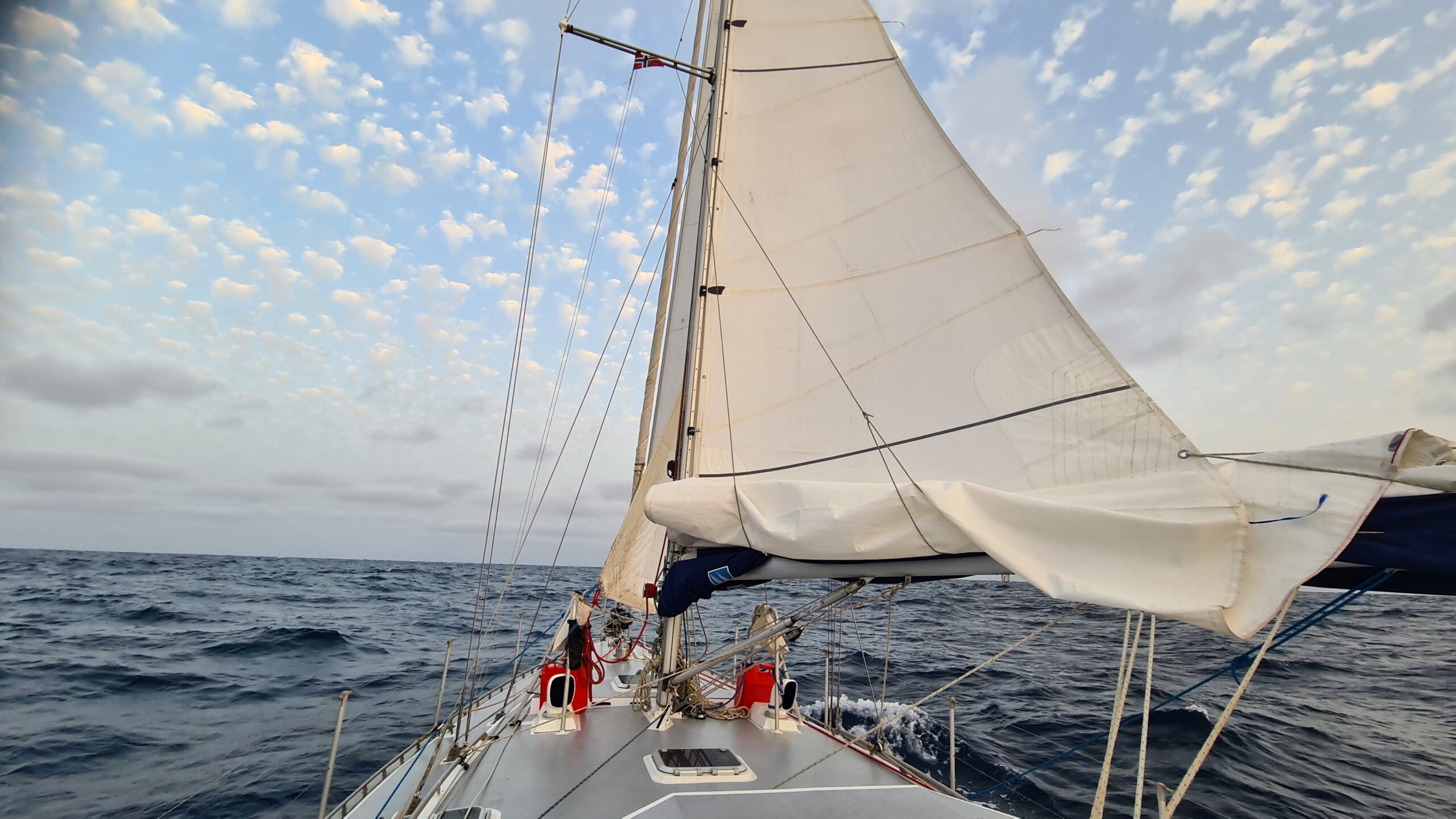
We are approching, hove to, as slowly as possible
Moreover, we’re no longer ahead of the season after our long stopover in the Canaries. We’re well aware that our time in Cape Verde will be limited and our minds is already focused on the Atlantic crossing and the daunting Doldrums. We see this stopover primarily as a logistical one (rest and provisioning) before the big jump. Secretly we hope to feel some morabeza again—that beautiful spirit of kindness which reigns in Cape Verde—but we’ll take it as a bonus gift!
Enough overthinking. After 9 hours and 30 miles hove-to, beam-on to the swell, our advanced calculations show it’s time to get moving again—yippee! Here we are surfing at 7 knots once more, and light appears just as we reach the northern tip of the island. Excellent timing.
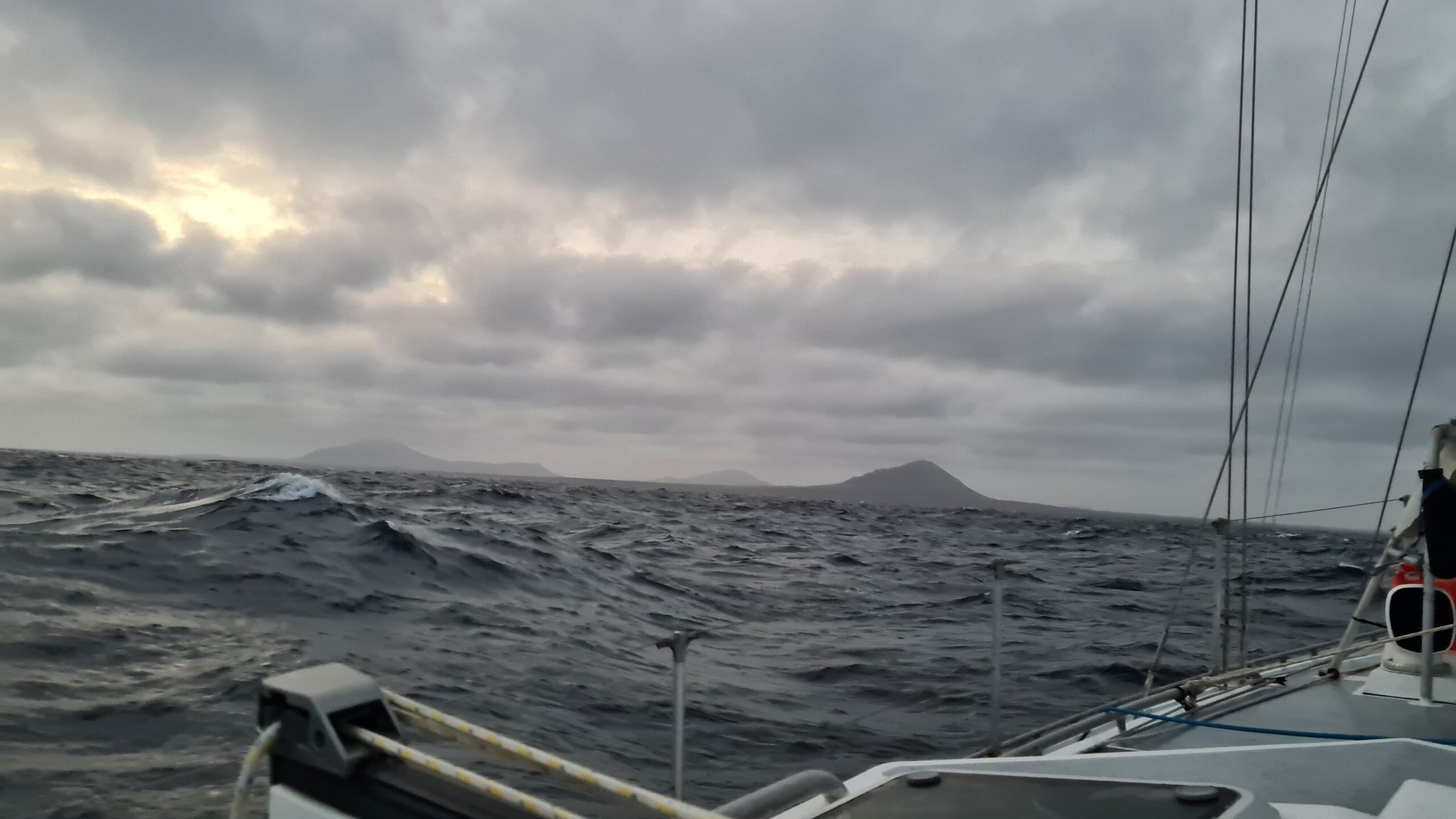
Approaching the Island of Sal in quite a bit of wind and swell
Mind you, that doesn’t stop us from running into a lobster pot a few miles from the harbour—fortunately with no worse consequence than a good scare. The water suddenly fills with dozens of local fishing boats; we’re almost there.
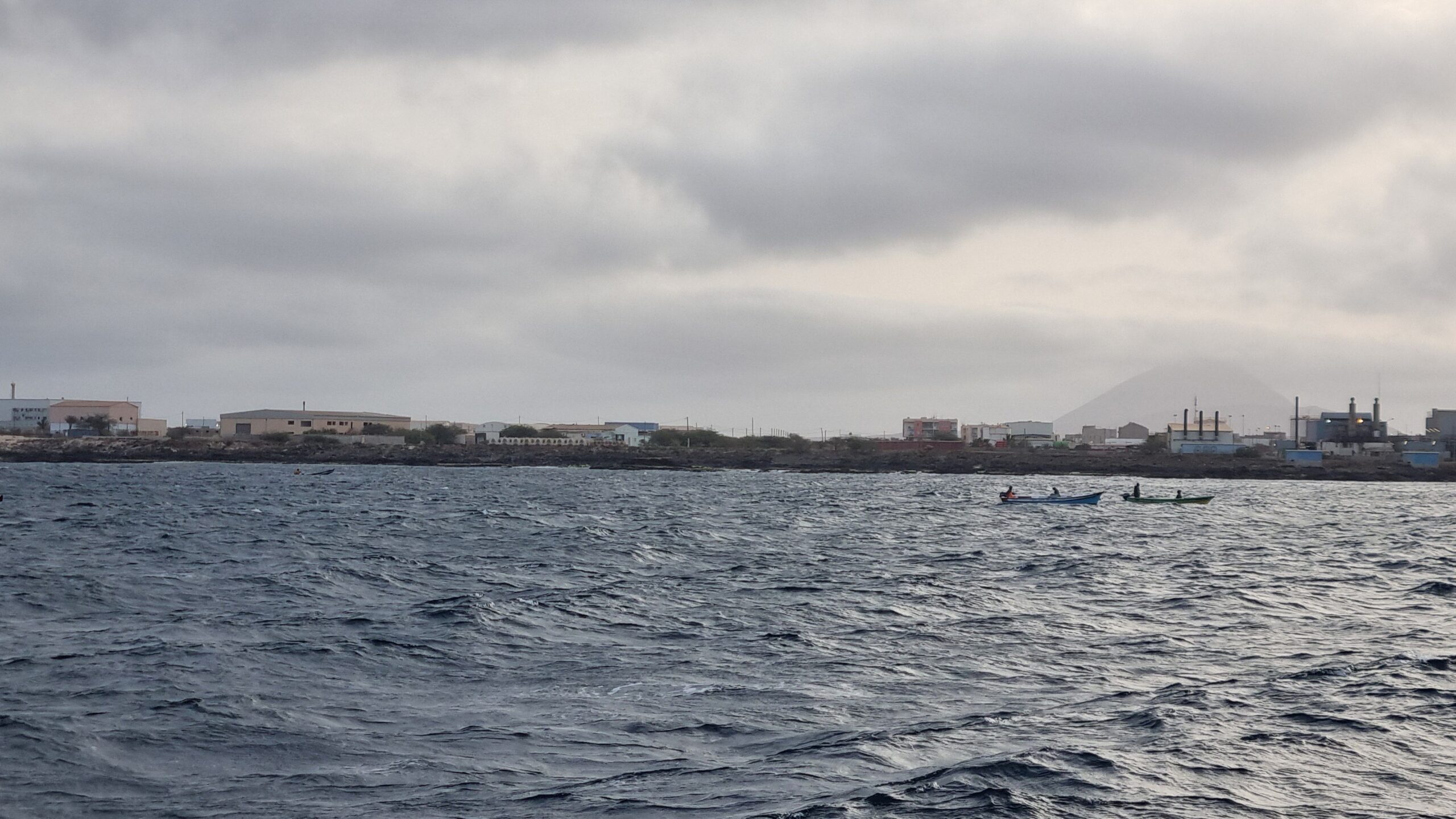
Sal, a safe haven for lost doves
And suddenly, having presumably caught the scent of land and spotted the hills of Sal, Pavlov takes off. He heads straight for his new Cape Verdean life with powerful wingbeats… without so much as a goodbye! We’re happy to see him fly away looking so confident; it bodes well for his future. Believe it or not, we’d grown quite attached to that dove after 5 days of living together—another lovely little story to remember this crossing by!
Time to drop sails and head into Palmeira Bay… which is absolutely packed with boats and mooring buoys! Wow, things really have changed in 15 years!! And what a brilliant idea to arrive in daylight… It’s barely 6:00 am local time, but someone is waving vigorously at us from a charter catamaran (yes indeed, there are now charter catamarans in Palmeira, we couldn’t believe our eyes either!). He jumps in his dinghy to meet us and, in flawless French, offers us a mooring buoy. It’s very kind of him, but we don’t trust these buoys with a heavy boat like ours, and we prefer to drop our own anchor. We explain this, expecting him to argue and push his buoy. Not at all! “No problem, follow me then, I’ll show you where the good sand is so you can anchor between the moorings!” Once UtPÅTur is safely anchored, we chat for five minutes, crack a couple of jokes, and part ways with a smile. Welcome to Cape Verde…
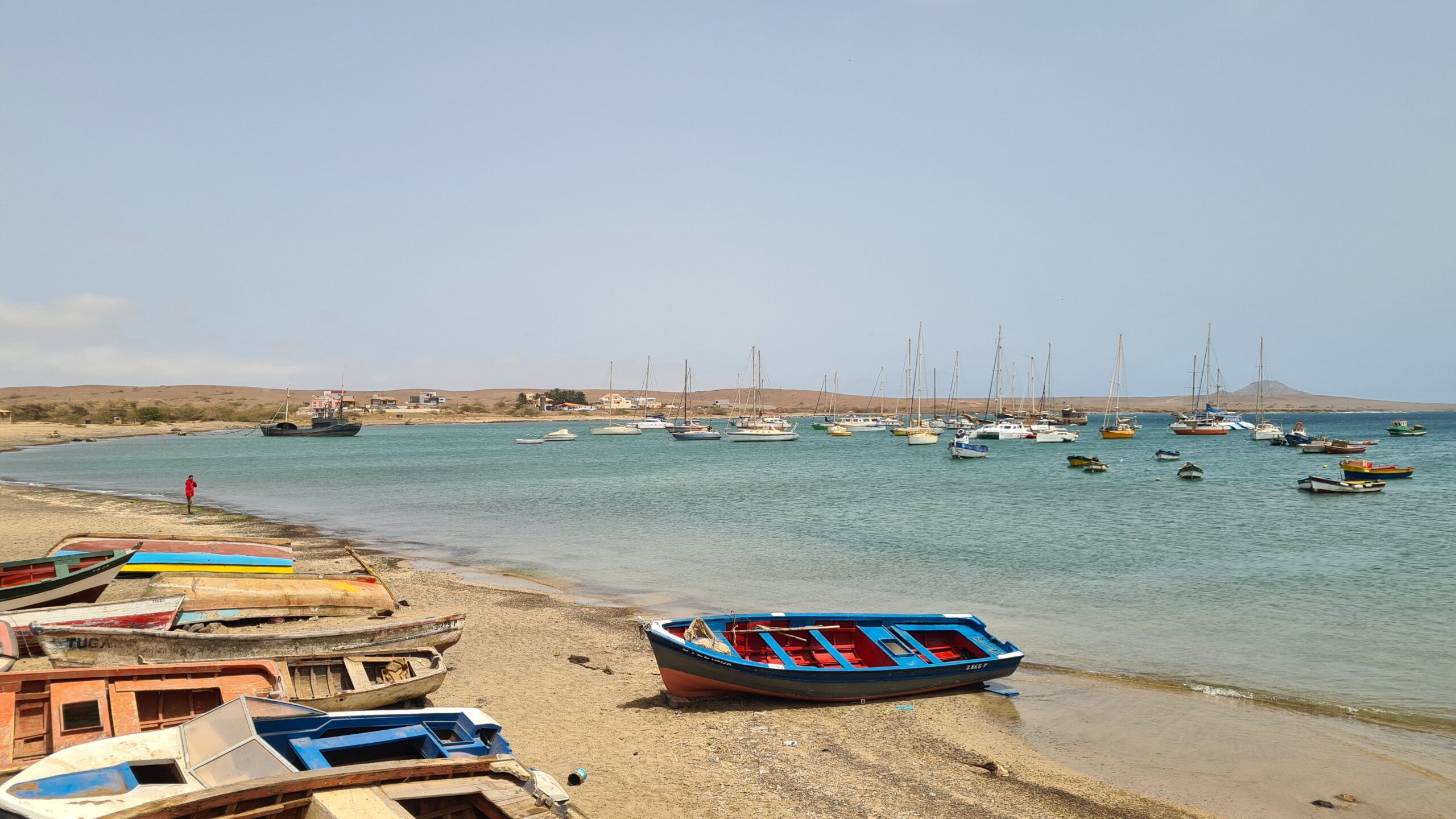
Palmeira, island of Sal, Cape Verde
 PDF