
October 11 – 27: Stopover in Brest
Our first days back in Brittany after our seven-month initiation loop are quite calm. We are delighted to find our friends Guillaume and Amélie (busy with the final work to get their Salamansa ready for relaunch), as well as Jean-François and Sylvie, who came to visit their Cordova and her new crew. We meet other nice people, like Marion and Félicien, two students who are also returning from Norway aboard their Jurançon in perfect condition. And we finally enjoy a flat bed, which is an invaluable luxury after the rolling anchorages of the last week.
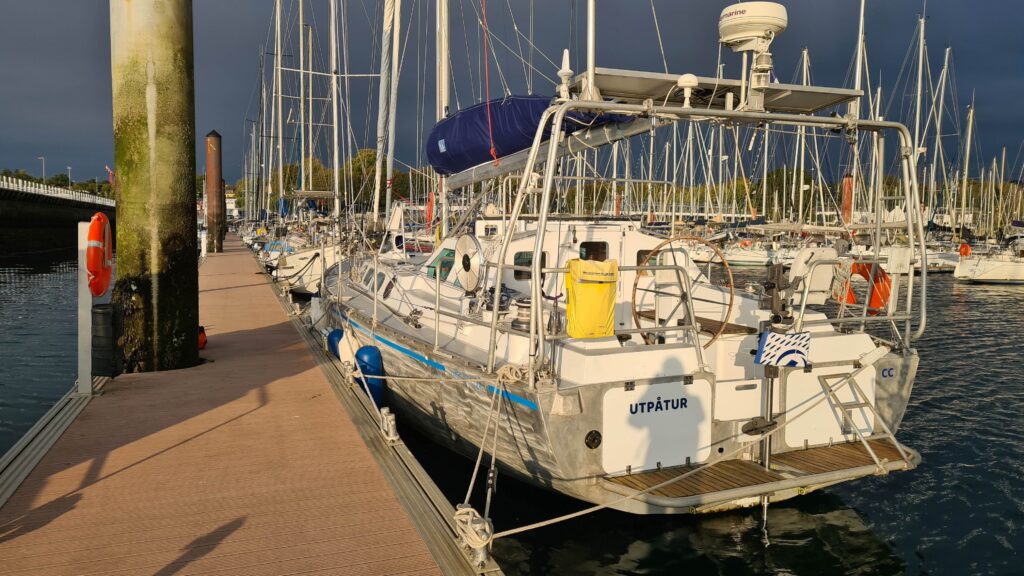
UtPåTur takes a well-deserved break at the Moulin-Blanc marina in Brest
But in choosing Brest as our arrival point, we had a bigger idea in mind. The Port du Moulin-Blanc is perfectly sheltered, not very expensive, and the city is well-connected. It’s the perfect opportunity to visit our respective families, right during the school holidays, which allows us to spend time with our nephews. It was, of course, during our absence that the first major autumn storm decided to rage… Fortunately, Amélie regularly checked that UtPåTur was doing well and sent us reassuring news—thanks again!!!!
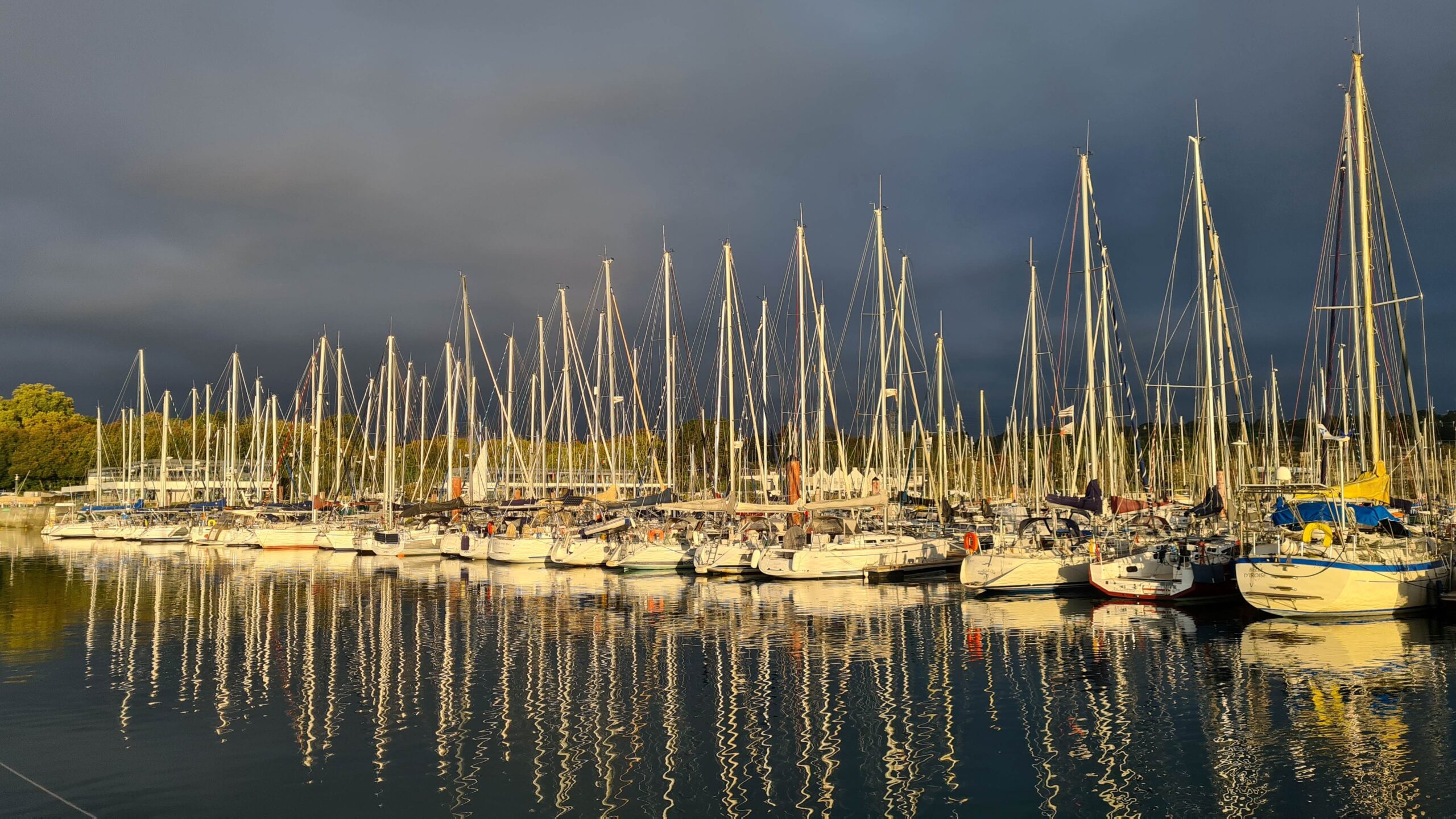
Nice lights, though it means it either has or will rain(ed)…
Brest is also a large technical centre where we can immediately start preparing for the “real departure” next year. We place a first order for hardware and antifouling, and take advantage of a good opportunity to buy a new dinghy, a bit larger and more stable than the one we had this year.
Staying a few days in the same place also allows us to have parts delivered that are not available in stores. Thus, we pick up a new depth sounder. Ours had a lot of trouble starting up, so much so that since Borkum, we had decided not to turn it off before Brittany, to ensure we wouldn’t lose the indispensable depth information needed for anchoring. It was a good thing we did, because when we tried it once we were safely moored to the Moulin-Blanc pontoon, it refused to start at all! The new depth sounder seems to be working perfectly for now.
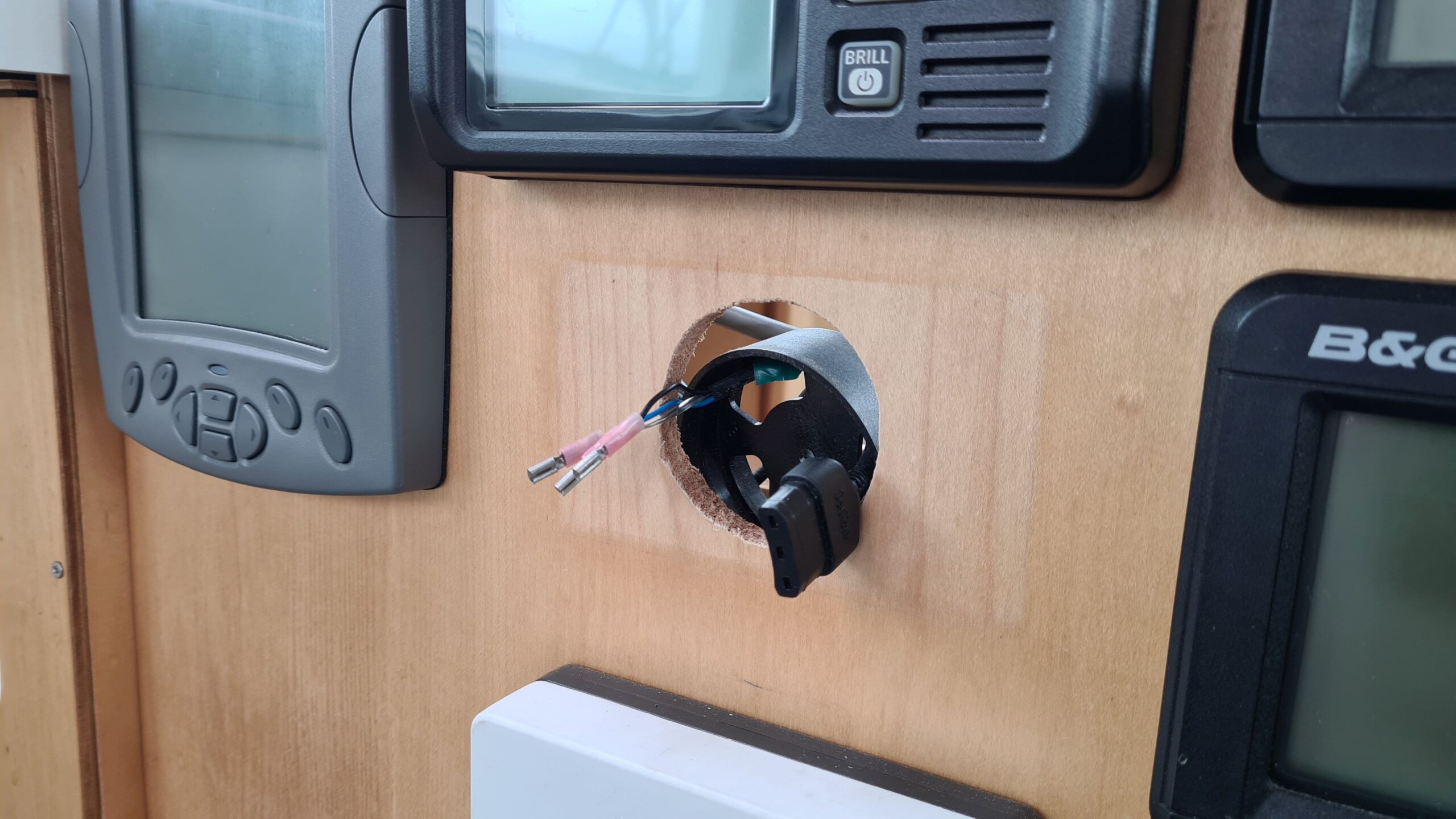
Waiting for the new echo sounder…
We also install a new 12 – 220V converter, as ours had never worked.
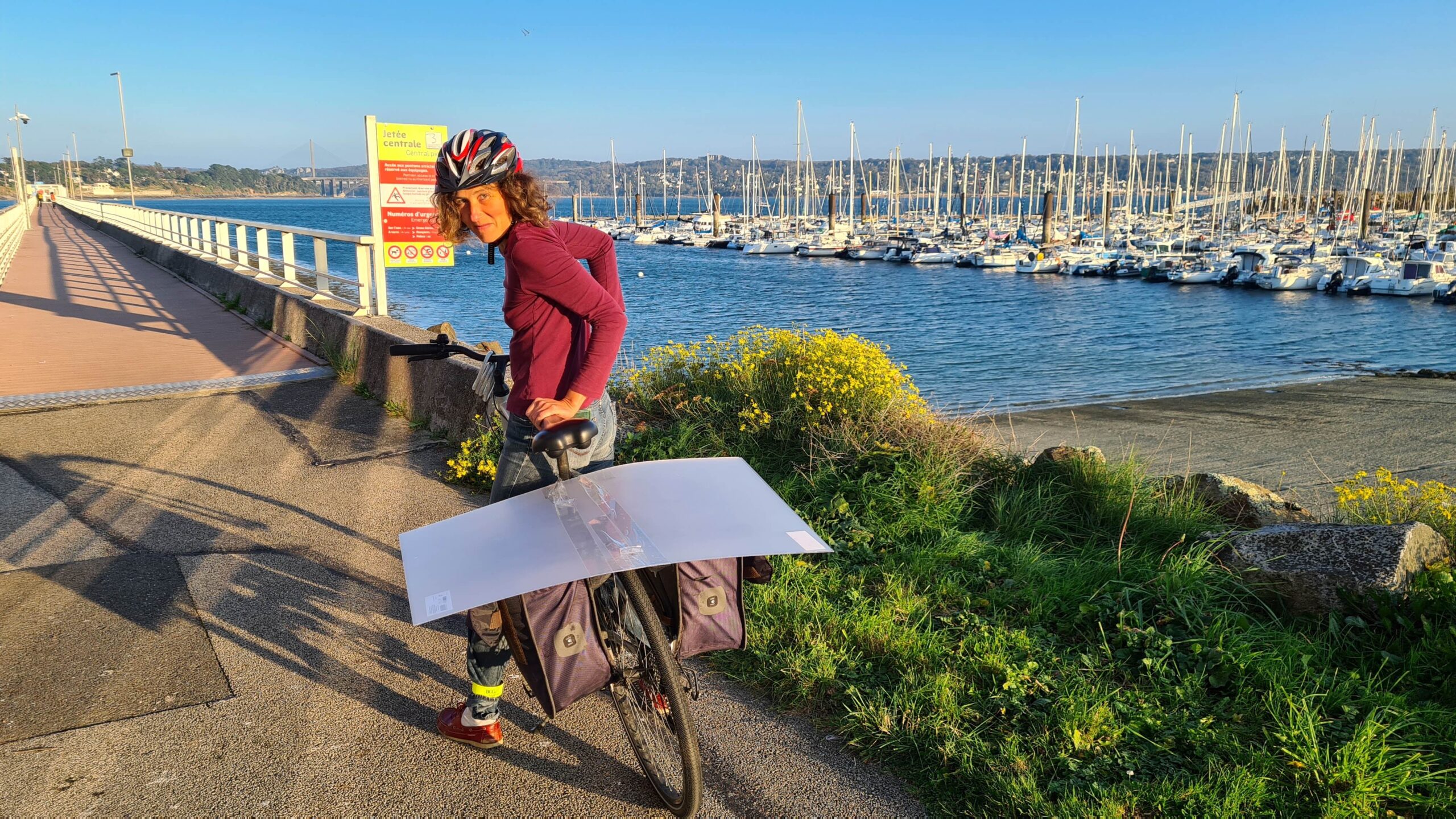
The first step in making the double glazing: transport by bike from the store!
Another improvement for the coming winter months and southern navigations: double glazing on the opening hatches. We found 1.5mm thick transparent polyethylene sheets, which we cut right to the size of the portholes. They stay in place by gravity on the edge of the headliner. It is extremely simple, but devilishly effective!! No more condensation above the bed in the morning! However, humidity now concentrates on the remaining thermal bridges, such as the dorado box vents, or the large windows on the upper level. So, we find water in new places… but we do note a clear improvement in insulation.
The weather forecast seems to show signs of calming down in a few days. The next step on our schedule will be Port-Laforêt, where we have an appointment with a rigger for some checks and improvements. To prepare for that work, we go up the mast to take measurements… and the order of our priorities abruptly changes once we reach the first spreader: the port lower shroud has two broken strands…
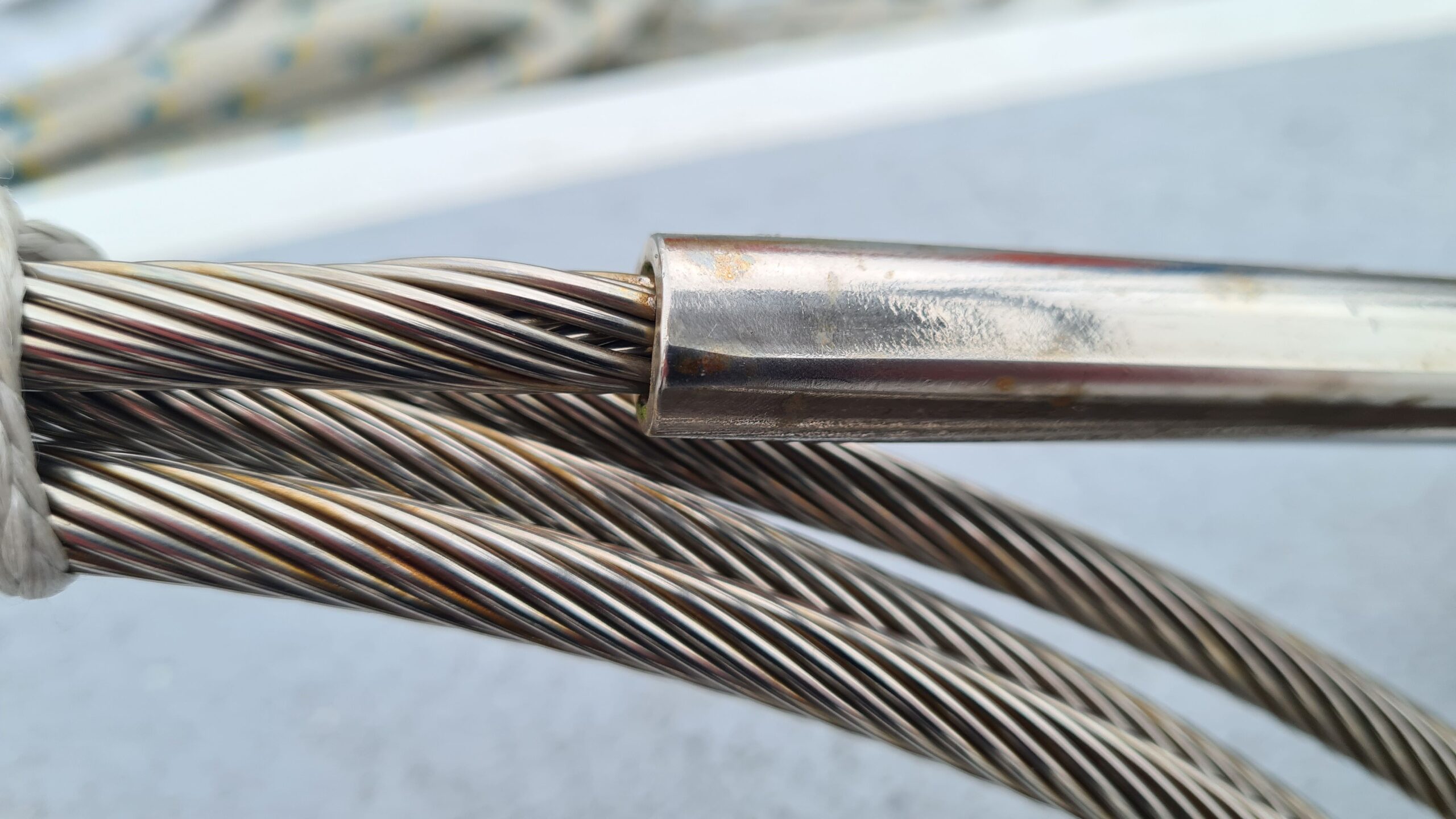
We had never broken any shrouds before… ticked now…
We discuss solutions based on Dyneema with Amélie, who already had the same problem (but in the Falklands…), to secure the mast until we reach Port Laforêt. Finally, we manage to have a shroud quickly swaged in Brest and put it back in place before taking to sea again. The problem is solved for this time, but we don’t understand how we broke this cable which is only 3 years old…
October 28: Brest – Port Laforêt (84NM)
Six o’clock in the morning, dark and chilly. It’s time to leave the comfort of the pontoon for the salty spray of the Iroise Sea. We’ve gotten a bit soft after this long period ashore, especially since Laure came back from Haute-Savoie with a bad cold and is not in the best shape… But the tide doesn’t wait, and requires us to be at the entrance of the Goulet de Brest at dawn to benefit from all the favourable current until the Raz de Sein.
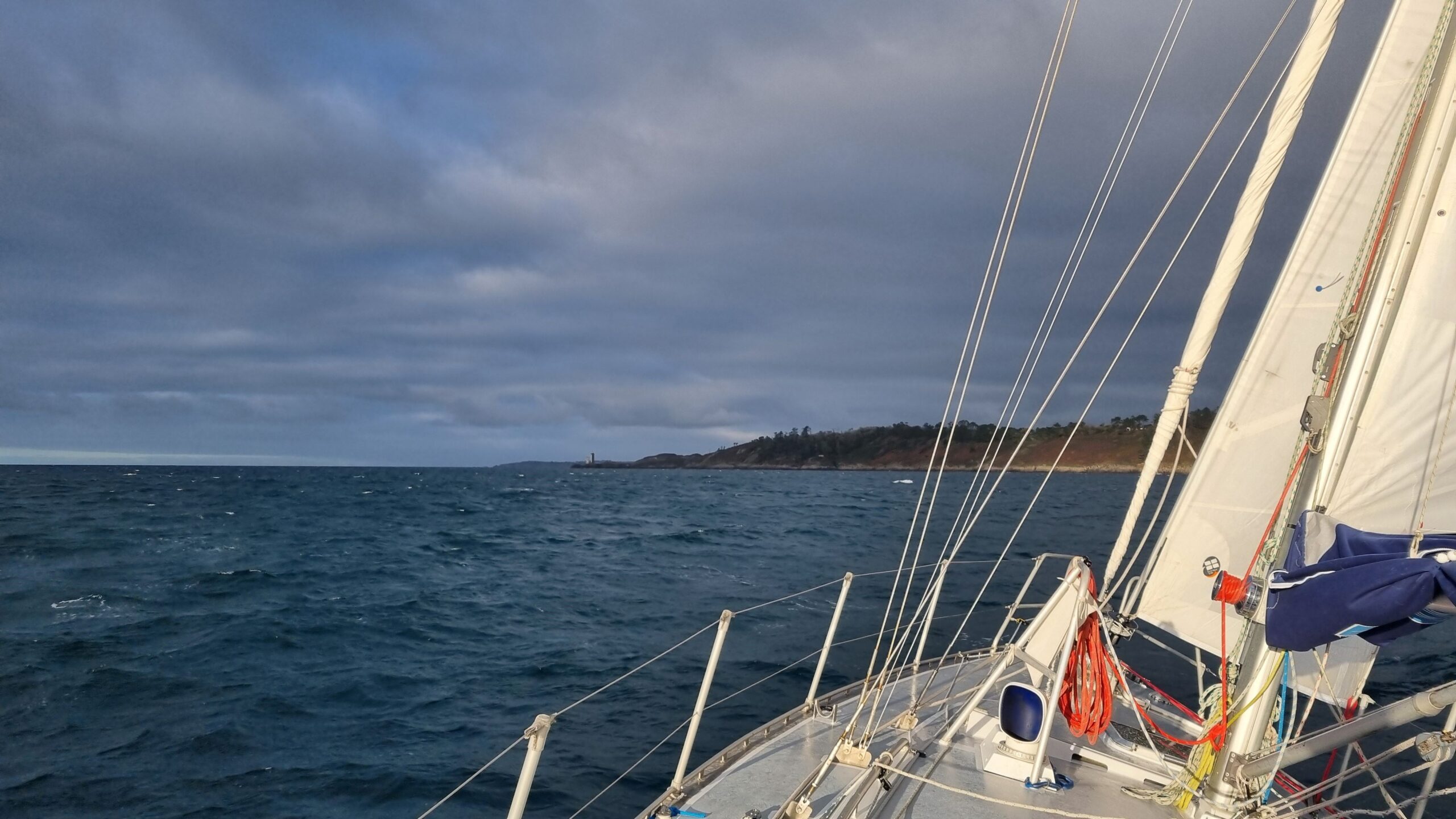
Tacking our way out of Brest
The navigation goes smoothly, close-hauled in a moderate wind and a big western swell. We can’t hold a direct course to the Pointe du Raz and we are going to be just on time for the current… So, we put a good amount of sail on the boat to go as fast as possible, and we are very happy to have a new lower shroud!
Finally, we reach the Raz just at the beginning of the counter-current, but with this being neap tides, we squeeze in! Then comes the endless Bay of Audierne, on a slightly less tight close-haul, escorted by numerous dolphins…
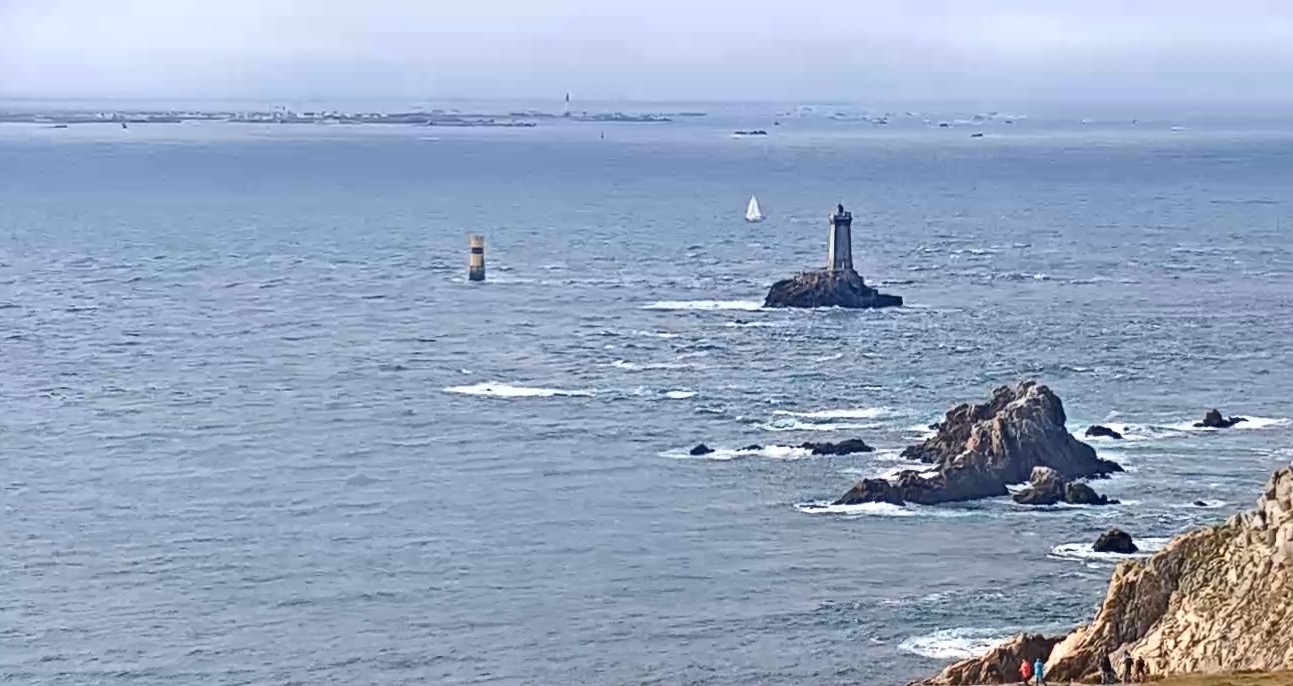
UtPåTur crossing the Raz de Sein, captured by the webcam at Pointe du Raz!
Night falls early and it is already dark when we approach the Pointe de Penmarc’h and its lobster pots… With no moon and under drizzle, the night is pitch black; we see absolutely nothing. If the dolphins continue to follow us, it is only by ear that we notice them!
We arrive at Port-Laforêt a little after midnight, with Laure on watch at the bow, equipped with a spotlight to flash the countless lobster pots. We sailed seven hours by night to arrive late in the evening, much more than most of our full nights this year… winter is coming, for sure…
October 29 – November 2: Stopover in Port Laforêt
The purpose of this stopover is to do a major check of the rigging with a professional to (re)gain confidence in our mast. We also have a multitude of questions, such as how to replace a broken lower shroud at sea (hypothetically…), or how to maintain our furling gear. Finally, we want to install a system allowing us to rig a storm jib if needed.
Everything goes smoothly; the rigging is generally in good condition, and we just make a few improvements to be even more confident : adding another degree of freedom on the staysail stay, changing the mainsail halyard sheave which had become ovalized, and reinforcing the spreader supports which were starting to wriggle a bit.
For the storm jib, we opt for a free-luff solution. Thus, we just reinforce the spinnaker pole topping lift sheave and, by using a Dyneema halyard, we will be able to hoist our storm jib directly.
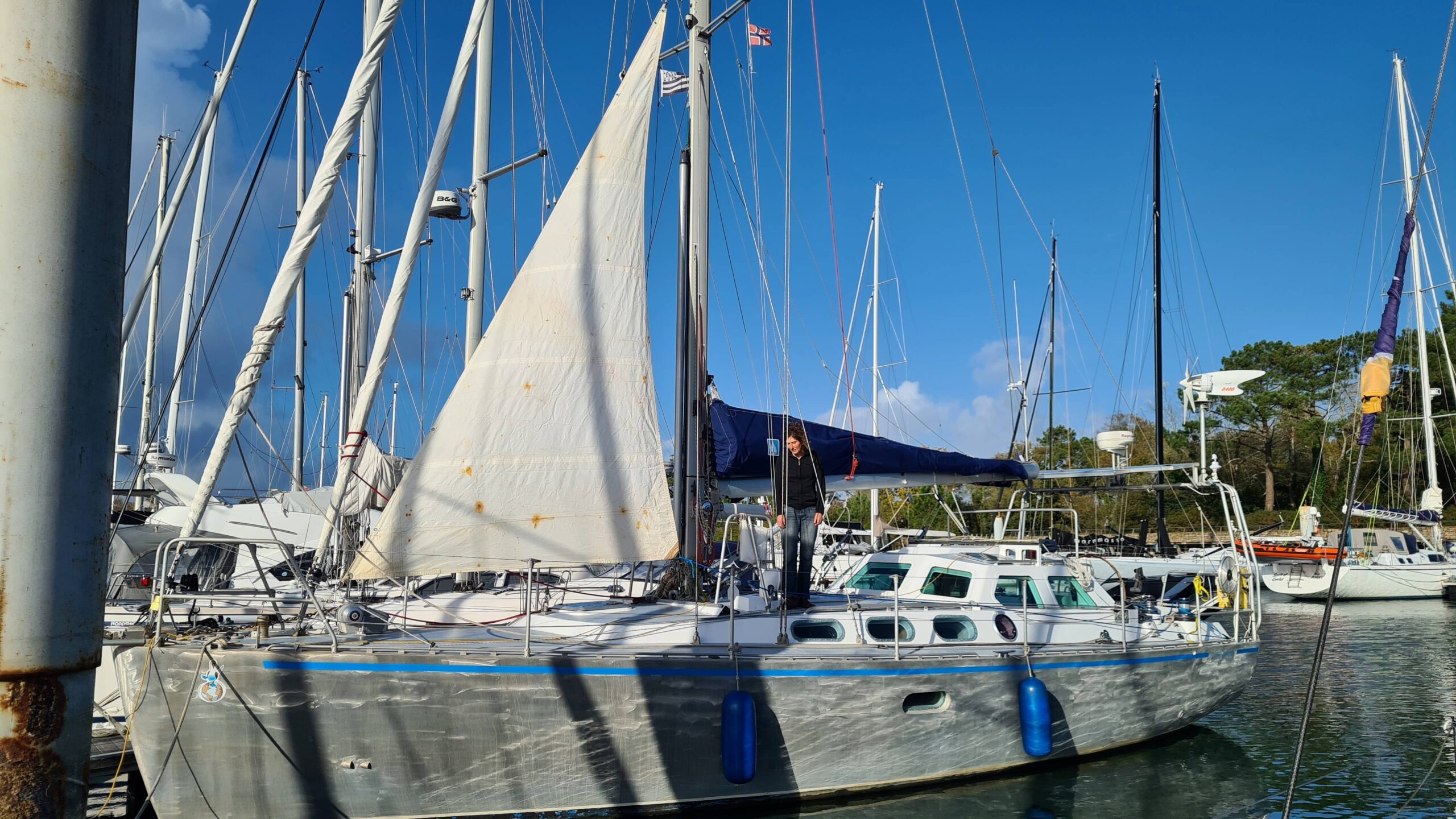
The storm jib! If we have to use it one day, it will be blowing hard…
We finish this check with a major mast tuning, tightening the shrouds which had always seemed a bit slack to us.
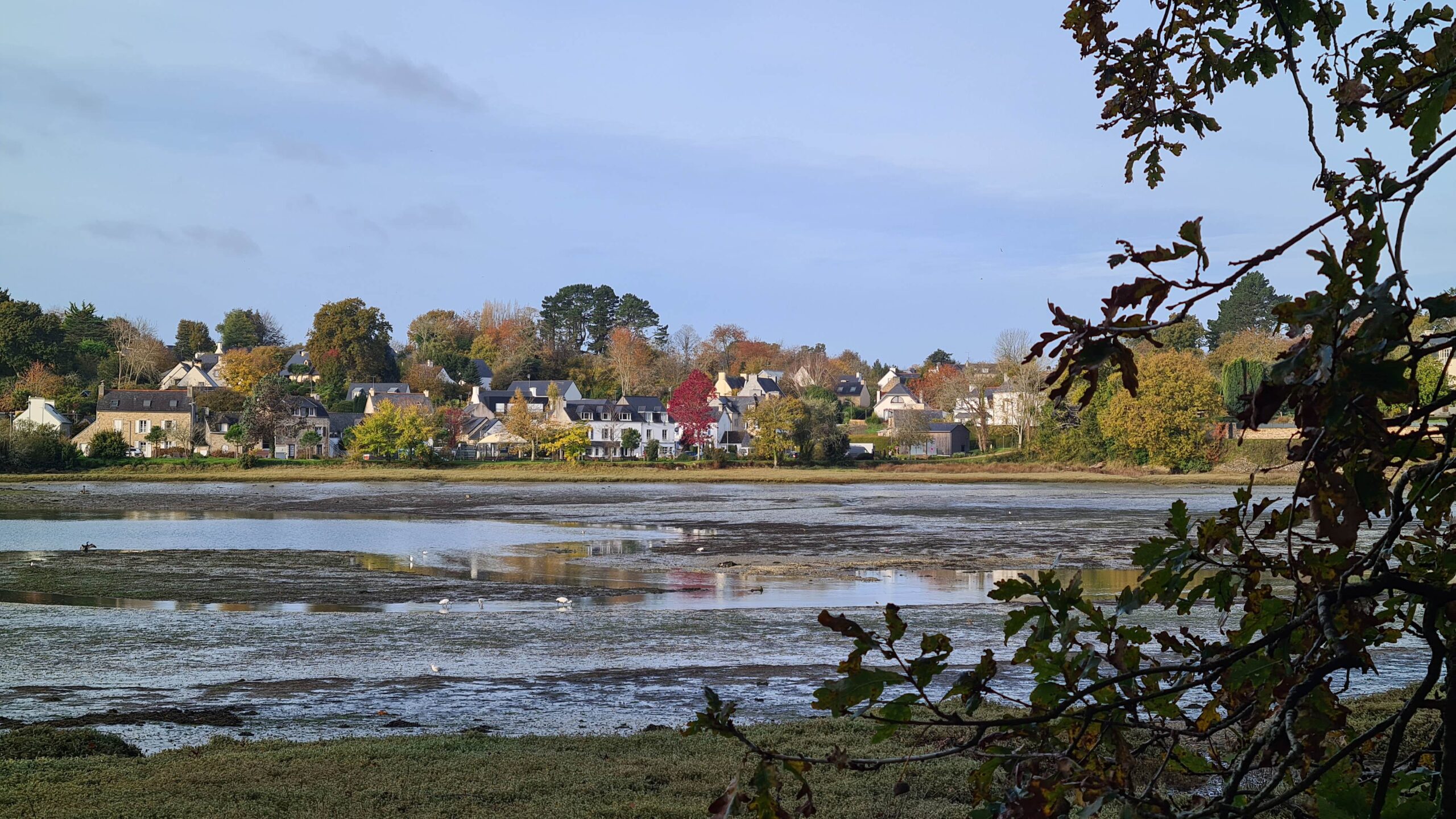
In between working on the mast and meeting nice people, we also took time for a few walks in Fouesnant
That’s for the technical part. The stopover was also marked by meeting Anahita, a Mareuil, a 12-meter aluminium ketch, and her super friendly crew! Aude and Frank have sailed a lot in Southern Norway and the Baltic, partly with their two boys, Simon and Maël. You know us, as soon as we can talk about Scandinavia, we’re in! And then the discussions continue, we talk about aluminium sailboats, long distance cruising, and we have a great time. So nice to have met them!
November 3: Port-Laforêt – Lorient (34NM)
The wind, which has been consistently blowing near gale force lately, takes a short twenty-four hour break. Perfect for moving one square closer to our winter shipyard, so, heading for Lorient! The navigation still promises to be quite windy, and we have an additional complication: while Laure has recovered, it is now Camille who is down, and completely voiceless! We will be able to test how coordinated we are at sea…
We are ready to leave, but when it’s time to lower the centreboard, to our surprise, it doesn’t move a millimetre! Damned! We try hitting it with a hammer to dislodge a misplaced periwinkle perhaps, but nothing works… The route to Lorient is mostly a beam reach, an angle we can sail without the centreboard. We decide to leave anyway, hoping that it will eventually drop at sea with the impact of the waves.
And indeed, after about an hour, it finally starts to drop, millimetre by millimetre, to eventually find its low position… We try to raise it gradually, only to find that the problem is still there and the centreboard drops only with great difficulty. So, we continue like this towards Lorient, in conditions that are a bit lively but efficient: we are doing about 7 knots under 1 reef and staysail. But we can’t enjoy this navigation with our wounded boat. It’s a shame because this will ultimately be our last sailing leg this year…
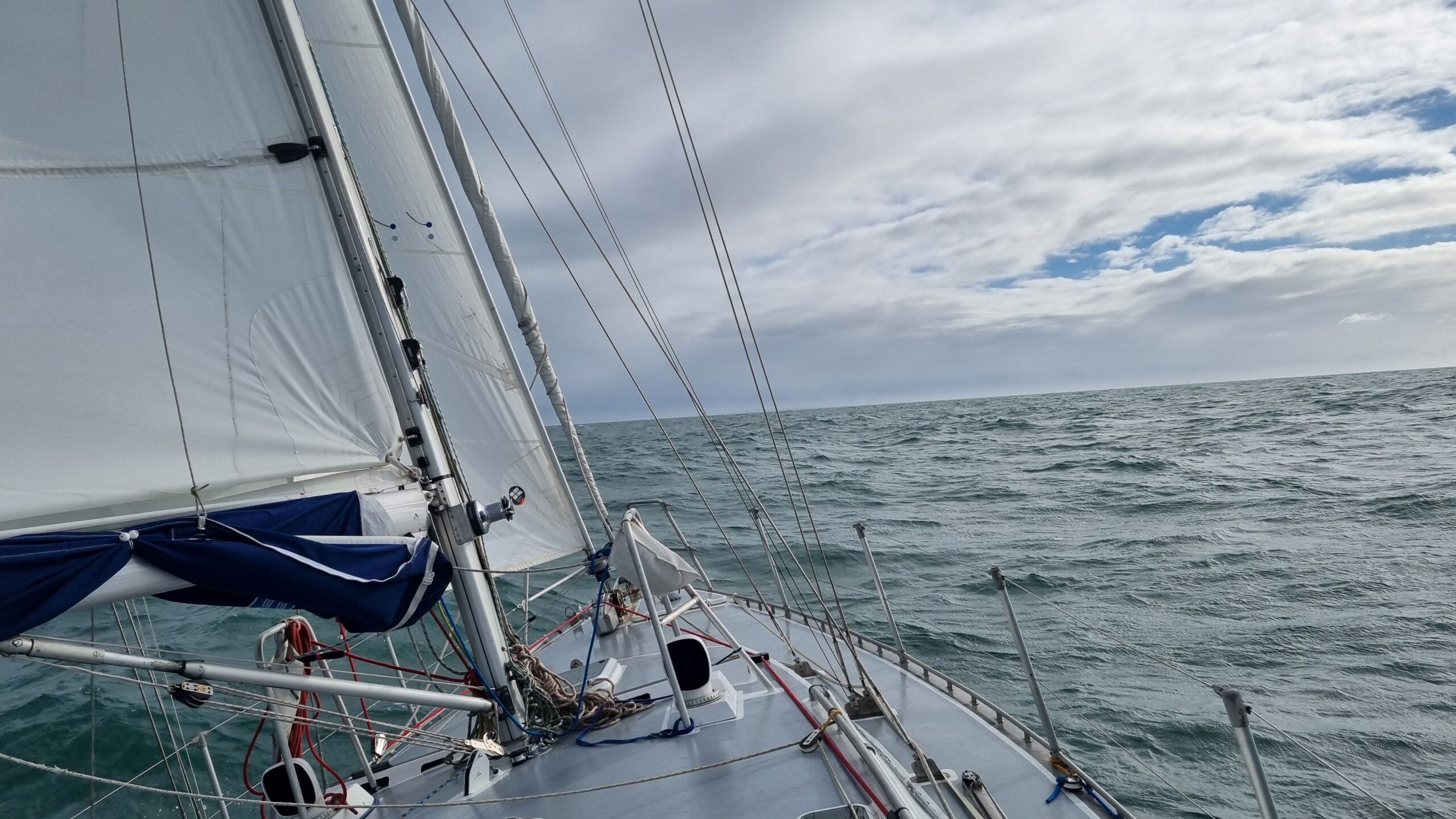
Full speed towards Lorient!
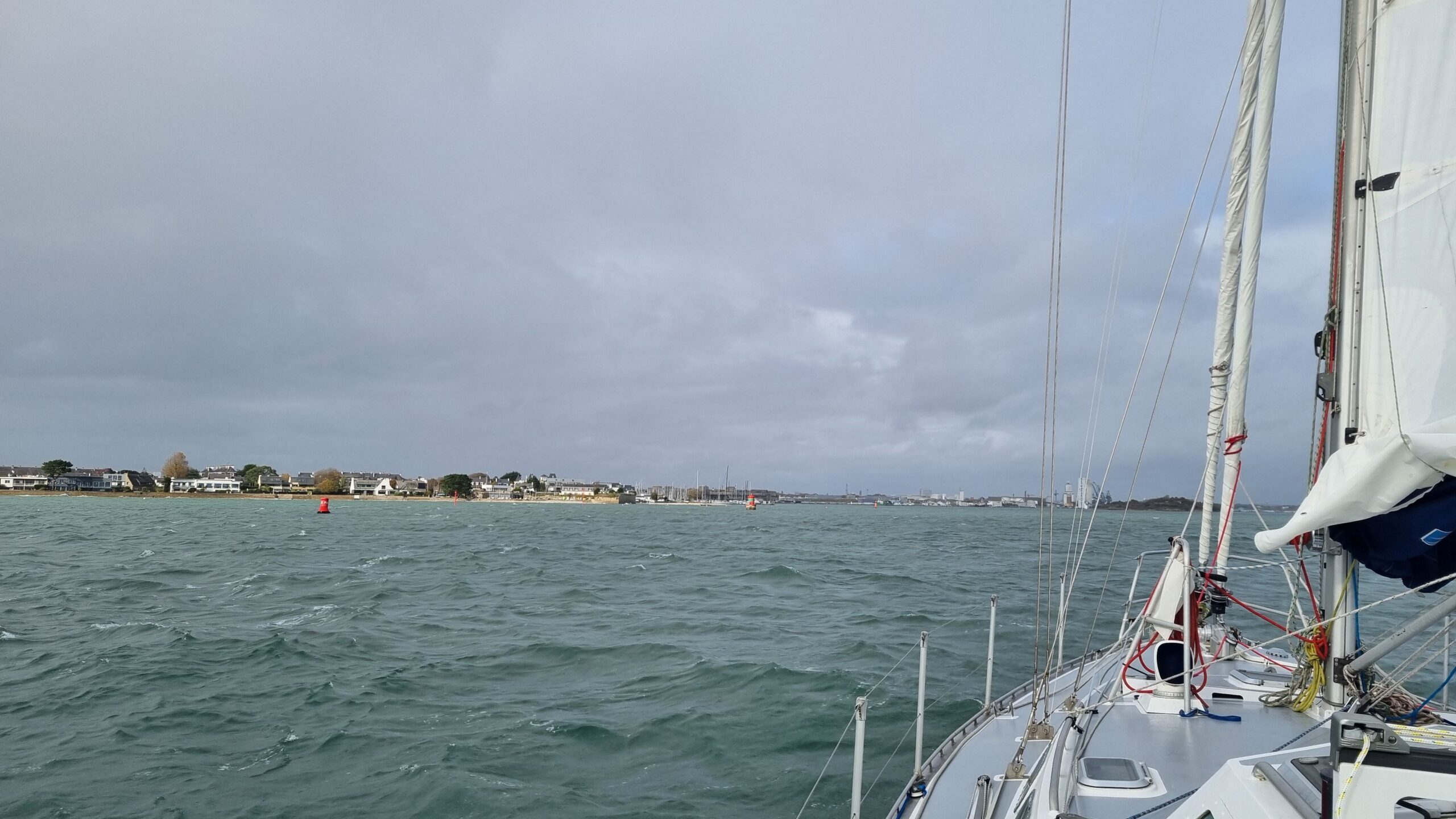
And here we are, arriving in Lorient, just like last February! A lot of water has flowed under the hull since then…
Upon arrival at the Port du Kernevel, everything seems strangely familiar. That’s because we spent time here during our very first weeks with UtPåTur! And after 8 months at sea, one thing is certain: we have made good progress in confidence and harbour manoeuvres! And all this without exchanging a word :o) We are moored almost in the same spot as in February, and we would really be in the mood to celebrate if it weren’t for that damn stuck centreboard…
November 4-12: Stopover in Lorient
Let’s be pragmatic: the centreboard worked perfectly before arriving in Port-Laforêt, we tightened the rigging, and now it doesn’t work at all. So, even though there is no reason for the two events to be linked, we still try to loosen the shrouds a bit to see…
And then, a miracle: the centreboard goes up and down as if nothing had happened… Against all odds, tightening the rigging must, in a certain way, slightly deform a plate in the centreboard casing… Well, we found the rigger’s setting really very stiff anyway, but we would have liked to have the shrouds a bit more tensioned than this year nonetheless… So, we try an intermediate setting, tightening the backstay more and leaving the side shrouds quite flexible. We tighten a bit, check if the centreboard drops—ah, no, it’s a bit too tight, we have to loosen a bit. It’s already not easy to tune a mast, but with this added constraint, it becomes really complicated… In the end, we find an acceptable-but-not-perfect setting, with the centreboard stuck just a little at the beginning. This is not very satisfactory, and we don’t want to leave for the South like this. It’s decided, we will have to drop the centreboard in the shipyard to rectify the problem this winter, and add this big item to our already substantial work list… Admittedly, our morale is not at its highest…
Fortunately, we have friends at Kernével, the Anouhés, whom we haven’t seen since Lerwick but with whom we have stayed in contact. No sooner had we moored than we were already summoned to bring our laundry and borrow the car if needed! What a welcome!! We can’t wait for Camille to be able to speak three words together other than by whispering so we can relive this year’s navigations over a drink and a good dinner!
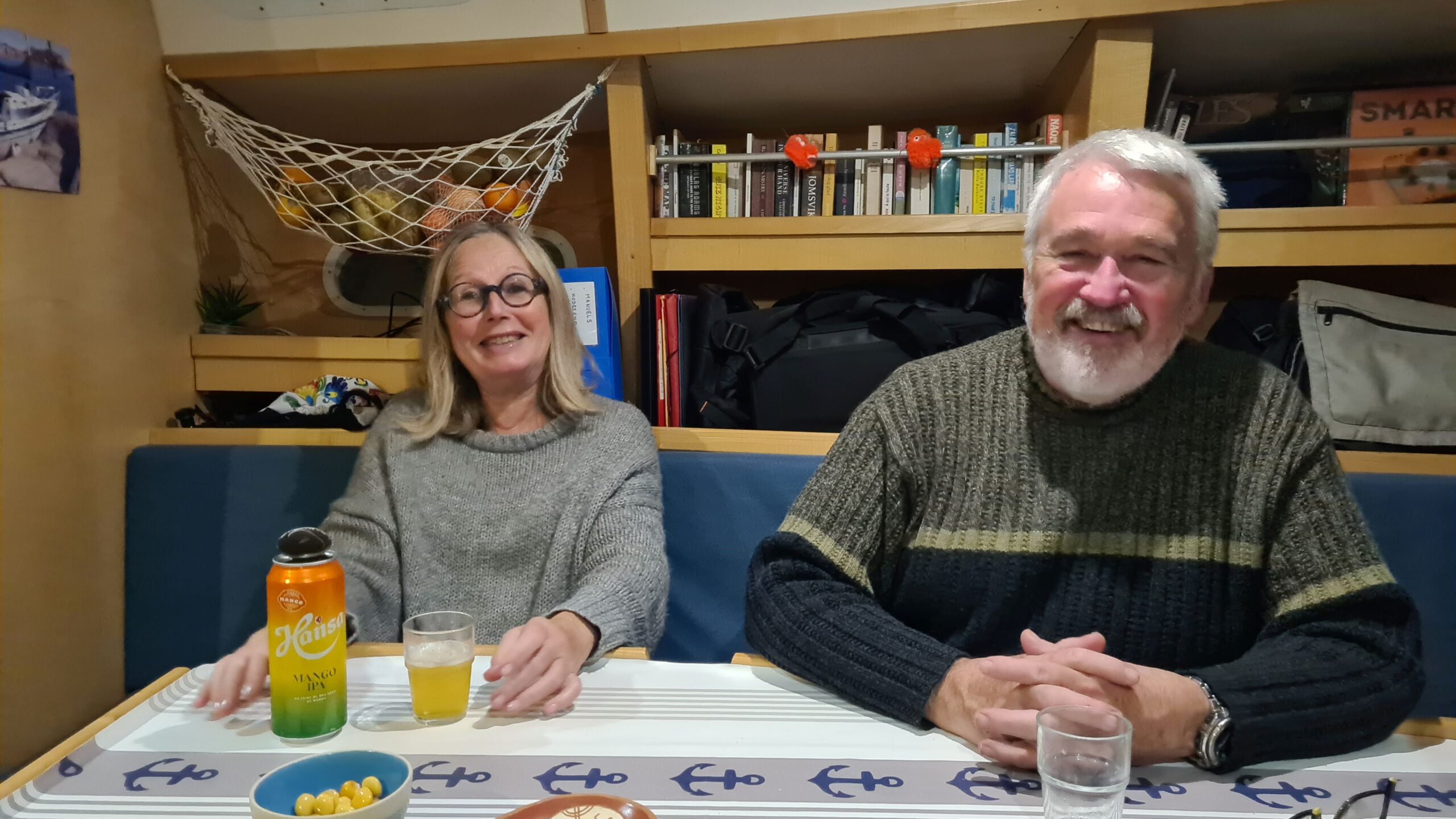
Our friends the Anouhés, thrilled to share one of the Norwegian beers we still had!
We still have a week before going to the shipyard and hauling out the boat, and we take advantage of it to push through our long list of small jobs as much as possible. The major operations will have to wait until we are dry, of course.
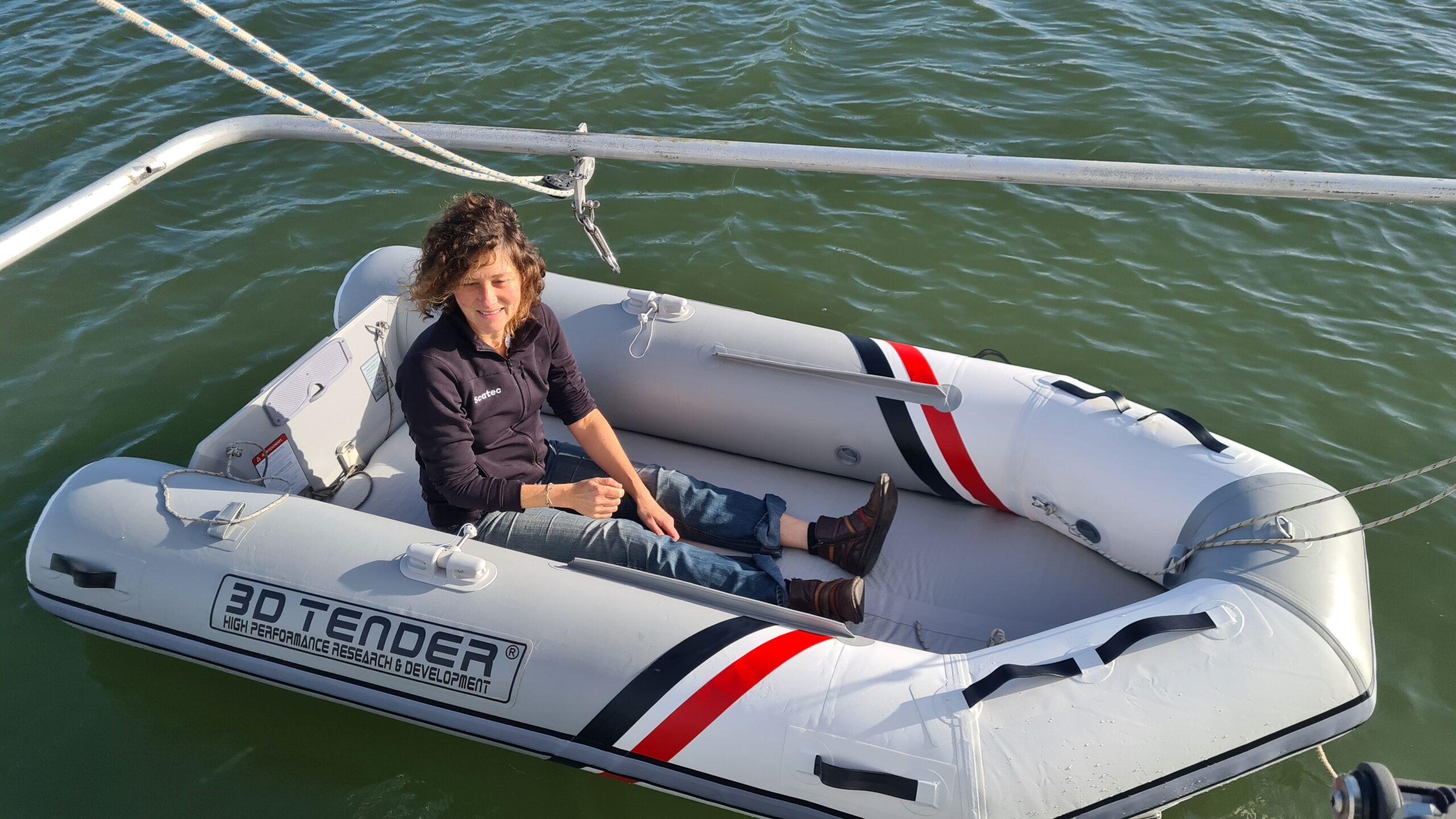
Laure approves the new tender, comfy enough!
We start with pleasant activities, like taking out our new dinghy and preparing it so it can be lifted into the davit, or redoing the anti-slip on the companionway. We also change the small NMEA / Wifi server that distributes AIS positions via Wi-Fi to the navigation tablet, and which wasn’t working. This seems quite successful!
We continue with the making of a spare snubber (this is the line that holds the chain when we are on our anchor). It had been a long time since we had done a “real” splice on a 3-strand line! And, on the only day when it doesn’t rain or blow too hard, we unrig the headsails… it’s the end of sailing for this year…
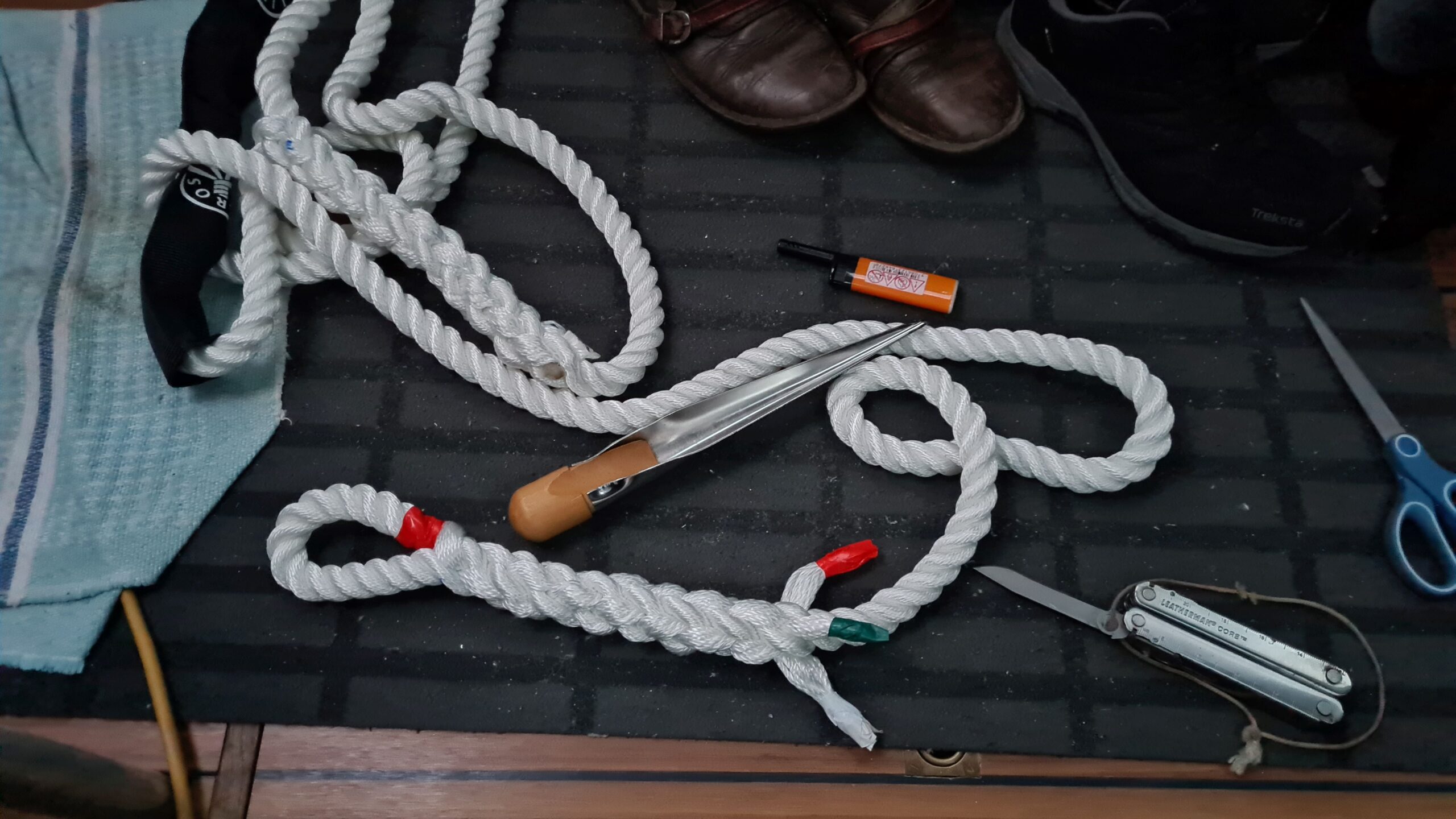
Nothing like a splicing activity on rainy days!
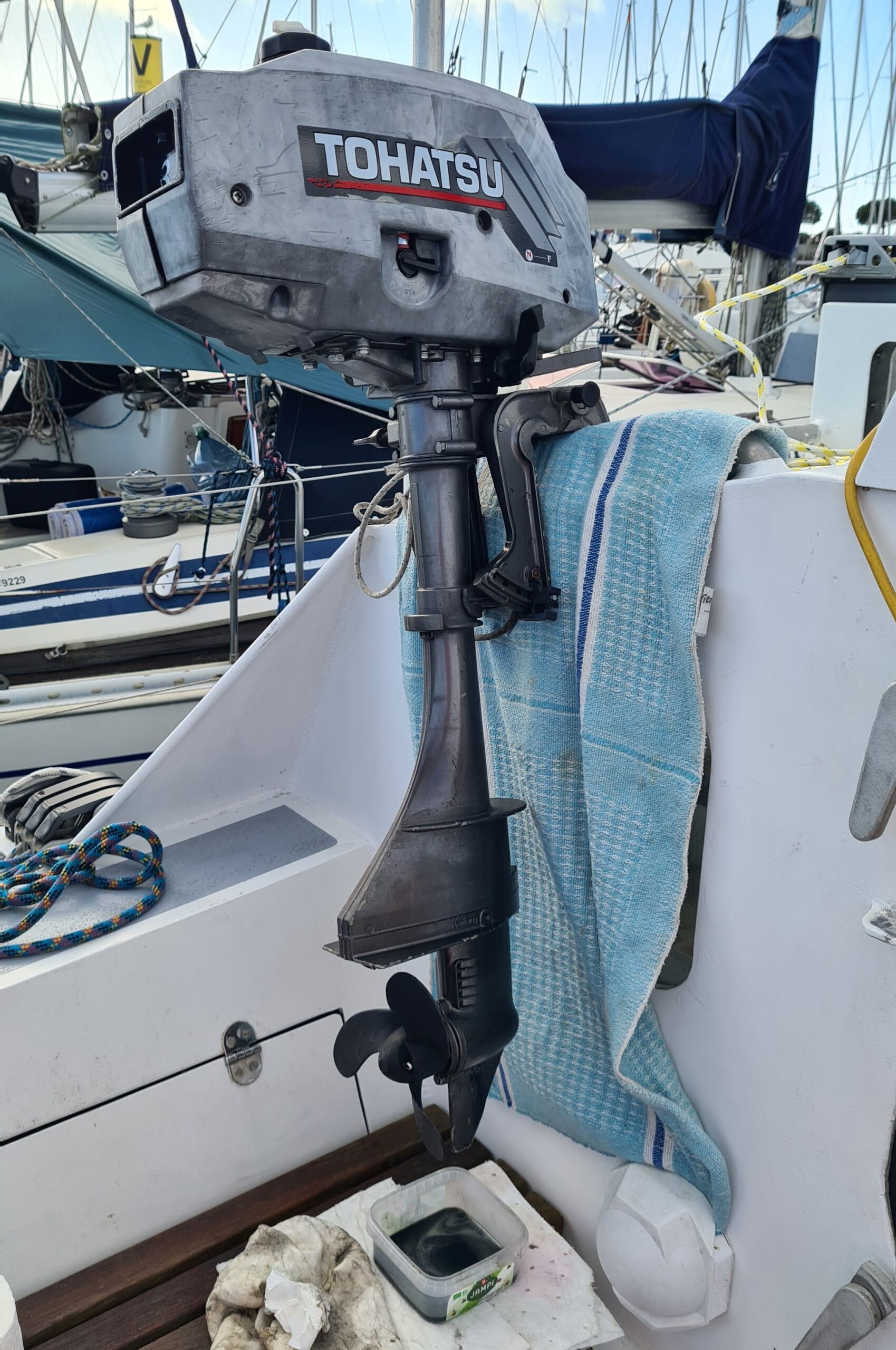
Improvised outboard workshop on the cockpit
Then less rewarding activities await us: itemizing all our spare parts and lines, maintenance of the outboard engine, and – the icing on the cake – cleaning the black water tank! We also check all the safety equipment, and gradually start emptying and cleaning every nook and cranny of the boat.
Between all these small jobs and our busy social life, we haven’t exactly taken the time to wander around. A few steps on Larmor beach, a lovely walk around the Étang du Ter which sometimes reminds us of the Vestmarka forest near Oslo, and a trip to the city centre to admire the boats, including a Patago 50, another aluminium sailboat by Jean-François André also leaving for the South. We were playing at “spot the differences” with ours without paying too much attention to the big Allures to which the Patago is rafted, when Laure finally realizes: it’s the boat of Géraldine’s father, her best friend from uni! The sailing world is really small… Beautiful boats indeed, but all empty for the moment; we return to Kernével without having met more sailors.
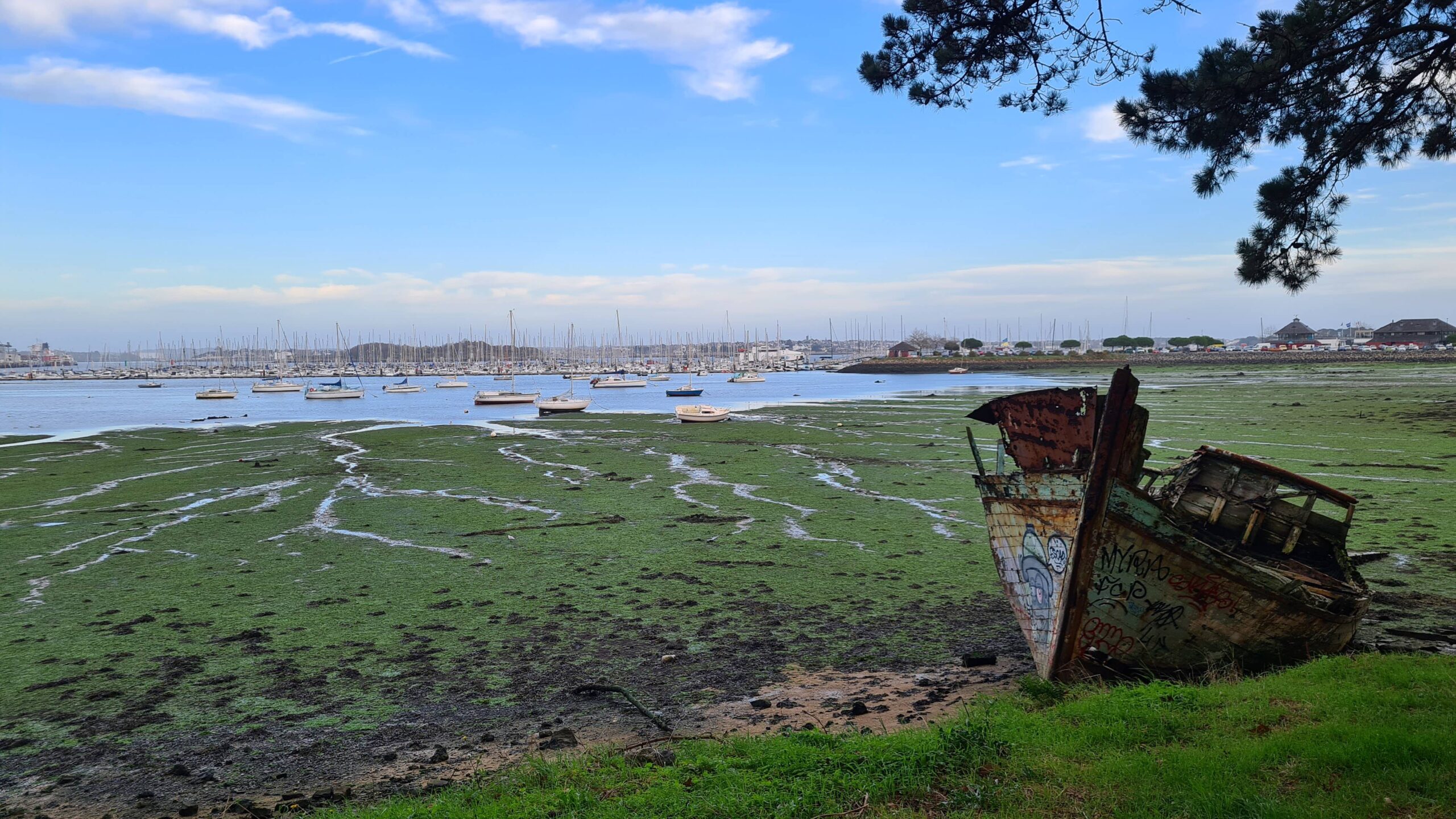
Around Kernevel harbour
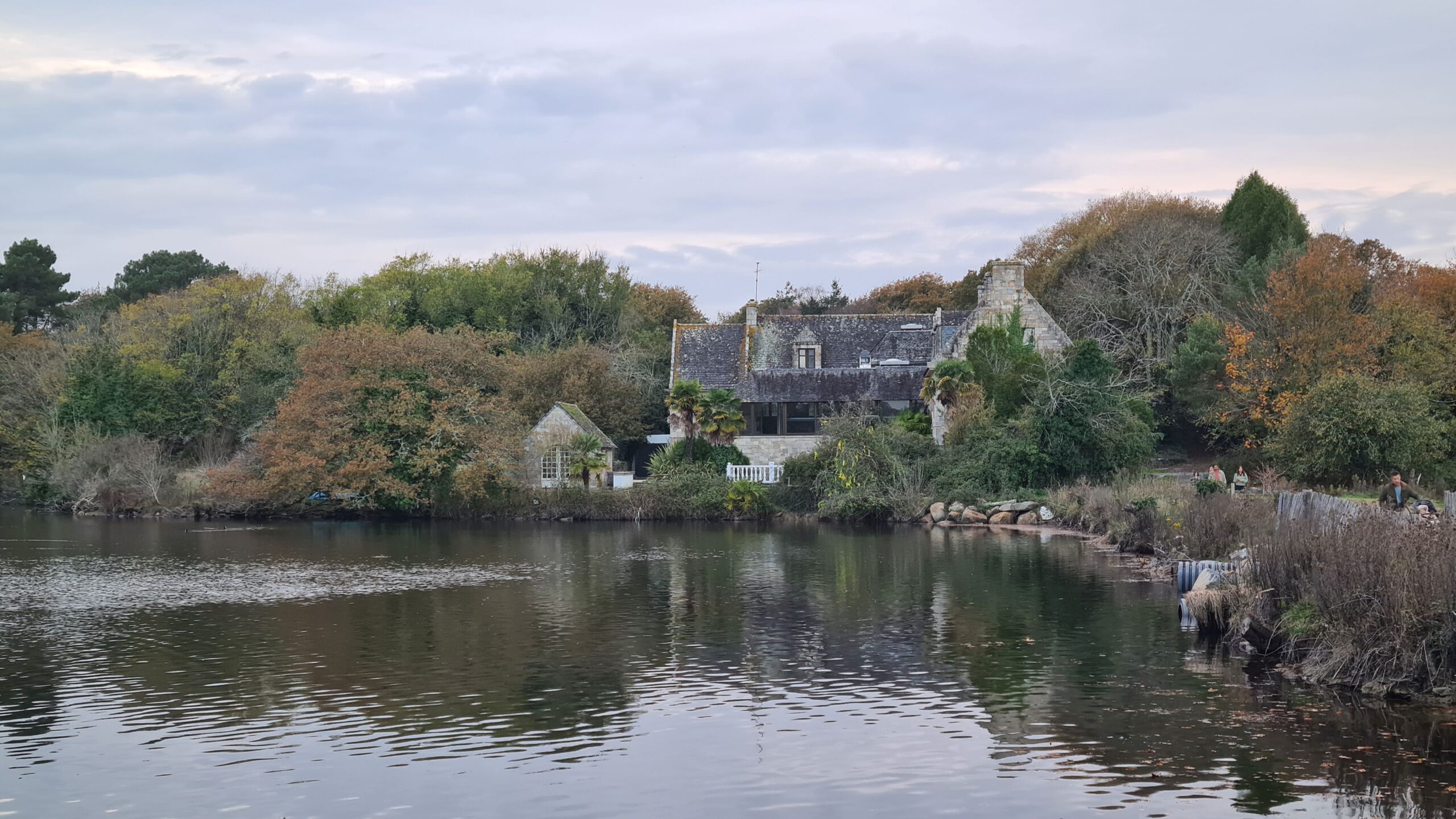
The surroundings of Étang du Ter
One last evening with the Anouhés on board, the revenge for the excellent dinner we shared at their place, and it will be time to head to our winter quarters, deeper inland on the Blavet River…
 PDF