
The full photo album here.
20th-21st May: Stornoway – Kinlochbervie (61 NM)
After the incredible Scottish holidays in the sun, it’s time to pick up the thread of our journey and head towards our northernmost destination this year: the Norwegian west coast. The wind isn’t quite of that opinion however and keeps blowing from the north… oh well, we’ll have to make do. So we set off upwind, in misty weather that further accentuates the feeling of being back at work.
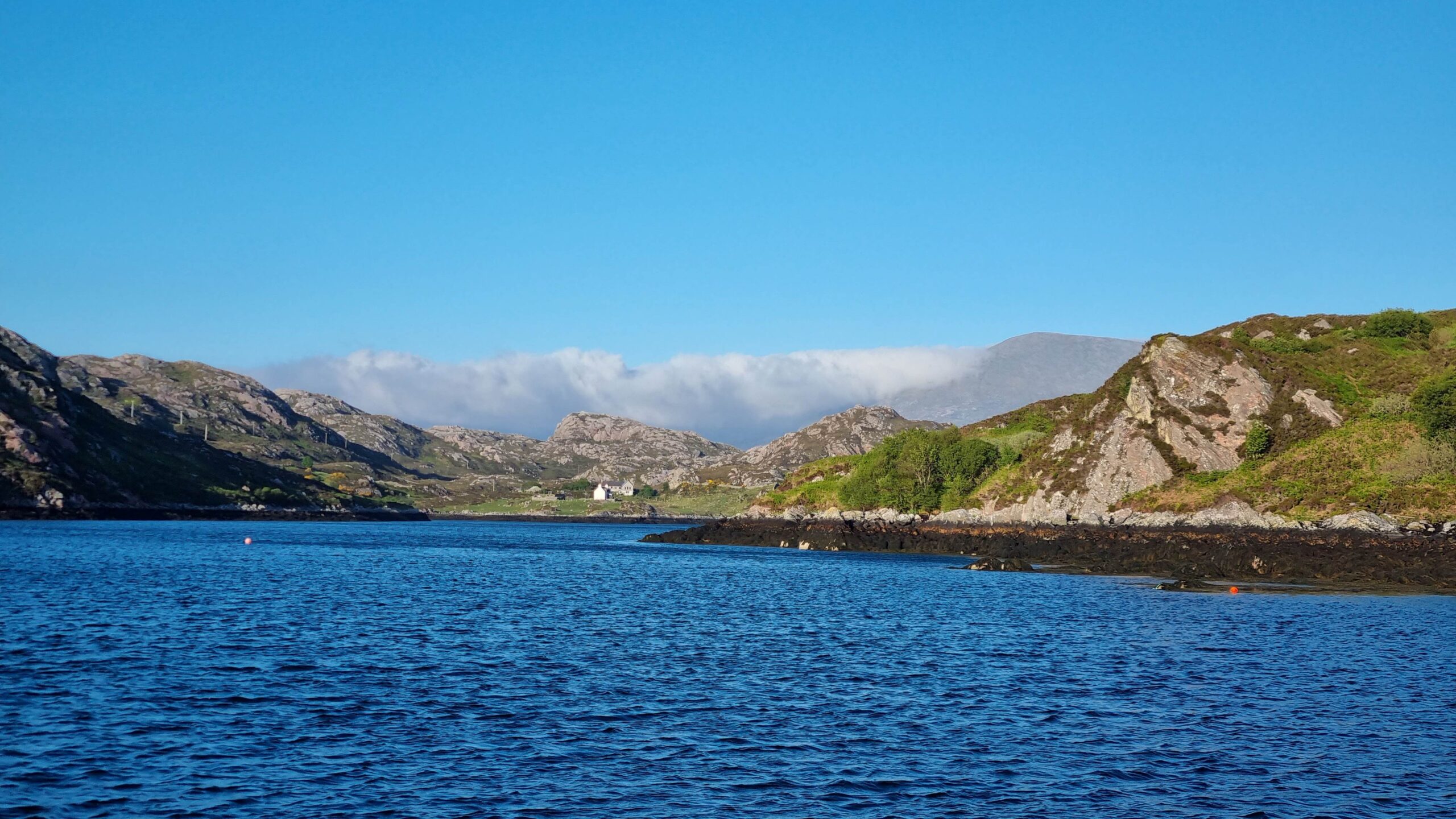
We sneak deep into the Loch Laxford
The fog clears after a few hours, letting the sun shine on our battle against the wind. We first tack close-hauled directly towards Scotland mainland, without any specific destination: we’ll spend the night wherever the wind takes us. This will be Loch Laxford, which we find hard not to call “Laks Fjord”, the “salmon fjord”… It’s teeming with fish farms, too! After a few zigzags between pot buoys, islands, fish traps and rocks, we arrive in a small, round bay at the foot of some very impressive mountains.
It’s beautiful and spectacular, but also a little worrying because this relief has a typical look of a katabatic gust creator… Bingo, here come the gusts! But they won’t exceed 23-24 knots, and with 35 meters of chain in 3 to 4 meters of water, we spend a good night.
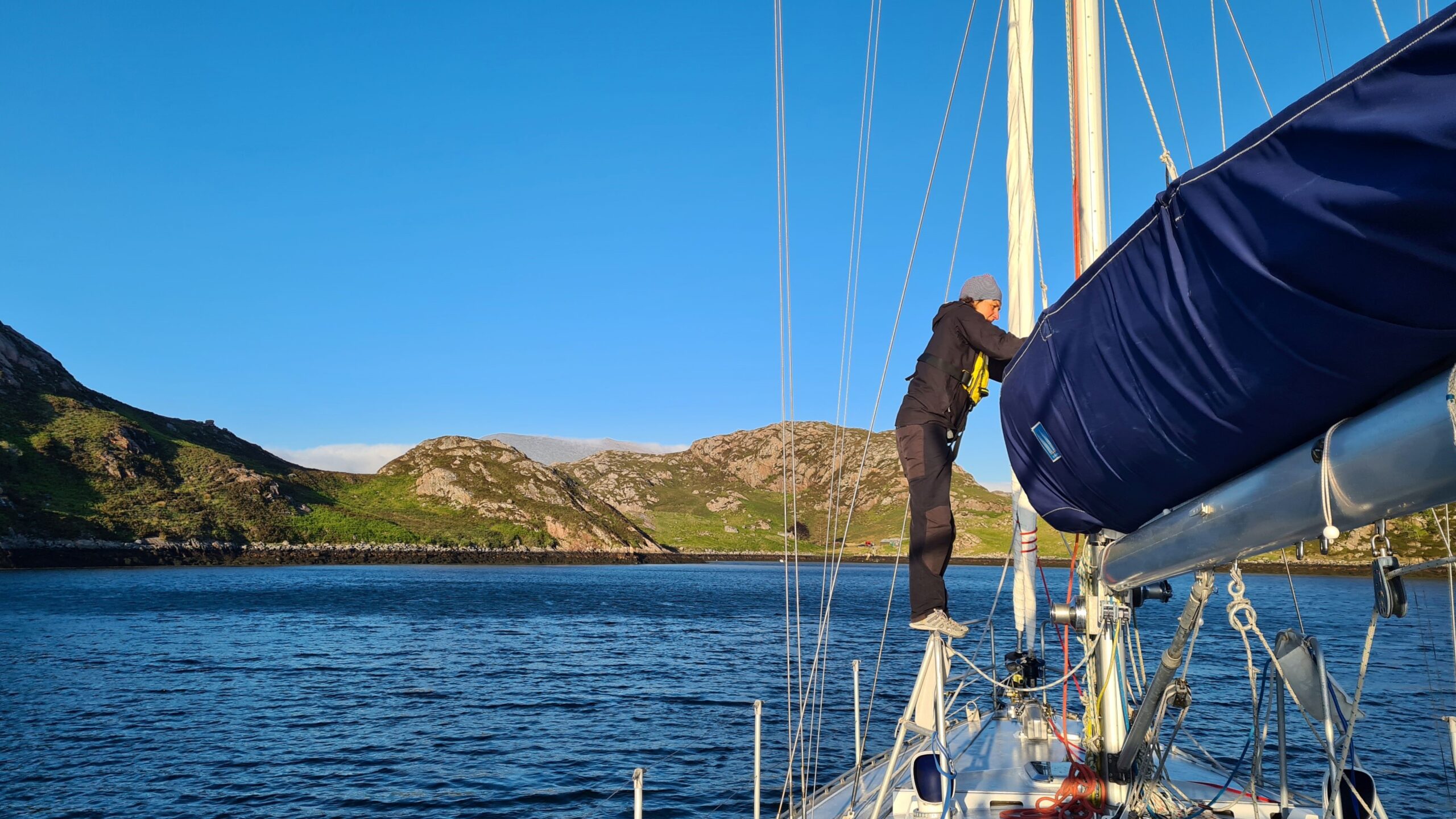
Laure finishes packing the main sail before the next gust…
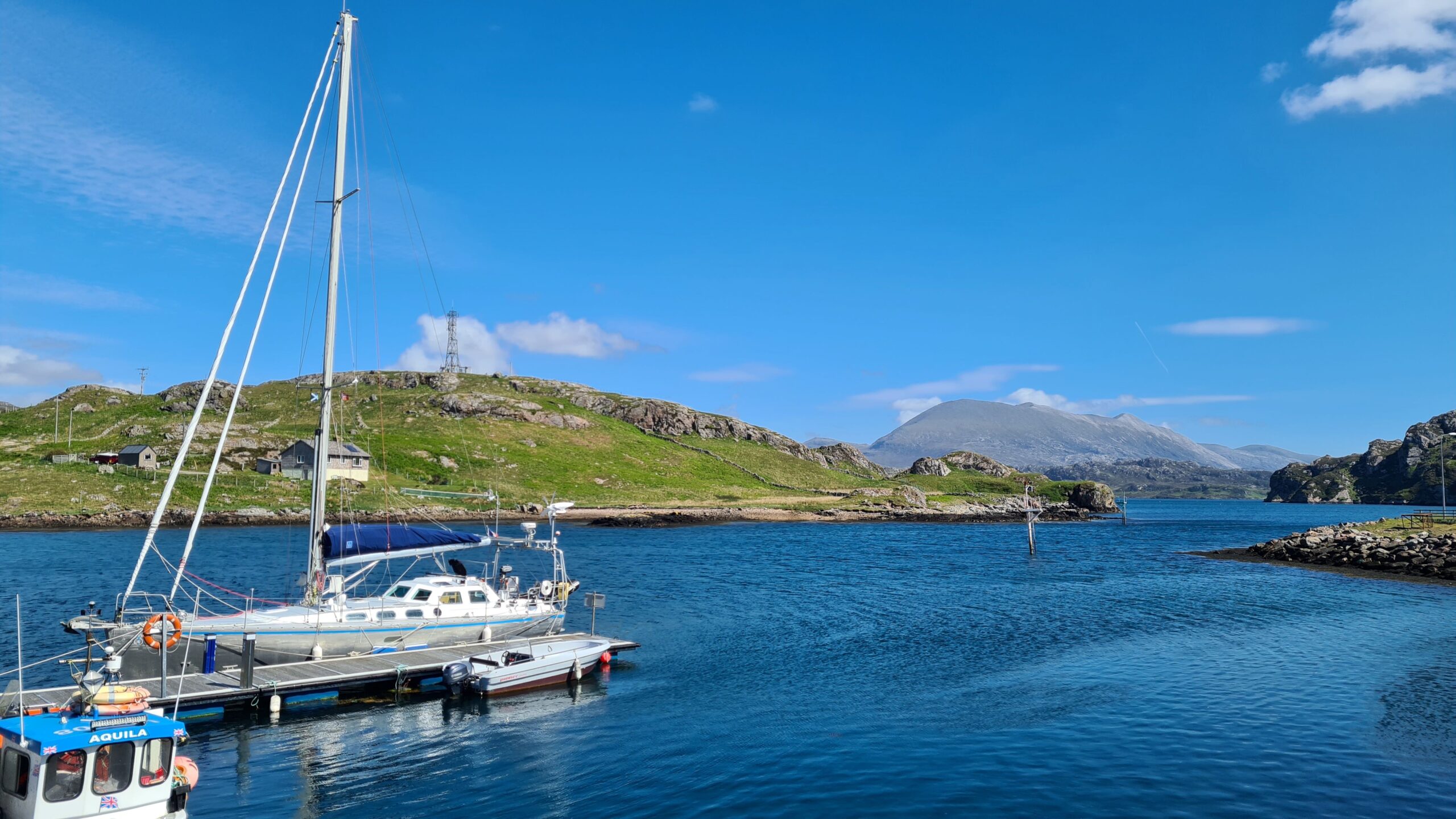
Kinlochbervie
The next day the wind veers a little to the East and strengthens, not the best conditions to round Cape Wrath, so we just make a very short trip towards the next loch. We first try anchoring in a pretty sheltered bay in the North-East, but to our great surprise local gusts come from the West… Strange… To our even greater surprise, the anchor doesn’t hold and we gradually drift towards the head of the bay. Finally we give up and leave to spend a night at the Kinlochbervie pontoon right next door.
Kinlochbervie is primarily a trawler port, the closest to the North Atlantic fishing grounds near Iceland and the Faroes. There’s also a pontoon for passing sailboats. We’re the only boat, so maneuvering isn’t too difficult! On land, there’s nothing and no one; we feel a bit like we’re moored in a ghost town… Our only neighbours are the ever-present seals!
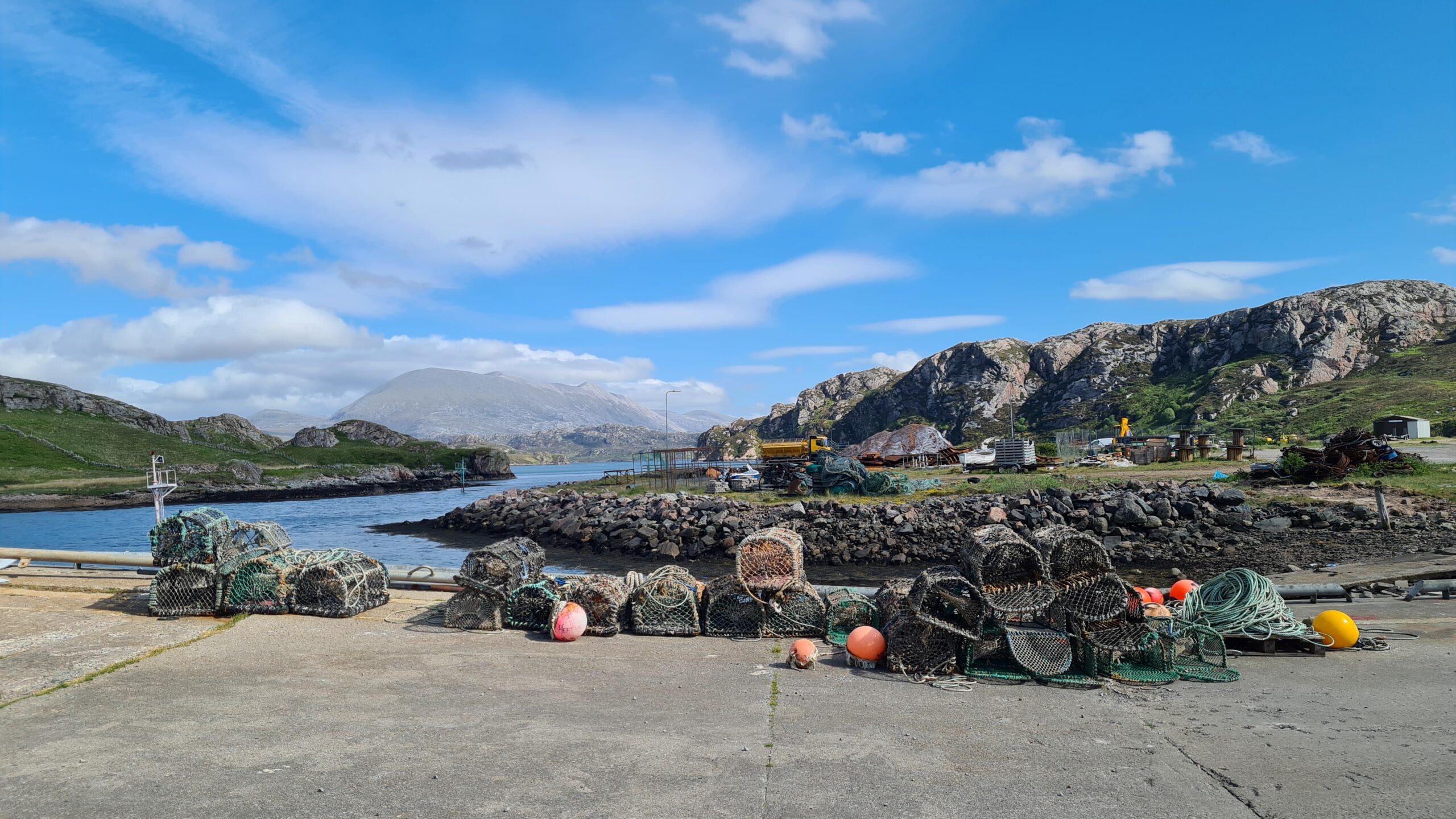
It’s calm, only the lobster pots bear witness to a human presence…
22nd-23th May: Kinlochbervie – Stromness (95 NM)
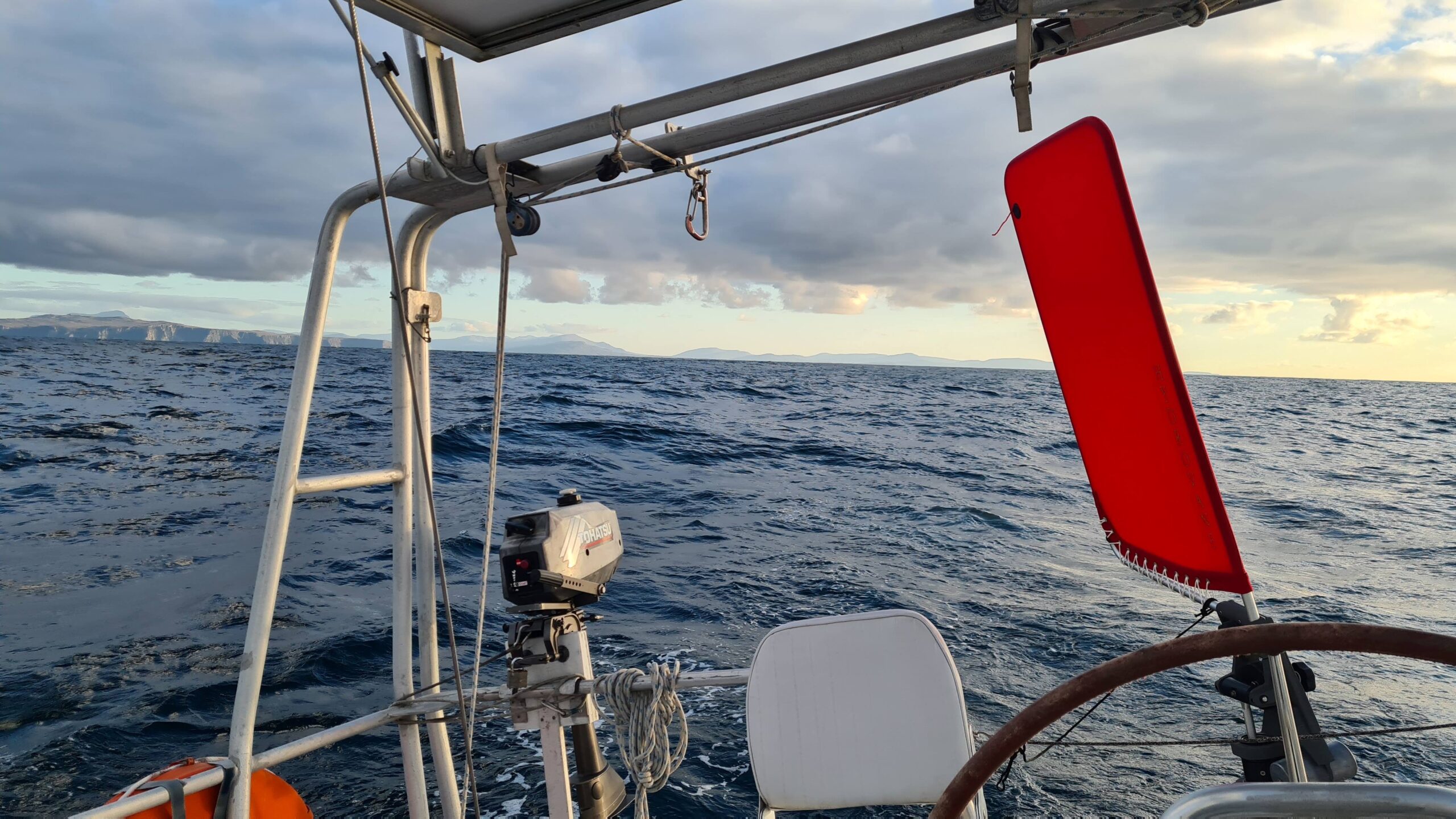
UtPåTur leaves Scotland behind her…
The wind has eased and is supposed to blow more north than east, which is what we need to round Cape Wrath, the northwest tip of Scotland, and reach the Orkney Islands. The weather is still relatively nice, but the temperature reminds us that we are now at 58 degrees latitude: it’s freezing! Visibility is excellent however and we can see the entire North Scottish coast, which we hadn’t seen at all in the overcast weather of last summer.
The wind, unfortunately, is more in the nose than we had hoped and we are beating against the swell. The sailing isn’t very pleasant, quite slow and rolling… we allow two hours of motoring at the end to cover the few miles that we can’t manage on a direct tack. Musclor gives its best and allows us to arrive with the current, an essential condition for entering the Orkney archipelago.
The Orkney Islands are located northeast of Scotland, and we’re clearly no longer in the Highlands. The islands are low and round, heavily cultivated, and feature this bright green colour we thought we had lost since Northern Ireland (it was replaced by brown and yellow). Above all, the archipelago is crisscrossed by very violent currents, easily reaching 7-8 knots in each narrow passage, creating waves and races when conditions aren’t optimal. The worst part is the passage between the archipelago and Scotland itself, which is almost impossible to navigate with a sailboat.
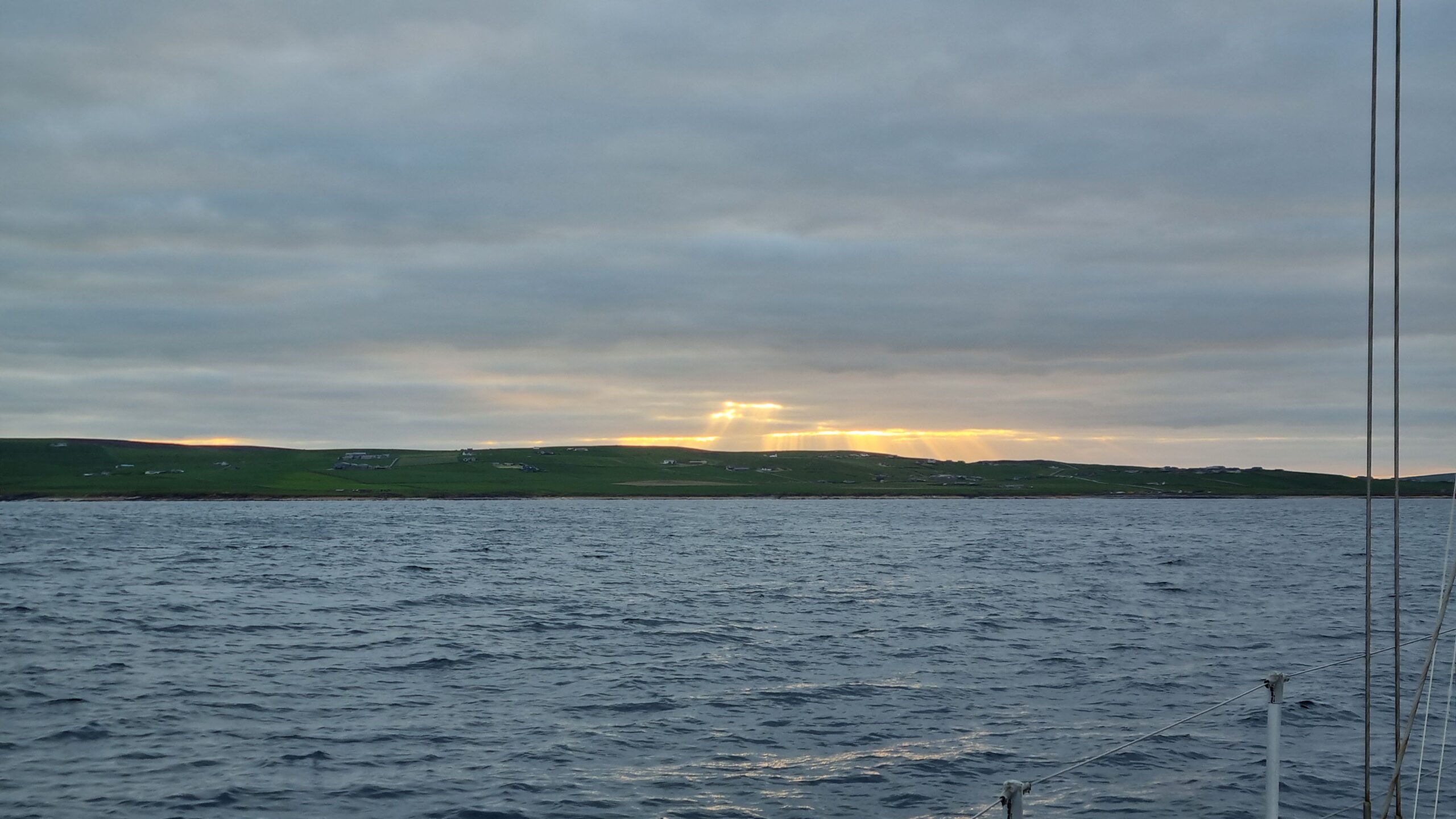
We arrive in the Orkneys in the divine morning light
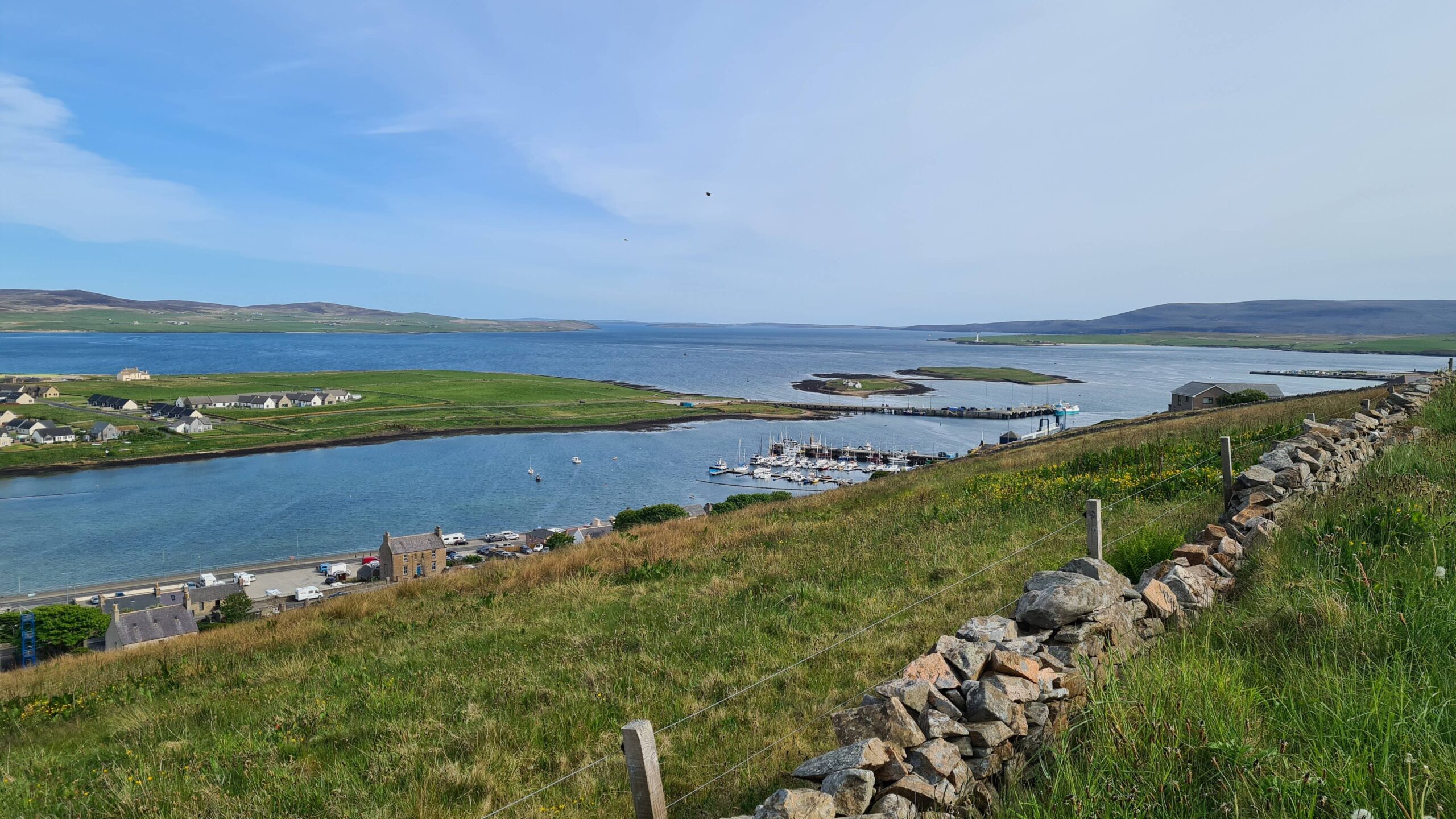
Stromness, very well sheltered from westerlies!
This early morning, with a slackening wind and a northerly swell, the sea is flat and we are propelled into the Scapa Flow lagoon. We take the first left to reach the port of Stromness and secure a good spot at the pontoon in anticipation of several days of strong winds to come. This will be one of the first really strong gales of the trip.
24th-28th May: stopover in Stromness
There are quite a few boats already in the small port of Stromness. Mostly Brits cruising their waters and two other French boats, including a JPK39 that we’ve already seen from afar in Scilly and Scotland. As we step into the cockpit, they hail us: “Hey! It’s us, the Anouhé! We’re friends of the Dibona, we’ve been following you on the AIS since Lorient!” And so our social calendar starts filling up again, yay!
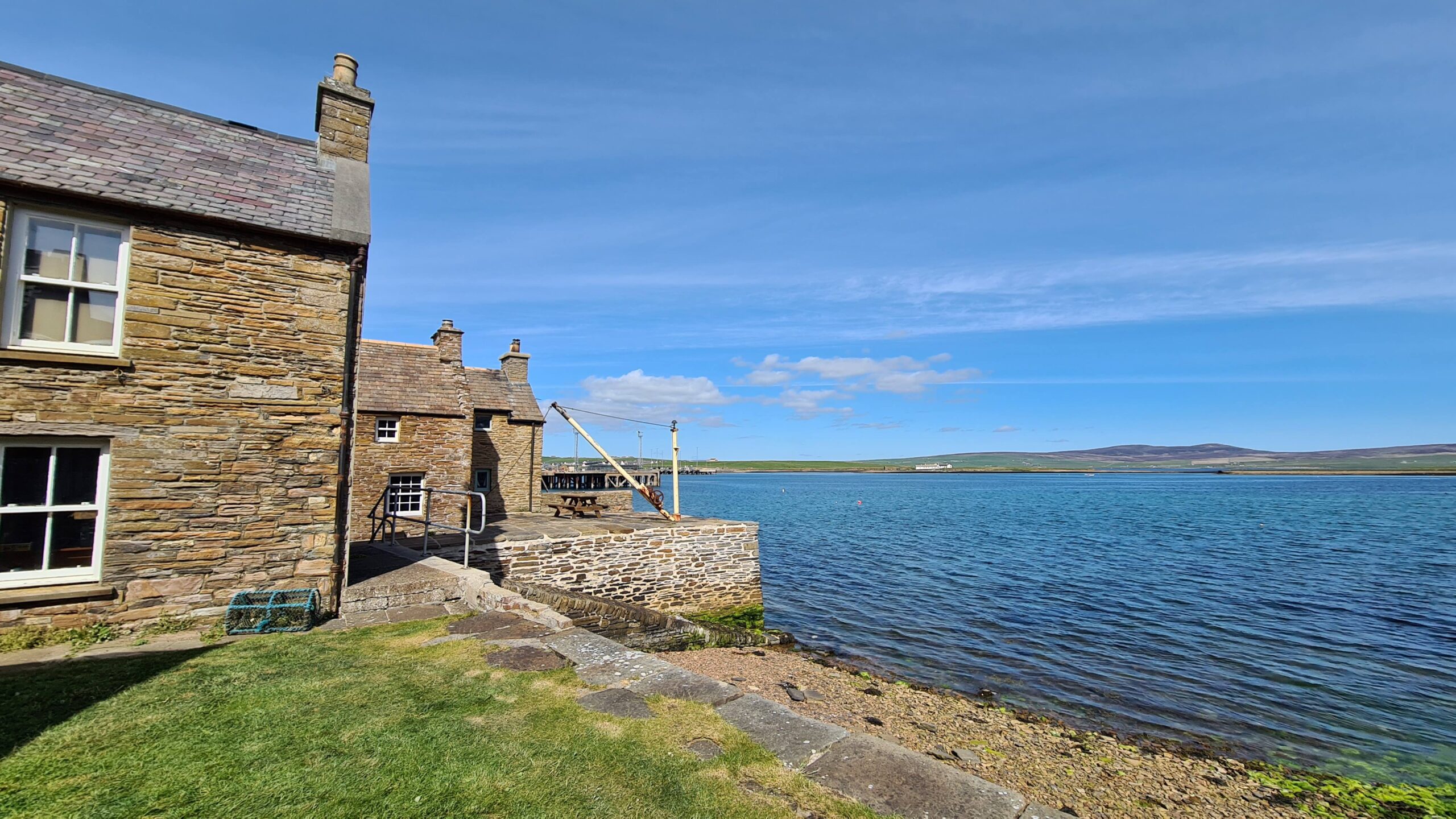
Beautiful stone houses in Stromness
Stromness is the second largest town in the Orkneys, behind the capital Kirkwall. It’s still a small village and we quickly walk through the three streets with their houses made of local stone, of a specific greyish ochre colour.
Yet the streets are packed with people, a third of whom are carrying a violin or guitar on their backs. We’re in the middle of a folk music festival and the entire town is echoing with Celtic notes. It’s really cool! We treat ourselves to a proper concert where we see five very different groups, our favourite being Malin Lewis. Originally from the Isle of Skye, they offer very modern Celtic-inspired music, mixing guitar, violins, violins tuned one tone higher (which gives them a very distinctive sound), and various bagpipes, some of which they made themselves! They are so full of energy and joy, great to see on stage! But the party happens also off-stage, outside from the organised concerts, in the pubs where dozens of young musicians come and go, joining in with the main group as soon as they know the tunes… a very nice atmosphere.
More musicians than public in this place !
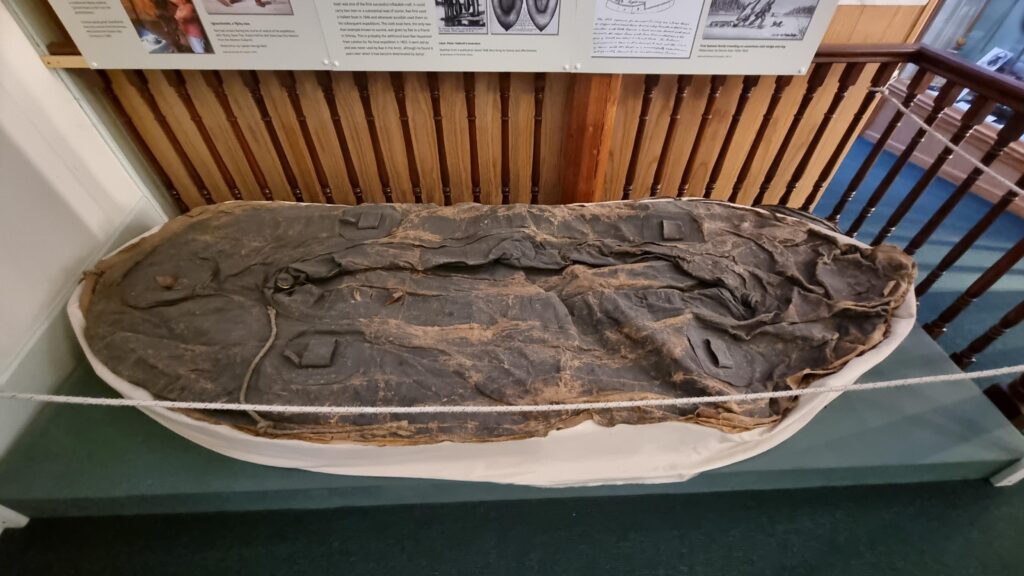
The oldest inflatable dinghy worldwide! 170 year old…
In town, we also visit an art gallery where we discover the Scottish artist Bet Low, and a museum. Aaaah, the small Scottish museums… We had loved the ones in Lerwick, Westray, and Tobermory last year, so we had pretty high expectations for the one in Stromness. And we aren’t disappointed! In a relatively small space, the collections are organized a bit like they fit in the showcase. But if you look closely, you find some real treasures… For example, one of the four remaining originals of a book by Daniel Defoe. Or the oldest inflatable boat in the world: the cloth boat used by Jon Rae in the 1850s (!!) to identify the Northwest Passage by land. There’s also an anthropomorphic statuette found on the site of Skara Brae, 5000 years old… Finally we learn the story of the German navy at the end of the First World War (16 battleships, 8 cruisers and 50 destroyers!) which scuttled itself in the lagoon of Scapa Flow in 1919 upon the belief that the peace talks at Versailles would not succeed…
But the main site around Stromness remains Skara Brae. Accessible by bus (riding along several circles of standing stones), this village was rediscovered in the 19th century when a storm literally ripped the dune apart, revealing the stone structures preserved in the sand. These houses date back to 3500 BC (the oldest village in Europe according to the brochures), contemporaneous with the pyramids and are extremely well preserved. All round, they even retain their stone furniture! They include beds, shelves, pantries, and the central fireplace—it’s very impressive.
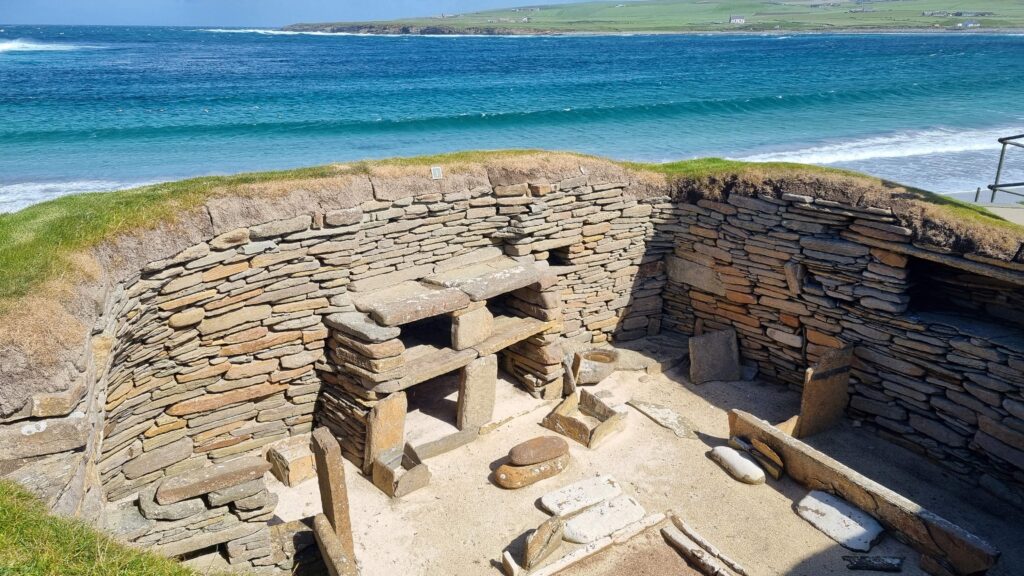
One of the houses of Skara Brae, 5000 year old…
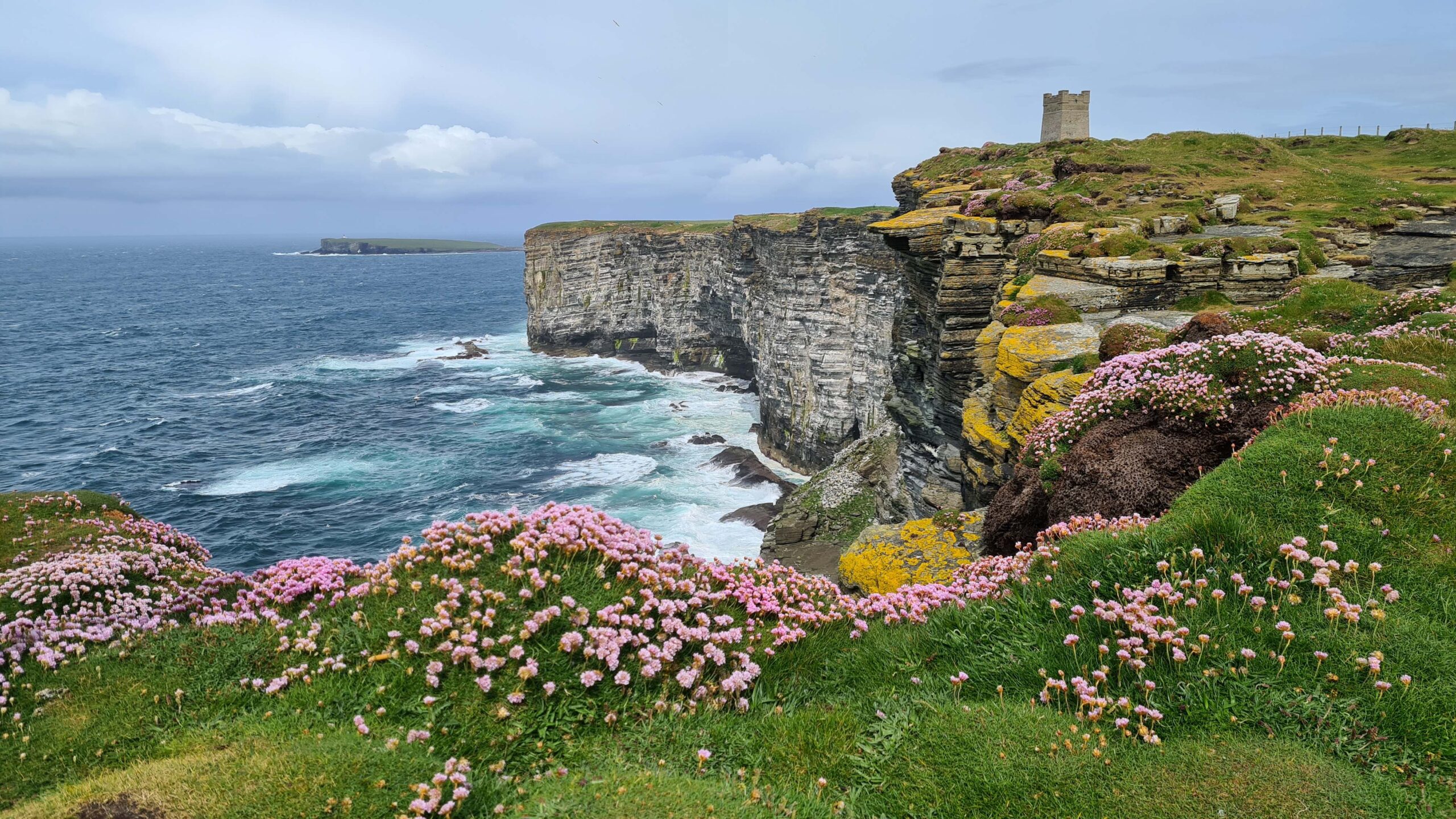
Cliffs and sea birds, ingredients for a perfect hike!
After the visit, we set off for a walk to the northwest tip of the island, to meet – guess what – seabirds of course! Have we already told you that we love seabirds ;o)? Here, a few puffins and guillemots, some gannets too, but above all, we see our friends the fulmars, offshore birds that don’t seem to venture south of the 58th parallel. We discovered these cousins of the albatrosses last year and they are still as endearing. Very curious, they escort boats offshore and often come to see what kind of bipeds we are on the coastal path, before returning to nest in a long gliding flight without the slightest wingbeat… We end the day with the local Stevenson lighthouse on the next peninsula, collect our evening protein (periwinkles this time!), and return with the last bus.
Onboard, between two dinners with the Anouhé, we prepare the boat for the next leg. The surprise of the day is the engine belt: it’s far too loose. It doesn’t seem serious, we’ve already tightened the belt by moving the alternator to Saltimbanque, we know how to do it…
Yes, but you have to shift the alternator so much to get the desired tension that it’s touching the bulkhead now, which isn’t great. It doesn’t matter, we have a new belt on board, we’ll change the belt…
Yes, but the new belt, which isn’t stretched, is much shorter and we can’t install it. No problem, we’ll move the alternator in the other direction…
Yes, but we can’t shift the alternator far enough because it’s hitting the coolant hose clamp. No problem, we’ll remove the clamp while we put the belt on and tighten it afterward. After a lot of effort, the belt is in place, all that’s left is to tighten the clamp…
Yes, but with the new belt, the alternator is so close to the heat exchanger that we no longer have access to the clamp to tighten it. The hose even started leaking during the belt installation process. We quickly have to take everything apart again to tighten the clamp…
Finally, we manage to find a position where the clamp doesn’t interfere with the installation, tighten it before installing the belt, and then finish reinstalling the belt and alternator. The hose doesn’t seem to be leaking, but we’ll have to keep an eye on it to be sure.
In short, a classic DIY story!
29th-30th May : Stromness – Lerwick (141NM)
If the entry into Scapa Flow with its strong current went well, we’ll have to get out now… The current flowing to the West is even stronger and tends to create a race against the West swell. There’s been a 35-knot wind outside for three days, so the sea isn’t exactly calm… The sailing instructions books are clear: you have to get through thirty minutes before the turn of the tide. That means two thirty-minute slots per day to get out, the first at 5:30 in the morning. The Anouhé made the same calculation and we sail together for a few hours, taking pictures of each other. Their boat is a fast-cruising type and we are convinced that they’ll overtake us right away. But downwind, to our great surprise, we’re really on par at around 7-8 knots (probably a bit of a downwind current helping).
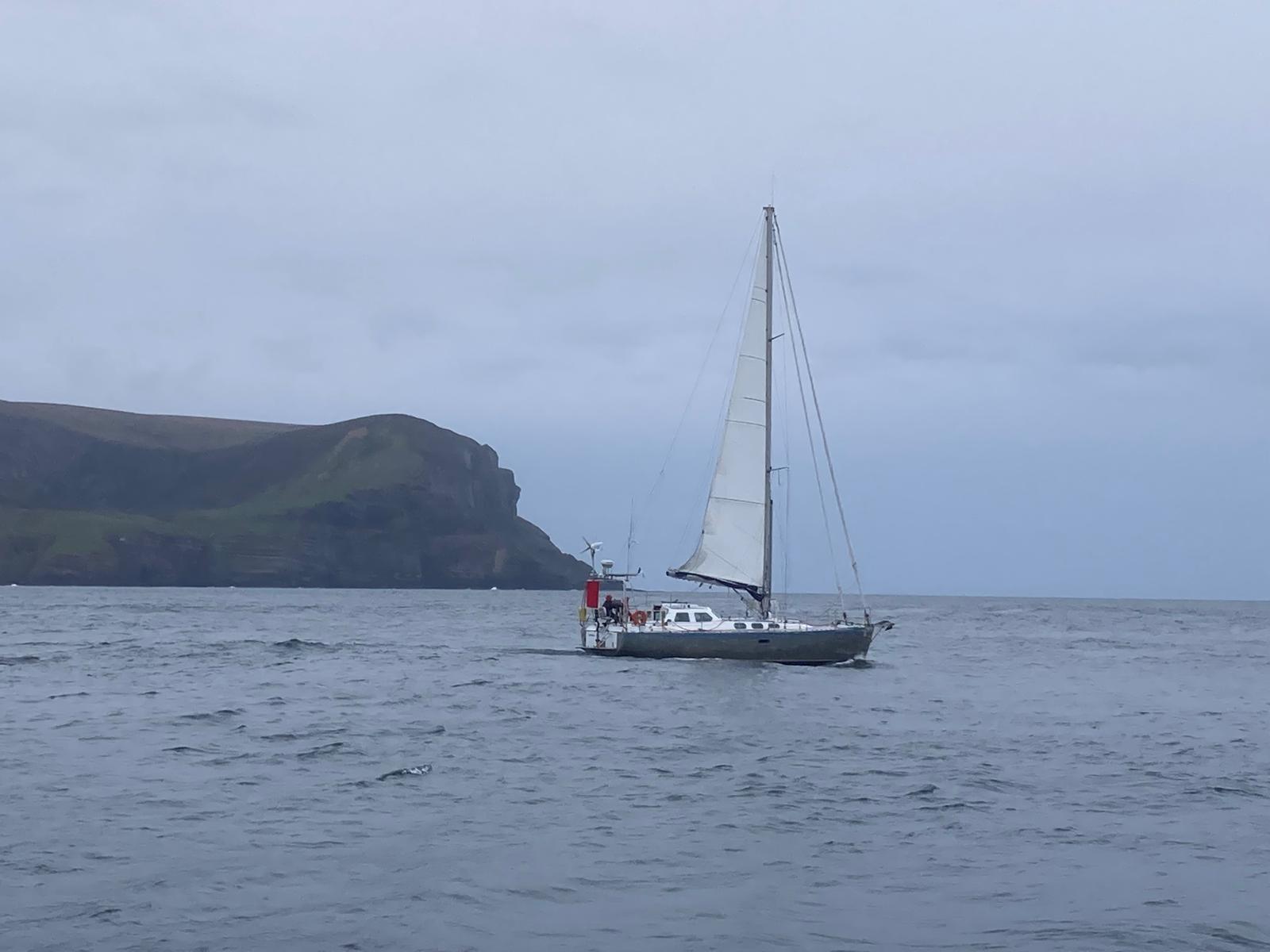
UtPåTur leaving the Orkneys, thanks Anouhé for the pictures!
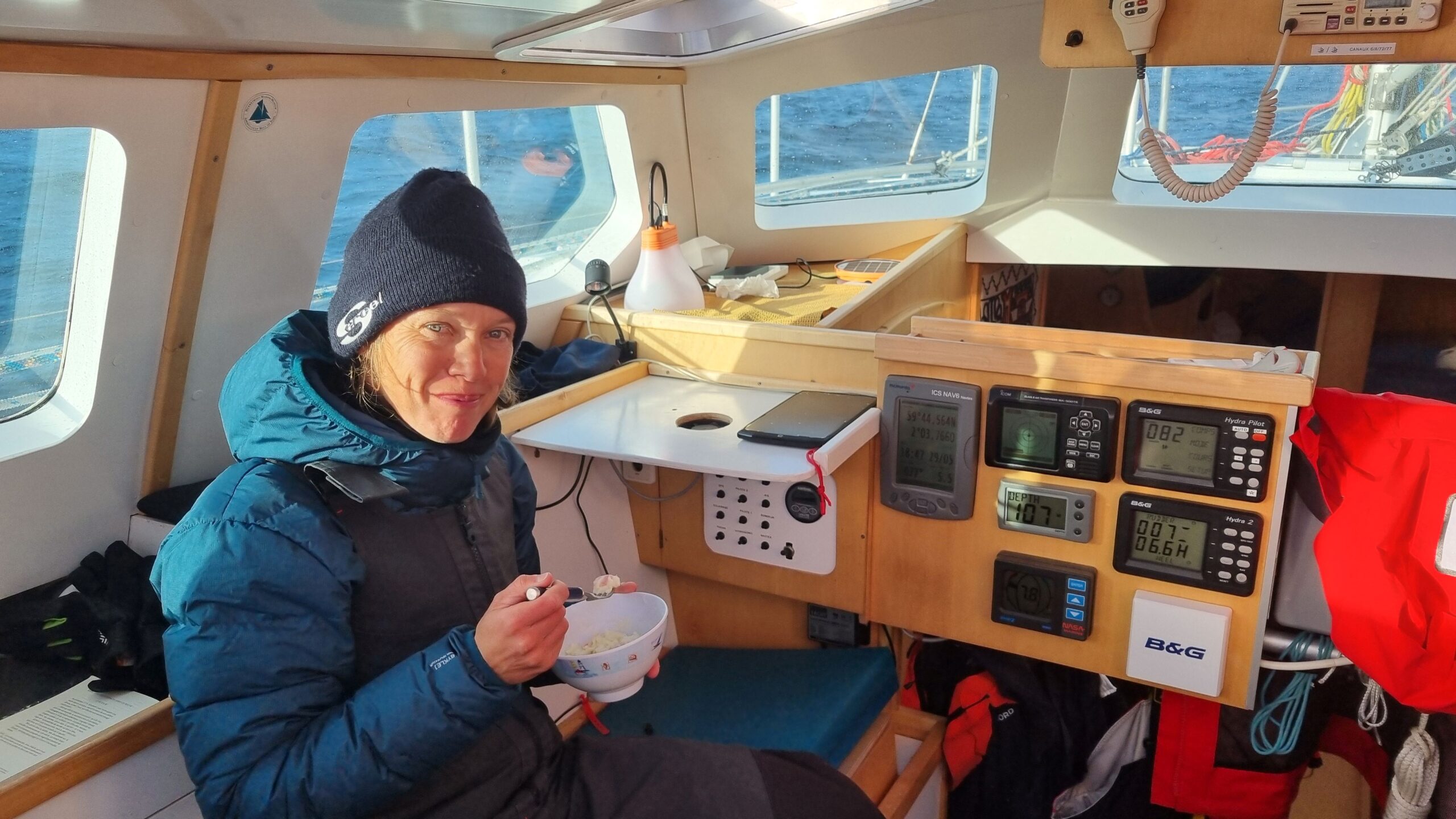
“Upstairs”, where we spend most of our time when at sea!
Once we’re clear of the island however, we have to luff up and then Anouhé goes “beep-beep” and sets off like the road runner in the cartoons… Alright, we’re in no hurry! We continue close-hauled in the rain, with the staysail up then with one reef, then a second when we start to get gusts above 25 knots. It’s the first time we’ve sailed in pouring rain on the trip, we haven’t missed it! Luckily, we can spend most of our time upstairs in the lookout station…
The southeast wind is turning northwest from the north, as a small low pressure passes over us during the day. The opportunity for a beautiful gull wing shaped course, just like in the books: we turn into the end of the low and set off again with the cold front. The wind is not as strong as expected, but the weather is nice again, and that’s great!
What’s less great is the sea state, crossed between the old west swell and the new south-east swell. Laure’s inner ear loses its bearing and despite the Scopoderm patch, the eddies of Sumburgh prove fatal to her stomach… The patches don’t seem to have as much effect on her as before, we’ll have to look for other solutions against seasickness…
With all that, night hasn’t had time to fall before daybreak, the joy of high latitudes in summer. Because that’s it, we’ve reached the 60th degree of latitude North! As high as Bergen and Oslo. Once past the southern tip of the Shetland (well offshore because of the strong tidal current), we still have to tack along the island. It’s not the fastest pace with a centerboarder but rather pleasant as the sea calms down a little together with the wind, and Oscar steers all by himself. Oscar? Yes, Oscar, our wind vane. We named this piece of fine engineering in homage to the automaton from the video game Syberia (sorry, we can’t always have references as mainstream as Tintin!)
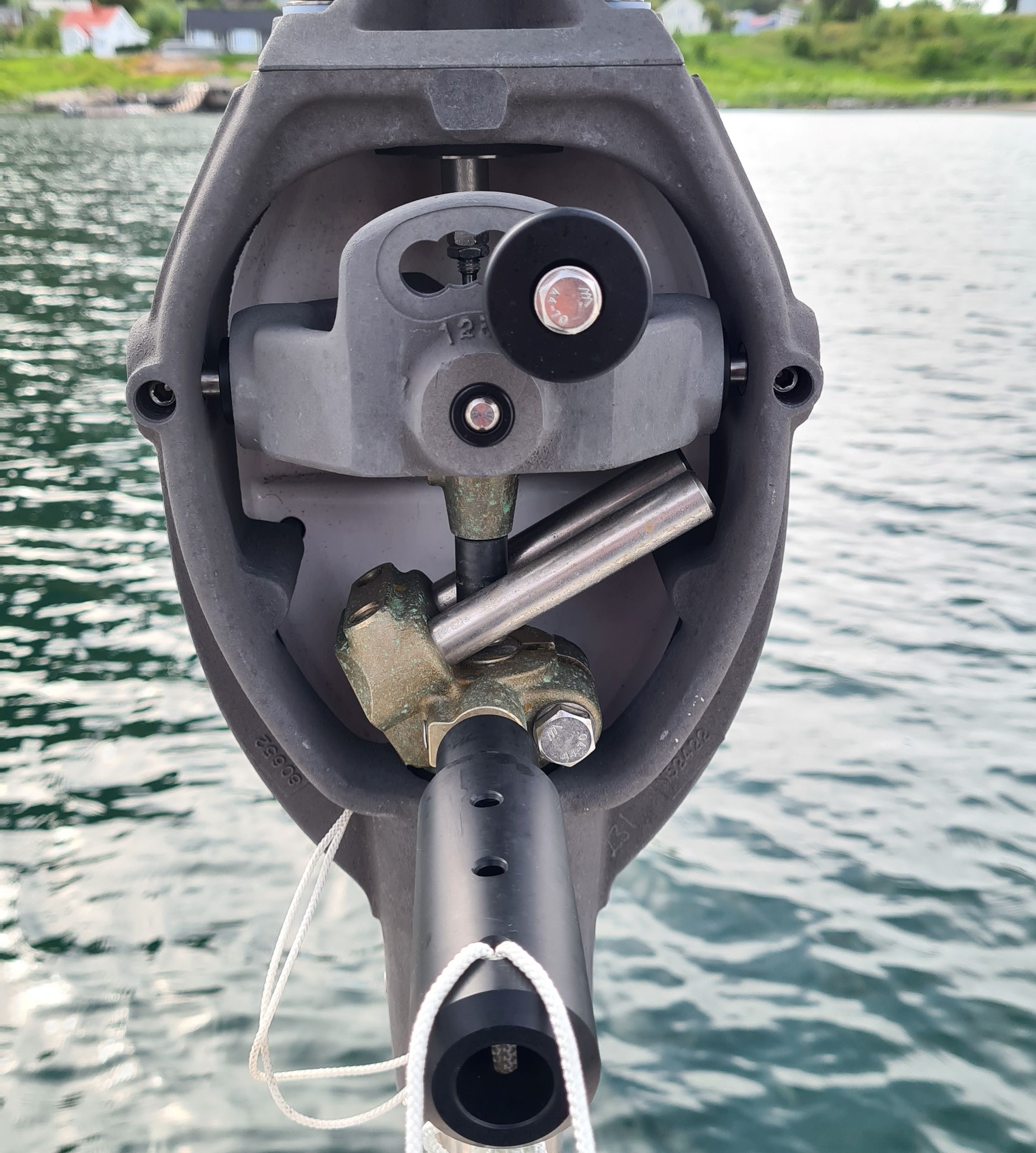
The heart of Oscar…
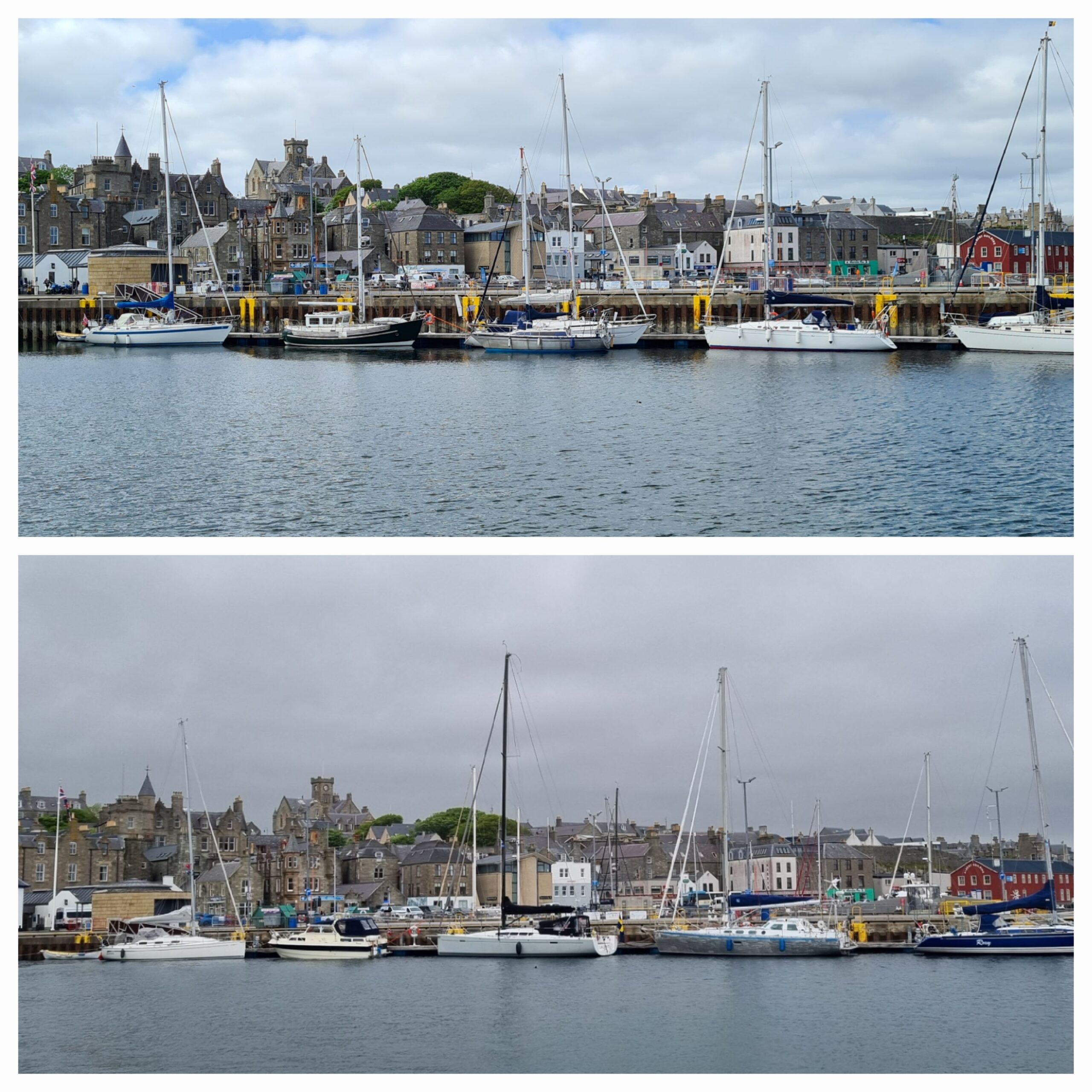
Lerwick, feeling of deja-vu…
We were planning to anchor and sleep for a few hours before reaching Lerwick but we decide that we can also sleep there while tacking, it will save us time and manoeuvres. The last miles in the beautiful morning sun and a now very light wind are magnificent. It’s strange (and rare!) to see the archipelago other than in the rain or fog! We recognize the islands of Bressay and Noss, their gannets colony, then Lerwick channel. The port is approaching, we are taking the same place as our friends Dibona had last year, then behind our little Saltimbanque… There we are again, at the end of the diving board, waiting for a weather window to cross to Norway.
31st May – 4th June: stopover in Lerwick
We have a mixed relationship with Lerwick: we love this place and yet we spend our time here anxiously screening the weather forecast for the right window to leave! Last year, we waited twelve whole days so when we disembark now, the town actually seems extremely familiar. We know its small streets, the habits of the locals, the bus schedules… Our yacht club is still there in the heart of the old quarter, but the very welcoming tourist office has unfortunately closed…
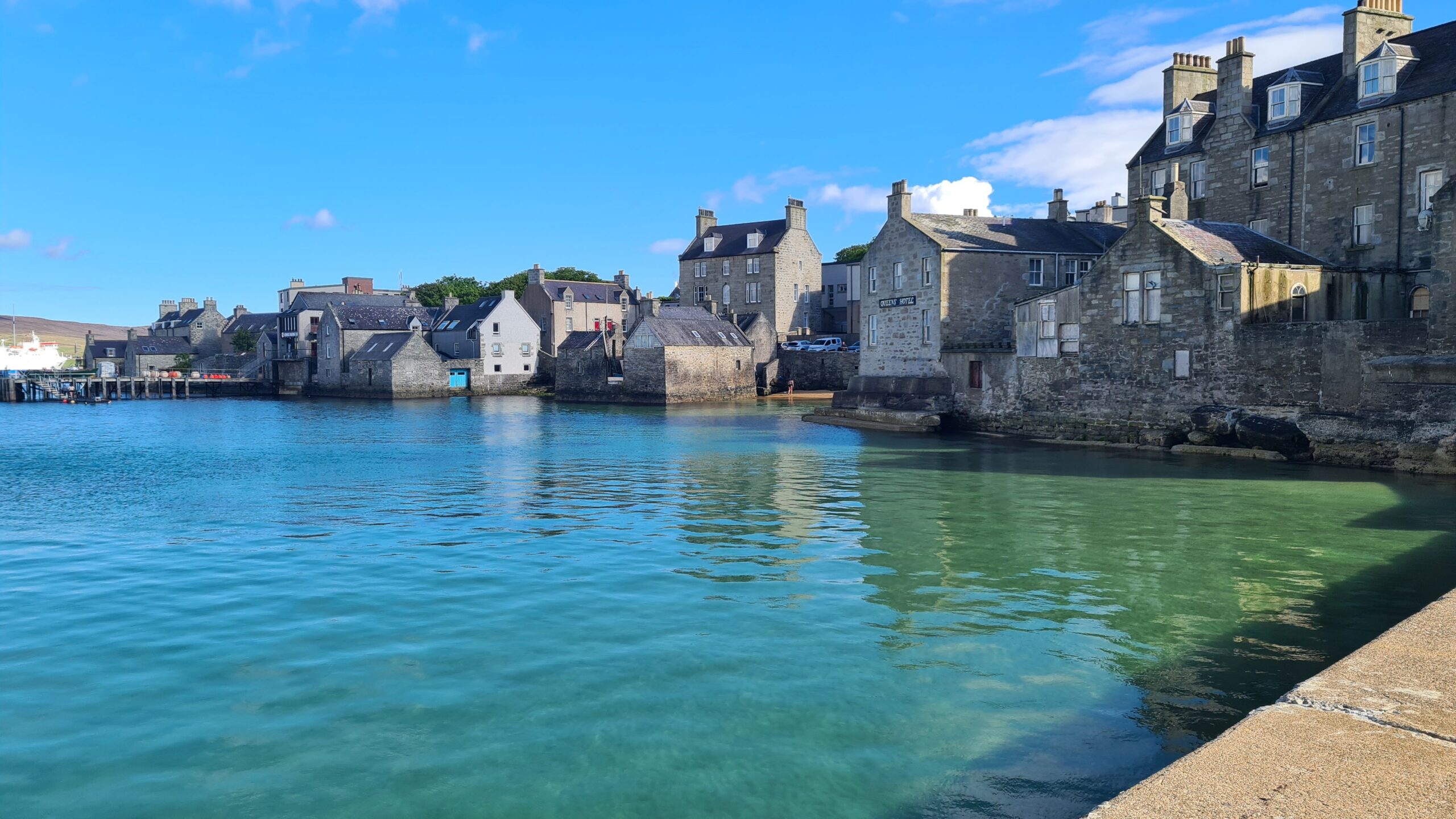
Lerwick is even more beautiful in the sun!
There are plenty of resources in Lerwick and we easily find the few bits and bobs we were missing. As for today’s surprise: a small leak on the water heater’s expansion tank… Nothing serious for now, but we buy a valve to isolate this part from the rest of the freshwater circuit in case the leak gets bigger. The large Tesco supermarket allows us one last big run of groceries before—we hope—sailing further from civilization in Norway.
Meanwhile, our social life is in full swing at the Lerwick hub. On the way of any boat crossing the northern North Sea, all the sailors in the area take refuge here in case of a gale. The southerly wind is getting up to force 9 now and the port is packed. A great opportunity for new encounters! Our friends the Anouhé are there too, and we get acquainted with Noranna, very friendly Quebecers on their brand-new Ovni 430 (hybrid, with diesel-electric propulsion). This guarantees some great evenings full of sailor stories and live music in pubs…
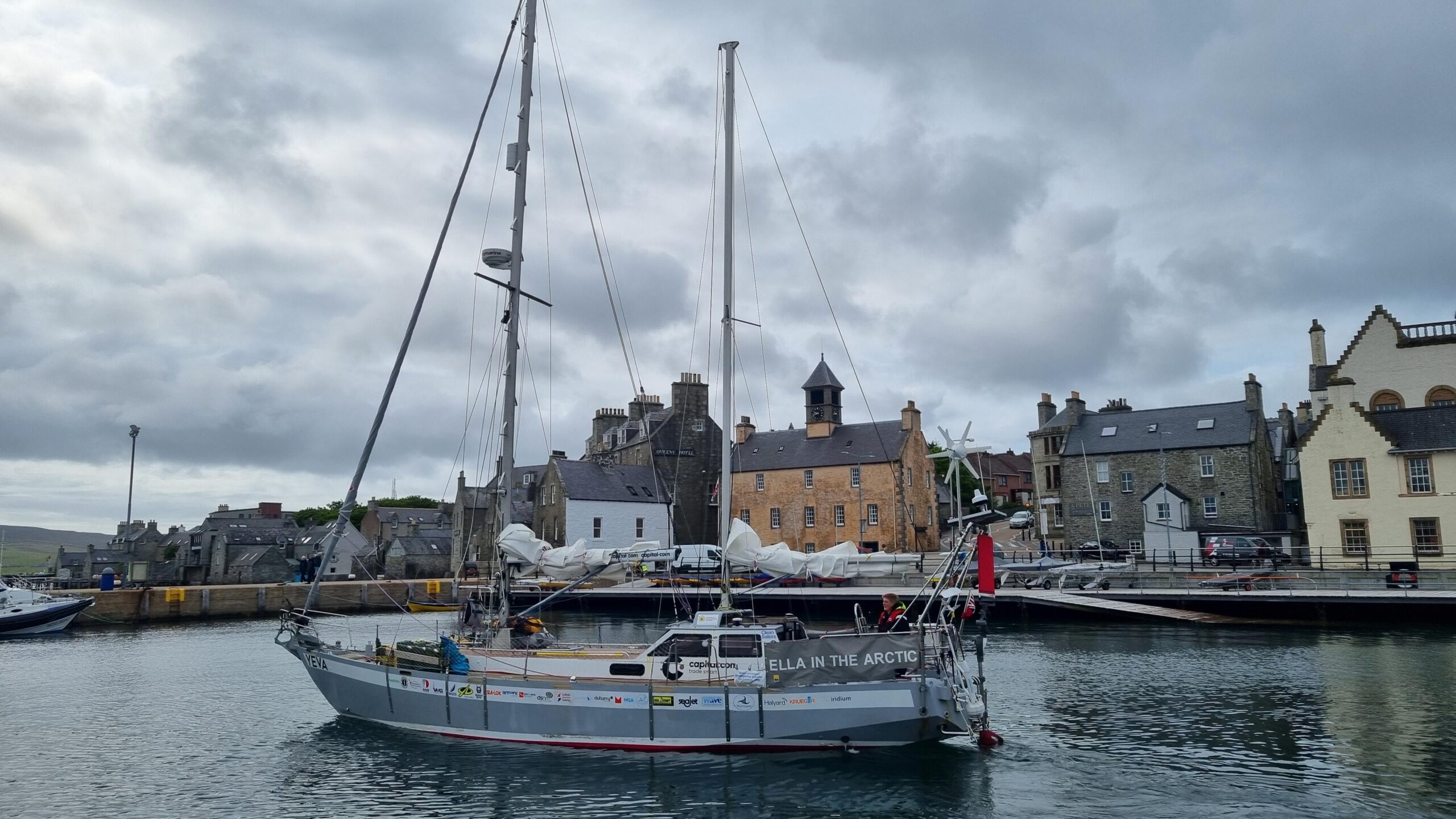
Ella is leaving for her start line on the arctic circle
We also meet Ella, a young Englishwoman who is attempting the somewhat crazy challenge of being the first person to sail solo around the Arctic in one season, that is to say cross the Northwest Passage in the north of Canada, then the Northeast Passage in the north of Russia, in a row! Her steel ketch, Yeva, rafted alongside us is well prepared and we wish her good luck, she is going to need it… Other well-known boats are there too: the Fleur de Lampaul, or Guppi, Laura Dekker’s boat.
And then there’s this incredible evening on Bressay… Last year through the Wayfarer we met Tom, a young man living on the small island, working in Lerwick on the relationship between the development of renewable energy projects and local communities, and dreaming of sailing. This was a nice meeting, so we contacted him again this year to have a cup of tea onboard. We chat a bit, and Tom invite us to dinner at his house. We are curious to see life on an island like Bressay and accept the invitation. Once off the ferry, we pass the island’s town centre (namely a small shop, a cafe, a closed church, and a school also closed), and arrive at Tom’s parents’ house. Battered by the force 7 to 8 winds blowing today, the house is located on the west coast of the island and has a large plot of land on which they have created an extraordinary vegetable garden. The first step was to grow trees to protect the plots. There are no wild trees in Shetland, they were all cut down thousands of years ago and haven’t grown back, unable to withstand the wind. To plant a tree, you first have to let it grow under the shelter of pallets for several years before it’s strong enough to stand a chance. Once the plots are completely surrounded by trees, the vegetables are planted in large raised boxes, insulated from the overly soggy ground. And this is how Tom’s parents produce a good portion of their own vegetables. Even tomatoes, which grow in the greenhouse where we have pre-dinner drinks.
We were a little afraid to impose ourselves for dinner but Tom had reassured us: in the family they like to entertain. Indeed, we did not expect to find ourselves in the middle of such a tribe, worthy of the Malaussènes (Daniel Pennac, a classic!). Here are Tom’s parents from the island, Tom himself, his son and his twin daughters, but also his Chilean mother-in-law, then a Czech nephew turns up at the table… and finally the local craftsman joins and shares the meal before going back to changing the windows in the next room. Stories are told, about the island and about the end of the world (the father is a well-travelled journalist and author of 19 books of reports and for children). The dinner is delicious, a potluck of fish, potatoes, salads and various seaweeds (the Chilean mother-in-law is an agronomist passionate about seaweed cooking). Before leaving we have to sign the guest book of the house. Out of curiosity, we take a look at who came before us: three boxes above, we notice visitors from Alaska, from the village of Cordova in particular. Cordova… this the very place where our boat was designed and christened (Cordova, first of the series of Cordova 40)! It’s a small world, and all roads lead to Bressay it seems… In any case, Tom owns a plot of land in Patagonia where we are invited in advance!
And what about walks? Beautiful landscapes and seabirds? It must be said that last year we had already crisscrossed the archipelago by bus, so the thirst for discovery is less strong. There is still an unexplored destination near Hillswick. There we find a little of everything that makes the Shetland: a Stevenson lighthouse, fulmars, gannets, a magnificent coastal path, sheep, an old broch, a self-service rhubarb tin on the side of the road, a white sand beach (perfect for a quick swim), and even a seal rehabilitation centre in the garden of a private house!
Biking on the Shetland roads
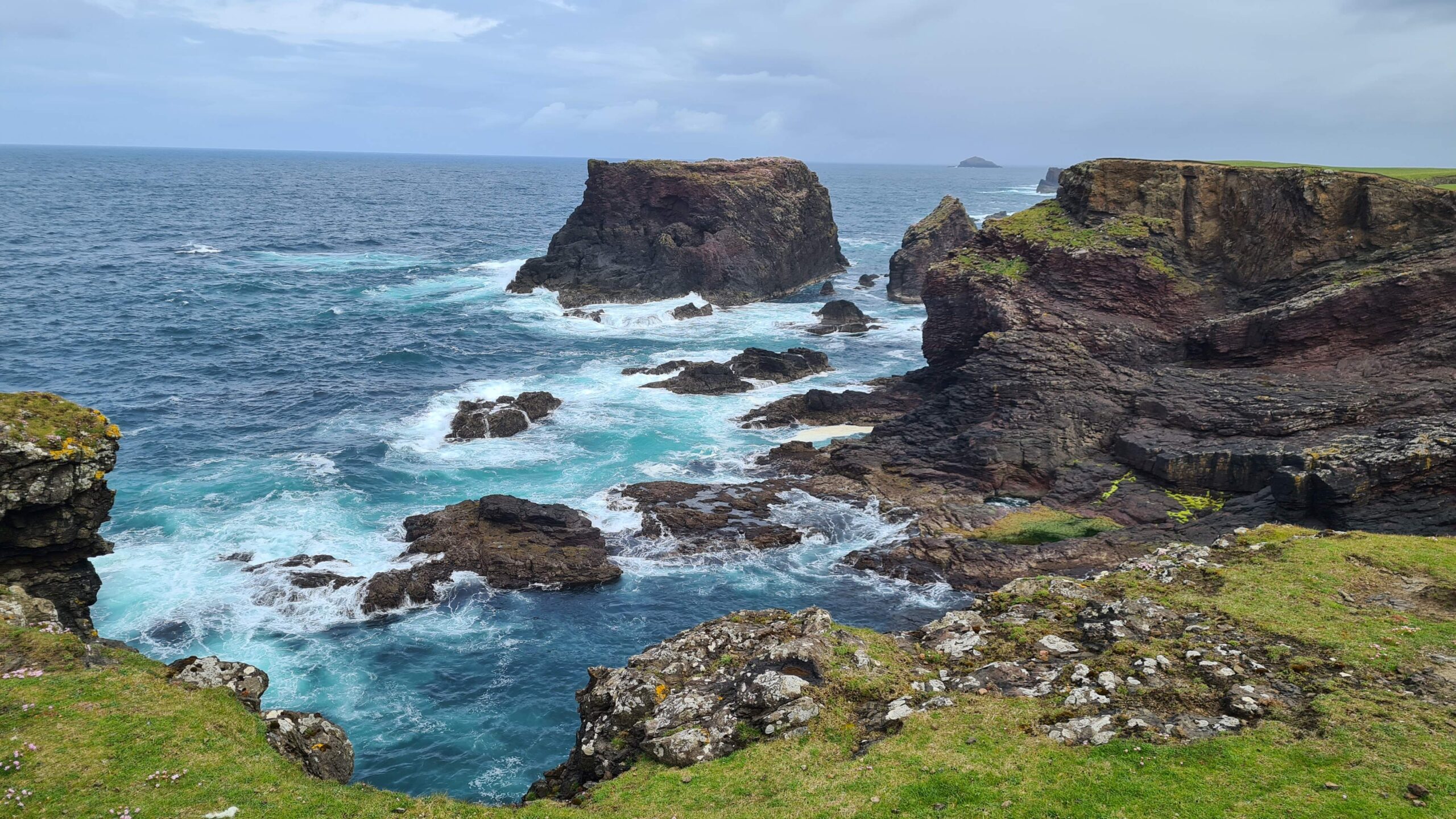
Cliffs by Hillswick
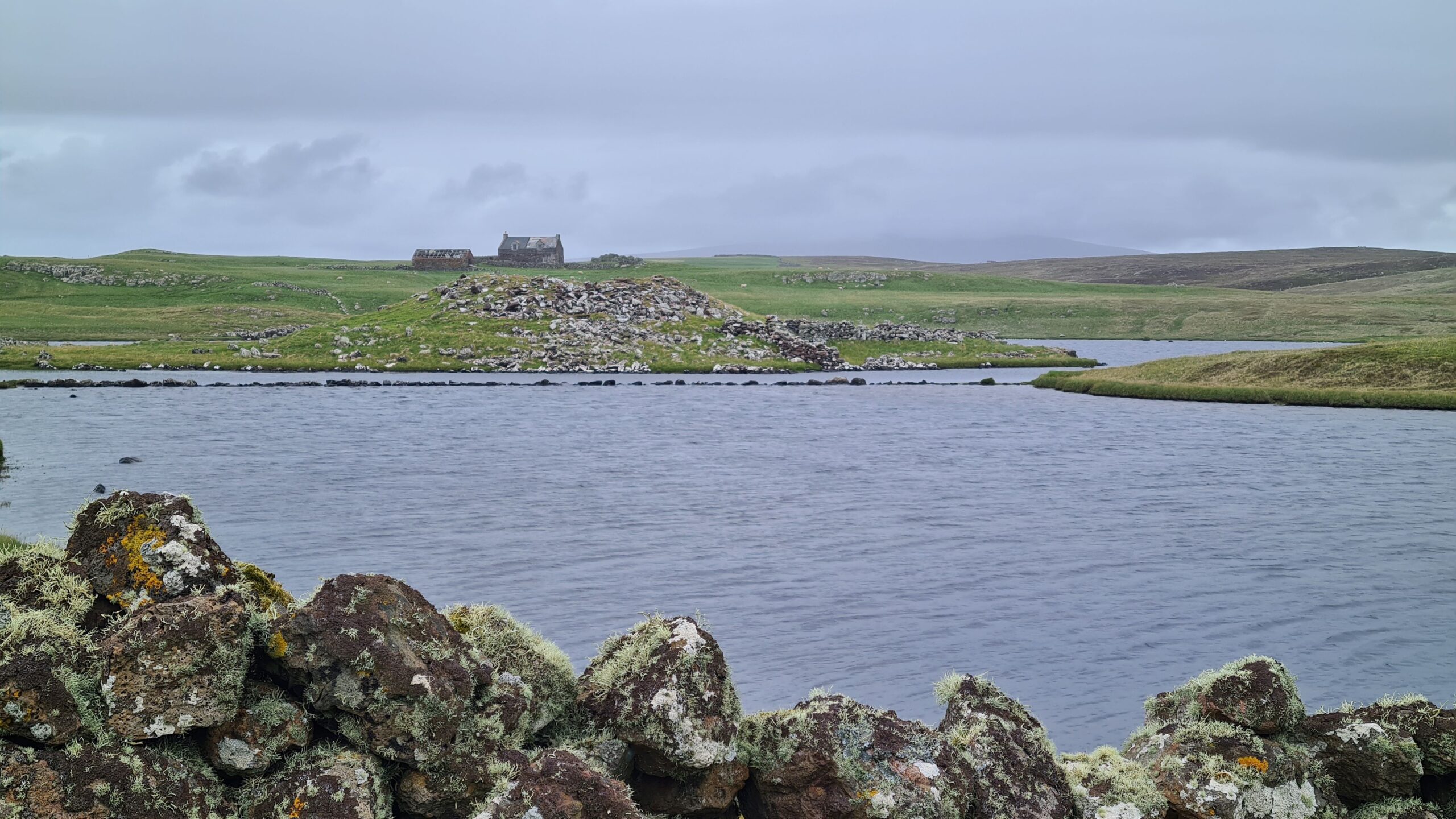
Scotland in a nutshell: ruin, broch and rain!
Finally, time flies, and the weather seems to be catching its breath for the next 48 hours, giving us a window to continue our journey. We are now preparing to leave the UK at its most northerly point, after entering in Guernsey on April 8th at its most southerly point. Time to go home: heading for Norway!
 PDF
Congratulations on another fascinating instalment of your ongoing adventures. You tick all the boxes: interesting and witty commentary, fabulous scenery and video clips, and a diverse range of subject matter. Every new post is eagerly anticipated and triggers a range of emotions: you lift my day 🤩