
After her Bahian pit stop, UtPåTur gets back on the road southwards, sliding along a stretch of this colossal country that is Brazil, aiming for its most iconic city: Rio de Janeiro.
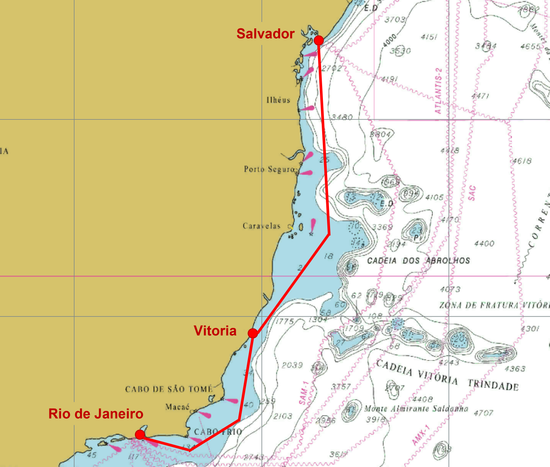
797 nautical miles sailed– 11 829 NM in total on UtPåTur
The full photo album here.
3rd-7th August: Salvador – Vitória (507NM)
After three intense weeks in Salvador, we finally lift our heads out of the insides of the boat and slowly start scanning the weather charts again. Things look rather lively… It’s the dead of winter down here in the Southern Hemisphere, and while we’re still nicely warm in the tropics, further down in higher latitudes, violent storms are raging back-to-back. Every so often, one sneaks around the South Atlantic High and dumps heavy swells and southerly winds on us. These are the infamous cold fronts dreaded by local sailors, and we need to dodge them if we want to make any progress.
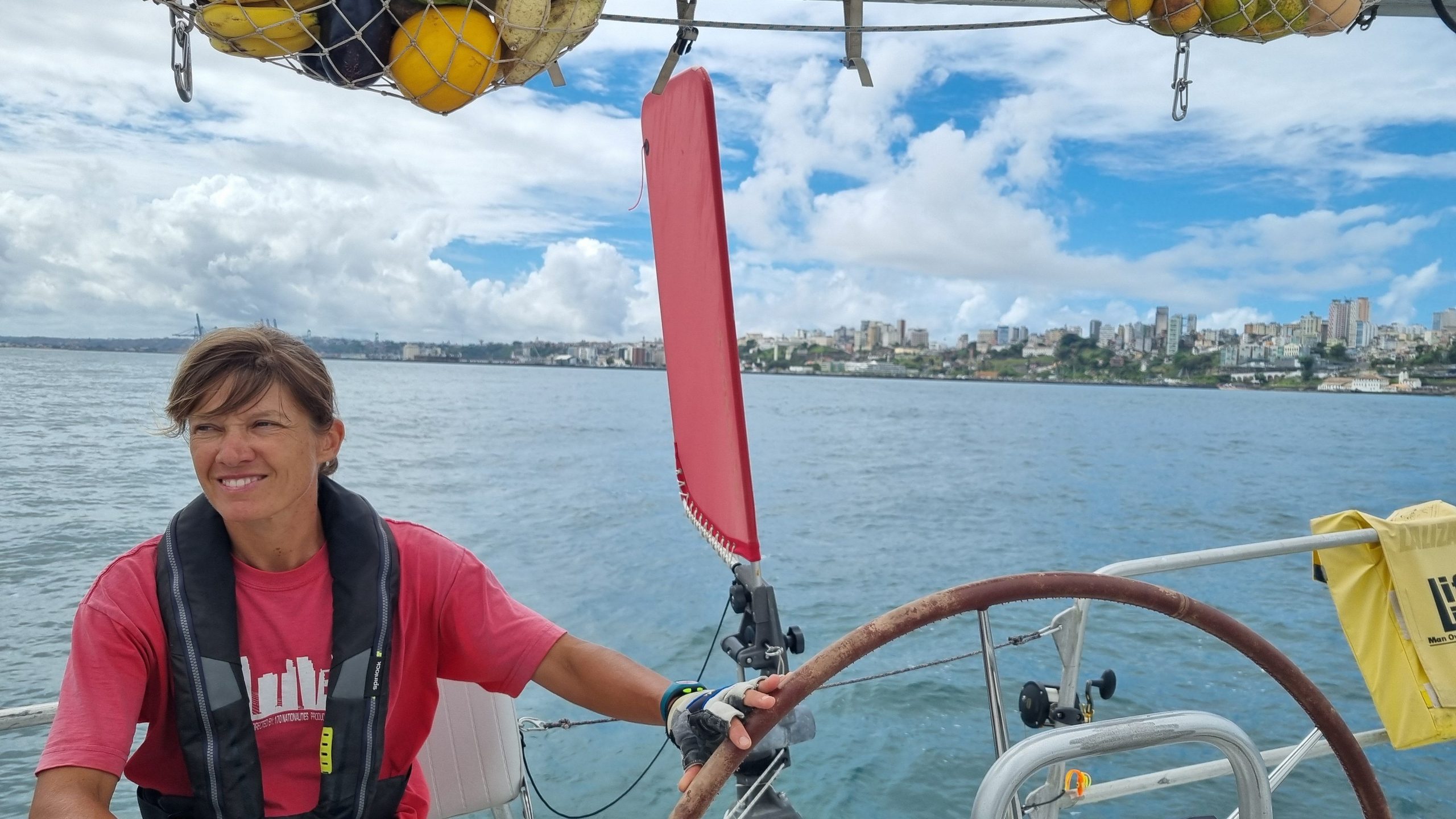
Bye bye Salvador, we are heading South!
One of these fronts is forecast for the end of the week, leaving us just enough time to reach Vitória. The ink barely dry on our departure paperwork for the state of Bahia, we cast off and leave our now-familiar Bay of All Saints behind.
The wind and swell are perfectly manageable for now, yet we’re still a bit jittery. It quickly dawns on us that we didn’t get nearly enough rest during our stopover in Bahia, and at the very first squall—granted, a proper massive, wet, angry one—the traumas of previous passages come flooding right back. Hyper-cautious early reefing, compulsive checking of the shroud swages… but nope, everything seems to be holding up nicely. Just as well, as conditions on arrival are expected to be rather sporty…
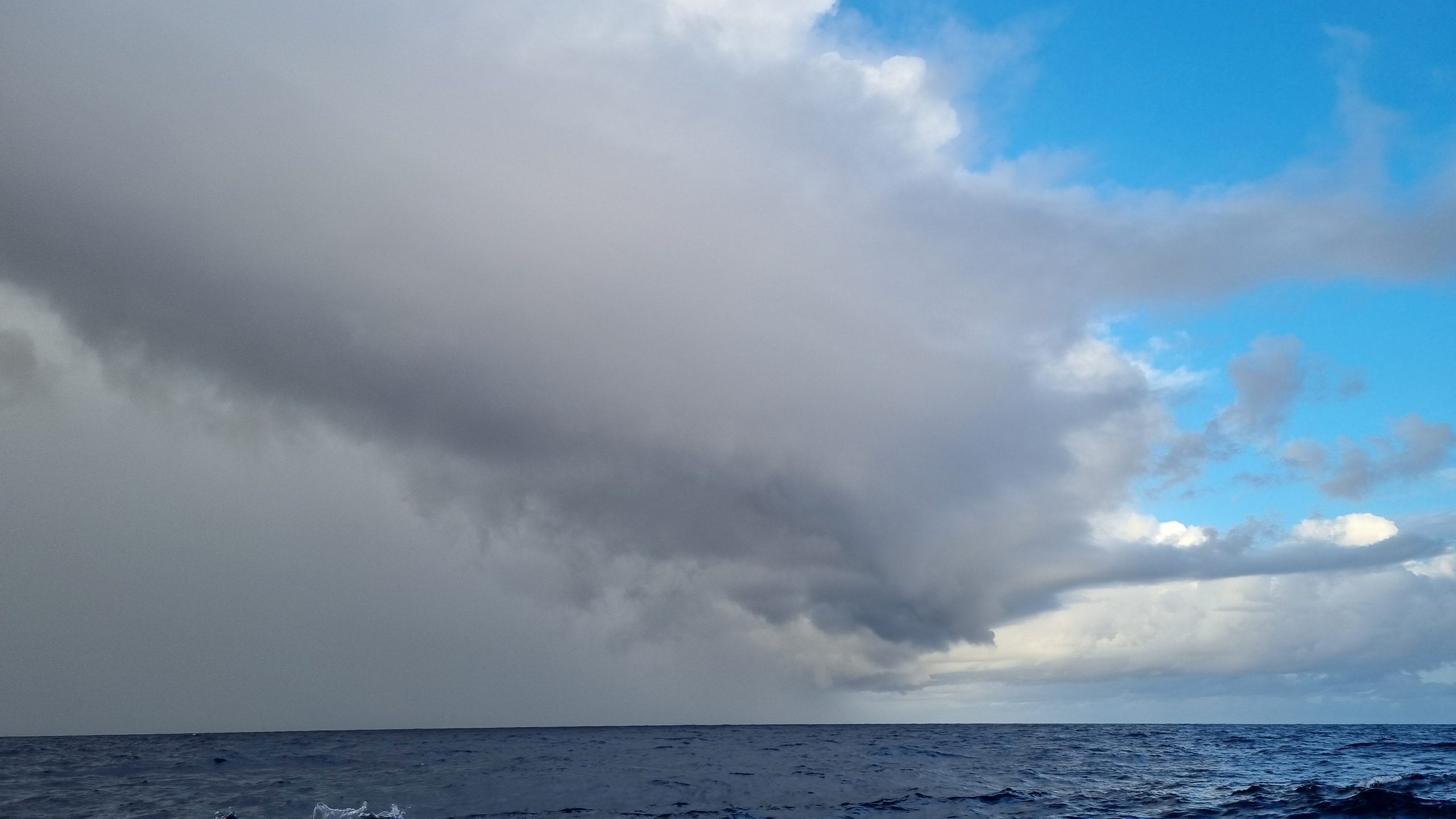
The first – and almost only – squall of the crossing
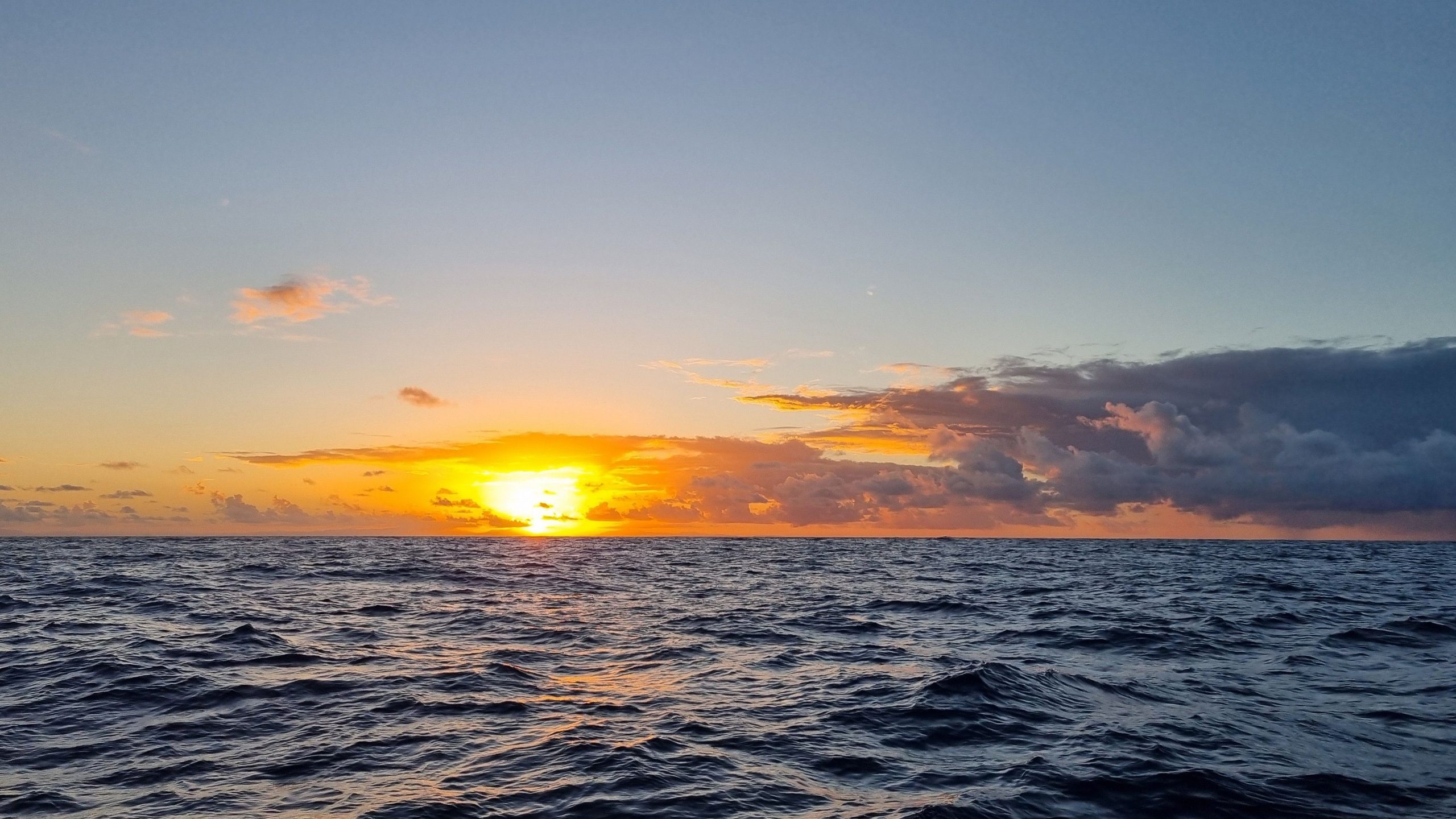
Sunset over the tropical South Atlantic…
For now, though, we have to admit that life is sweet! Wonderful weather, calm seas, virtually no more squalls, starry skies, deep waters with no risk of fishing nets—we really ought to be soaking up these last tropical miles! Flying fish are already getting noticeably scarce…
By day two, the seabed rises up: we’re approaching the vast Abrolhos Bank (literally “Open your eyes”). This time of year, it hosts thousands of humpback whales migrating up from Antarctica to mate and give birth. We’re keeping everything crossed for a chance to spot a few…
The first individuals show up over the shallow patches of the Banco Royal Charlotte. First it’s massive plumes of water on the horizon, then spouts, a giant tail, flippers slapping the sea, and suddenly an entire humpback whale (a respectable 15 metres and 30 tonnes…) launches out of the water, crashing back down in a thunderous explosion of foam.
And suddendly comes the humpback whale !
We spot a few dozen whales over this first bank, mostly at a respectful distance. But the main crowd is supposed to be gathered over the main Abrolhos Bank… which we reach just as night falls… Now that’s a bit annoying, because while whales easily dodge boats by day, they sleep by the surface at night, making collisions a very real hazard. Some sailors recommend running the engine to warn them off, but that means having a spinning propeller in the water, ramping up the risk of getting entangled in fishing gear. And while we don’t know anyone who has hit a whale, 100% of our buddy boats sailing around here have caught a net! In the end, we decide to stay under sail but throttle back to 5 knots—and we don’t hit a thing.
At first light, we are completely surrounded… There are whales absolutely everywhere!! Unlike dolphins, who linger at the surface so you can track them with your eyes, whale sightings are far more fleeting. One second you see a spout, then a tail, and that’s it. Then another whale leaps out of the water on the other side of the boat! It’s practically impossible to get decent pictures of the spectacle, yet it’s happening all around us.
Our friends of Aurora managed to film one of these impressive breaches!
One more video from Aurora showing the tail banging
Wherever we look, we don’t have to wait long to see a whale putting on a show. They’re a proper acrobatic species and frequently breach completely out of the water—sometimes as a pair when a calf mimics its mother. Every so often, a deep, rhythmic thud shakes the entire hull: another whale slapping the surface with its tail for minutes on end, sending an intimidation signal to potential rivals during mating season.
The breaches always happen—thank goodness—at a safe distance from the boat. But the whales, curious creatures that they are, also glide right alongside, coming within a few boat lengths of UtPåTur, who isn’t always feeling particularly brave about it! A quick glance, a heavy breath, and sometimes a raised tail signalling a deep dive into the abyss. Not once does a whale put the boat in danger. And given the sheer numbers (we easily spotted a good hundred whales in 48 hours), we reckon they dodge us just as skilfully at night!
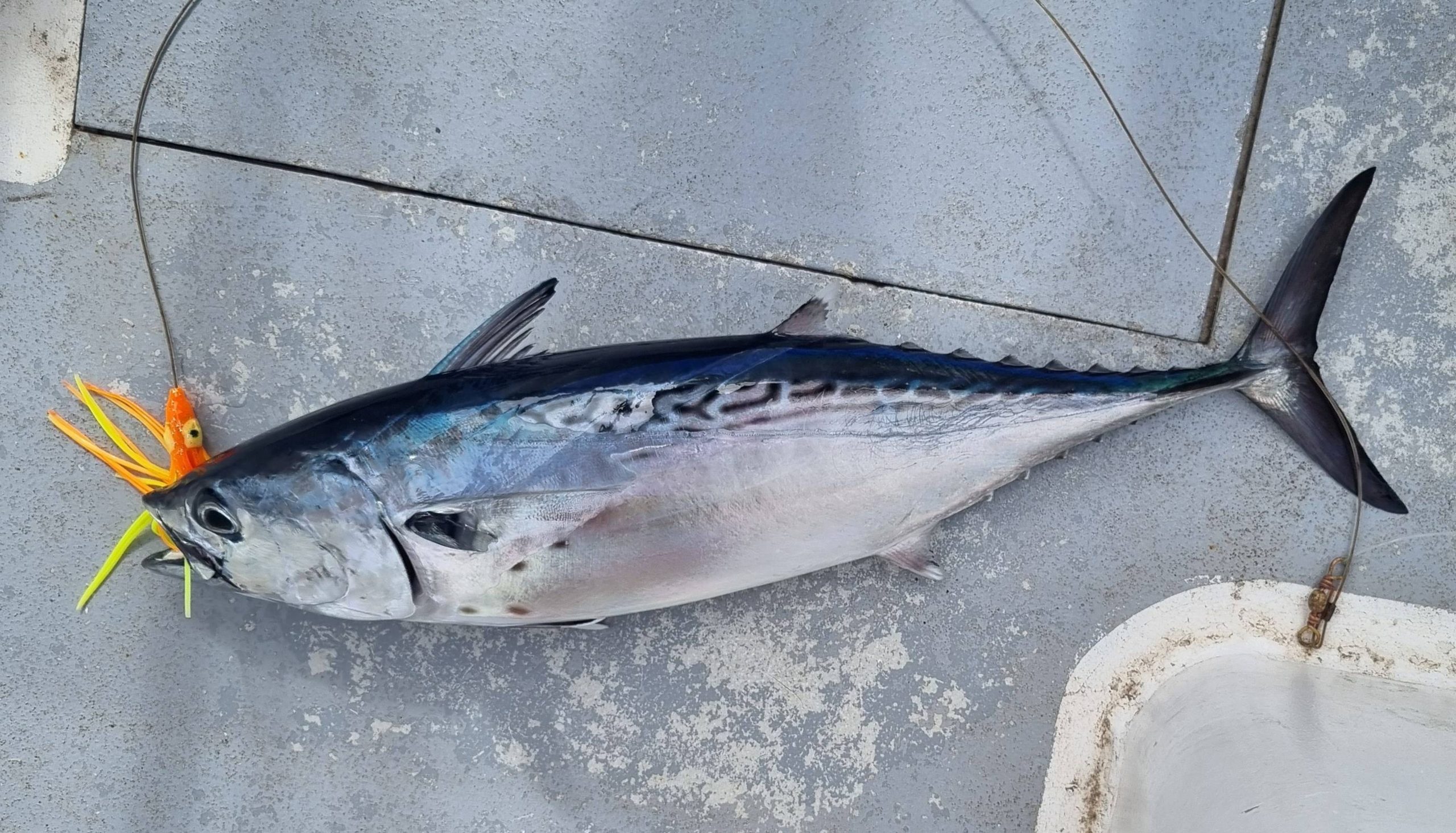
There’s more than just whales around here, we caught two little tunnies in just a few hours!
Which is just as well, because by dusk the wind starts building up as forecast, and we’re in a right hurry to arrive. No more controlling our speed: we blast through the pitch dark at 7-8 knots, putting our faith in the animal kingdom. The wind climbs to 20-25 knots on the beam, and the boat simply takes off! It’s been a very long time since we allowed the boat to sail with so much power on our fragile rig…
A curious whale comes very close to check on us
At daybreak, the coast comes into view. It’s almost mountainous, a world away from the flat shores of the Nordeste. We’re still flying along on our approach to the port when a whale pops up just one boat length away—the closest encounter we’ve ever had! Miraculously, we still haven’t hit a single thing overnight…
And then comes the entrance to Espirito Santo Bay, right at the foot of Vitória Island. We spot our Brazilian buddy boat Aurora and drop anchor right next to them, off a beach lined with palm trees and shiny new high-rises. We’re going to be very comfy here—which is just as well, as we might be stuck for a while…
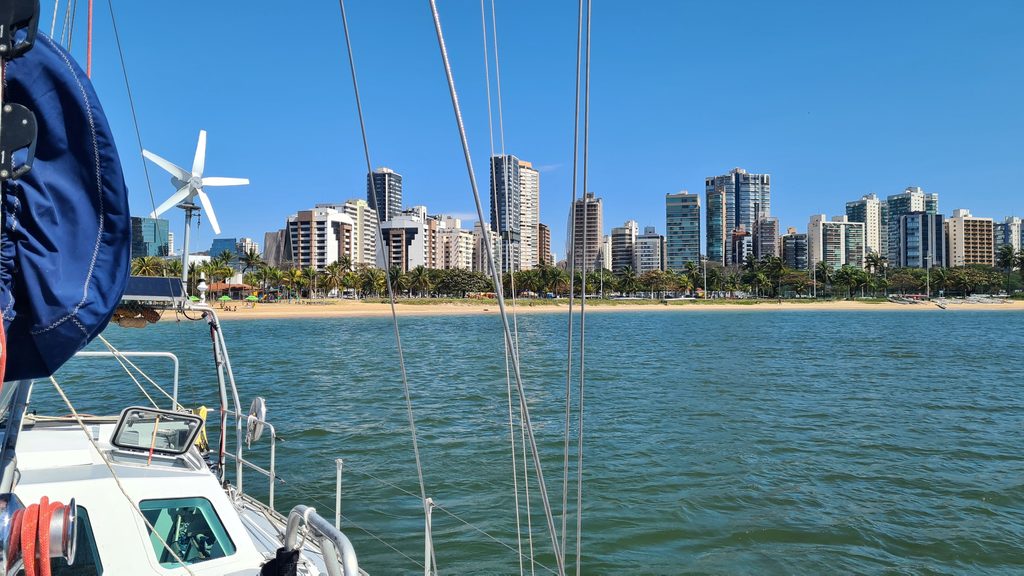
Vitoria, beach and the city!
8th-16th August: Stopover in Vitória
According to Marcos and Ludmilla on Aurora, local sailors aren’t overly fond of Vitória because you often end up trapped here for ages waiting for a weather window… A sort of local Lerwick or Cuxhaven! And indeed, the GRIB files look pretty dismal as far as the forecast goes. No big deal: we desperately need to recharge our batteries and we’re not about to complain about an enforced break.
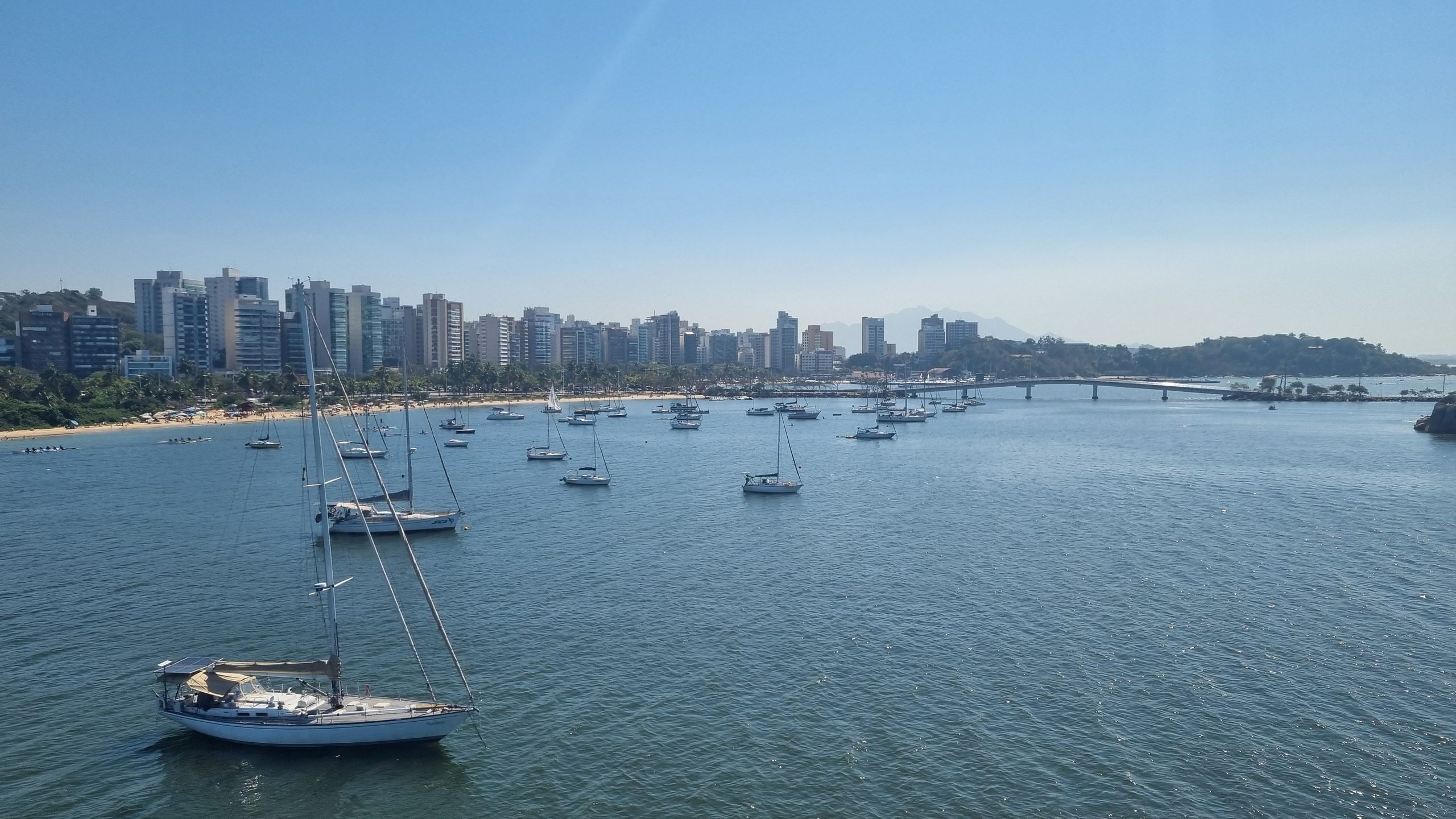
In the absence of a drone, we have to be content with photos taken from the top of the mast!
Our first order of business after a proper night’s sleep is, as usual, inspecting our Mast of Damocles. But this time no nasty surprises! Every single shroud is securely swaged, nothing has moved! It’s the very first time since 31st May that we’ve arrived anywhere with our entire rig intact… instant weight off our minds, meaning we can actually enjoy the stopover!
We like the place straight away. The bay where we’re anchored is ringed with beaches where the whole town seems to gather to exercise. The absolute rage here is outrigger canoeing. These little pirogues are everywhere; as early as 5:00 am before first light, you can hear them training, and by the weekend we find ourselves right in the thick of some proper serious races! We also dodge heaps of kayaks, SUPs, windsurfers, wings, and long-distance swimmers criss-crossing the bay in every direction. You have to be hyper-vigilant when motoring around…
Along with Aurora, we have a front-row seat!
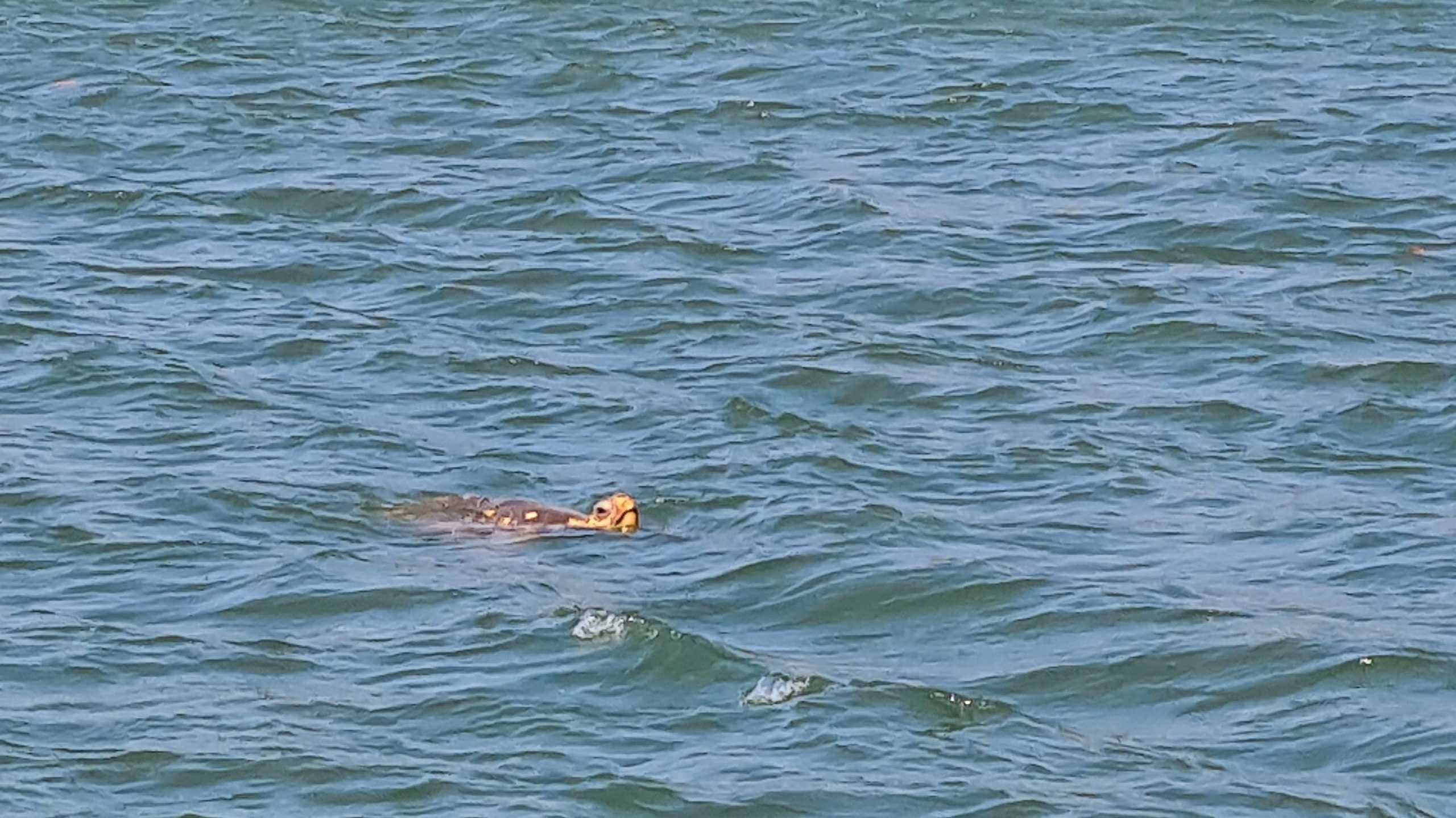
We have been seeing many turtles since we are in Brazil
Come the weekend, these innocent craft are joined by excited swarms of jet skis and massive motorboats boasting even bigger engines… The decibel level goes up and the vibe shifts considerably, forcing the bay’s numerous sea turtles to take shelter right against the rocks.
Speaking about rocks, we’ve been reunited with our absolute favourite: granite! Like proper Breton-Norwegian sailors, we feel right at home in this landscape. Though instead of Scandinavian pine trees, it’s succulents and cacti sprouting out of the rock face! Exotic…
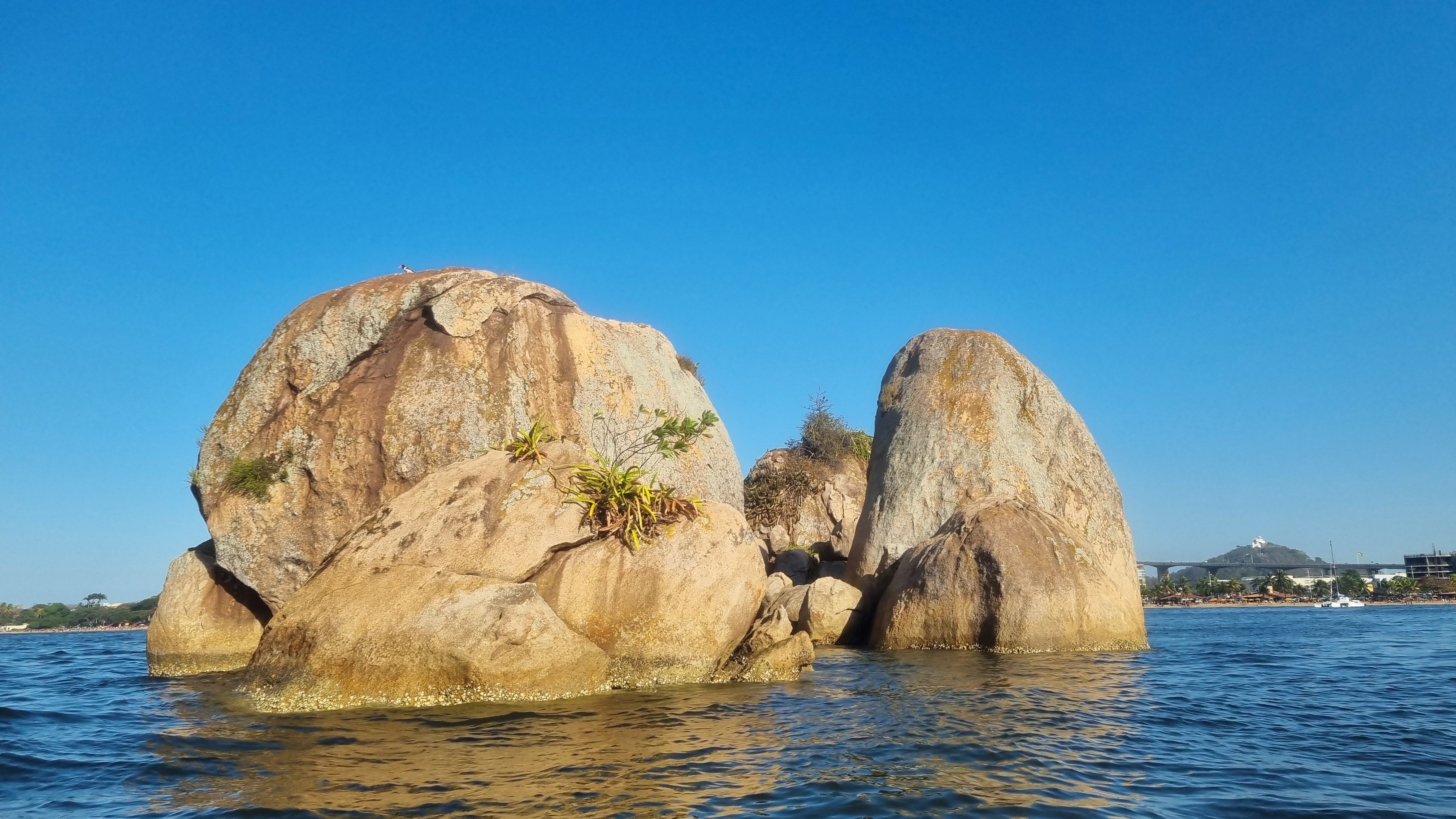
Granite, and even an oyster-catcher on it, no doubt we feel like home here!
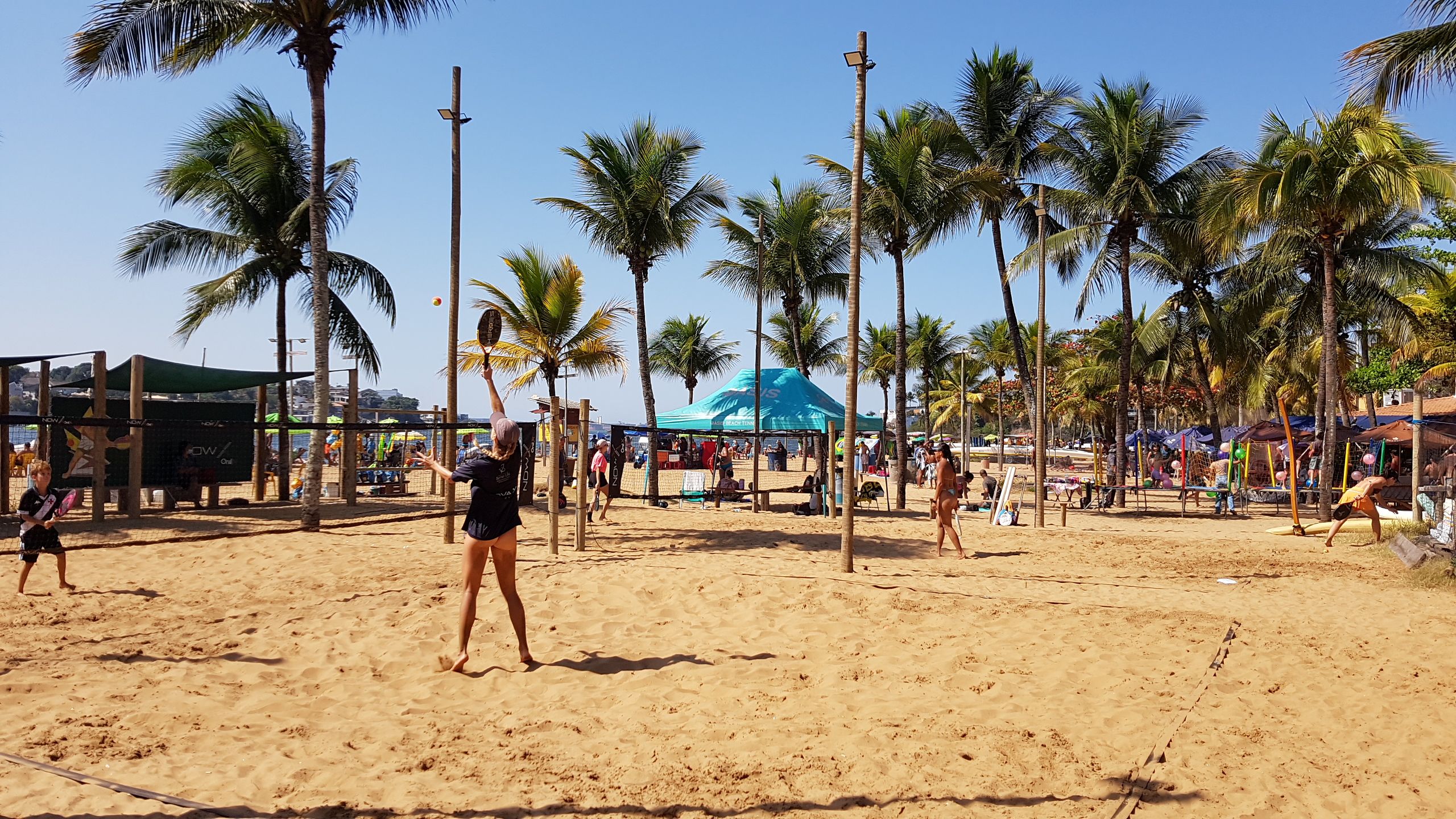
Beach-tennis on Vitoria beaches
Ashore, the sports marathon continues. People are jogging and bustling around the endless nets set up on every single beach. But plain old beach volleyball is far too mainstream; nowadays it’s all about beach tennis (using paddle rackets) or beach football—same rules as beach volleyball, but no hands allowed. Looks confoundingly hard…
Best of all, everyone gets around on bikes using proper, well-designed cycle paths. What absolute bliss to dig our folding bikes out of the locker! What freedom compared to Salvador, where we were trapped taking Ubers everywhere. The general sense of security in town is a whole different world, too. The anchorage sits off an affluent neighbourhood, and we feel distinctly underdressed stepping ashore without smartwatches or the latest trainers. Sure, we don’t wander out at night, but during the day we feel completely at ease amidst the crowds enjoying themselves and ignoring us. That is relaxing!
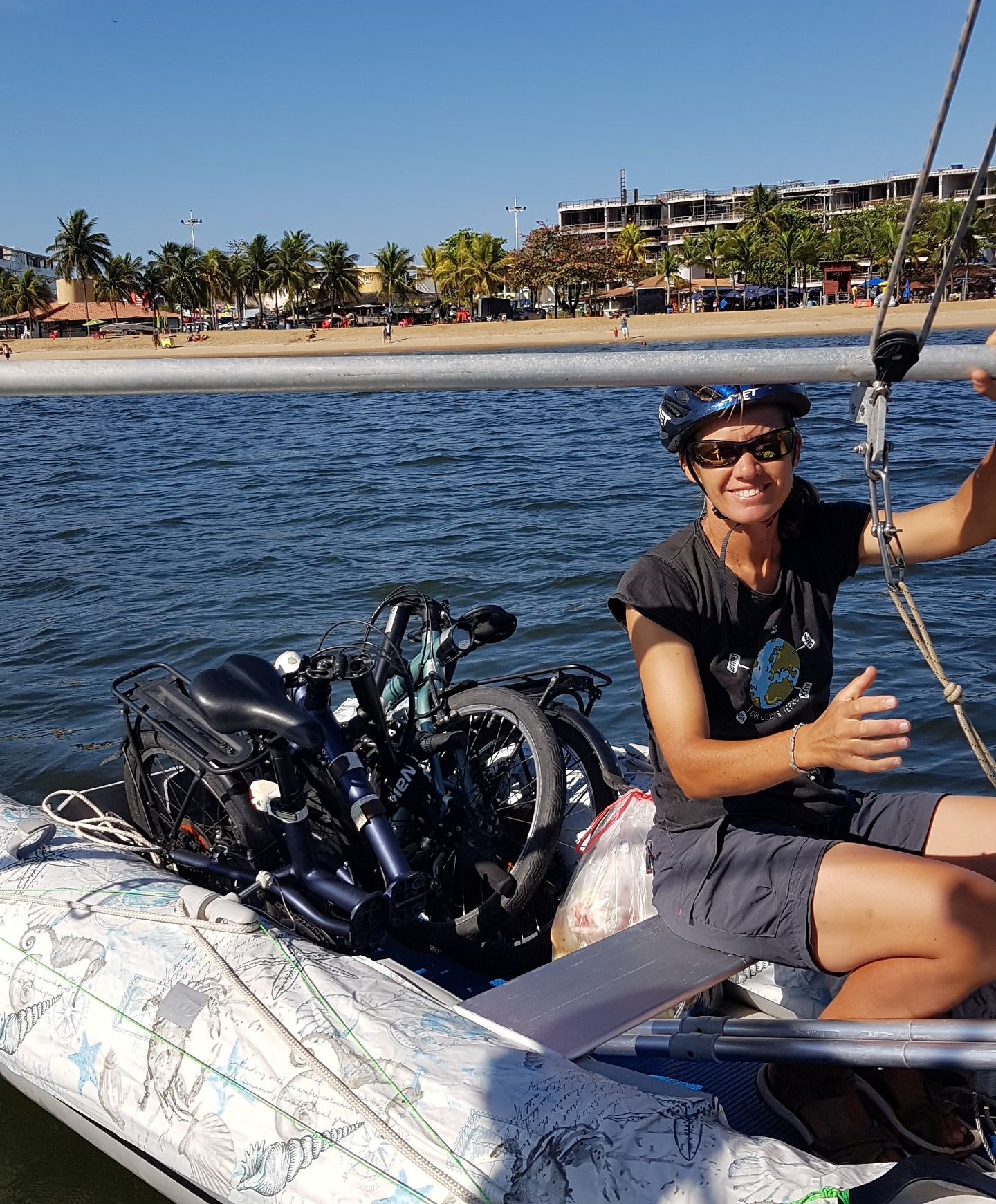
Our folding bikes fit easily in our large tender, what freedom!
So, it’s in this comfortable setting that we spend 9 days waiting for a decent weather window. We spend heaps of time on board—one of us lazing about, writing, napping, playing music, and lazing about some more – the other tackling various water sports (kayaking on the inflatable paddleboard, winging, and swimming), both sleeping, doing a bit of low-stress boat tinkering. Basically, the main objective of this stopover is total rest! The peace is occasionally shattered by the persistent piping of the Bem-te-vi—a cheeky little yellow bird with a black head from the passerine family that loves perching on the boat to sing out its anthem at the top of its lungs: piii pipiuuuuuuu – piii pipiuuuuuuu!
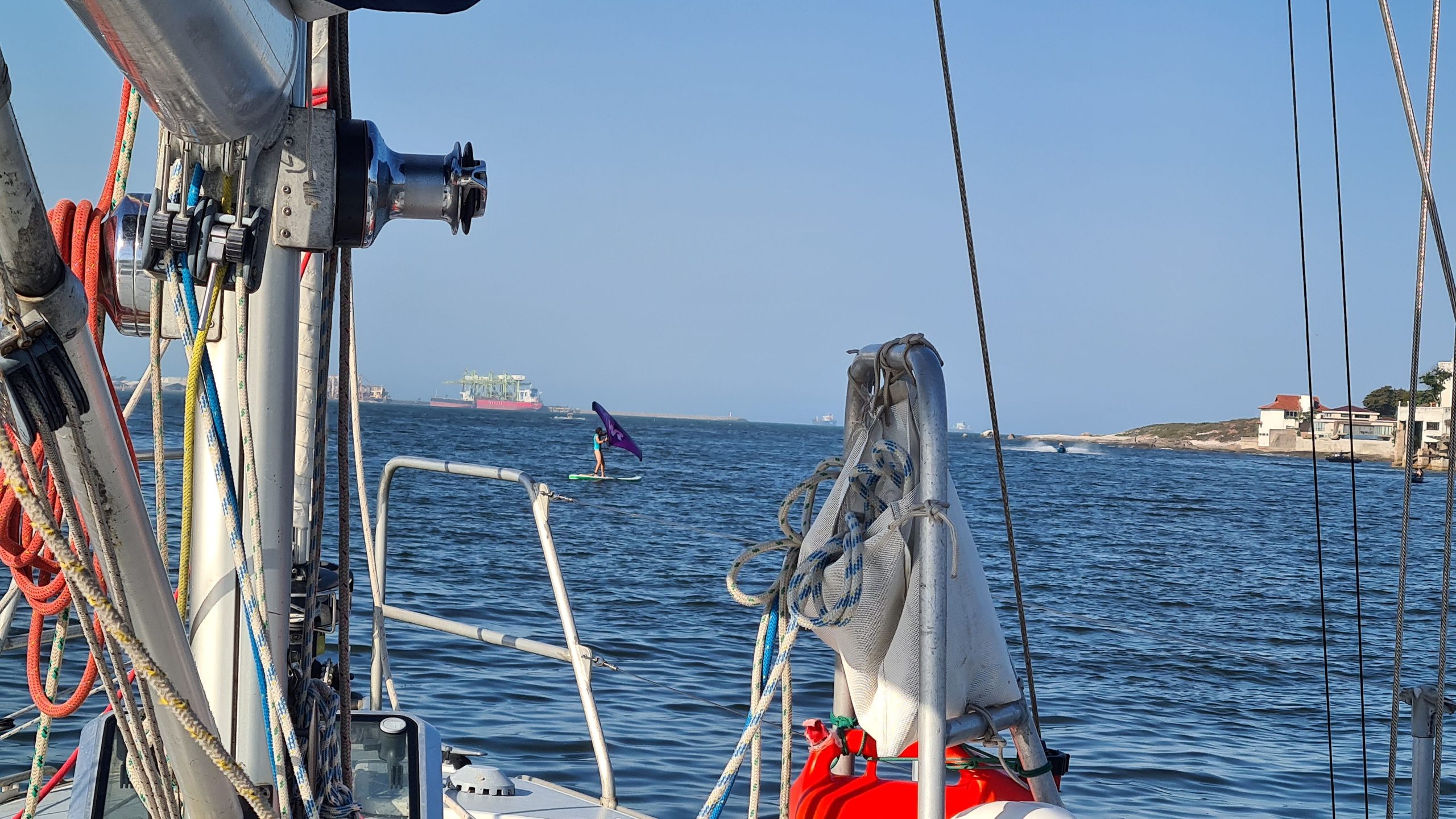
Laure trying to fly her wing again, though the wind is a bit weak
The “pipipius” are singing all day long
Ashore—aside from clearing in and out at the port authorities as required for every new state, grocery shopping (we always feel like we’re ingesting an absurd amount of food), and doing the laundry—we actually find time to play tourist.
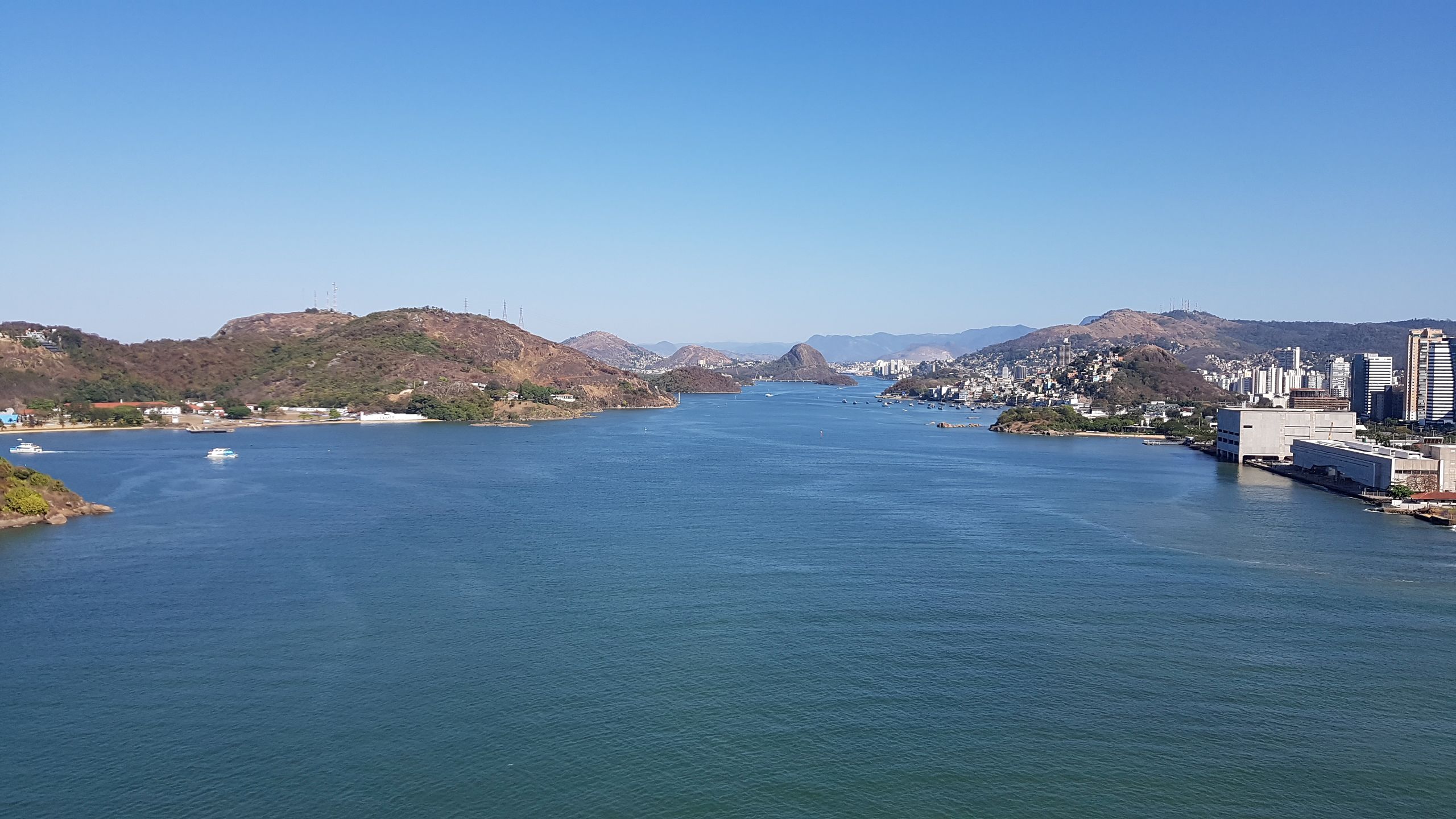
The bay of Vitoria as an appetizer before Rio…
Our first pedal strokes take us over the massive bridge spanning Vitória Bay towards the Convento da Penha, a monastery perched high on a hill offering stunning panoramic views. While there’s still some Bahian mangrove lining the riverbanks, the first granite sugarloaf peaks are a sure giveaway that we’re slowly approaching Rio de Janeiro. The state of Espirito Santo, where we currently are, was somewhat overlooked for a long time, squashed between bigger neighbours: Bahia with its powerhouse identity, Minas Gerais with its mining riches, and Rio de Janeiro, which needs no introduction. Perfect! It means nobody bothers the residents of Vitória—allegedly one of the most liveable cities in Brazil!
Another visit: the Monjardim family estate, a lovely colonial mansion whose walls have watched every local notable pass through for the last 400 years. A brilliant guided tour of a deeply fascinating building. Special mention goes to its avenue of giant mango trees which, lacking basic manners, kept dropping heavy fruit all over the ground! Good thing we were there to clean up after them, really ;o)
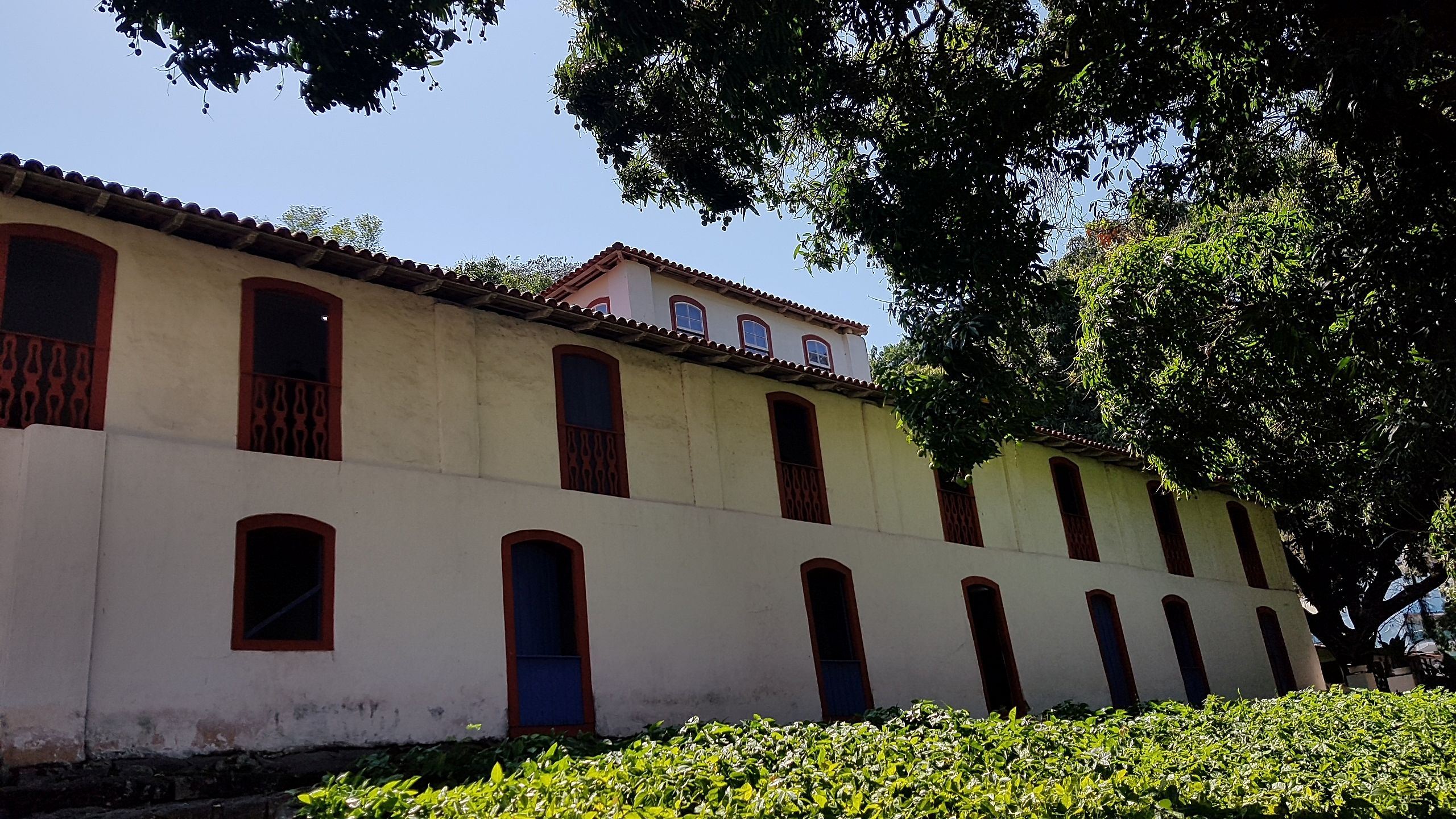
You can clearly see the mangoes hanging from the trees in the garden!
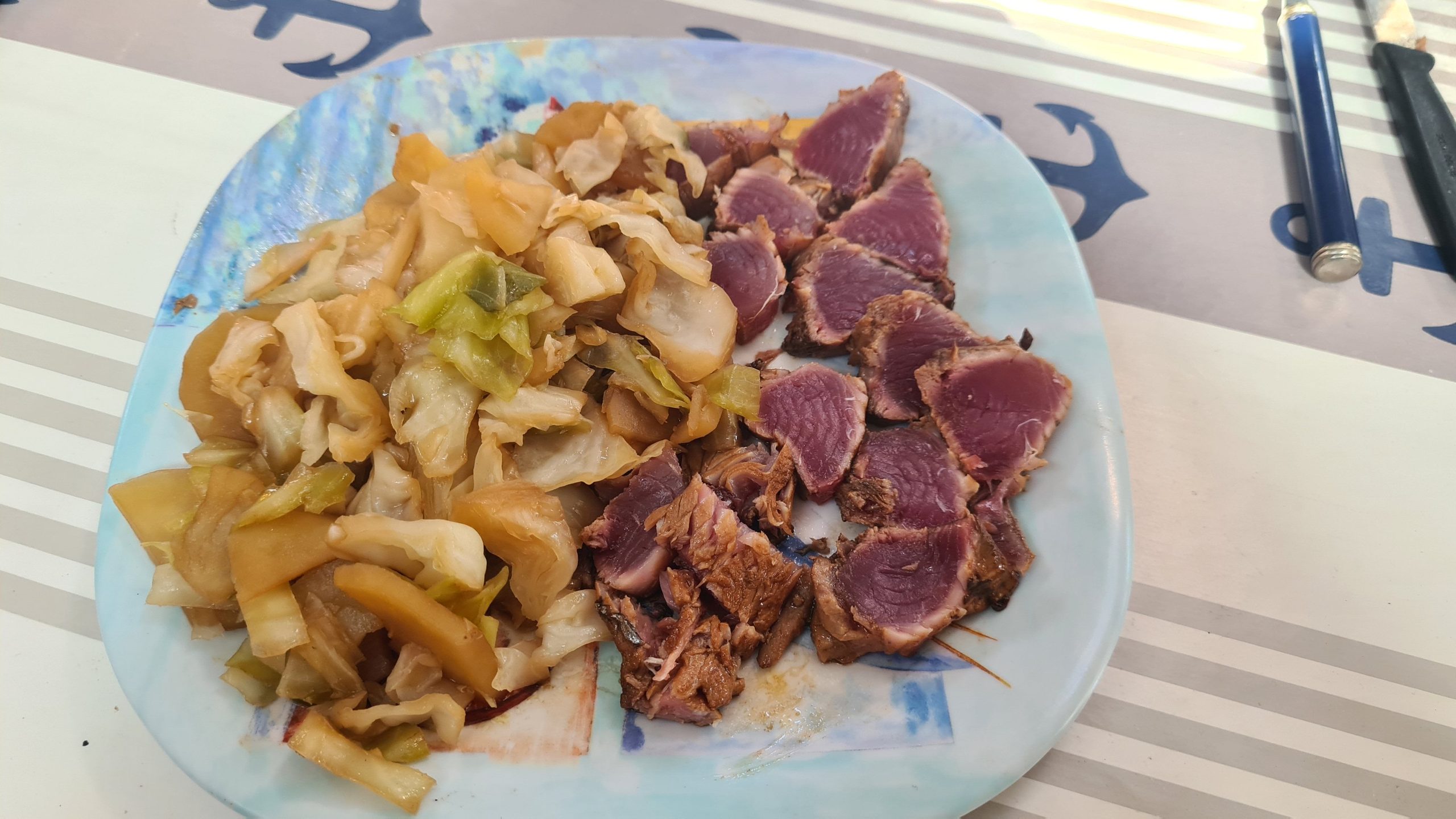
Little tunny tataki, cooked outside and raw inside !
And so time trickles by at the Vitória anchorage. We test new fish recipes, bake a coconut tart to share with Marcos and Ludmilla over a lovely evening together, go back for more swims, and start sleeping a little less heavily and a little less frantically. We’re almost on the verge of getting bored! High time the weather opened a little window for us…
17th-19th August: Vitória – Rio de Janeiro (290NM)
Having let two cold fronts and their associated swells pass by, and after waiting for the wind to swing back to the north-east and become manageable, we spot a three-day pause before the north-easterly builds again, followed by another rather violent cold front. While we are still officially in the tropics, we’ve clearly left the steady trade-wind belt behind. In fact, our last two days in Vitória are marked by a most bizarre phenomenon: non-stop rain! Not a big tropical squall, mind you—just good old-fashioned grey clouds and continuous drizzle for the entire weekend! And chilly with that—barely 22 degrees… We haven’t experienced weather this cold and damp since… Tenerife back in early April!
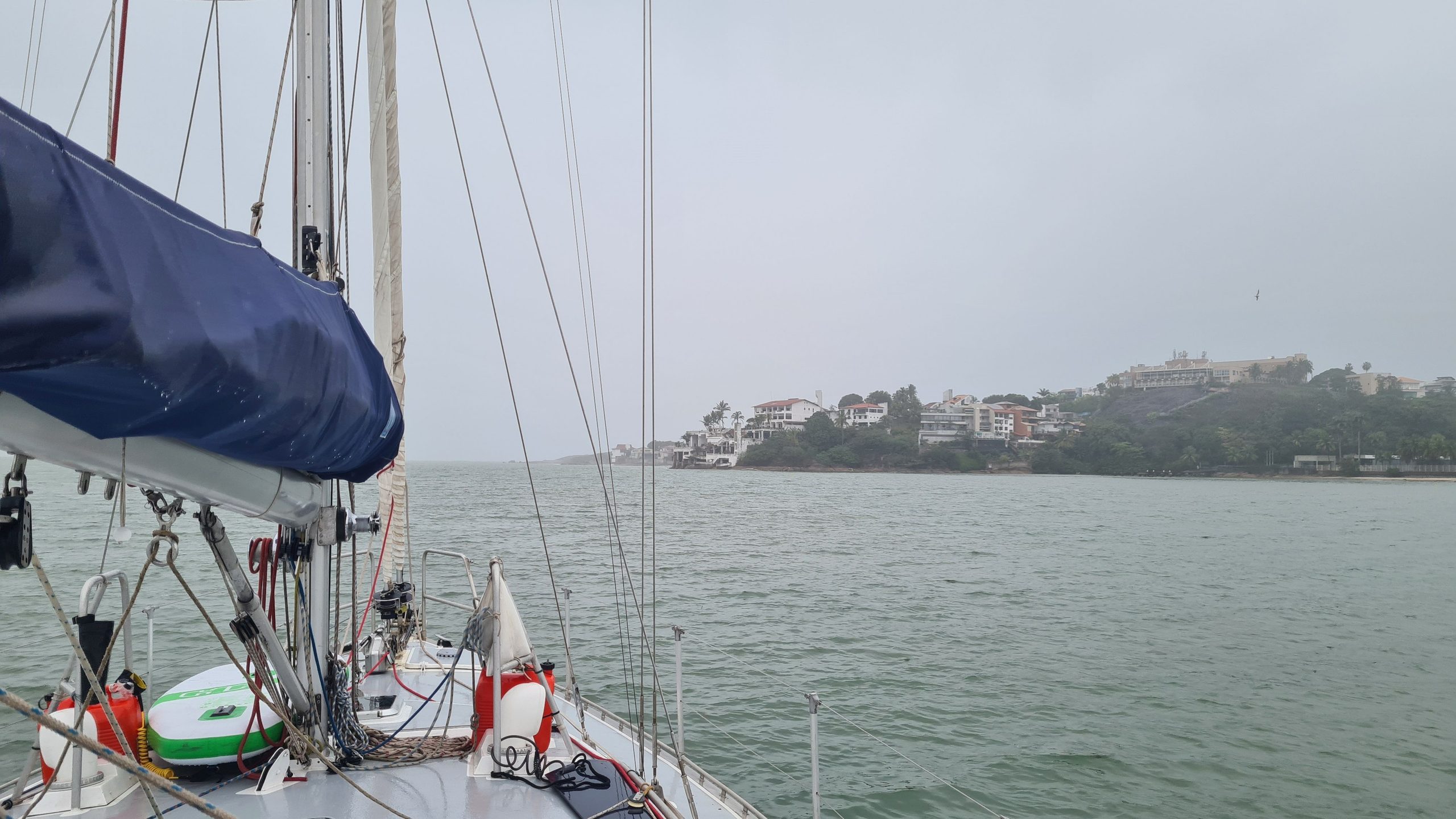
But what kind of weather is this at 20° latitude?
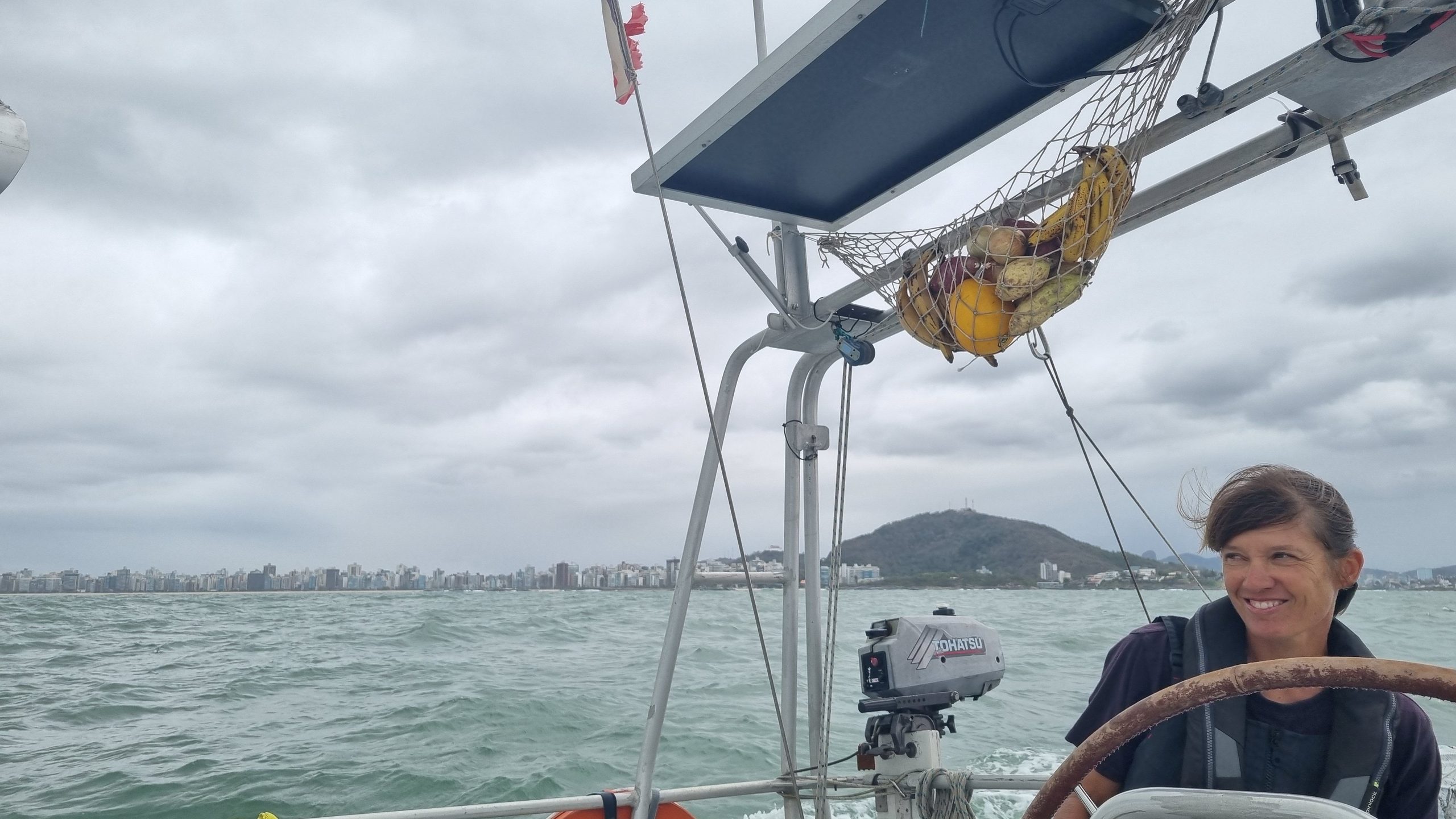
Bye bye Vitoria, we are heading South!
The rain is well behaved and stops right when we want to set sail; funny how life works out sometimes. The swell is still present as we clear the bay. We trim the sails for a reach and begin our wild ride south, propelled along by the Brazil Current.
We rack up the miles at a surreal pace; topping 10 knots inside a particularly helpful vein of current. The wind picks up a tad during the night, but nothing dramatic, and we keep hammering along past the offshore oil fields off Açu and Búzios.
Emboldened by our two little tunny catches from the last leg, we trail a fishing line, but the only fish we actually see is a flying fish that—as they so often do—lands flat on the deck overnight. It’s absolutely gigantic! Over 40 centimetres long with wings wider than our hands; we’ve never seen one so massive! With a few thumps of its tail, it quickly wriggles back into the water, leaving behind giant scales and a lingering stench.
And there are still whales until Cabo Frio
The wind will keep picking up until Cabo Frio…
We do the math after 24 hours: 169 miles logged! Just 2 miles shy of our all-time record set during the transatlantic in the Equatorial Current. At this rate, Cabo Frio—a major landmark on the Brazilian coast—is rapidly approaching. Especially as the north-easterly wind starts building in earnest. We’re expecting 25 to 30 knots rounding the cape, so we’re not caught off guard, but it’s still the kind of weather that commands respect and requires precaution.
The famous cape is now clearly visible on the horizon in the setting sun. Cabo Frio—much like Cape Finisterre in Spain—is a stark meteorological boundary, and there’s always more wind and swell than forecast. We approach it under three reefs and staysail, treating it with all the reverence it deserves. The sea in particular is horribly steep and uncomfortable. We’re now seeing far more 30-knot gusts than 25, but downwind everything goes smoothly. Unfortunately, we have to luff up about thirty degrees behind the cape to lay a course for Rio. On a beam reach in those conditions, it’s a whole different ballgame: the windvane struggles massively to hold the boat in the gusts. So, for once, we take the helm ourselves. Every time a monster wave rolls under us, or when we hear the distinct hiss of an approaching squall, we bear off hard to keep the boat from rounding up.
Highly effective, but exhausting! Thankfully, the wind eases off in less than two hours once we’re sheltered behind the cape, allowing us to slip back into our standard watch rotation. We are now on the Rio maritime highway, surrounded by platform supply vessels and a few fishing boats. The wind collapses rapidly: on the very first watch change, we go straight from three reefs to a full mainsail! The genoa replaces the staysail barely an hour later, and our speed drops off a cliff…
6 miles from the entrance to the bay, we no longer have enough wind to steer, so we call the engine to the rescue. Dawn slowly breaks and the outline of the coast begins to take shape. It’s dramatically jagged, carved into countless rounded peaks—a whole family of little sugarloafs. But the real deal—the original Sugarloaf Mountain—is sitting right there on our bow…
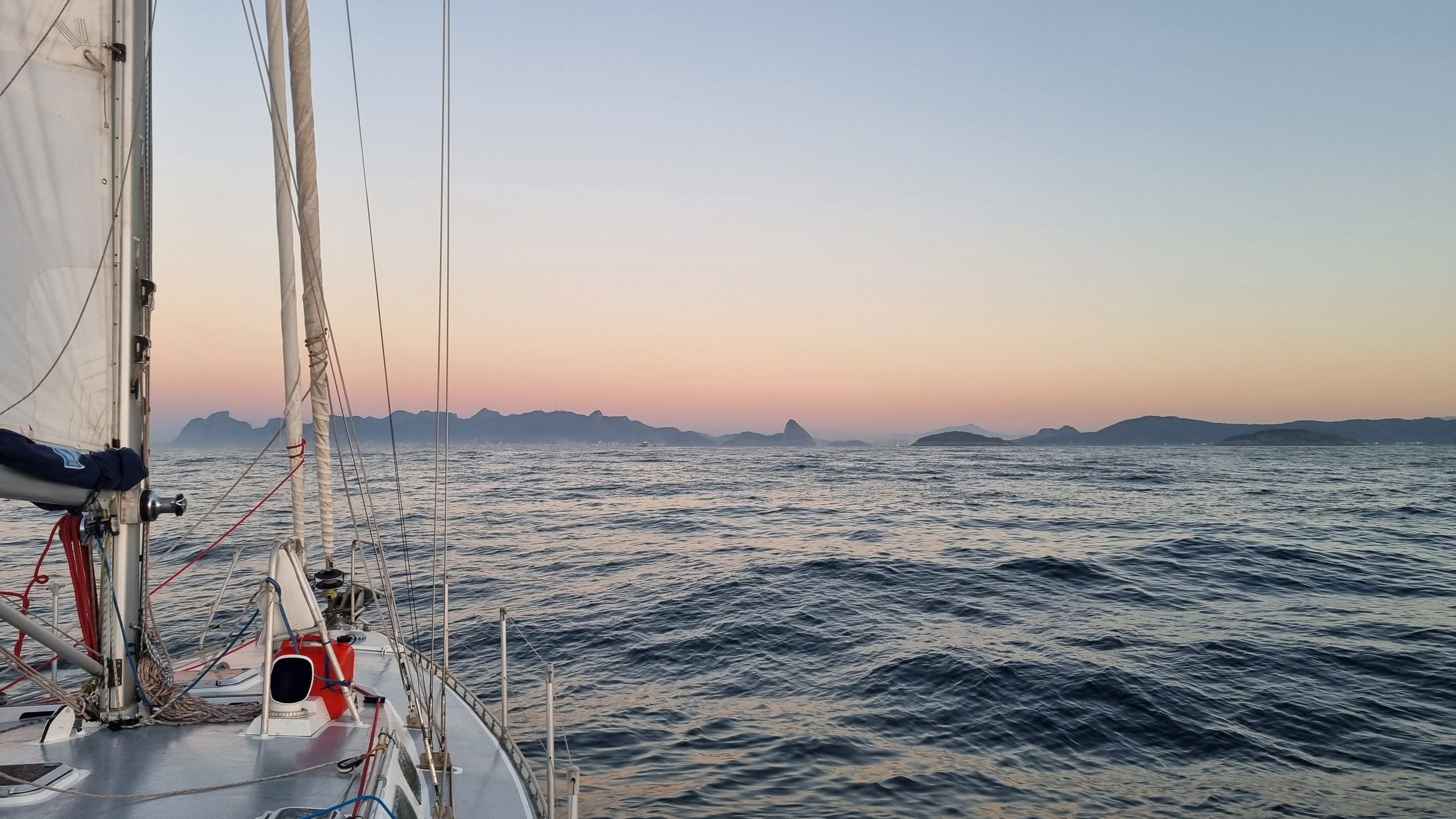
Rio de Janeiro, ahoy !
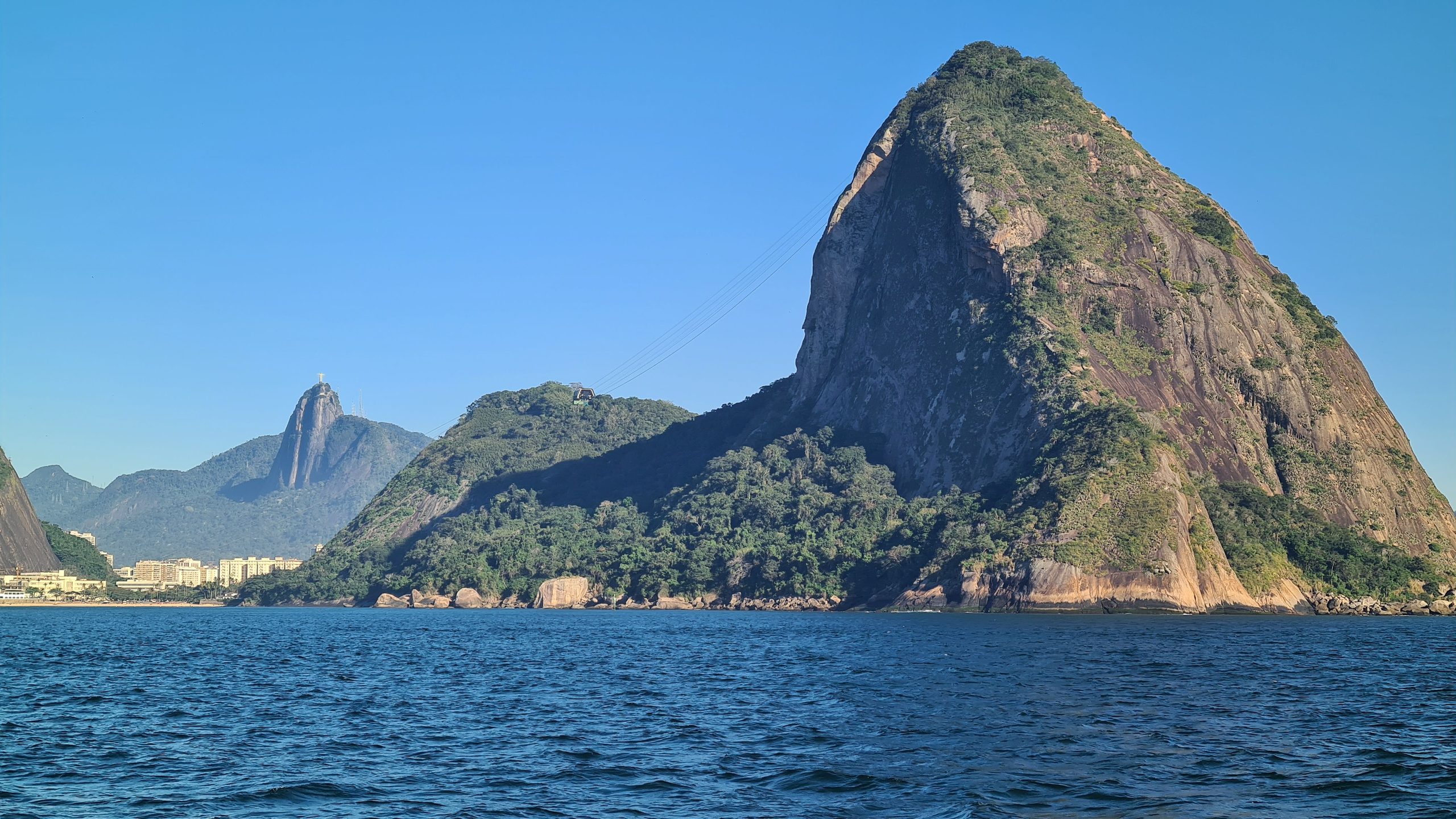
Yes, those are indeed Corcovado and Sugarloaf Mountain!
The sun rises just as we enter Guanabara Bay… We couldn’t have dreamt up a more magnificent arrival! We glide past the beaches of Ipanema and Copacabana, surrounded by brown boobies and under scores of high flying frigatebirds. Then, right at the foot of Sugarloaf Mountain, we swing left into Botafogo Bay.
We pick up a mooring buoy off Urca beach, nestled right beneath Sugarloaf Mountain, not far from the famous Christ the Redeemer. It’s surreal. It looks like we’re in Rio… RIO !!!!!!!!!
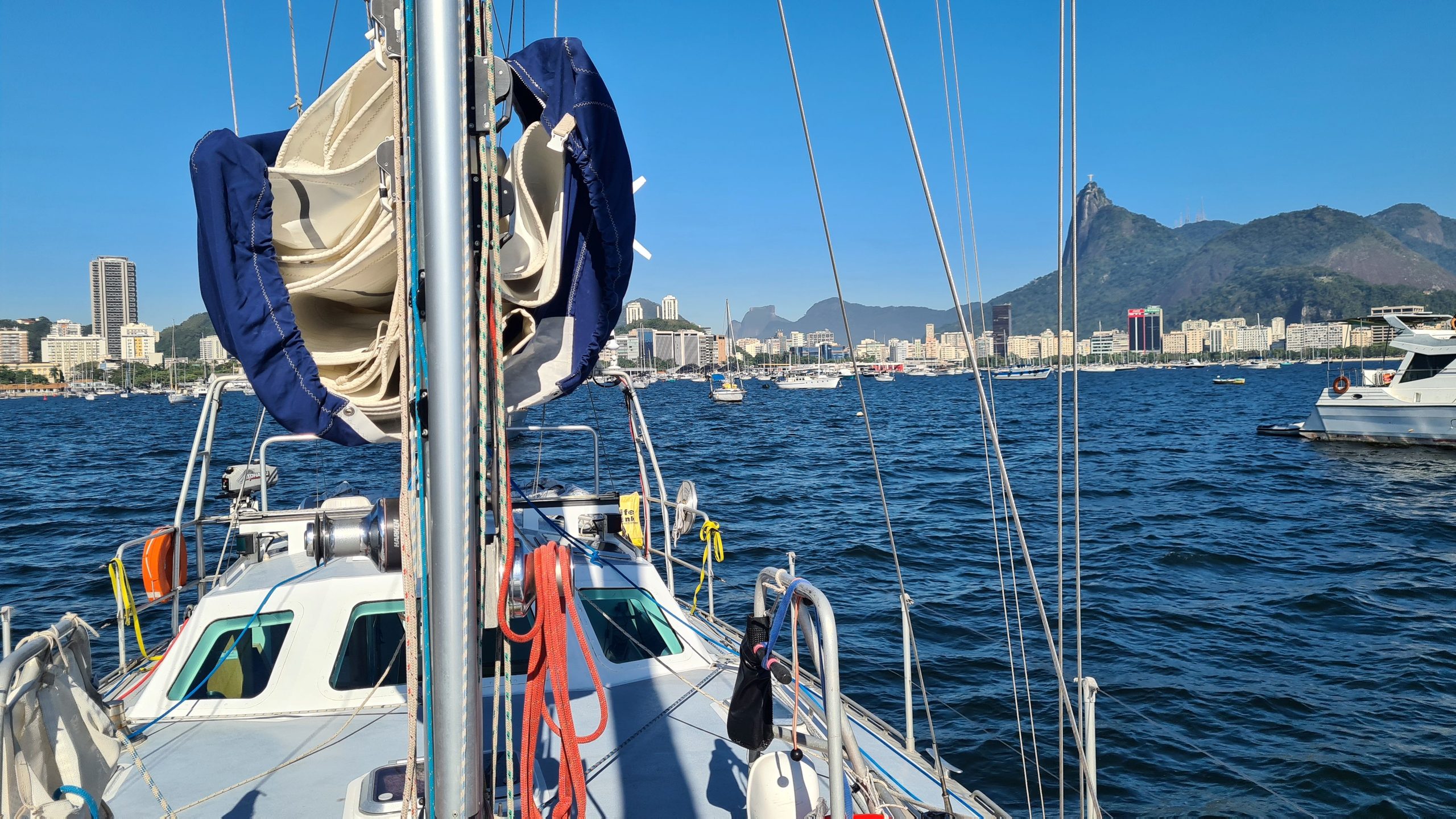
The Corcovado from UtPåTurs’s deck, stunning !
 PDF
Great to see the whales and I enjoyed reading about your well described adventure! Keep enjoying!