
After a rapid passage across the state of São Paulo, UtPåTur drops anchor around Florianópolis in the state of Santa Catarina. A bit of logistics, a bit of shopping, and a whole lot of waiting for weather. And this is undoubtedly only the beginning… welcome to the South!
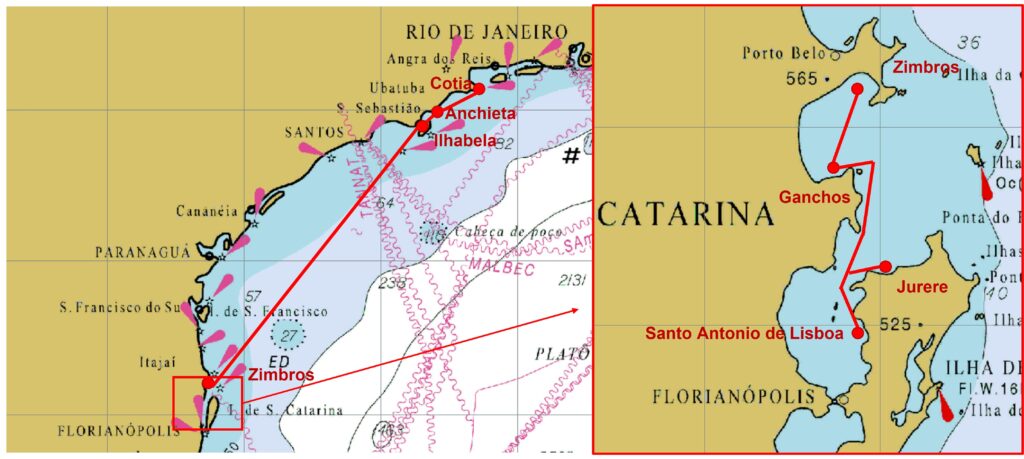
396 nautical miles sailed– 12 399 NM in total on UtPåTur
The full photo album here.
13th–15th September: From Cotia to Ilhabela (78NM)
The forecast had promised us a day of Force 3 south-easterly wind—ideal weather to reach the island of Ilhabela in one long beam reach. So off we go, confident as we leave our brilliant shelter in Cotia under the usual bucketing rain, setting course south once again.
Unfortunately, the promised wind fails to materialize. When it finally makes a faint attempt to pick up in the afternoon, it’s only to drop dead again almost immediately, and still in very damp conditions. Enough motoring for one day: we spot an island along our route with a sheltered anchorage and pull in for the night. Ilha Anchieta looks stunning, but we only catch a glimpse of it at dusk and then at dawn—and always behind a curtain of rain…
The next day, the wind refuses to show up again, so we end up motoring the entire day to Ilhabela. Crossing the Tropic of Capricorn on the way marks the official end of the holidays in peaceful waters… It’s striking how different tropical weather is here compared to the Northern Hemisphere!
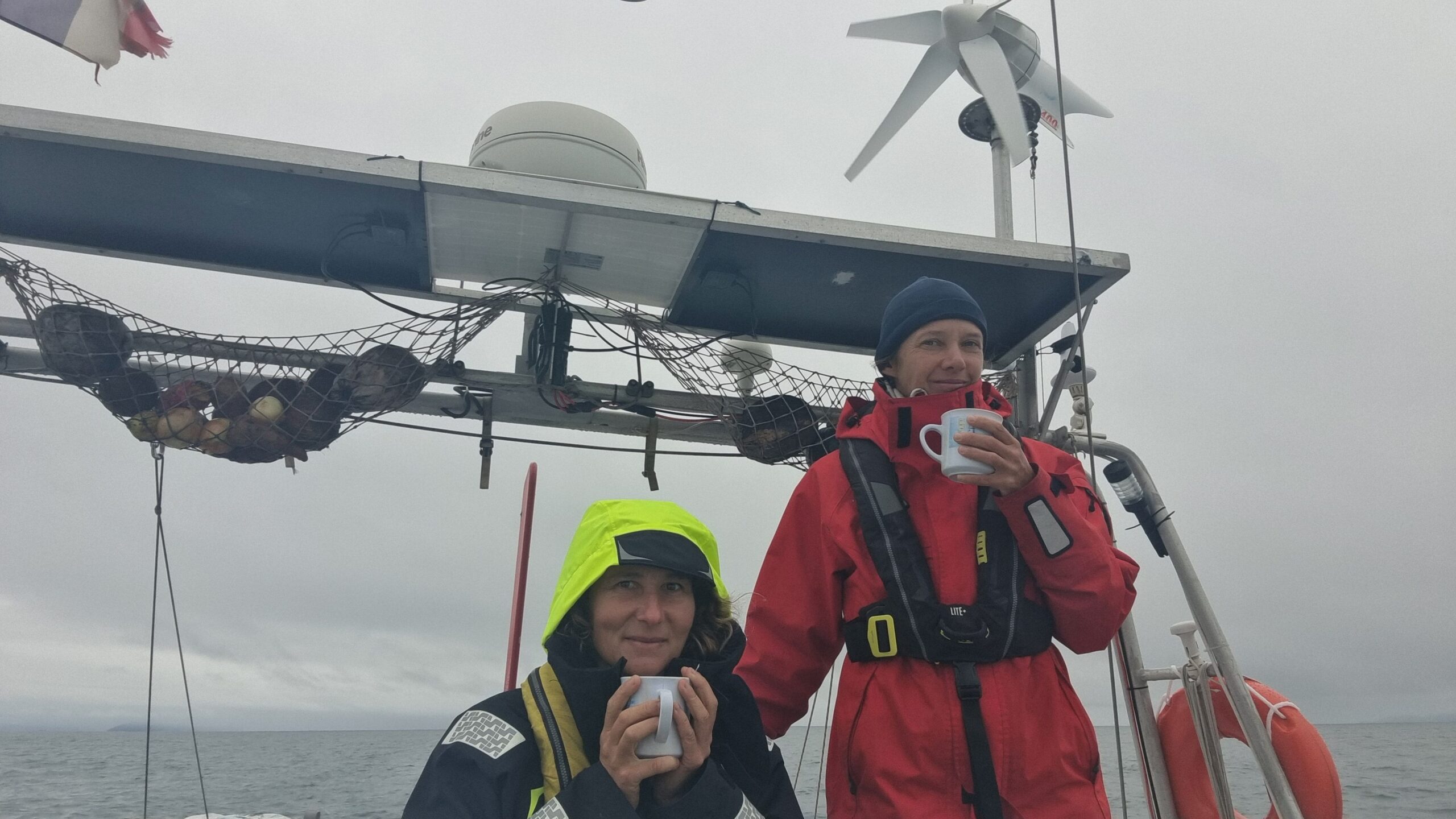
Crossing the Polar Circle? No, Tropic of Capricorn !
At Ilhabela, we tie up at the very posh Iate Club, which offers four courtesy days on a mooring buoy to foreign boats—nice touch! (A practice that seems fairly common in this part of the country, where marinas are otherwise prohibitive). It gives us good shelter and total peace of mind to leave the boat behind and head ashore. But that’s tomorrow’s agenda. For now, the rain redoubles and we spend the afternoon on board harvesting rainwater…
Eventually the weather improves: if not glorious sunshine, it’s at least dry, so we take advantage of it to stroll around the town of Ilhabela. The place is extremely touristy and the vibe reminds us of the Canary Islands: a pretty palm-lined seafront, large squares planted with red flamboyant trees (not in bloom, since here again we’re at the start of spring!) and trailing ficus trees, plus ice cream parlours and restaurants galore. You hear Spanish in the streets, too: Argentina is close, and most tourists hail from there.
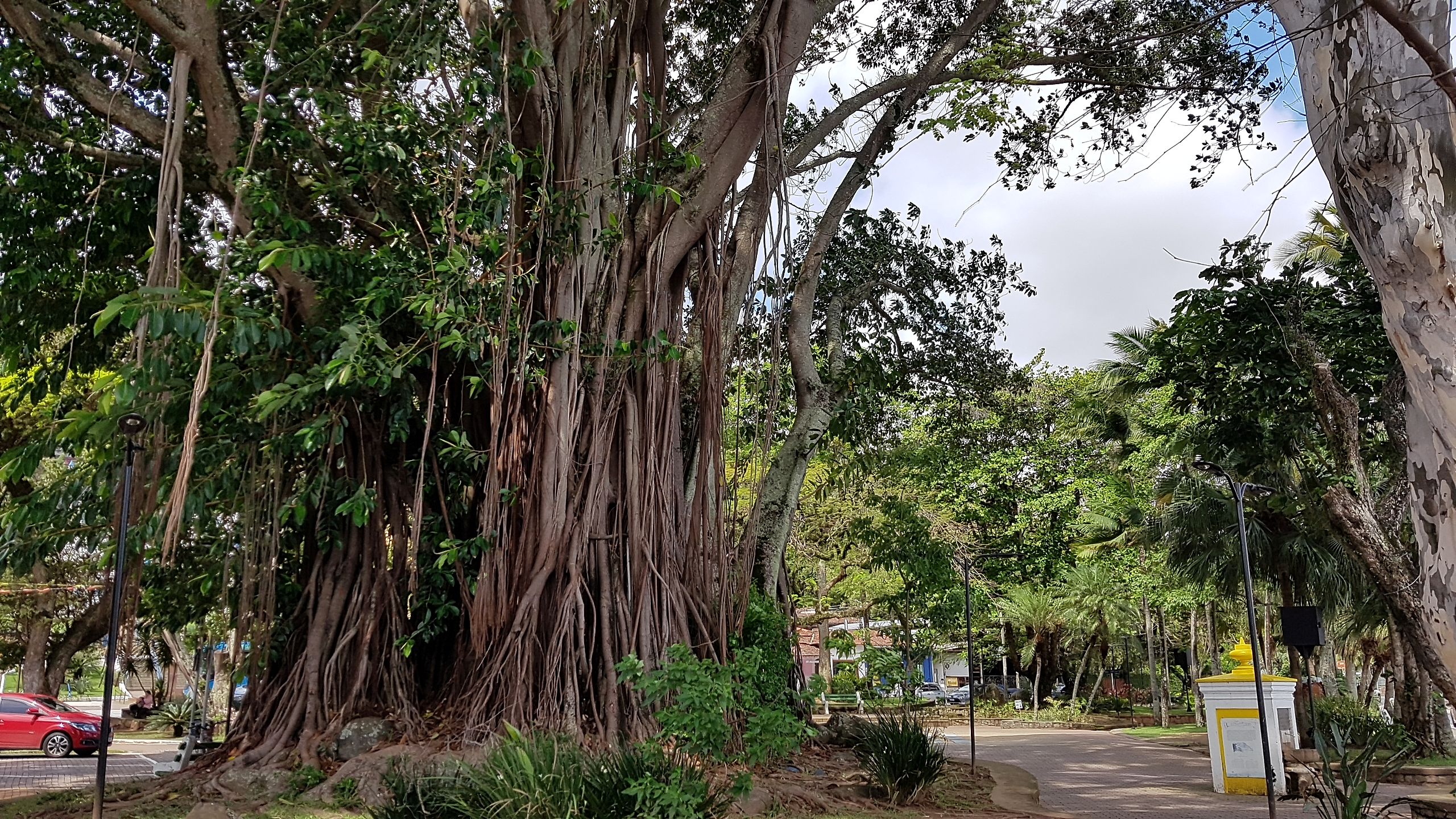
A huge trailing ficus tree, like in Tenerife
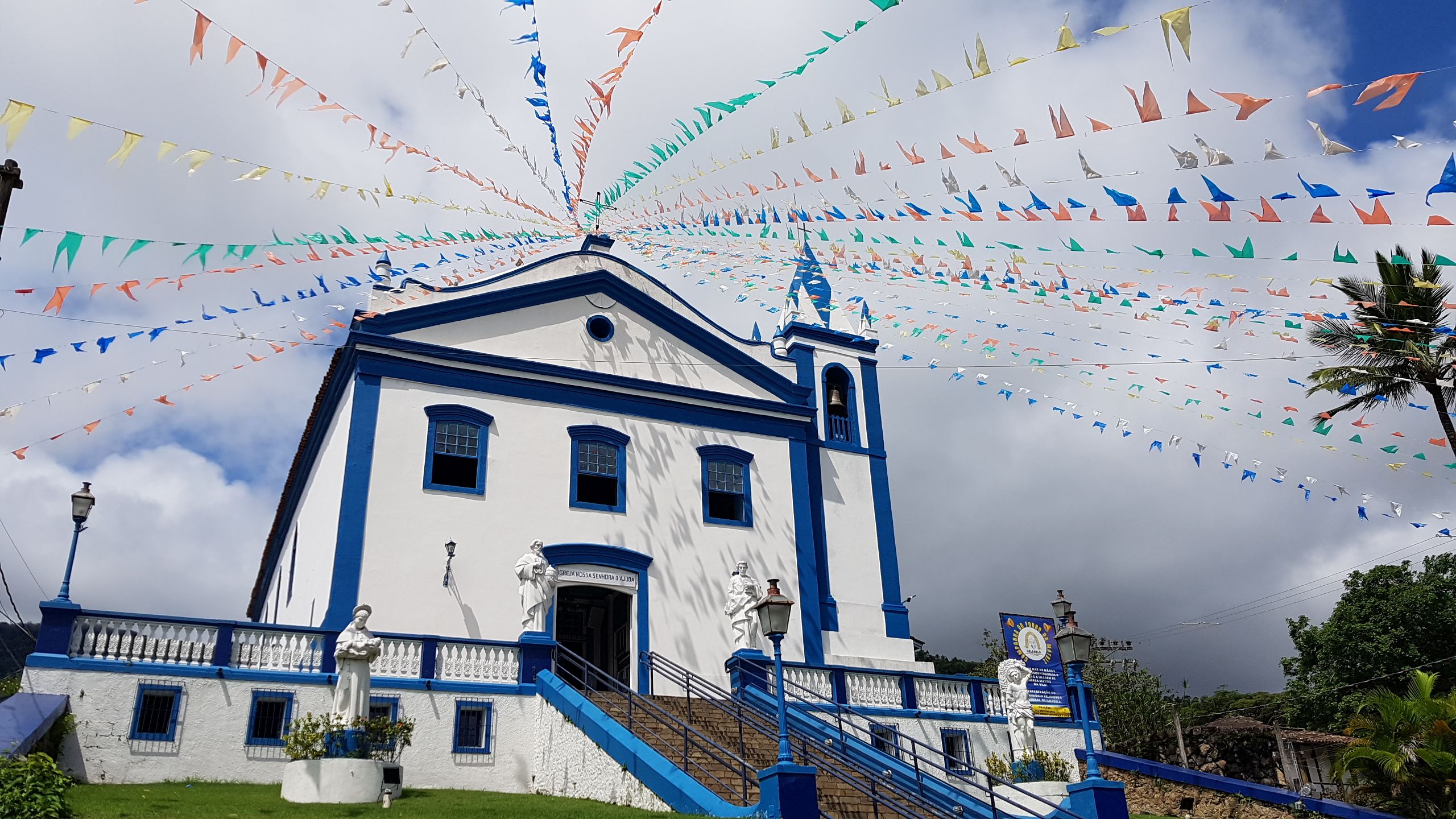
Very chute church
We’re now in the state of São Paulo (yet another saint!), where the local delicacy is the pastel—a fried pastry stuffed with whatever takes your fancy: cheese, prawns, or even broccoli!
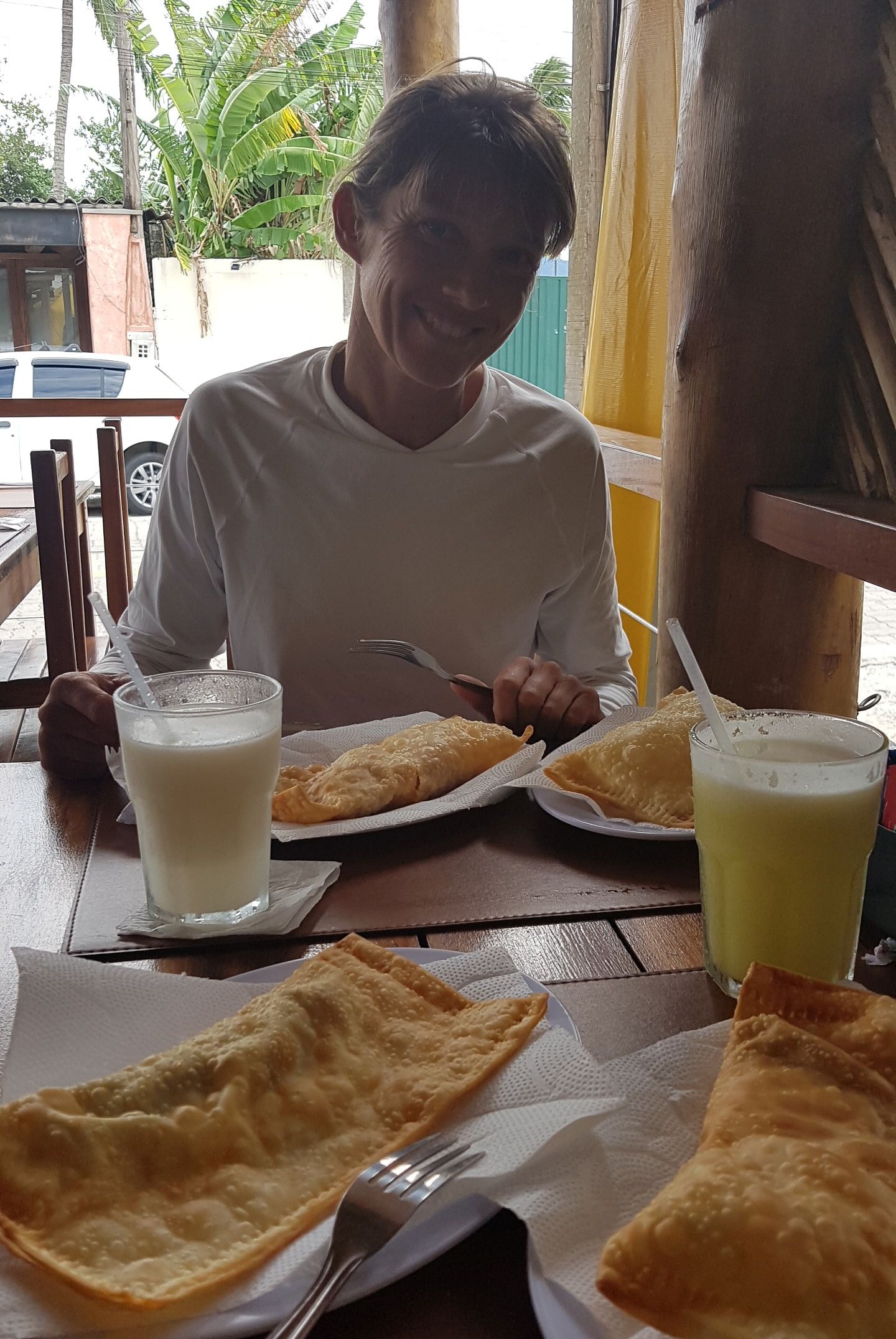
Local lunch made of pastels and fresh juices
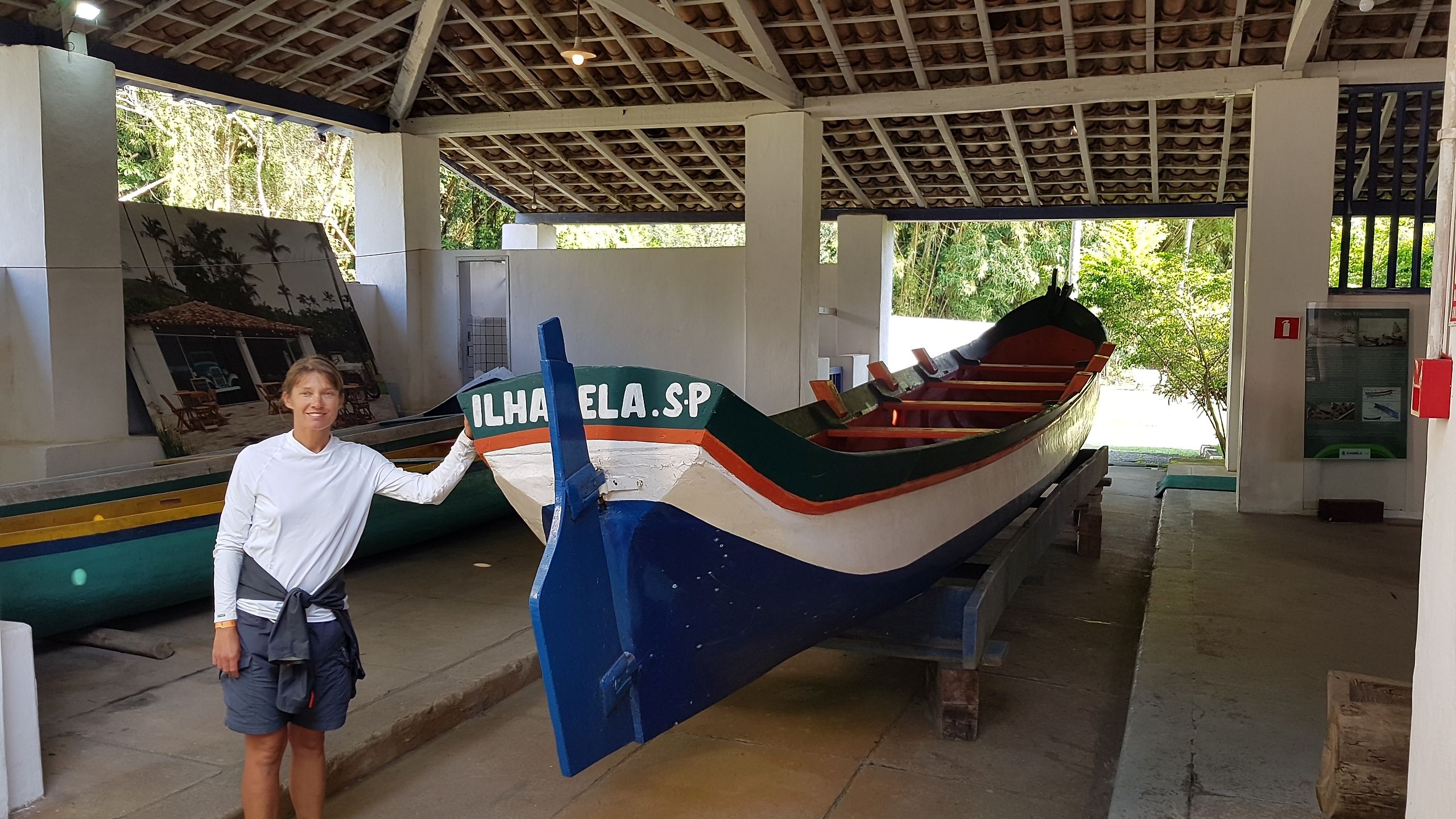
Traditional boat, dug in a single – huge – tree
Duly fed, we continue exploring. A quick stop at the maritime museum is a must—though it turns out to be mostly a shipwreck museum, just like the one in Cuxhaven exactly a year ago. Then our footsteps lead us, almost by chance, to the Engenho da Água house, a colonial estate that became a sugarcane plantation and Cachaça distillery in the 20th century. The self-guided tour is fantastic, set right in the middle of a gorgeous garden. We learn that up until 1970, the island was covered in sugarcane fields, before they were all banned to reforest the island with traditional Mata Atlântica.
One last local curiosity, alongside the small fresh fish shop where we finally find proteins other than red meat or ham: an imposing series of sculptures representing a classic Christian Way of the Cross, intermingled with all sorts of other deities. You find the distinctly Brazilian Orixás from Bahia, before things go completely off the rails with Ganesh, Buddha, Chief Seattle, and Haile Selassie! Talk about syncretism!
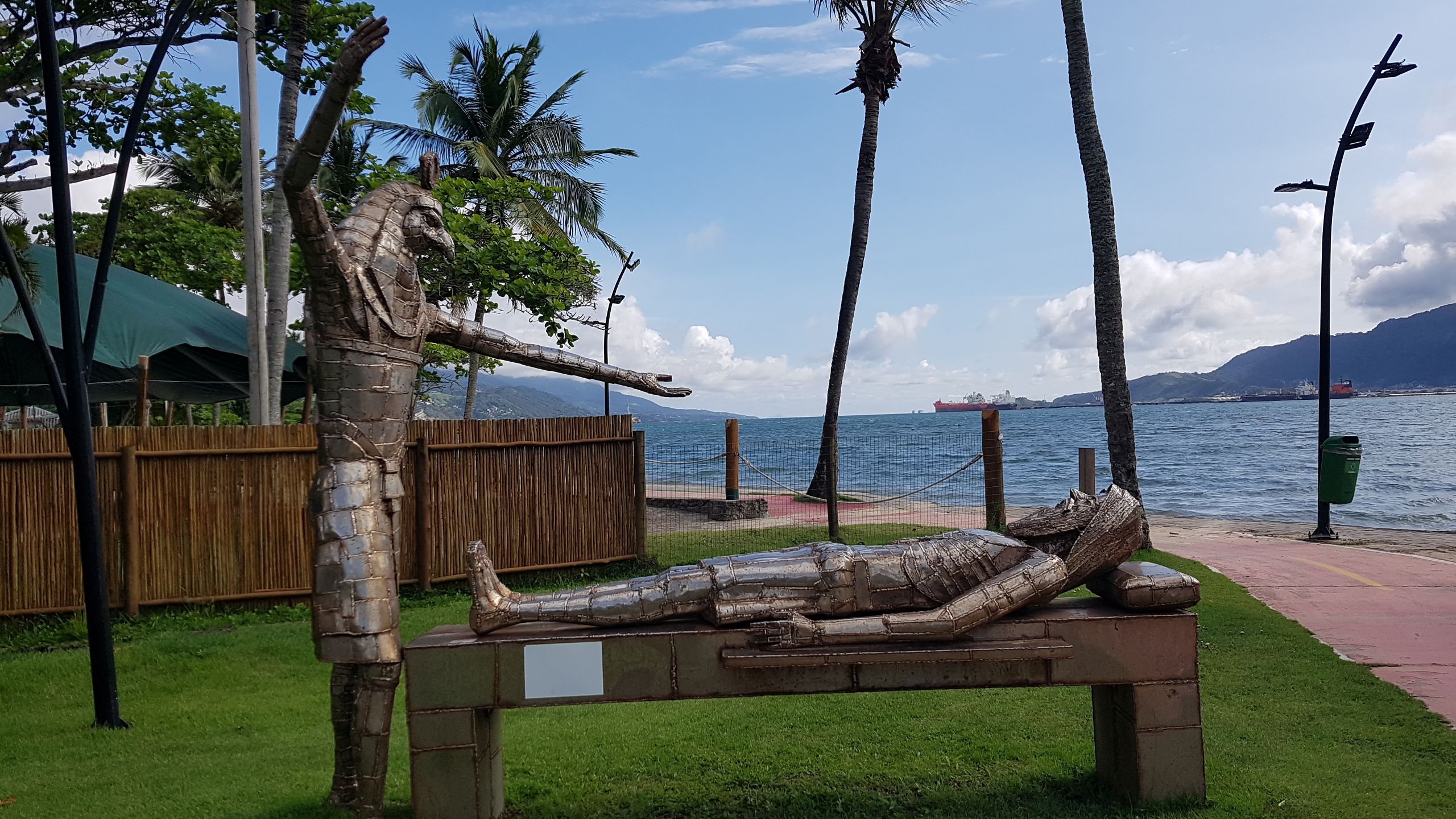
The famous mummification of Jesus
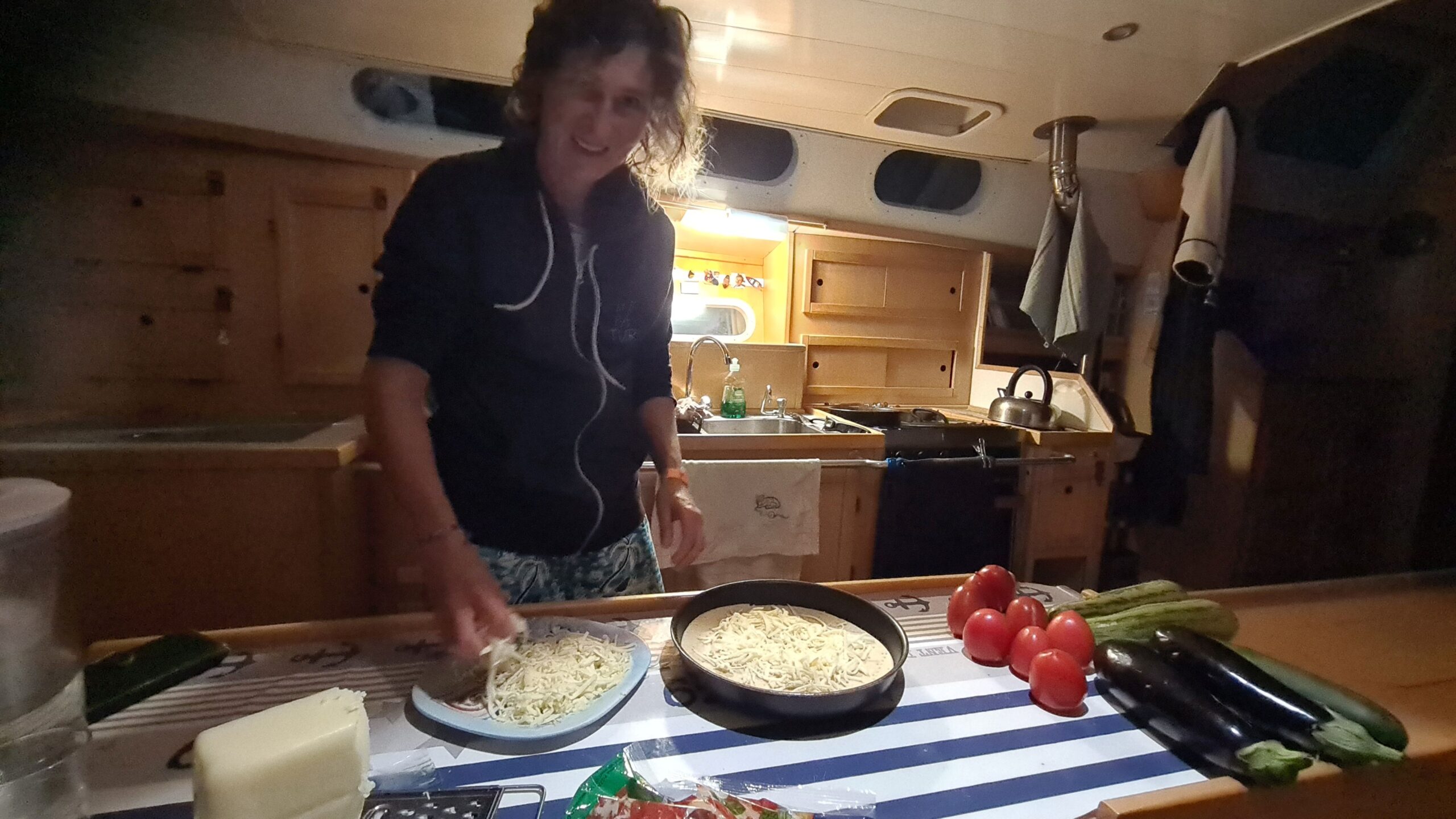
Pizza time! Baked in the frying pan!
Back on board for a homemade pizza—our go-to meal before a big passage. Because tomorrow, we put back to sea…
16th–18th September: Ilhabela – Zimbros (283NM)
With the Itajaí River tricky to access at the moment due to flooding (it’s been raining a fair bit lately…), we set our sights on the Baía das Tijucas, 30 miles further south, where we’ll find sheltered anchorages depending on conditions. The passage looks easy on paper: dry weather (!!) and a moderate beam wind to start, turning more and more downwind and picking up towards the end. Perfect conditions for our return to offshore sailing after a month of stopovers and short coastal hops.
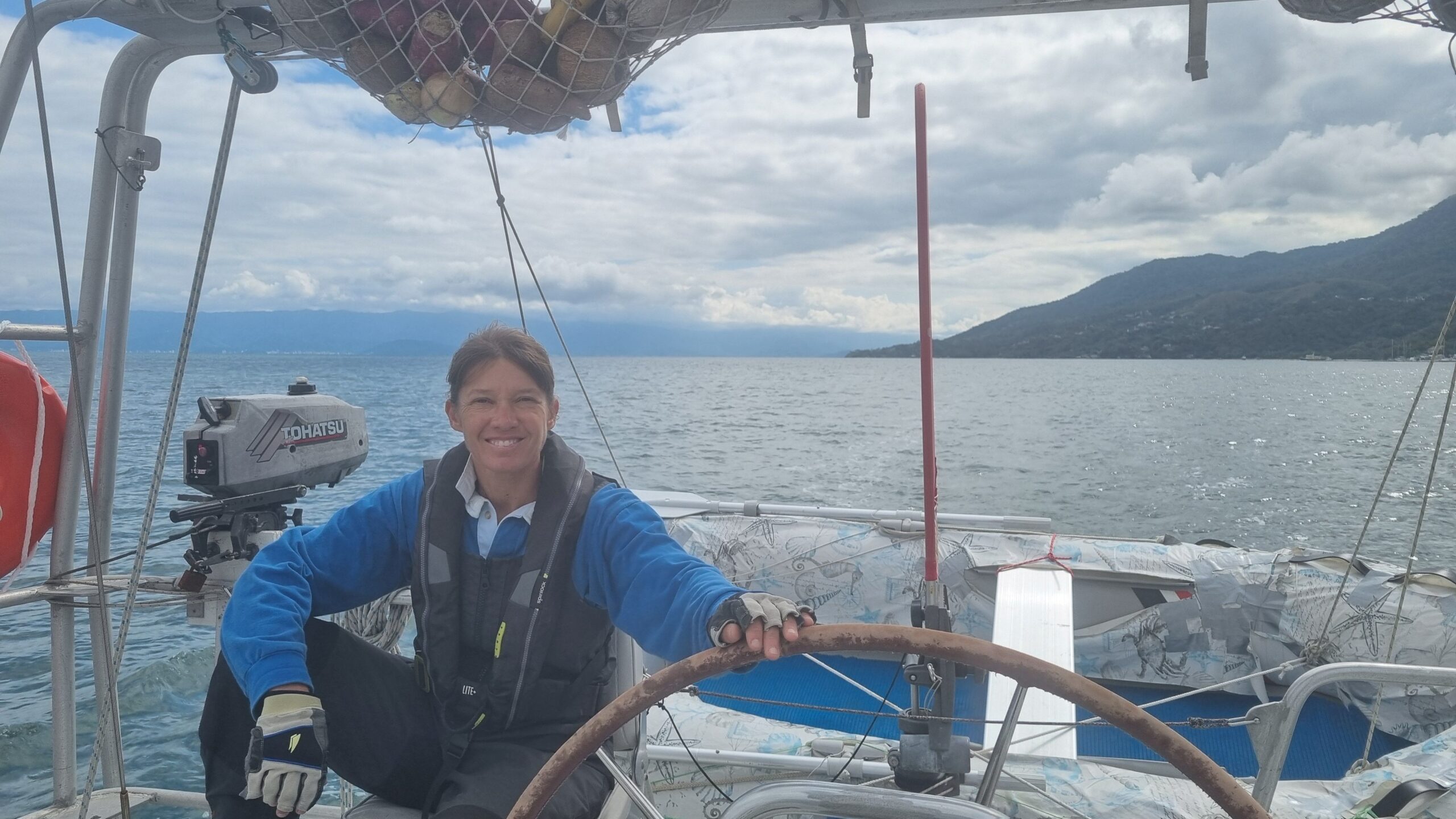
Leaving Ilhabela, without a rain jacket for once!
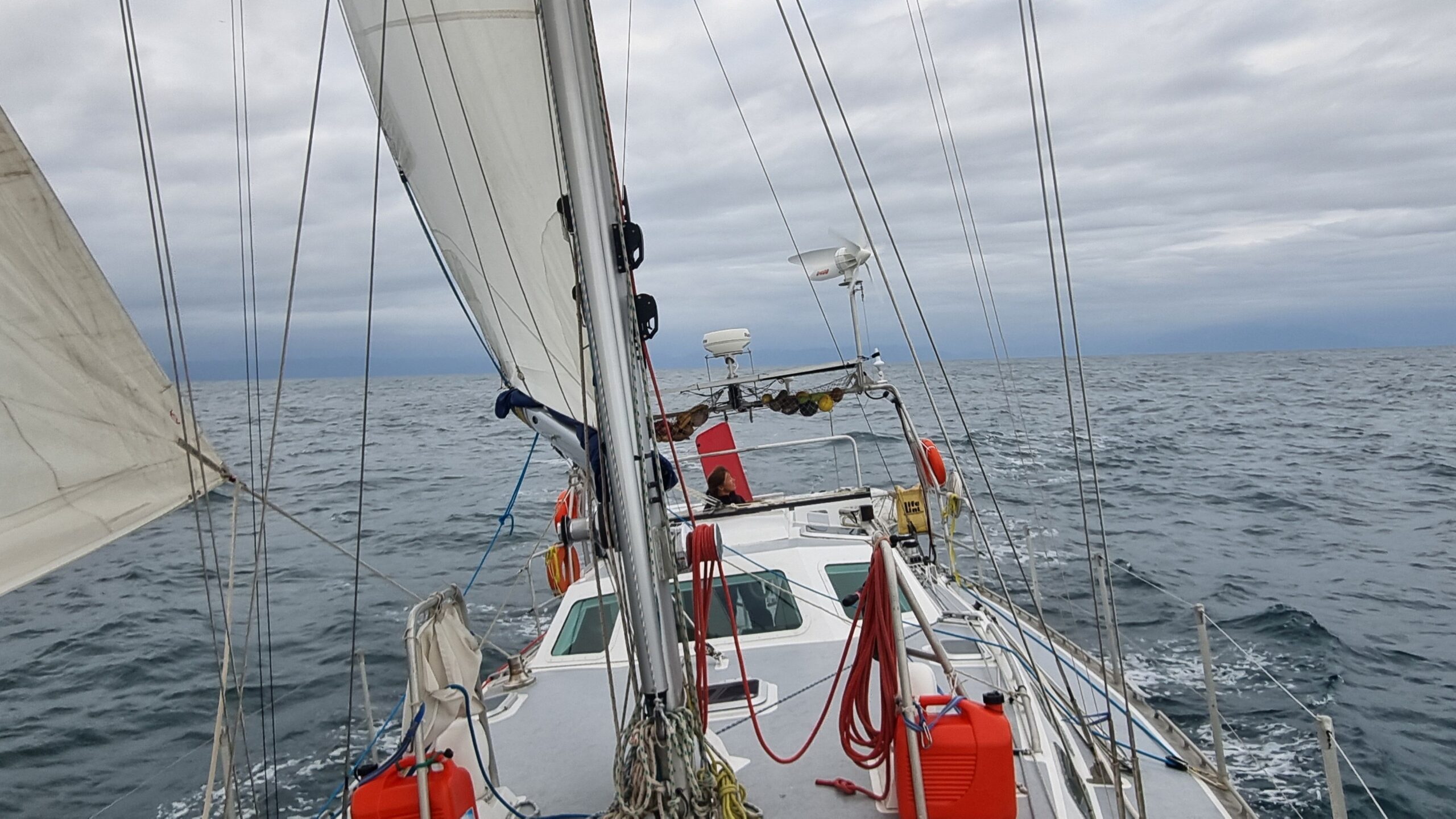
UtPåTur glides slowly under the usual grey sky
And indeed, the passage isn’t overly sporty. The wind blows from the east as forecast, but rarely above 10 knots. We cover nearly 300 miles under full sail without ever having to reef—unbelievable! While the swell is very annoying at first, it soon settles, and we make progress slowly but comfortably. The Brazil Current gives us a nice boost, allowing us to stay under sail for almost the entire crossing. We finally give in 15 miles from the finish line when the anemometer registers a fierce 0 knots of apparent wind…
Even if the weather remains a bit dull, it stays dry, making for very pleasant conditions. It’s even warm enough to sit outside and watch nature go by. The humpback whales are gone, but we finally run into dolphins again! A pod of about twenty Atlantic spotted dolphins swim out to meet us on the very first day, sticking around for ages to play in the bow wave. Absolute bliss—you can never get tired of these interactions…
Dolphins!! It has been a while!!
Stars are exceptionally bright on the first night. We spot Orion—now hanging upside down—but we can’t find the Southern Cross, which sits very low on the horizon this time of year. However, for the very first time, we observe the Magellanic Clouds: two dwarf galaxies close to the Milky Way, only visible from the Southern Hemisphere (and mostly south of 20° latitude)…
At night, the stars shine in the water too, thanks to bioluminescent plankton flickering in the spray or the boat’s wake whenever the sea stirs. Suddenly, several comets charge straight at UtPåTur—large glowing spheres leaving pointillist trails behind them. Dolphins, of course! Their outlines are perfectly visible down to the finest detail, every contour traced by tiny specks of light. The most stunning night-time dolphin display we’ve ever witnessed… A moment suspended in time…
Yet as is often the case, it’s mostly birds that keep UtPåTur company on this leg. They’re all around the boat. A few brown boobies, lots of petrels (of the white-chinned variety), terns, and a newcomer: long, narrow wings, endless glides skimming the water, a hooked beak, and a stern eye. We hardly dare believe it, but our field guide is categorical: our very first small albatrosses! Atlantic yellow-nosed albatrosses, to be precise, which venture quite far north in winter. This time, we’ve truly stepped into a different world…
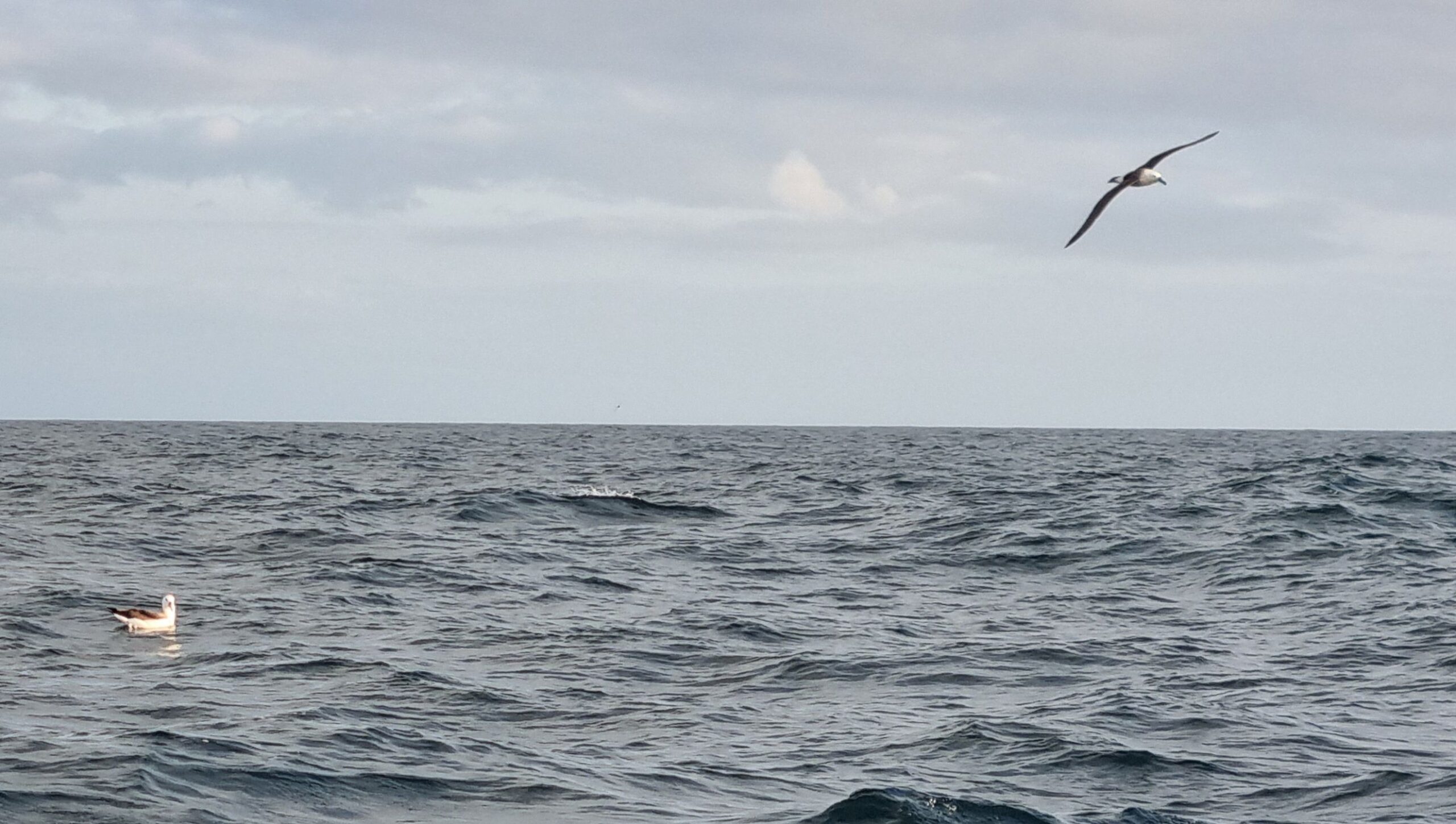
Our first albatrosses…
Despite motoring the last two hours, it’s pitch black when we enter the massive bay of Zimbros. Fortunately, our friends on Edna, who arrived two days ago, sent us the coordinates of the bay’s shellfish farms. We weave through without a hitch, pulling up right alongside them and dropping anchor within easy dinghy distance. There’s nothing quite like arriving in a bay and finding a buddy boat to make you feel right at home!
19th–23rd September: Waiting in Baía das Tijucas (9NM)
Here we are in the state of Santa Catarina—a female saint this time for a change—the penultimate Brazilian state before the border. Our minds are turning increasingly towards the South, and we’re itching to press on towards Uruguay, where we’ve booked—a slightly reckless act with looming consequences—a flight back to Europe for late October… So we’re a bit stressed and impatient, driven by an insatiable urge to be efficient and productive.
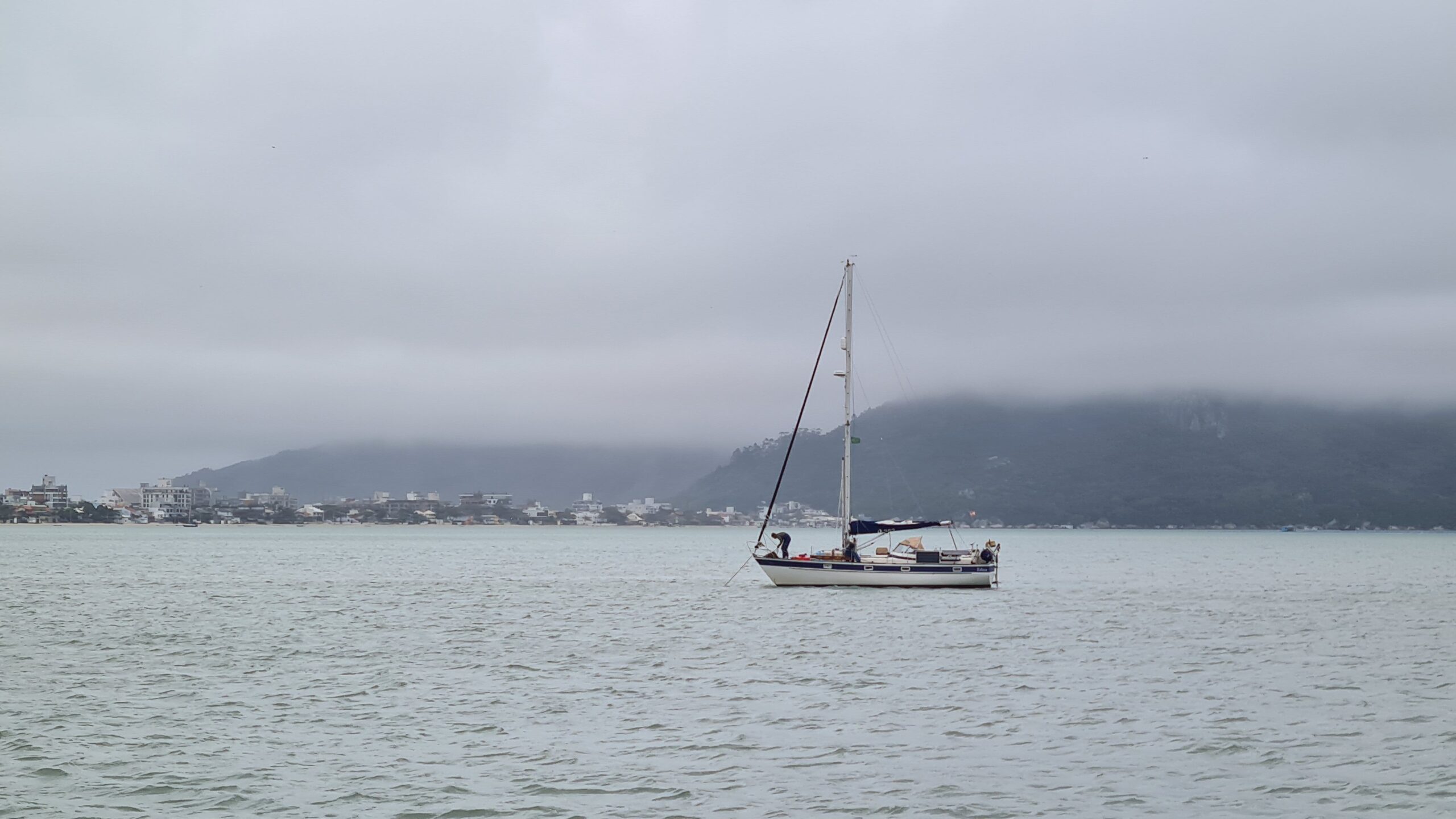
With Edna in Zimbros
And yet, we end up stuck in this bay for five solid days, held hostage by particularly moody weather… An entire weekend in Zimbros to begin with, sheltered from a stiff north-easterly wind bringing downpours. Doing anything outside is out of the question, so we stay cocooned below deck. Fortunately, we spend a fantastic evening aboard Edna, sharing tales of our respective adventures since Salvador. On top of that, they bake us cinnamon buns for dessert—the ultimate way to treat Norwegians far from home!!
Taking advantage of a brief lull, we head ashore to explore this new region of Brazil, with its temperate climate and strong European heritage. The vibe is lovely on this Sunday afternoon: the entire village seems to have gathered on the fine white sand beach that starts right where the streets end. The houses look quite different from what we’ve seen so far, sometimes resembling Swiss chalets. And the flora is much less exotic: we spot pine trees and hydrangeas!! We top off this lovely walk with fresh fruit juice at the beach bar—sometimes you just have to know how to relax…
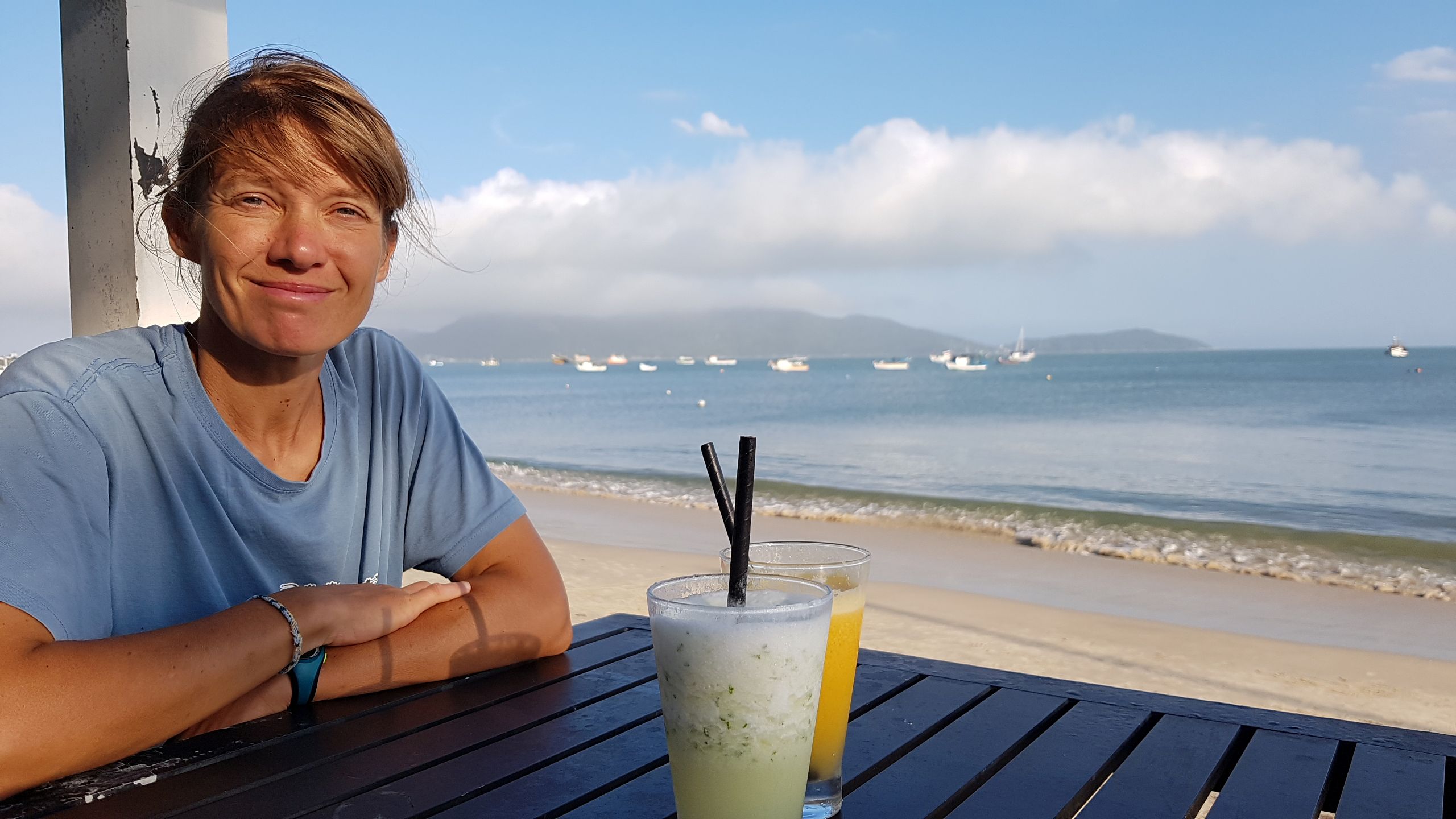
Fresh juices: ananas – mint and maracudja, sweet Brazilian treats!
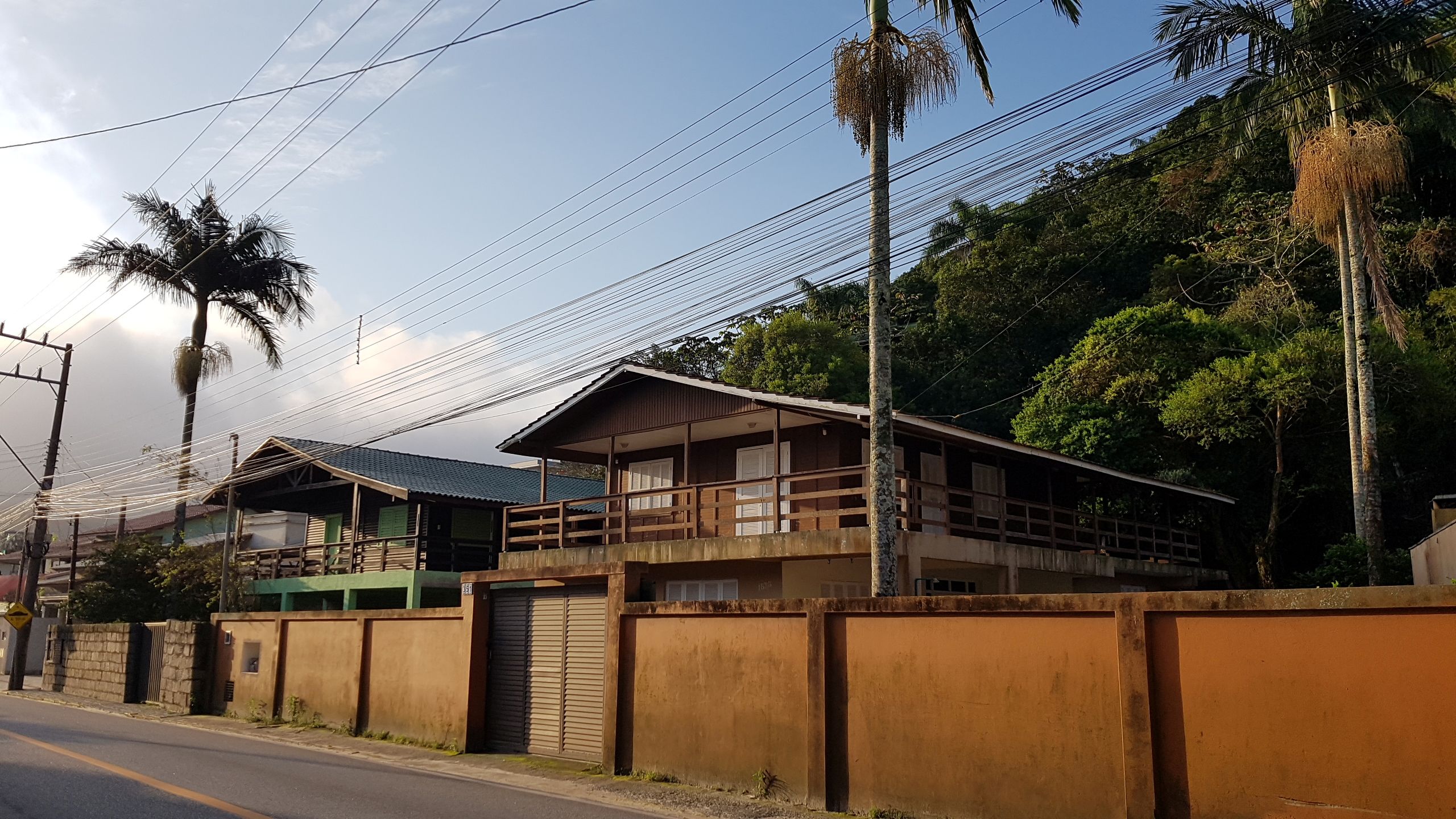
In Zimbros we are not far from Switzerland…
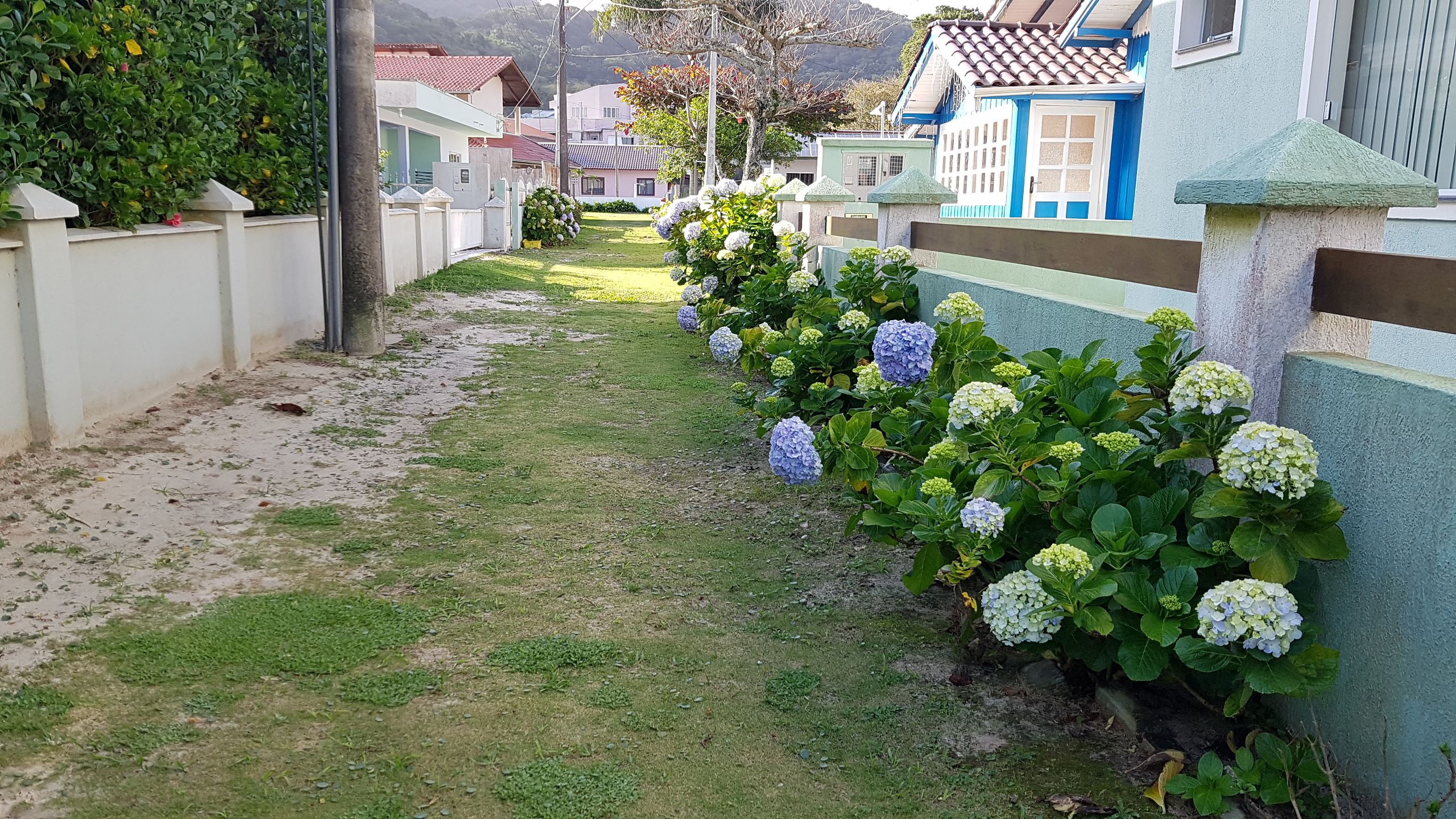
… nor Brittany!
Come Monday, we shift anchorages ahead of an incoming cold front. The village of Ganchos, in the southern part of Baía das Tijucas, is reputed to be the best shelter in the area against southerly winds. We barely drop anchor when—guess what—thunderstorms roll in and rain falls with a force rarely seen even in the tropics. These extreme downpours are apparently a consequence of a strong El Niño boiling the Pacific ocean at the moment… Another day where our to-do list doesn’t move forward an inch and an evening spent counting the seconds between lightning flashes and thunderclaps… Not to mention the northerly gusts (!) charging into our bay, whipping up a short steep chop of nearly a metre across the anchorage… The fake caravel for tourists anchored behind us takes on the look of a ghost ship in the horizontal rain… talk about atmosphere…
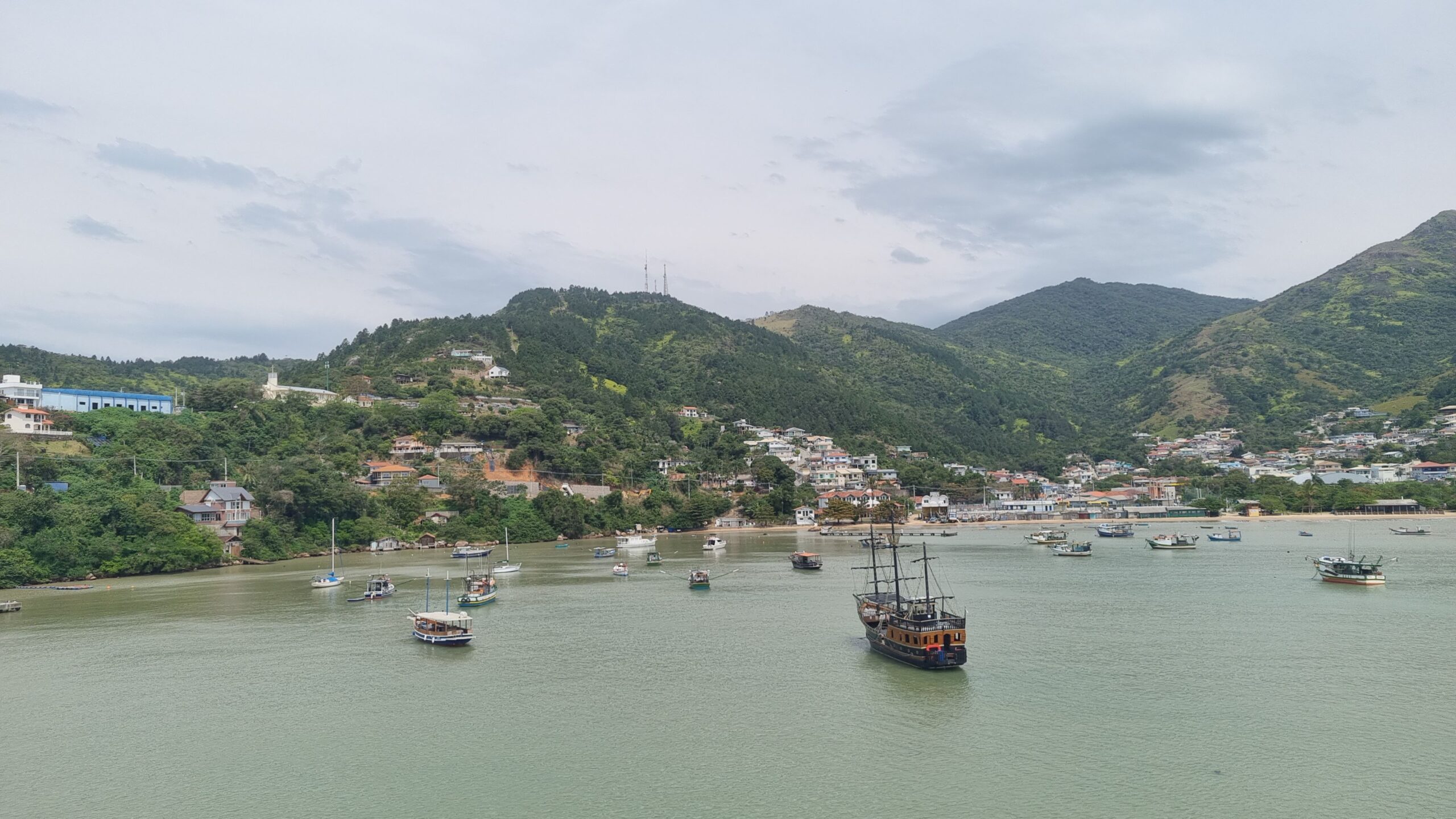
Ganchos bay from the top of the mast
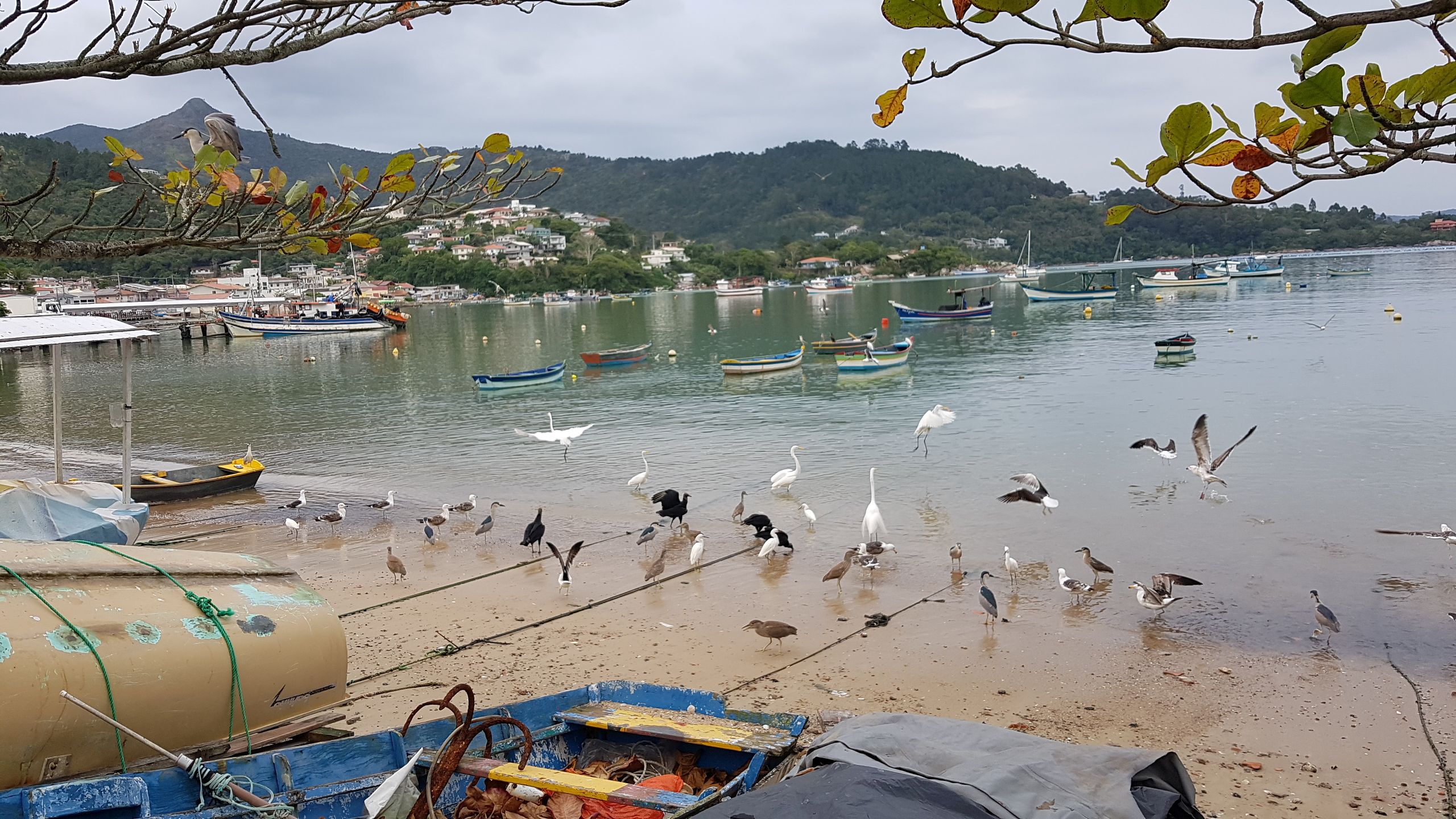
So many birds on Ganchos beach!
The cold front finally arrives. With it, the wind swings south—the direction from which we’re well protected—the rain stops, and the temperature plunges… 17°C inside the boat; we’re wondering when we’ll be lighting the heater again! We can finally get on with some tinkering, tackling some minor repairs (a sticky door handle and a loose connection on a navigation light), and begin to set up a plank on-deck to store four diesel jerrycans for Patagonia. We had scavenged a fantastic wooden board off Dentist’s Beach, so we spend the afternoon sanding and painting it. Finally, taking advantage of a fuel station right nearby, we top up our diesel. We should hopefully have enough to last us all the way to Ushuaia now!
24th–29th September: Florianópolis (17NM)
Making the most of a calm spell, we quickly reach Santa Catarina Island, specifically the village of Santo Antônio de Lisboa, where a small marina offers a few mooring buoys at a reasonable price. Downtown Florianópolis is easily accessible by bus, allowing us to finally tackle our to-do list! It actually grew a bit longer this morning when the anemometer suddenly stopped displaying wind speed…
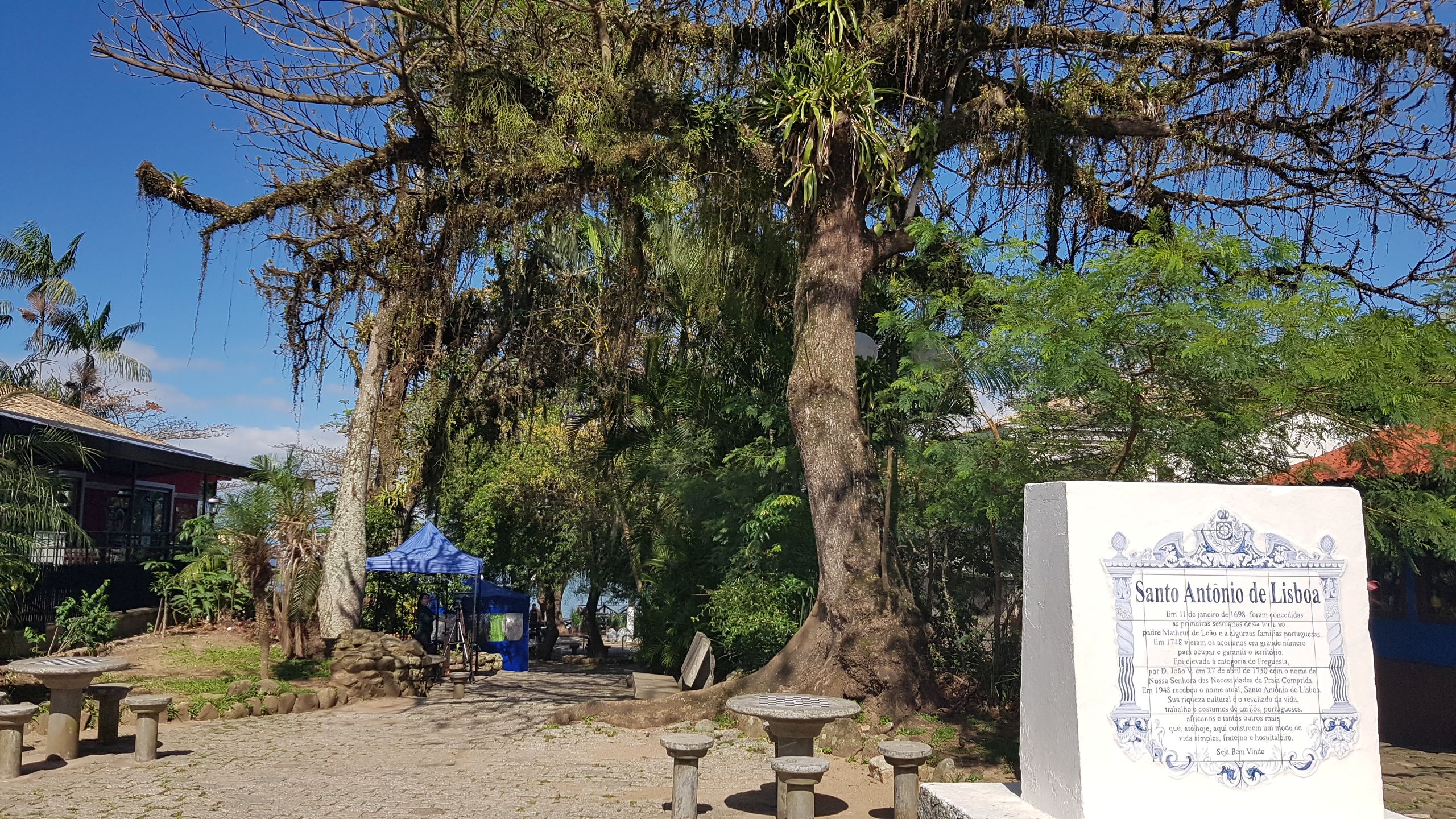
The village of Santo-Antonio was built by Azoriens who emigrated in the region in the 18th century
First item: clearance formalities. Our visa expires in four days and we’re growing jittery… While French citizens are strictly limited to 90 days over a period of 180 (reciprocity rules, as Brazilians can’t do so in France or most of Europe either), we don’t normally have this issue as Norwegians. Still, the relief is immense when we retrieve our passports stamped with the precious extension! Ironically, we’ll choose to check out of the country a few days later to head straight for Uruguay if the weather allows, but we’d have been a day or two short without that renewal.
We also want to use our—possibly—last stop in Brazil to push forward our Patagonia preparations. Before arriving in Argentina and Chile, we must have all mandatory equipment for those countries on board. And the list is long, not to mention somewhat ridiculous… For instance, we need two hard plastic ring buoys (our horseshoe buoy doesn’t count), an extra fire extinguisher, a fire axe (!), a ship’s bell (?), every single flag of the international alphabet, and so on. It all adds up to a hefty budget, which we try to minimize by buying most of it here in Brazil where prices are lower than in Uruguay. We pick up all our orders downtown and raid the local chandlery.
We also take advantage of a massive supermarket near the port to begin stocking up on dry provisions for our three months of autonomy in Patagonia. Armed with an Excel sheet to calculate rations, and after two trips with backpacks and a trolley, we make the boat a good deal heavier.
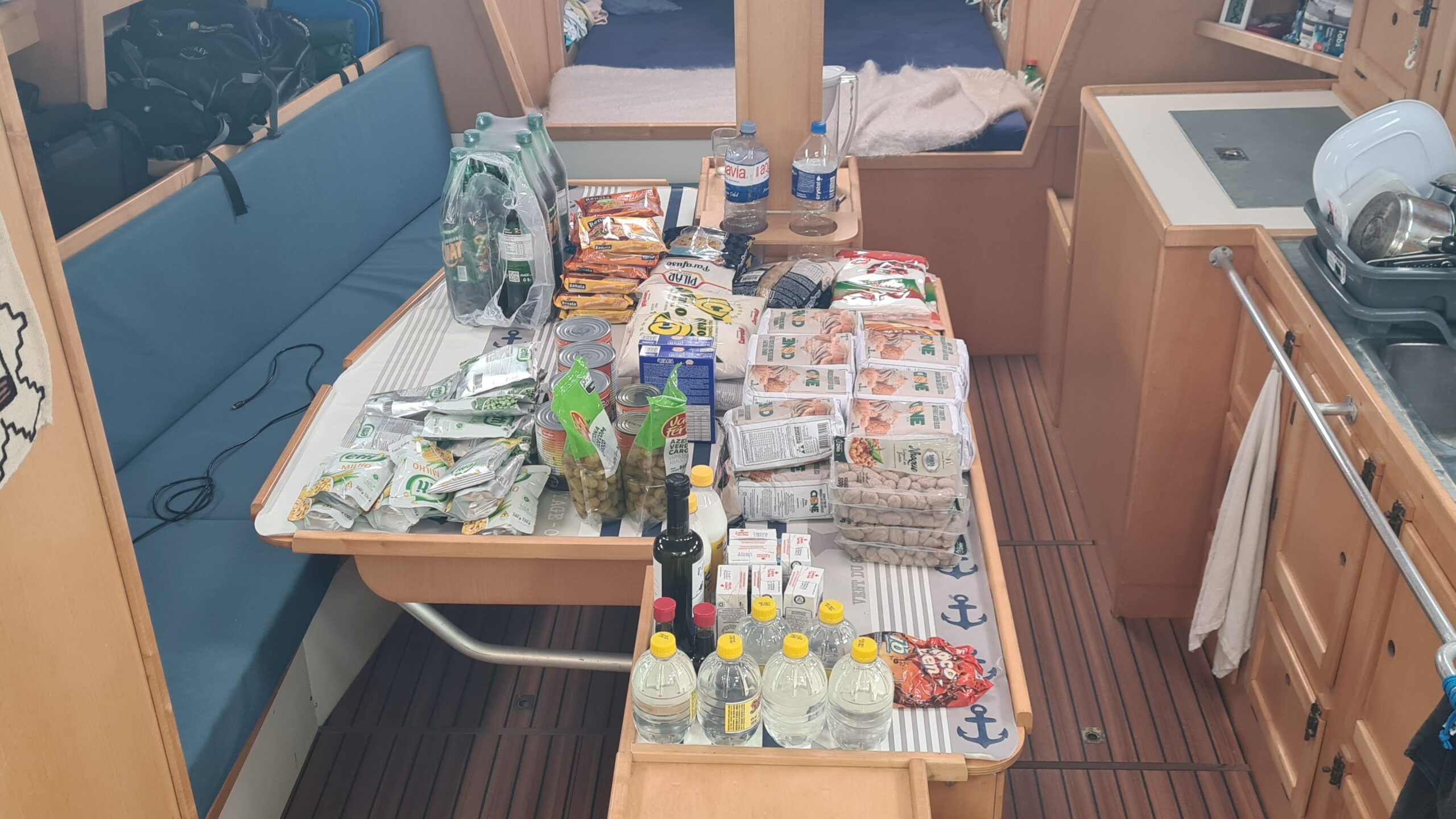
Back from the first shopping trip
Meanwhile, we’re still waiting on our standing rigging… Manufacturing got delayed when the factory in Porto Alegre lost power during one of the endless thunderstorms of recent weeks. But suddenly the situation unblocks, and the shrouds arrive directly at our marina two days ahead of schedule! Fantastic! We’re thrilled … for about an hour, just long enough to open the package and discover the factory cut the wrong thread pitch: impossible to screw these shrouds into our turnbuckles… This is unbelievable, our rigging must be cursed!… Less than six hours after receiving them, our shrouds are headed back to Porto Alegre, leaving us empty-handed and dwelling on all those hours wasted trying to find the cheapest and most efficient solution, and trying hard not to think about the glorious weather window we’ve let slip by over the past few days… To be fair, the factory manager is extremely responsive and spends his weekend working out a fix.
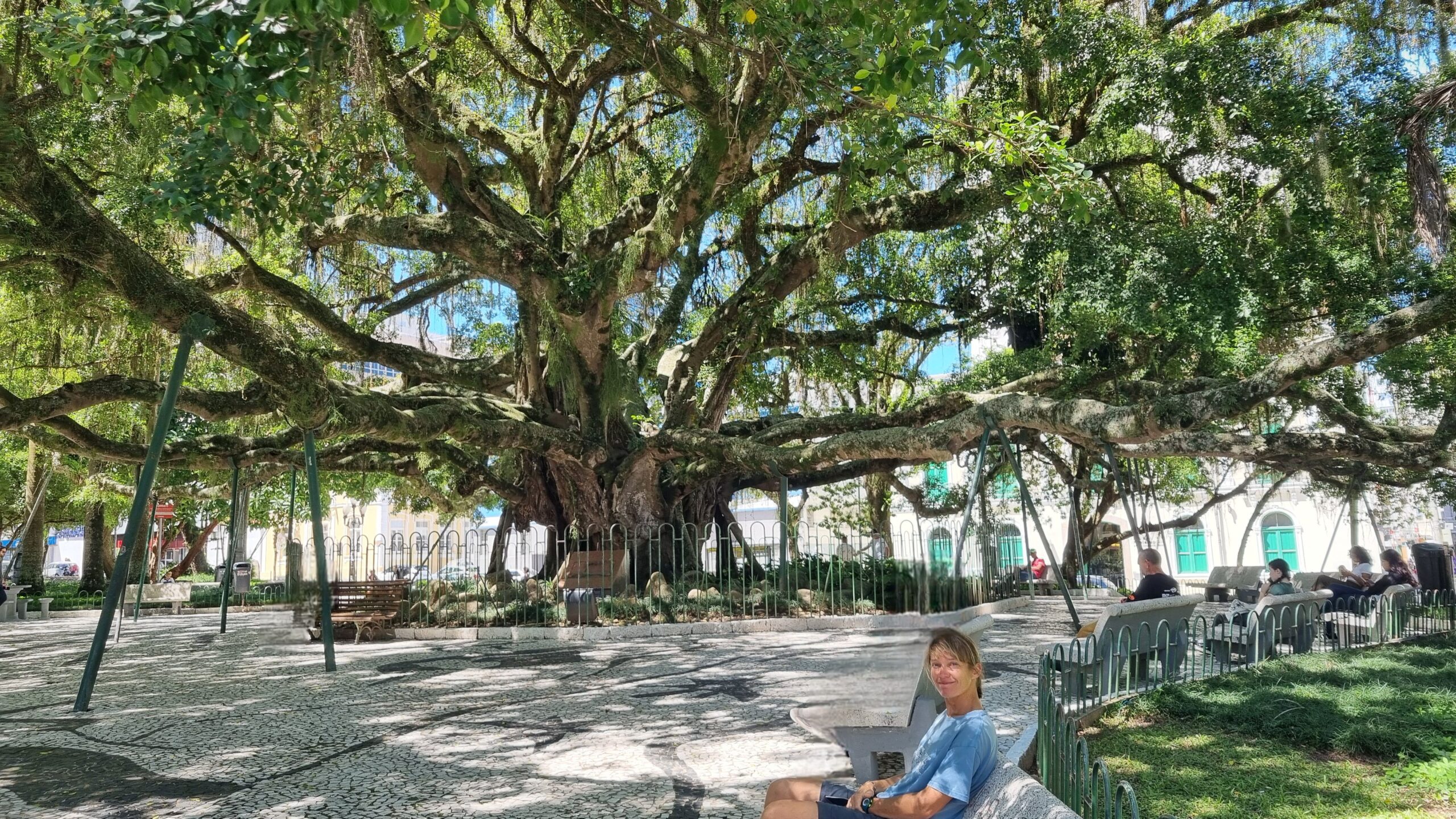
Hundred-year-old fig tree downtown Florianopolis
Between all these tasks, we find time to explore Floripa, as the city is called around here. The history of this region differs from the rest of Brazil: later colonization (from 1750 onwards) brought Azoreans first (along the coast, living off fishing and whaling), followed by Germans and Italians (inland, mostly farmers). No vast sugar or coffee plantations here, nor gold—the economy was built on small family farms and workshops. The 20th century saw the advent of major industrial projects (like the suspension bridge linking the island’s capital to the mainland) and numerous universities. As a side note, we actually meet a few shopkeepers and even police officers who address us in English!
The city centre is pleasant, decorated with murals, but quickly toured: a large leafy square dominated by a hundred-year-old fig tree, a pretty church, two former palaces converted into museums, and a public market. We finally find fresh fish there: an Anchiova (very similar to sea bass) and a surprisingly delicious Lookdown, all for just above £2 a kilo!
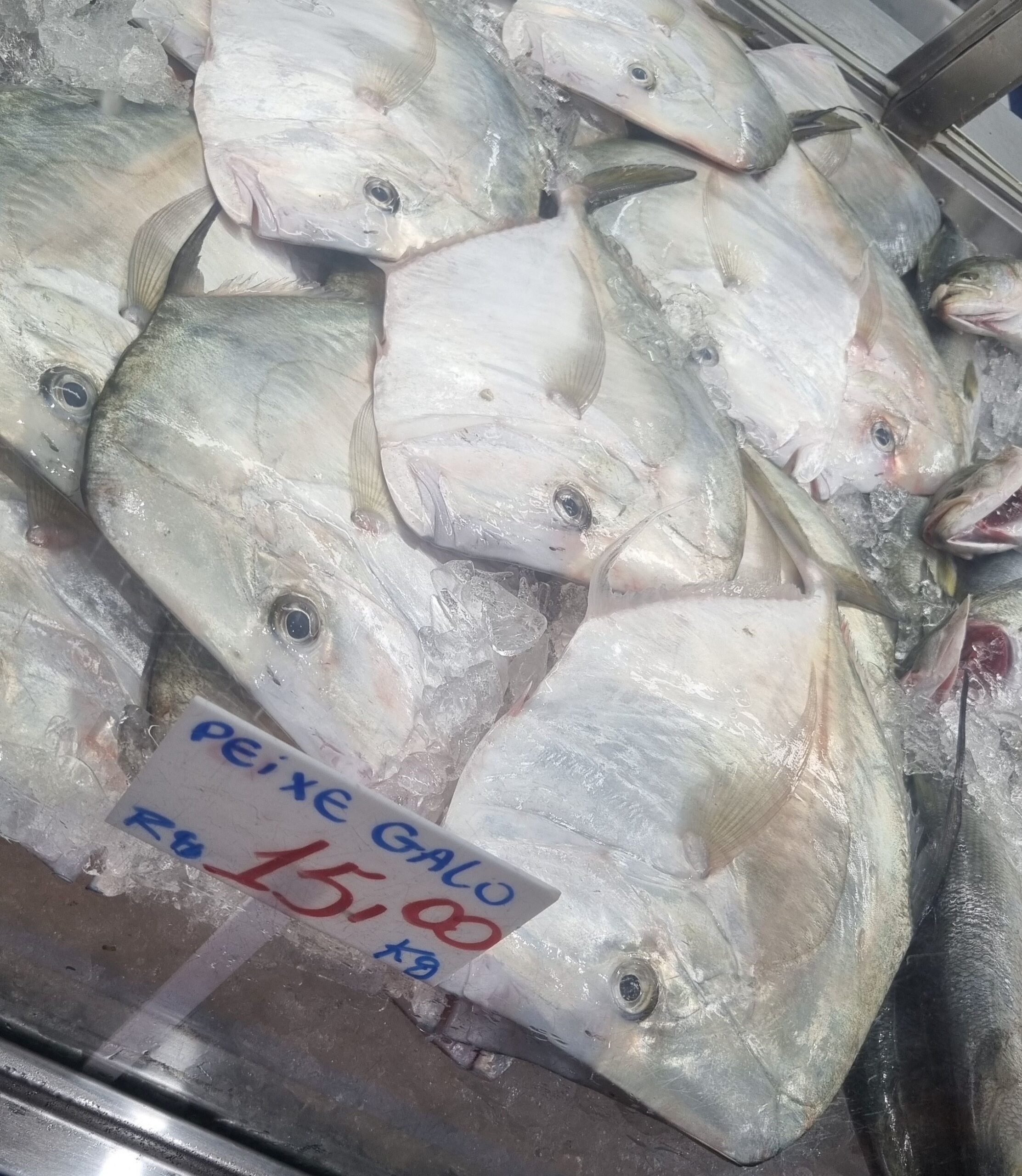
Lookdown fishes, both delicious and funny!
30th September – 2nd October: Jurerê (9NM)
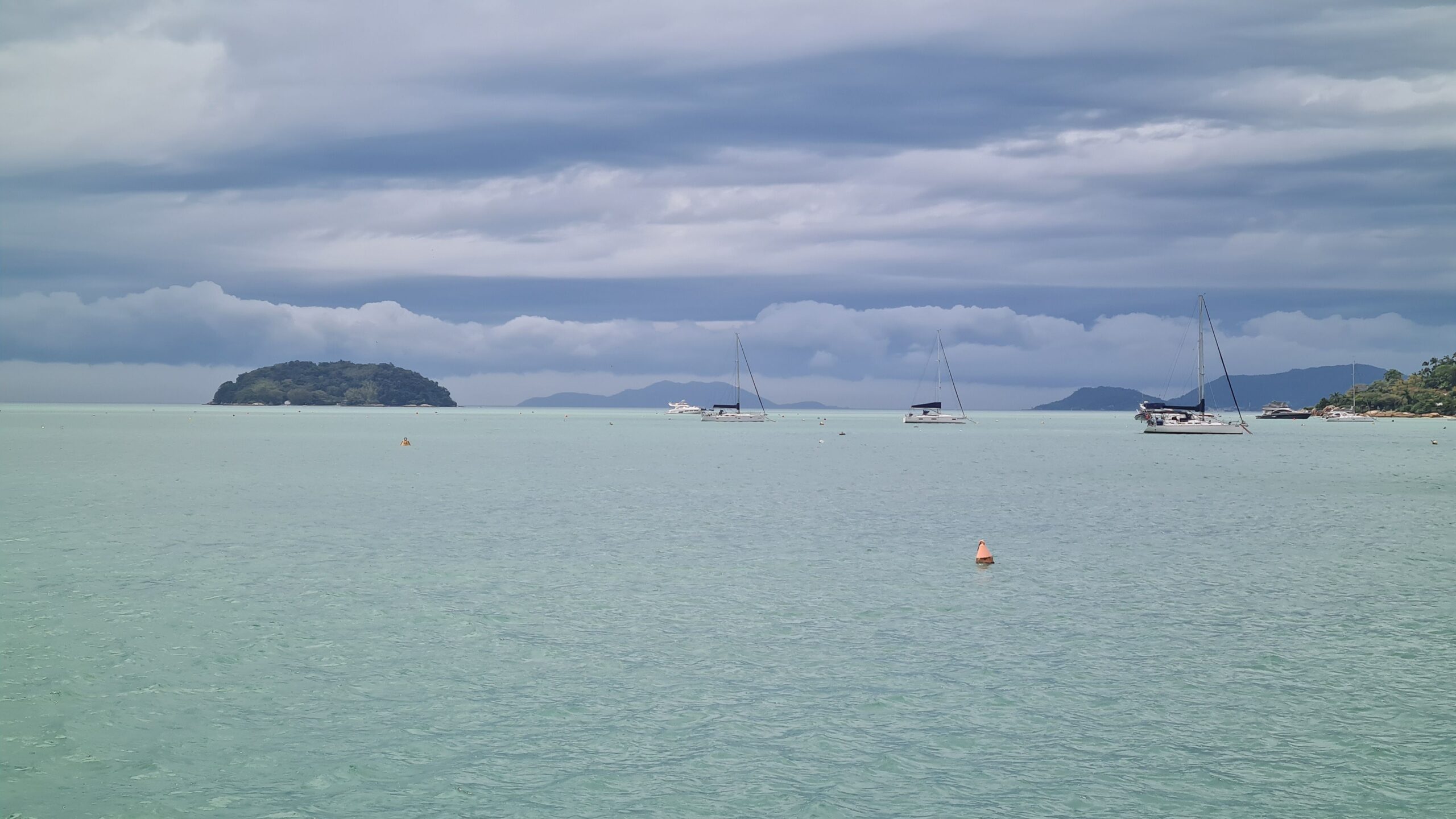
Jurere anchorage, before the squalls…
We’re starting to run out of things to see and do at the Santo Antônio mooring, so as the wind shifts south, we move over to Jurerê Beach where anchoring is free—right next to the Iate Club buoys, which cost – brace yourself – £81 a night! And that’s off-season. Mooring fees for leisure boats in these parts are truly absurd…
We try our best not to despair over the lack of a clear weather window to head south, doing everything we can to stay as busy as possible… Patience and simple acceptation of what’s coming aren’t exactly our strong suits, especially with our flight deadline creeping ever closer…
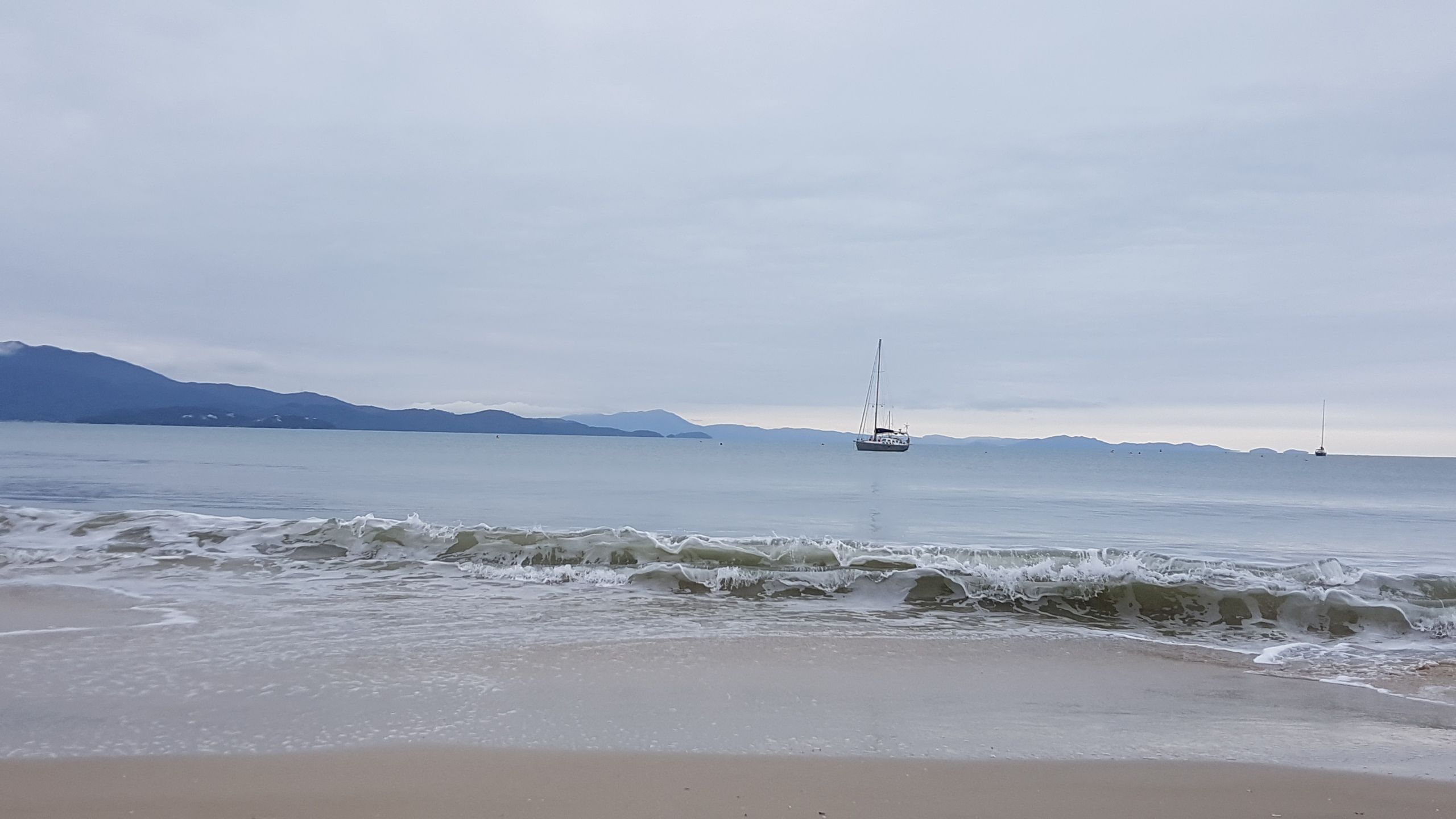
We would really like to see this boat far offshore rather than safely anchored…
Fortunately, UtPåTur makes sure we never sink into idleness. We’d noticed the hull was getting dirty fast lately, and our speed had dropped off a bit. So we make the most of a few very hot hours (30°C) before the next round of thunderstorms to dive into the water (that’s dropped to 21°C now—brrrr!) That’s when we discover the full scale of the disaster: in ten days of anchoring near mussel farms with no fish around to nibble on the algae, we’ve grown a proper jungle under the waterline! No barnacles, thanks to the ultrasonic antifouling, but the algae and weeds come off in big clumps… We attempt a semi-successful scrub from the dinghy, before Laure volunteers to dive and strip the worst of it. She surfaces freezing cold and covered in tiny skeleton shrimps that are apparently also part of the ecosystem we’re now towing along with us… We’ll need to find a more efficient way to scrub the hull fairly soon, and with a tidal range of just 30 cm here, drying out the boat on a beach isn’t going to happen…
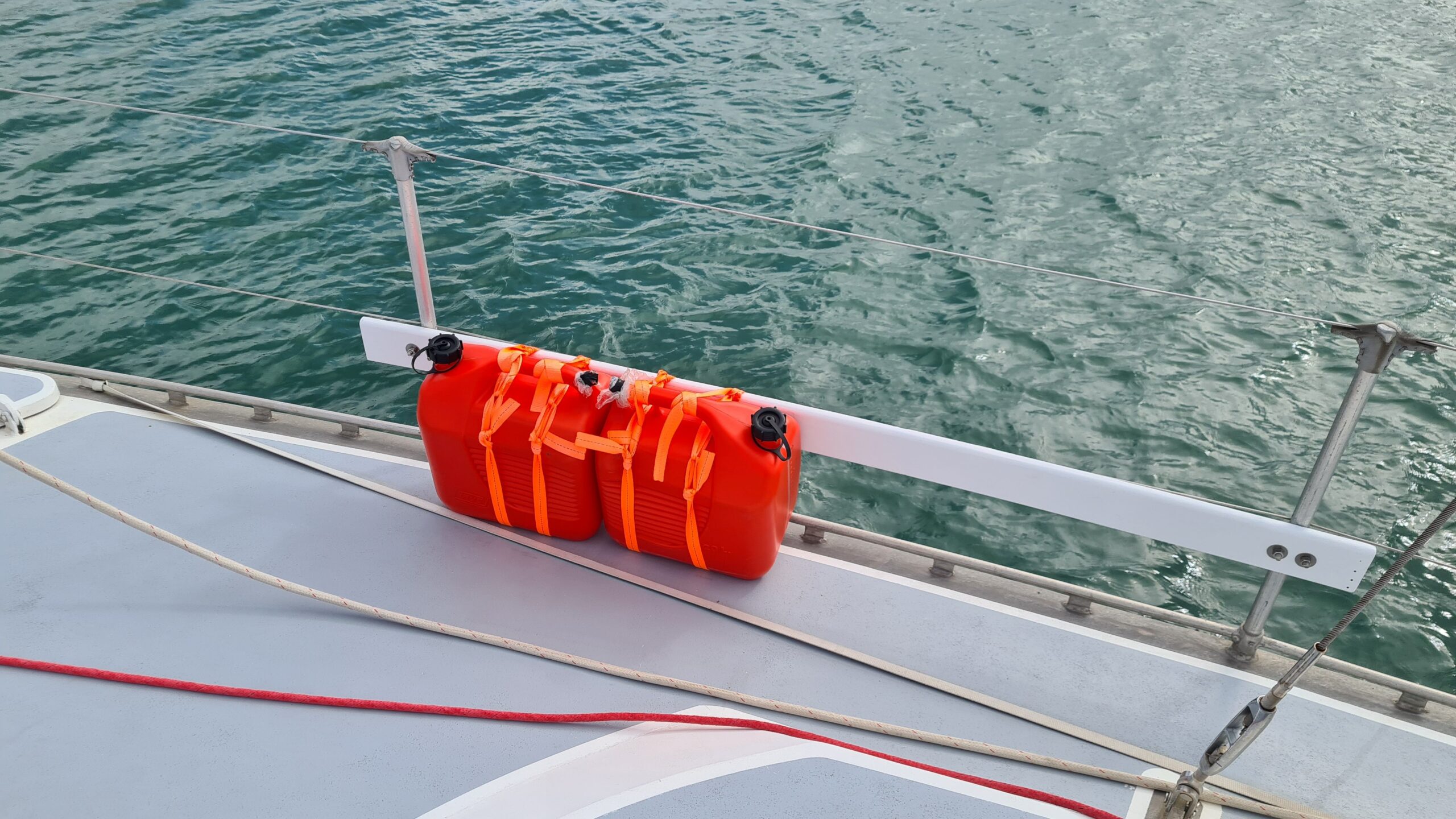
Only missing two extra jerrycans and we will be ready
We also use the stopover to finish our deck-mounted jerrycan storage system. We’ll just need two more cans to top it off, bringing our total fuel capacity to 500 litres—which we reckon should be enough to navigate the Patagonian channels with peace of mind.
Next, we tackle our anemometer, which has been silent since Ganchos. Just like last year, we find water inside and corrosion around the small circuit board in charge of measuring wind speed… No matter how much we dry it out, the board seems dead. Looking closer, it’s actually very simple: two wires and a small component—specifically a reed switch, a magnetic switch that closes the circuit when the magnet on the spinning cups passes by. We test the component with one of our fridge magnets: nothing, component is dead. What if we just replaced the component instead of swapping out the entire anemometer? After touring the electronics shops in town and a bit of research on the required sensitivity, we order a pack of 10 reed switches online for about £13, and solder the new part onto the board. We reassemble everything, plug it in, and… IT WORKS!!!!! Fantastic! Not only do we have a working anemometer again, but we have enough spares to fix it another nine times! In fact, we prepare a little stock by fixing our two back-up units (left overs from last year’s reparations) that were showing the exact same fault, thoroughly pleased with the elegance of our solution!
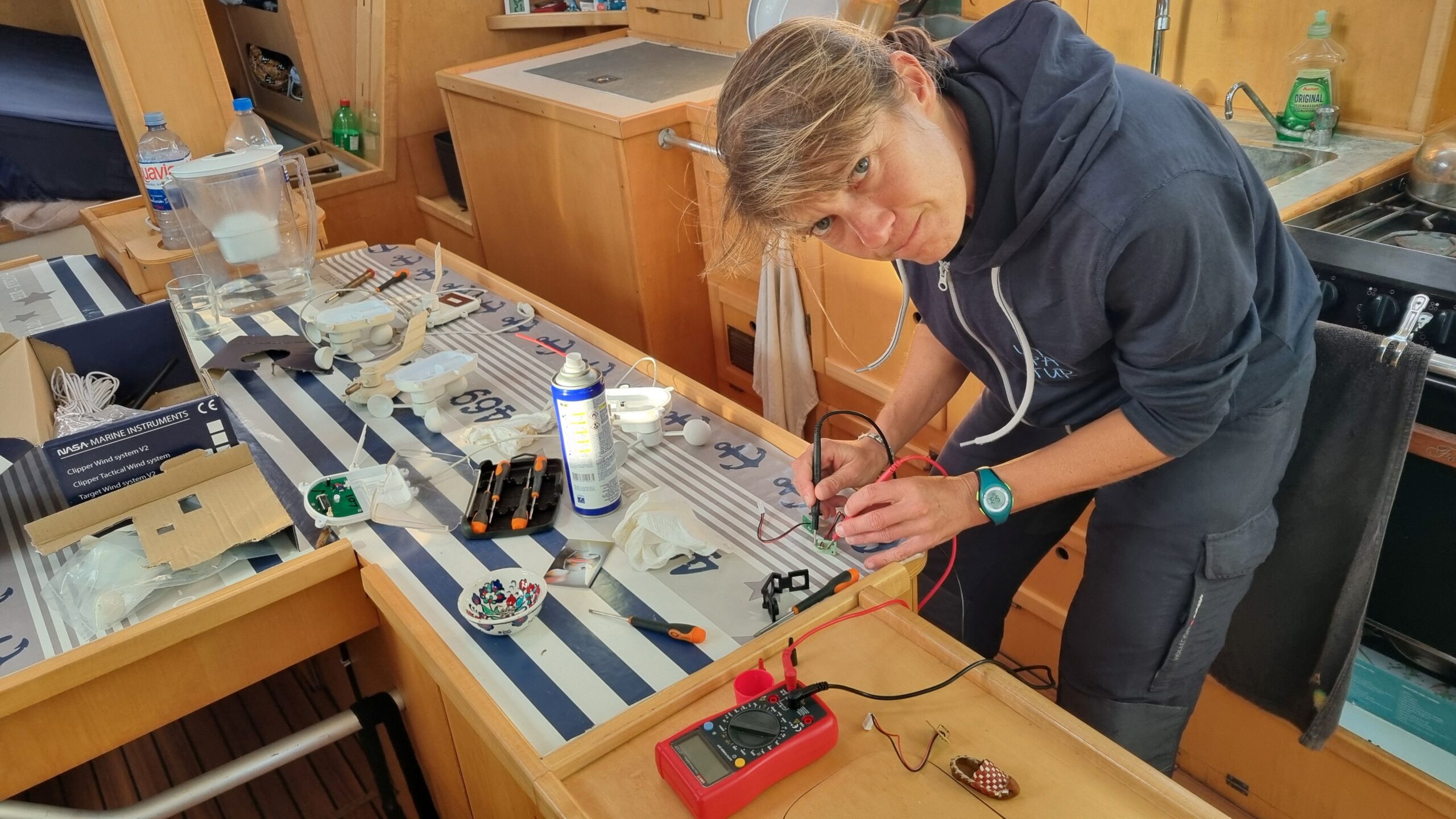
We are not going to let ourselves be bothered by a tiny, insignificant component!
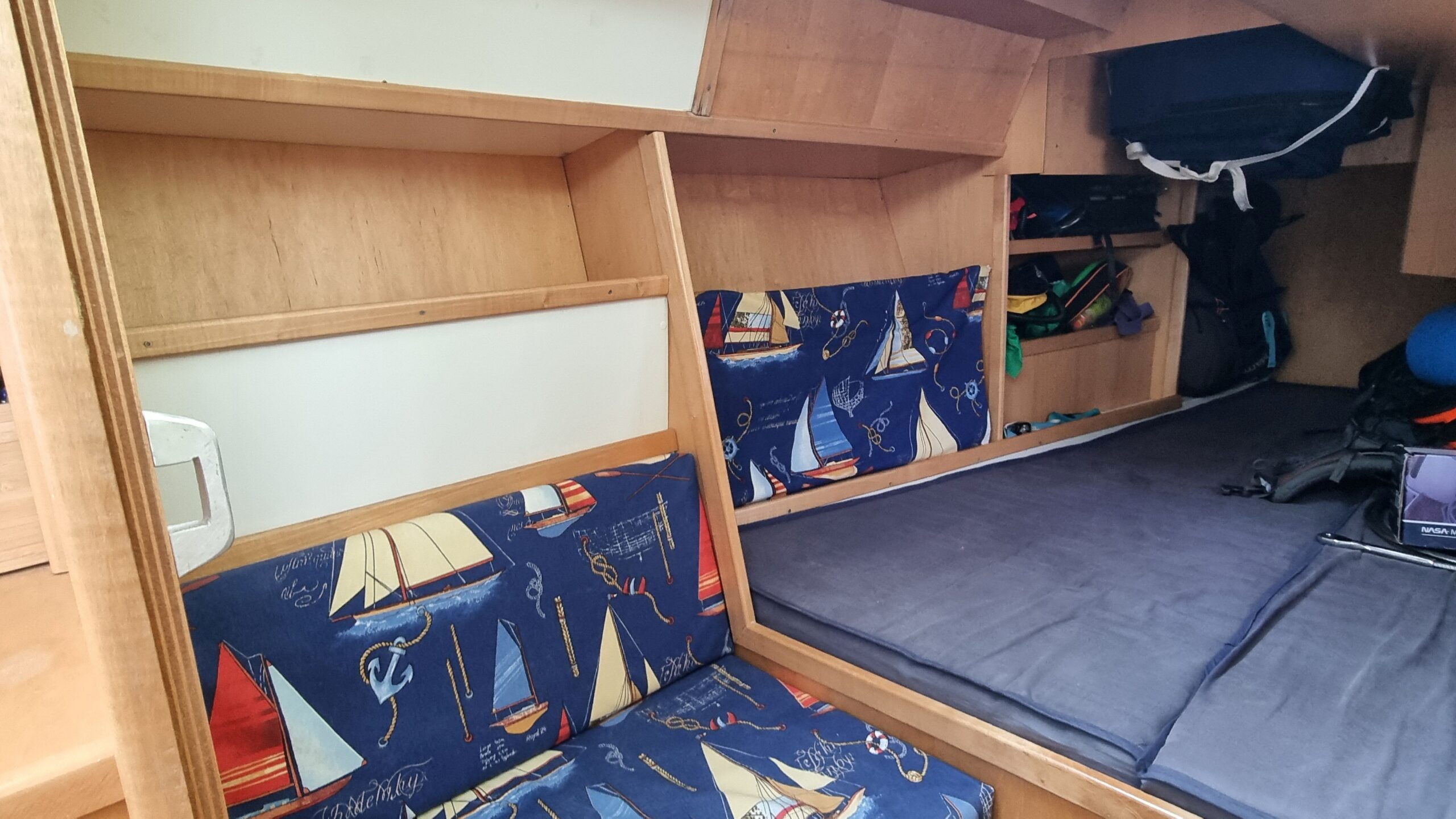
Installation of a storage partition above the seat and a fabric storage pocket next to the bed
We’ve really made serious progress on our job list this time. The only thing missing is the shrouds, which finally return five days after their first appearance—this time with the correct threads and dimensions. We’ll install them later when we’re tucked up somewhere quiet in port. For now, it’s a matter of finding a place to stow them on board; but as usual, the boat’s storage capacity surprises us, and everything finds a home in a couple of hours. We have actually just increased the storing capacity by adding two partitions in the aft cabin.
This time we are ultra-ready. Nothing is holding us back in Brazil—even our passports are stamped! So weather, whenever you’re ready… if you could just open a little window, please, please, pretty please…
 PDF
Congratulations on a fantastically constructive use of unexpected ‘downtime’: your range of skills and resourcefulness never cease to amaze me. Bon voyage as you continue southwards, and I’m so glad my dolphin friends are still keeping an eye on you 🐬