
This is our third Atlantic crossing, and our very first foray into the Southern Hemisphere under sail. We are continuing our stubborn progress across our little planet, navigating through some fascinating weather systems: the tail end of the North-East trades, crossing the Doldrums, and finally meeting the South-East trade winds.
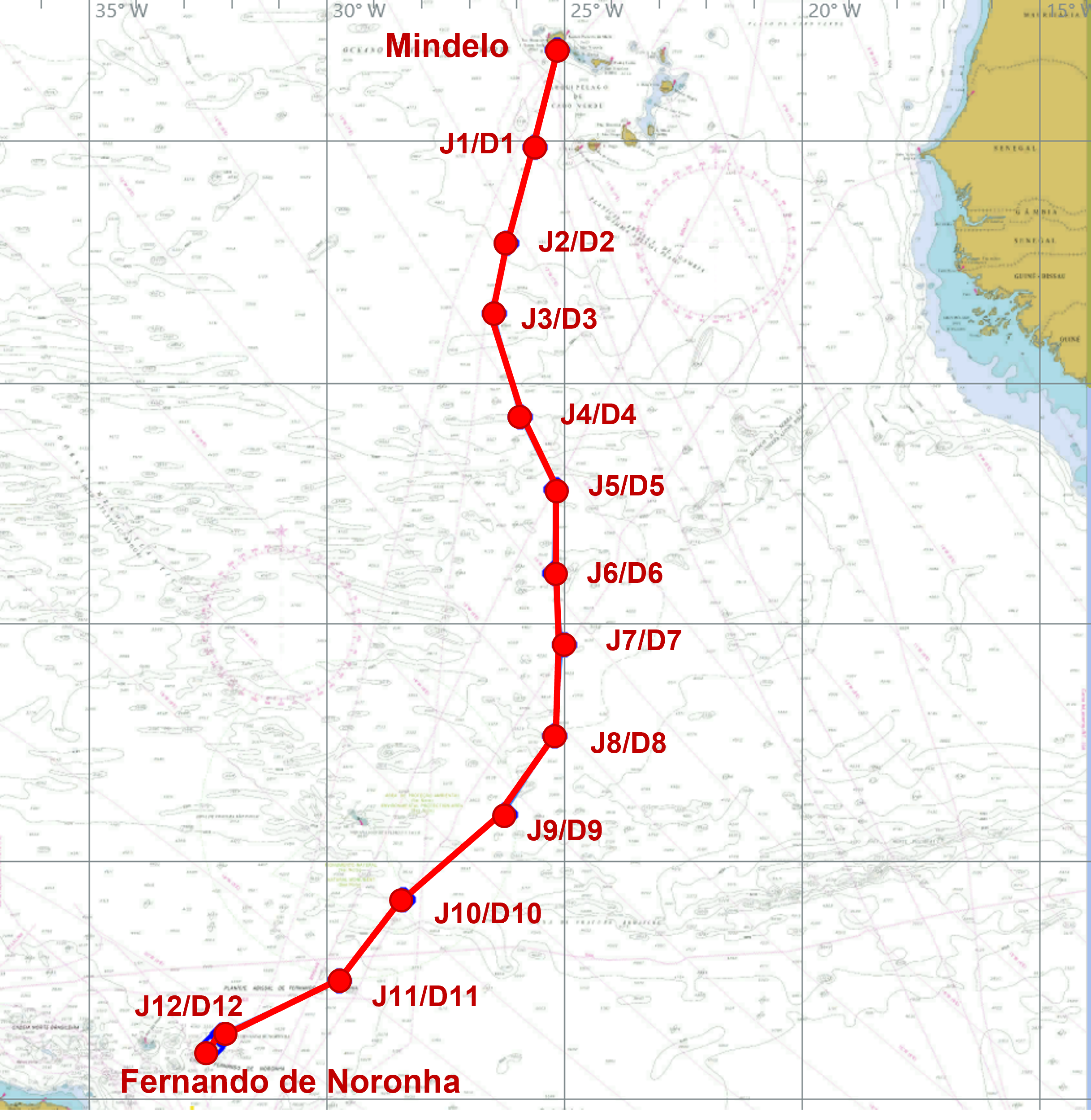
1538 nautical miles sailed– 10151 NM in total on UtPåTur
Day 1: Wind NE Force 5-8, moderate to rough seas (136 NM)
Everything will have been a struggle in Cape Verde this year, even leaving it. To get away from Mindelo, you have to head into the narrow channel between the islands of São Vicente and Santo Antão—a magnificent Venturi effect that seriously accelerates the wind. The day was supposed to be calm, but fierce gusts from 5:00 am right inside the marina do not bode well. Fortunately, our friends Margot and Obi are there to cheer us on, and gift us handmade lucky bracelets! So, we tell ourselves it might just turn out alright after all, and we slip our lines.
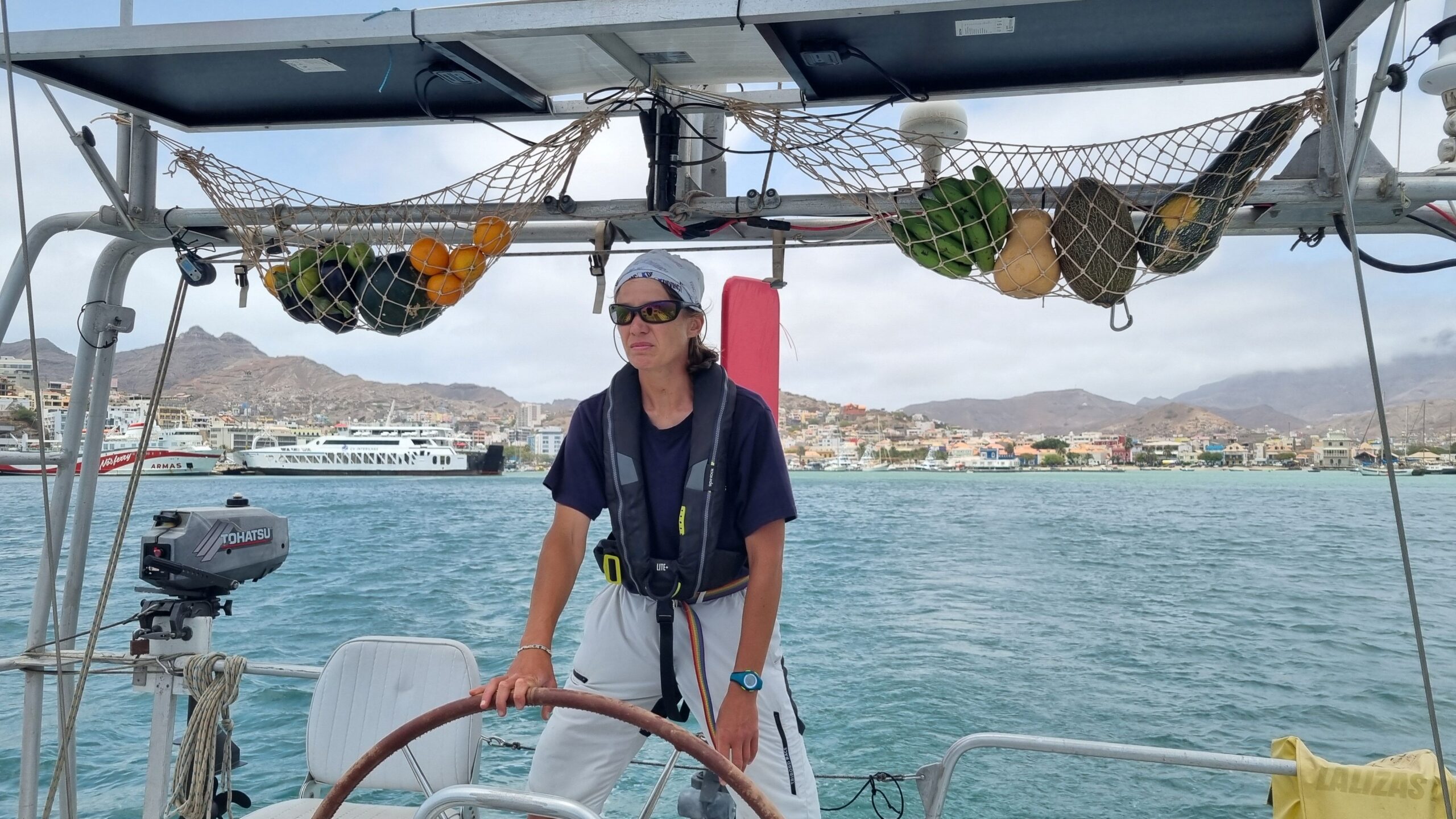
Intense focus while leaving Mindelo…
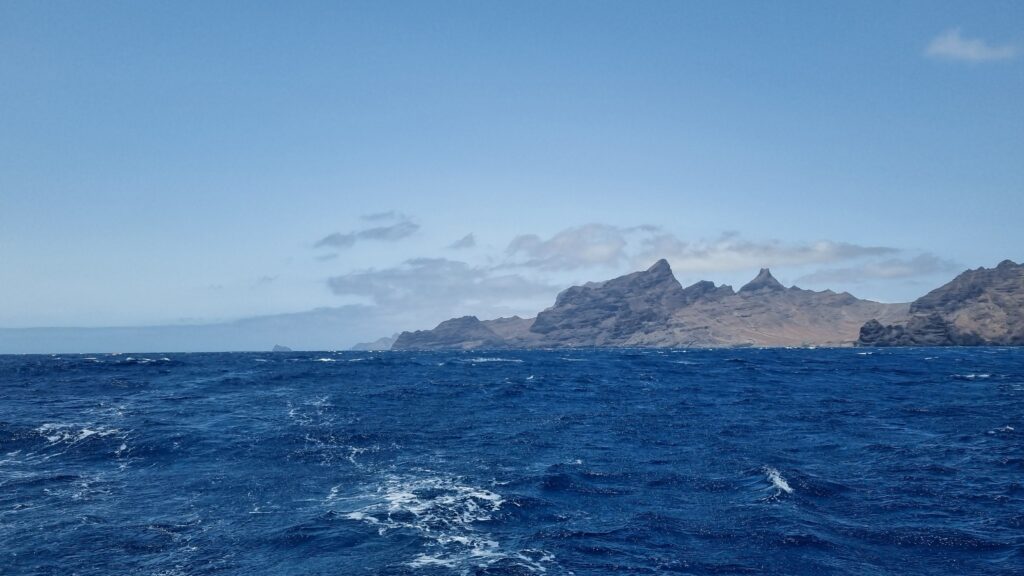
The island of São Vicente appears to us in all its barren glory…
We do not yet trust our new lower shroud and take no chances, motoring through half of the channel (35 knots today, classic for the area but truly uncomfortable), before timidly unfurling a bit of the genoa to finish.
When the wind eases, we hoist our mainsail with two reefs in… only to realise immediately that the sheet winch is completely jammed. It is simply not possible—when is this losing streak going to end?! Mind you, we have great experience in stripping down winches; a good deep clean later, and there it is, clicking away happily again. Perfect, just in time to put in the 3rd reef as the wind suddenly starts blowing back up over 25 knots… we are not going to get any rest just yet…
On the menu for this first day:
Lunch: Cereal bars and mango—no time to cook.
Dinner: Chicken escalope with mash, followed by bananas.
We start our first night at sea already quite exhausted, but thankfully the wind quickly settles into a classic downwind broad reach in the trades. Alright, we had to manage two diesel jerrycans stored on deck that started leaking (cracked caps…), but after that, the situation begins to stabilize.
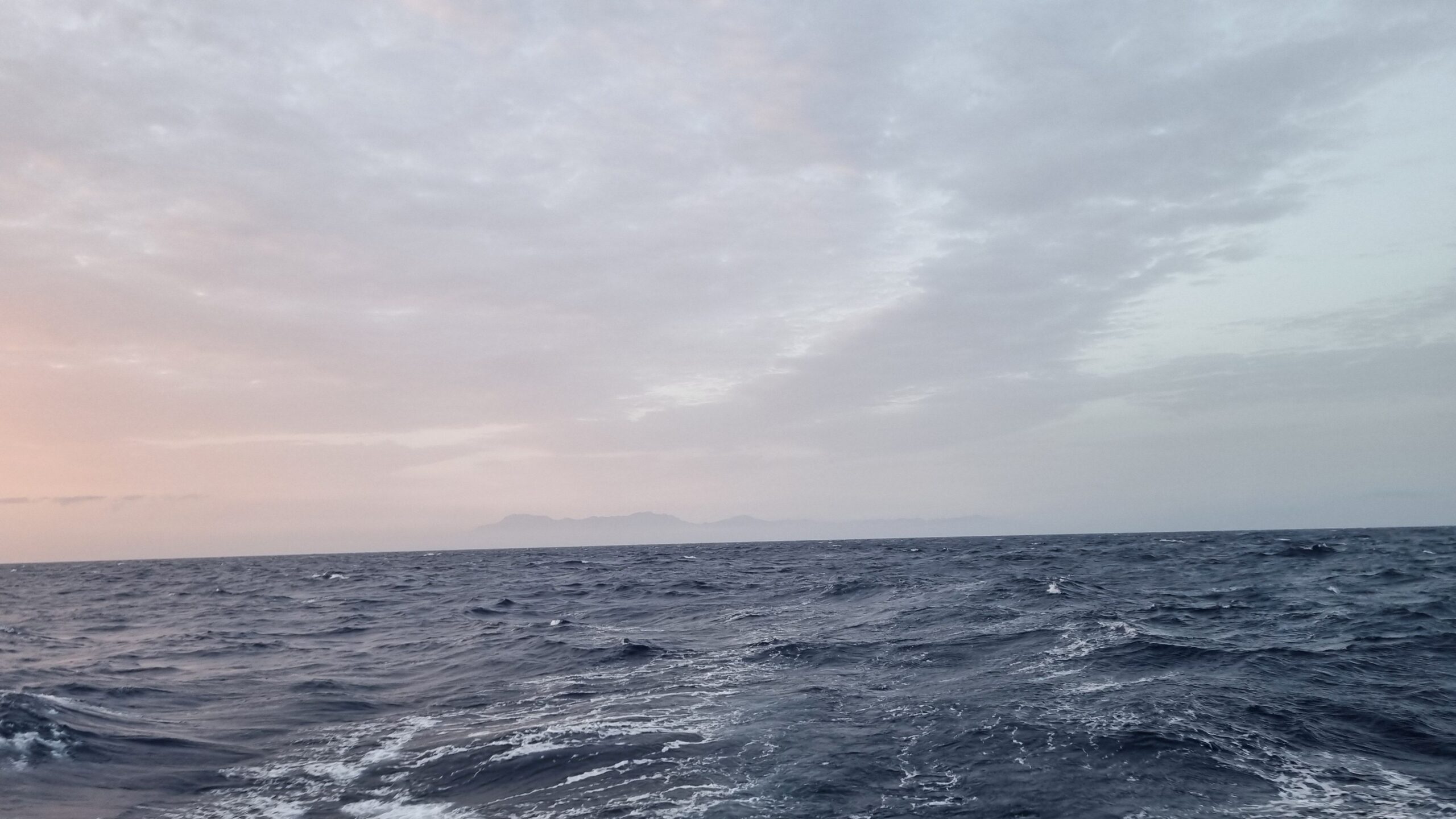
Last sight of Santo Antão before the night swallows us
The night time moment of poetry: the moon shows a slender first quarter tonight, while a star is incredibly close. For a few moments, there it is, positioning itself right on the tip of the moon, as if impaled by the point of its crescent. Magic!
Day 2: Wind NE Force 3-5, slight to moderate seas (125 NM)
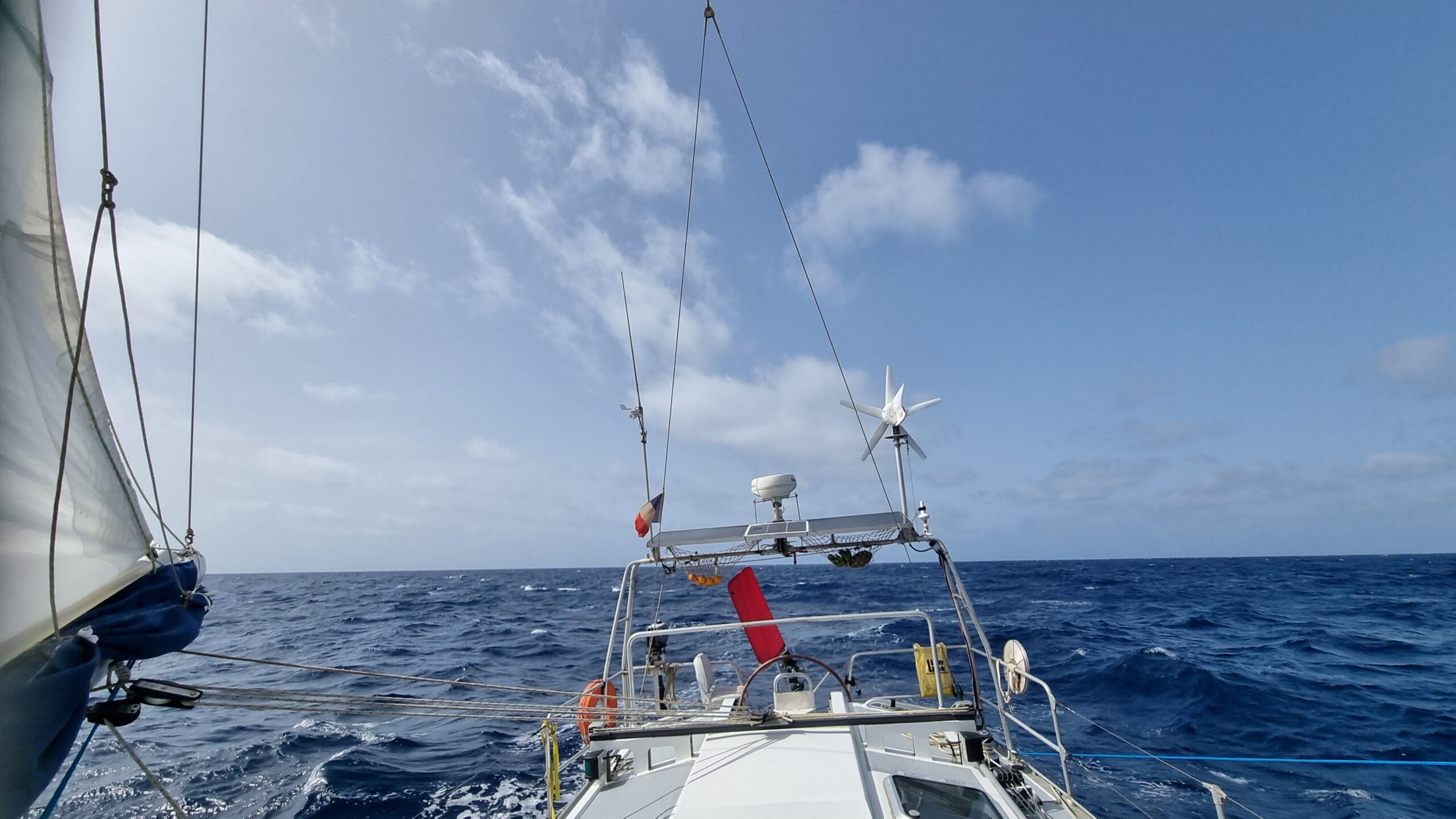
No more land in the morning, we are alone on the vast ocean
The hot summer tropical sun rises on what should be the only classic downwind trade-wind day of the crossing. And even if we are beginning to get used to it, we are still enjoying every bit of it! Abyss-blue water, genoa poled out, low swell—perfect weather! We glide effortlessly at 7 knots. What bliss, this downwind sailing…
The day ends on a high note with the catch of a beautiful bonito, which will make us two good meals! The first decent-sized fish since the Lofoten Islands…
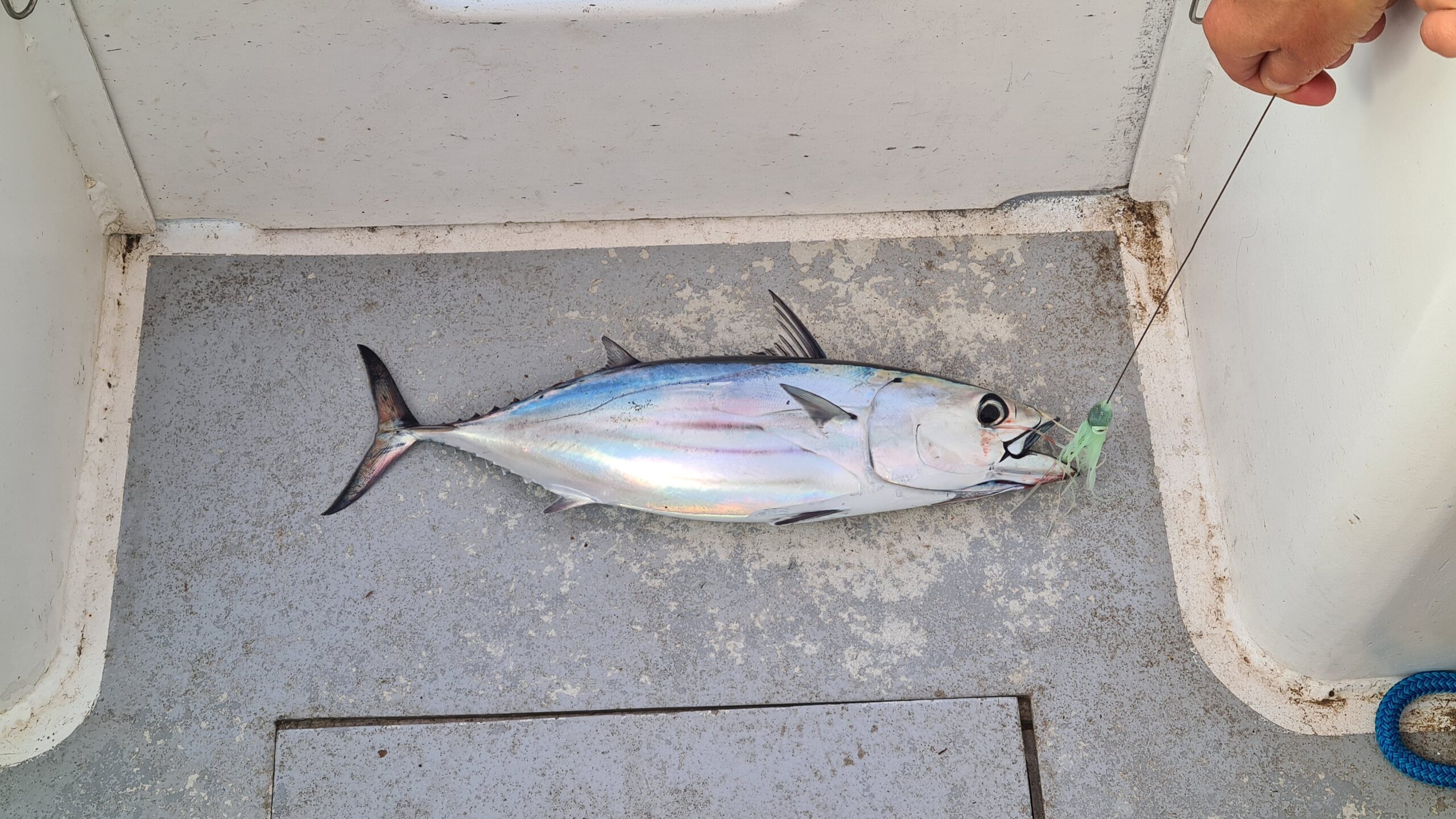
Yupee, proteins!
On the menu today:
Lunch: Couscous, tomato, ham, and cheese salad, followed by papaya.
Dinner: Pan-fried chicken with sweet potatoes and carrots, followed by bananas.
Night falls, but not the temperature. We remain in shorts and T-shirts all the time now, and sleeping during the day becomes increasingly difficult because it is so hot. We take down the pole in the middle of the night and gradually shake out all the reefs: the wind is starting to drop…
Day 3: Wind ENE Force 2-3, slight seas (94 NM)
A short 24-hour lull is forecast in the trades; our average speed is taking a hit. Never mind, we are not in a hurry, and we contemplate at leisure this magnificent blue sea under an equally blue sky and a blistering sun. Here and there, small clumps of brown seaweed: it is sargassum, but for now, it poses no issues for navigation.
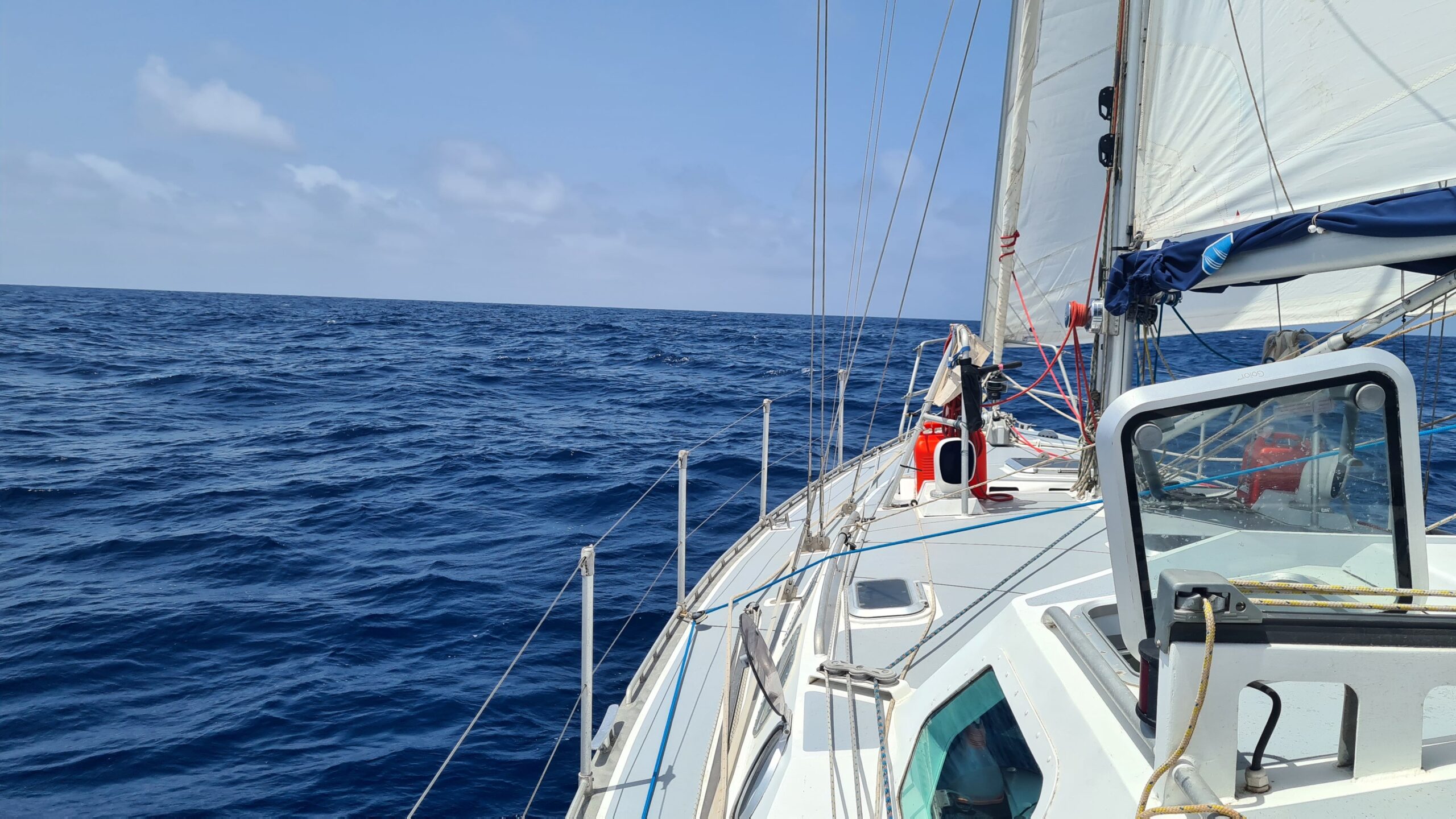
Navigation with portholes open to try and cool the interior
Between the lack of wind and our progress south (12°N today), the temperature goes up another notch. A shower only cools us down for a few minutes, the wide-open hatches are not enough to create a breeze, and we can barely wear a top. Cooking in front of the gas stove is difficult, yet we must find a way to use up our bananas, which we bought ripe and are really starting to smell… 35°C—perfect for a jam-making workshop, right? Our other bananas, bought green, should keep a bit longer.
With this calm weather, we can resume normal life on board: writing, reading, sewing, and Portuguese lessons—we do not get bored. We try to keep some time for a shared social activity (today, a Norwegian quiz game that was a departure gift), otherwise between watches and naps, we do not see each other all day!
On the menu today:
Lunch: Grilled bonito with pan-fried aubergines, peppers, potatoes, and onions, followed by yoghurt, mango, and banana.
Dinner: Pesto pasta with fresh goat’s cheese from Santo Antão, followed by papaya.
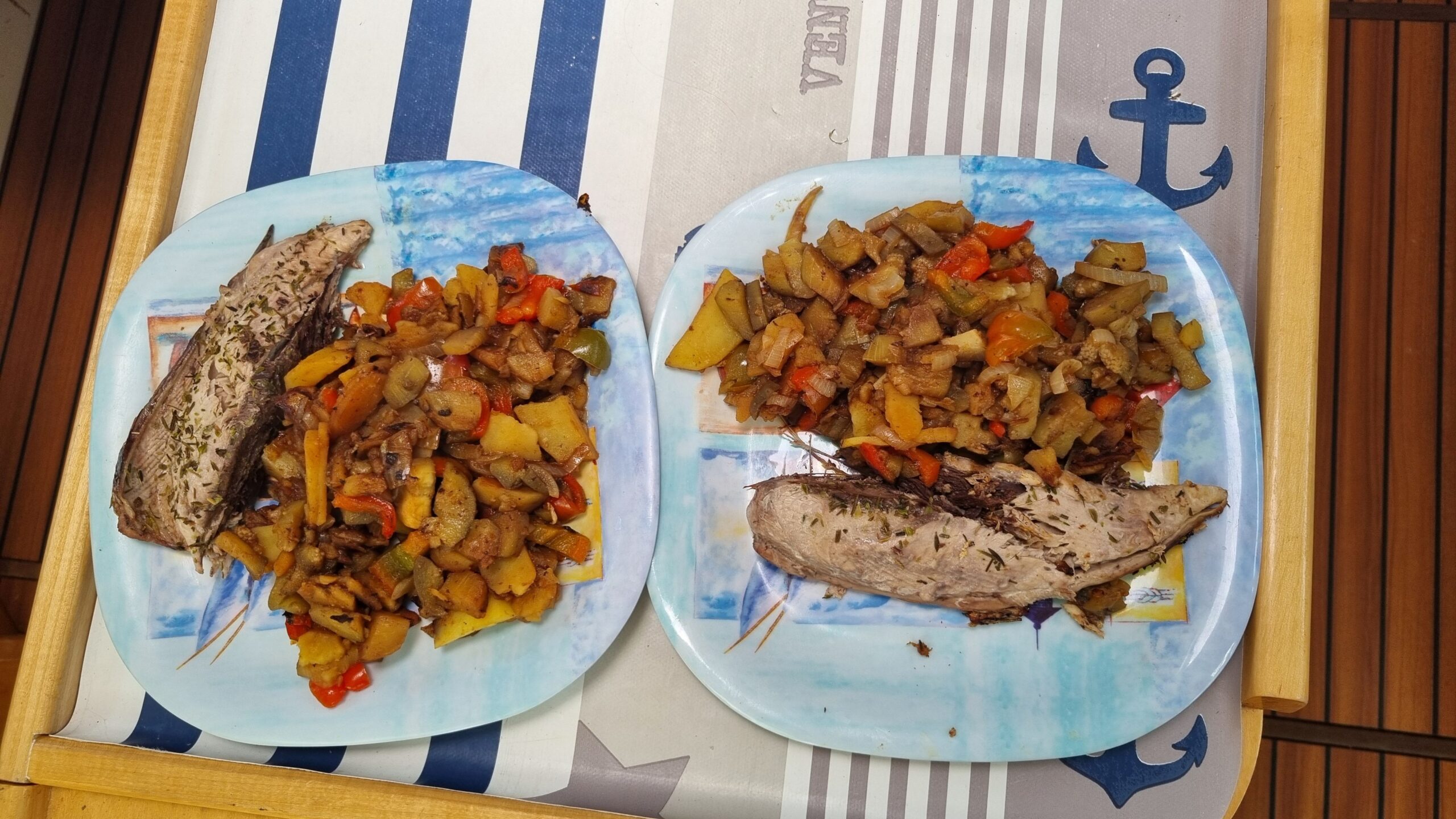
Nice weather, nice lunch!
The night is just as calm as the day, but after these recent very windy weeks, we are delighted to be wallowing along at 3 knots for once! We must still put the engine on for two hours in the middle of the night as there is no longer a breath of air, before it picks back up from the… North-West?! Strange…
Day 4: Wind NW to E Force 2-5, slight to moderate seas (135 NM)
The bizarre wind direction foretold it, and the leaden grey sky and confused swell confirm it: we are entering a different world. It is not the Doldrums just yet, but we are clearly no longer in the classic trades. We will even have a bout of drizzle mid-day!
Nature takes this cue to put on a spectacular show. First, a large pod of whales: one surfaces a few hundred metres from the boat—no doubt a sperm whale. The others are further off but make their presence known with massive splashes and tail flukes lifting high. There are at least 5 or 6 of them, absolutely huge. Humpbacks, perhaps, though we could not identify them for sure.
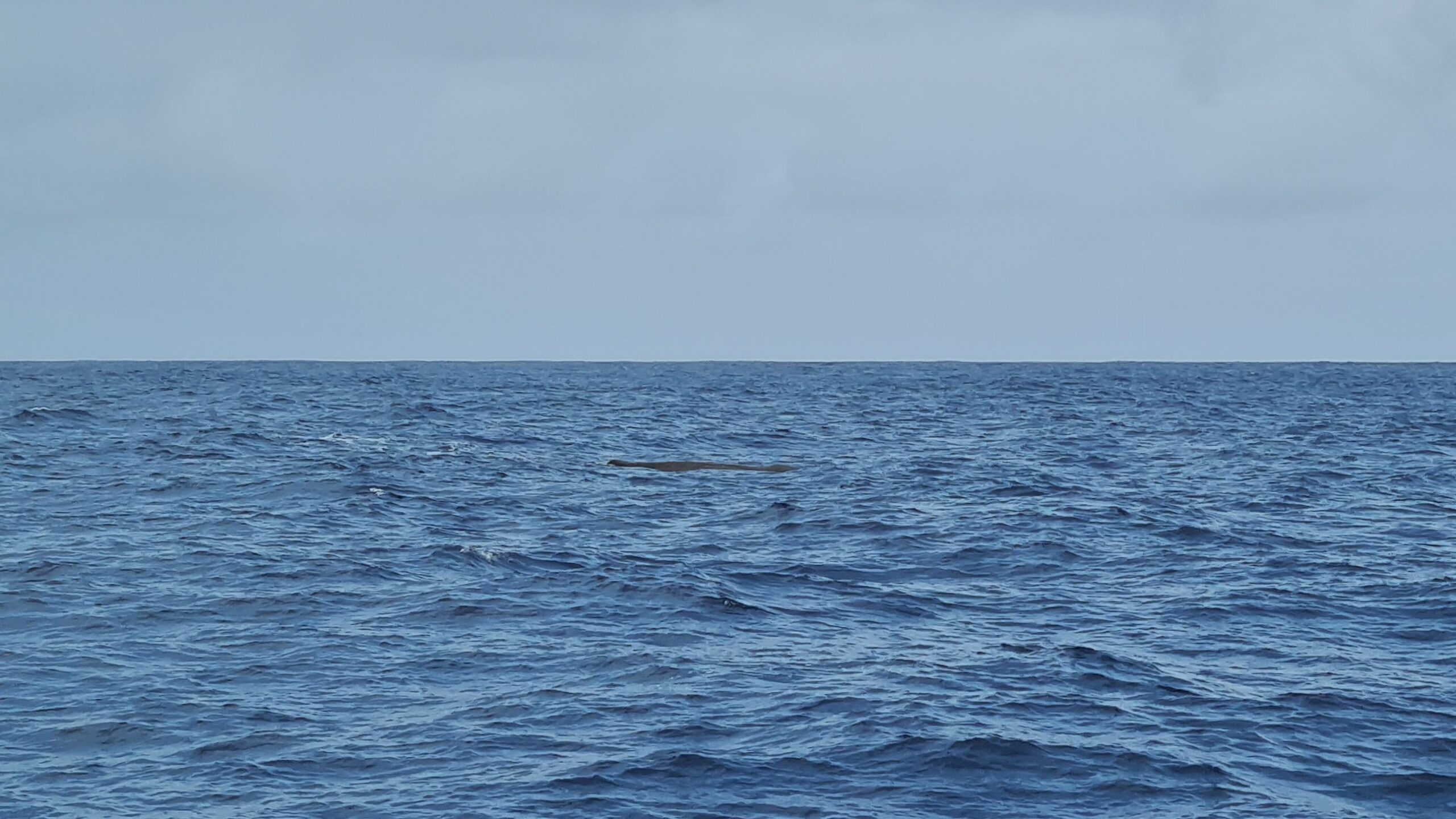
This is not a floating log, this is the back of a whale!
Our greedy booby
Then, a brown booby enters the stage. Appearing out of nowhere, there it is, circling the boat, brushing past us again and again. We eventually figure out its game: it is waiting for us to make flying fish take off with our bow so it can catch them mid-air. Clever! It will stay for hours, making full use of the UtPåTur cafeteria!
The North-East trade wind picks up again as predicted, but much more Easterly than Northerly, and we do not want to bear away to the west just yet, to clear a fairly active tropical wave well ahead of us. We find ourselves sailing full and by for a few hours, which allows us to check the behaviour of our “Mast of Damocles,” as we have nicknamed it. Everything seems normal, but we still have trouble carrying as much canvas as before… When are we going to fully trust the rigging again?…
On the menu for today:
Lunch: Teriyaki bonito with rice and carrots, followed by mangoes.
Dinner: Polenta with radishes, fried eggs, and Santo Antão cheese, followed by apples.
The wind finally settles for a fast and comfortable night. The conditions are stable enough to allow us to get some proper rest; we sleep nearly 10 hours each, in chunks ranging from 20 minutes to 3 hours.
Day 5: Wind NE-E Force 2-4, slight seas (101 NM)
The trade wind is holding up! Oh, it is not very strong, but UtPåTur moves quite well in light airs. We prioritise speed over heading, as long as we progress roughly South-South-East, and we shall see where we end up.
Indeed no matter our trajectory, we will eventually hit the infamous Doldrums. The North-East trades will then die out, their accompanying swell will slam into the southern swell in a highly unpleasant cacophony, leaving us in a glassy calm punctuated by violent, thundery squalls. That is, until we cross the meteorological equator and find new trade winds—from the South-East this time. Not exactly an enticing itinerary, but it is the mandatory toll to change hemispheres!
We see our first squalls this afternoon—still too small to be threatening, but it allows us to check that we see them on the radar and to perfect our avoidance and reefing procedures. Anxiety aside, it is quite fascinating to find yourself at the heart of such a massive weather phenomenon…
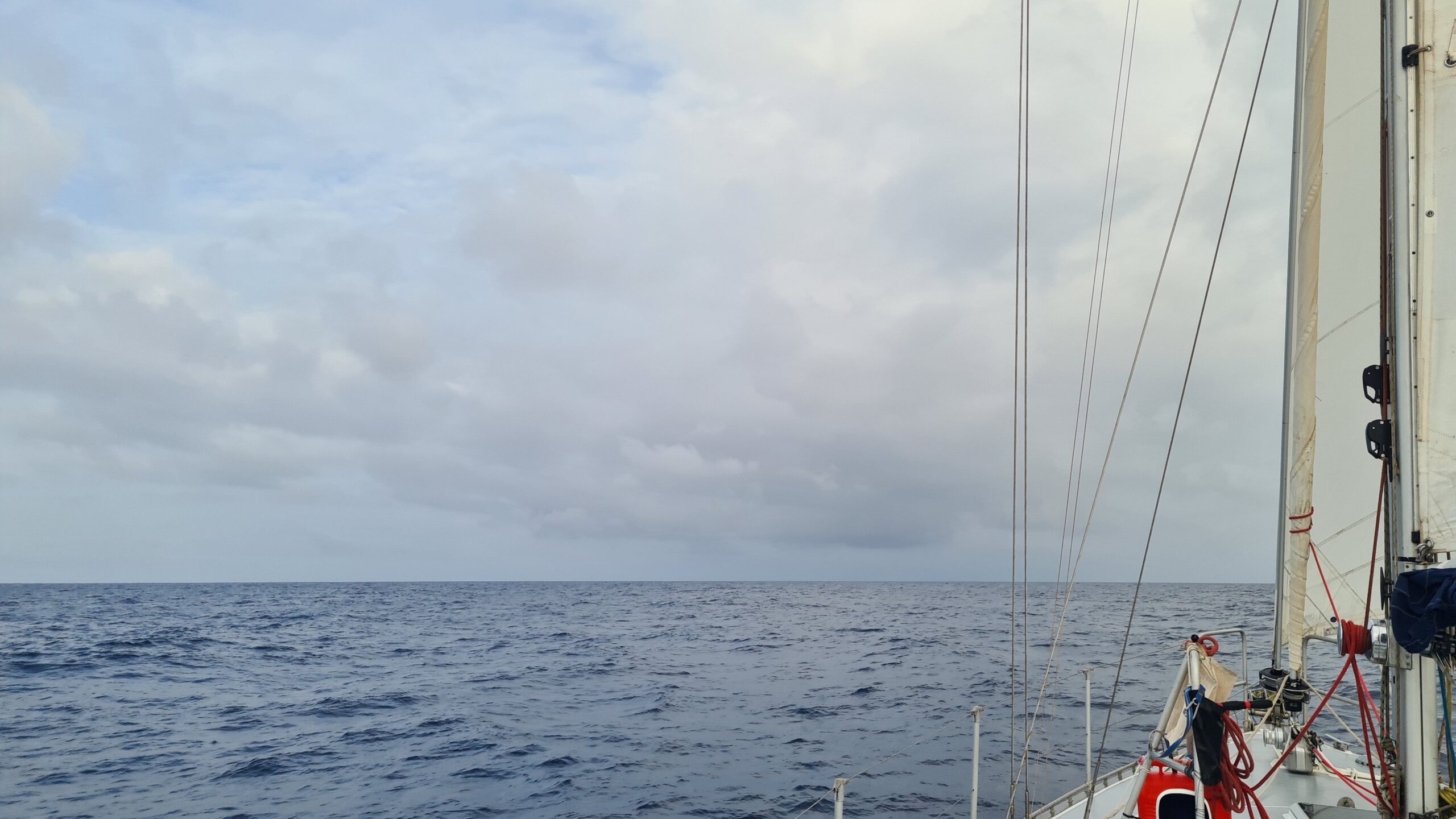
First baby squalls on the horizon
The boobies are back
We have company this evening. First, our brown booby is back! It is highly recognisable because it is missing a large feather from the tip of one wing. The UtPåTur buffet must have been good, because today it brought a mate! But where on earth do they come from, and how did they manage to find us again? And what about this butterfly that we see in the cockpit—was it born on board to find itself this far from land? Mysteries…
At dusk, a minor event: we see a cargo ship on the AIS, then on the horizon. It will be followed by half a dozen of its peers through the night; we have clearly closed in on a shipping lane. Our first signs of human civilization since leaving…
On the menu for today:
Lunch: Quinoa, surimi, cucumber, and cheese salad, followed by yoghurt, mango, and an orange.
Dinner: Pan-fried potatoes, aubergines, onions, pepper, and ham, followed by a slice of our banana jam on fresh bread straight out of the pressure cooker. Yum!
The night is also very calm, spent tweaking every possible setting (helm, windvane steering, centreboard, sails) to keep moving without getting too battered by the swell (our Mast of Damocles does not like that…) The sky clears, the stars are bright. Aside from the immense Scorpius, and the Plough lying upside down, we do not recognise much else…
Day 6: Wind NE Force 2-3 then variable 0-5, slight to rough seas (119 NM)
The North-East trades have been resisting for a long time, and so did we—luffing up to 60° off our course to create some apparent wind and keep moving under sail.
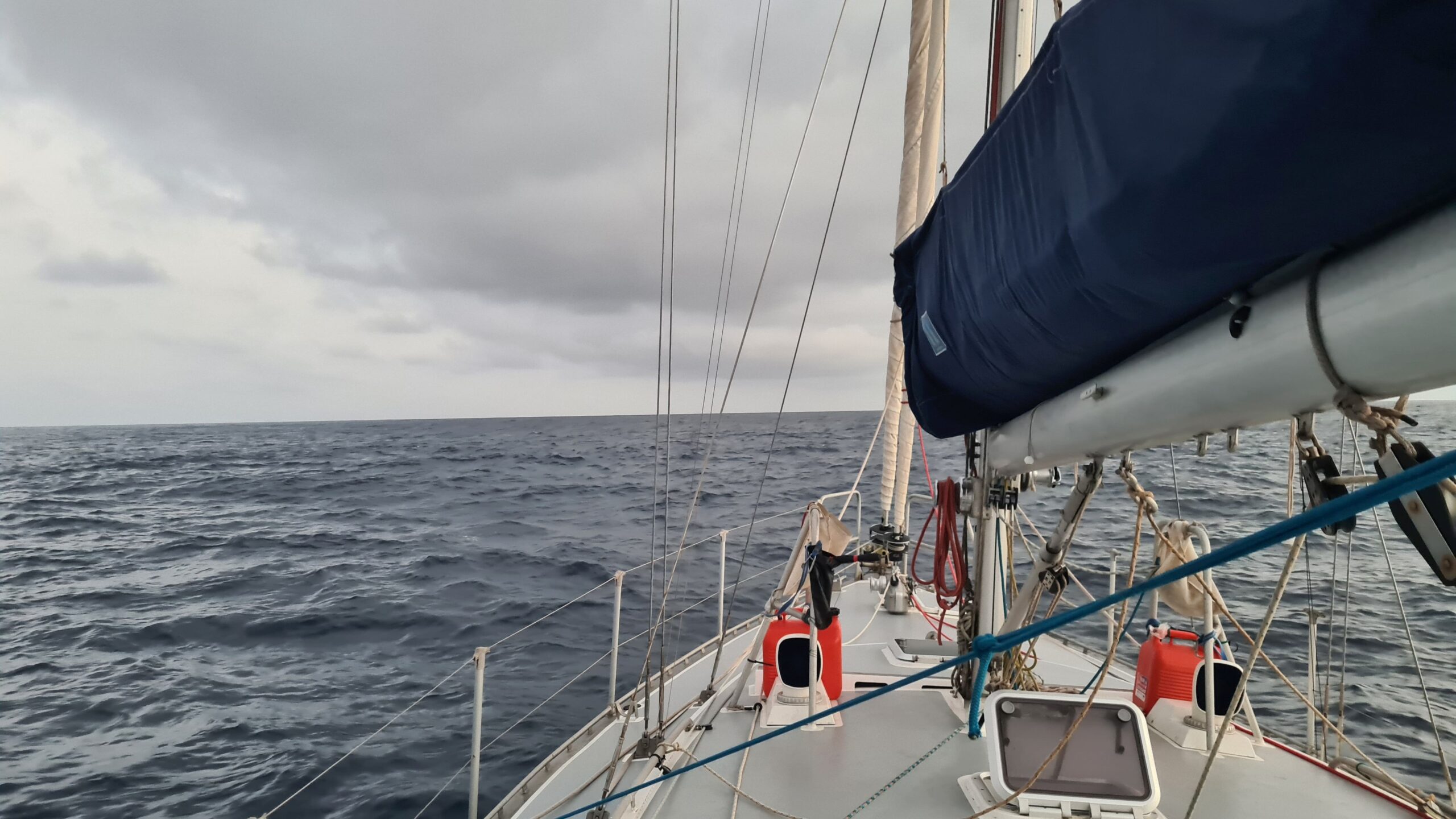
The North-East trades have finally blown themselves out
We give up at 4:00 pm and start the engine in a breeze that is nothing more than a whisper. We thus make the most of the final hours of daylight, a flat sea, and the sudden abundance of energy from the engine to run the watermaker and allow ourselves some water for a long shower! What bliss to be clean! Mind you, it only lasts a few minutes; you quickly become sticky again in this heat… 39°C in the saloon at noon. We appreciate the cold drinks and yoghurts from the fridge, even if the power consumption is quite shocking compared to Northern Europe.
On the menu for today:
Lunch: Sweetcorn, tomato, radish, and surimi salad, followed by cheese and apples.
Dinner: Pan-fried cabbage and ham, followed by banana jam on toast.
Note: And no dorado, as the one that had bitten our line managed to unhook itself while being reeled in… it happens often with those leaping fish. Shame, it was a beauty…
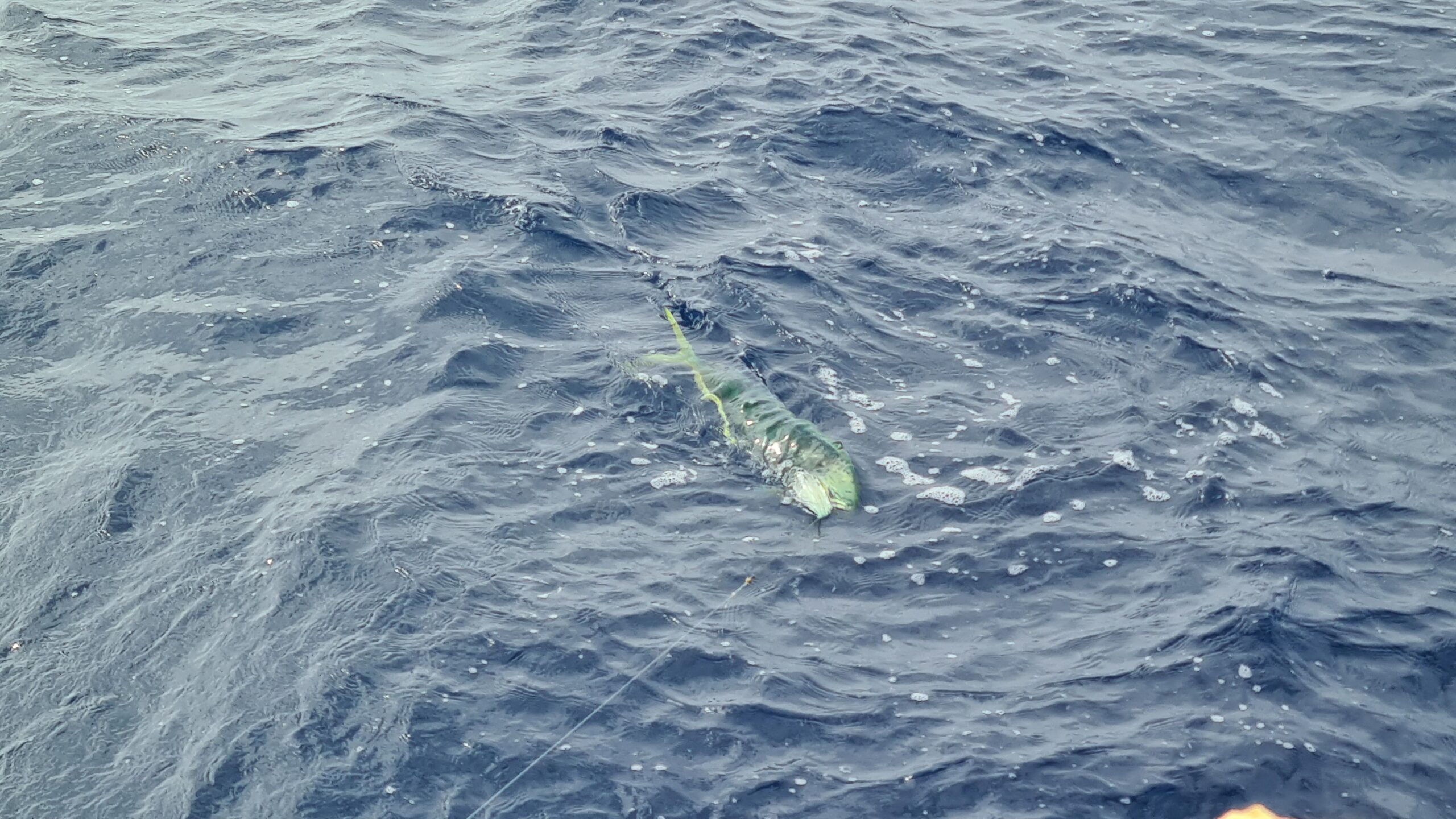
Nice dorado, which is likely stil enjoying life deep in the tropical ocean…
Night falls on a glassy calm and a sky heavy with bad omens… At 2:00 am, a massive black wall marches across our path. The squall, for that’s exactly what it is, is clearly visible on the radar and we try to dodge it. But the more we veer away, the bigger it grows. It is soon joined by a second one inflating on the spot before our eyes, easy to track thanks to the frequent lightning illuminating its entire core.
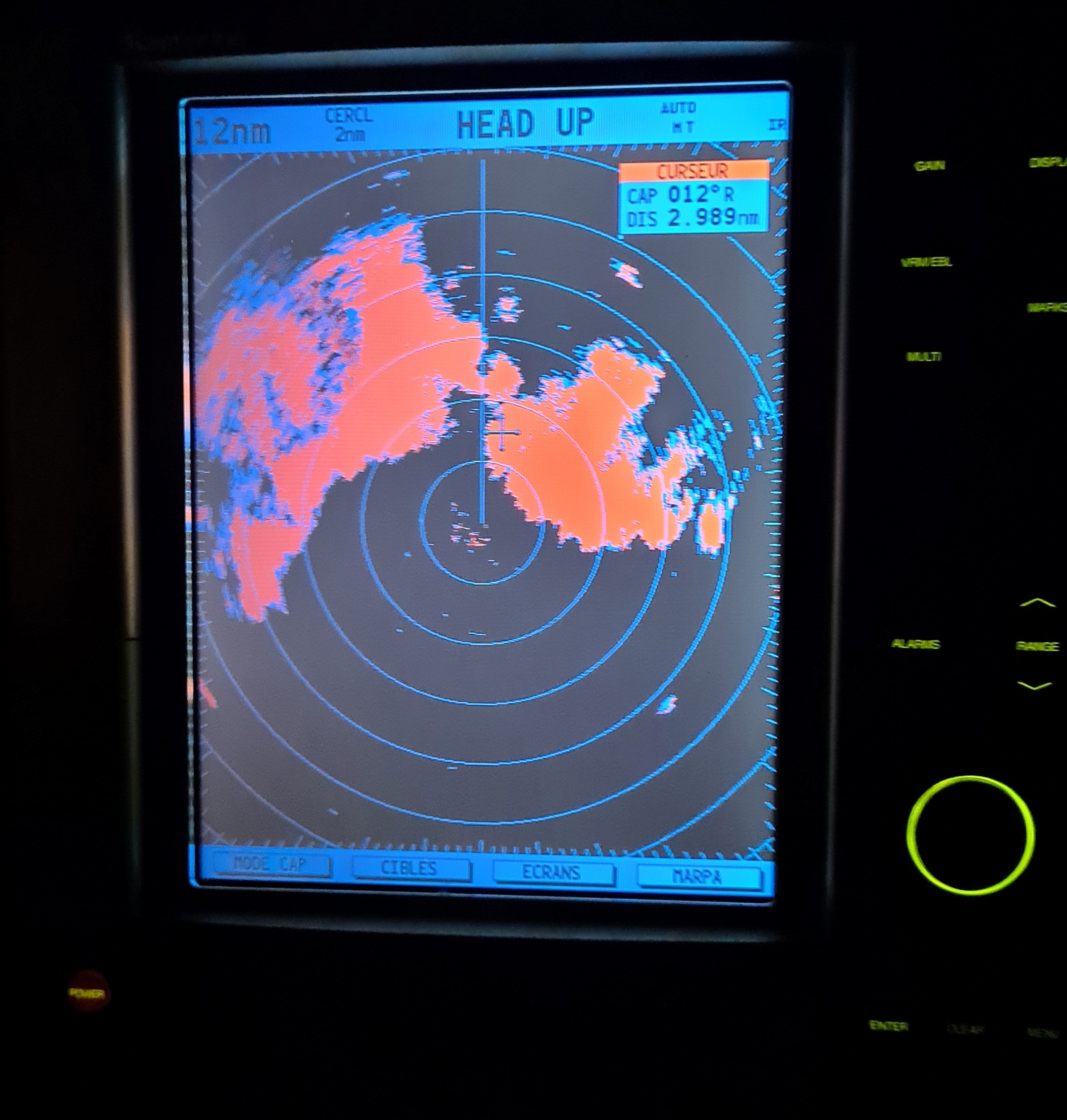
A wall of squalls for the next 12 NM
Here we are, quickly surrounded by squalls, with the sole option of punching right through… We stay under motor, having no desire to guess the wind strength inside this black hole, nor any wish to handle sails on deck in the middle of a thunderstorm. It seems as though the whole world is holding its breath as UtPåTur resolutely enters the orange mass visible on the radar screen… and then the rain starts to fall.
This is not a gentle British drizzle; it is a true tropical deluge. It rains buckets for 3 hours before settling into a more conventional heavy rain. The wind is manageable, and the rain—even if it seeps through a couple of hatches—was eagerly awaited to finally wash away all the dust accumulated in Cape Verde and the Canaries. Really, the only source of anxiety remains the lightning, which we would prefer not to attract down our mast. In the end, everything will go fine, but we will not sleep a wink all night… Meanwhile, a swarm of butterflies out of nowhere clusters around our masthead lights and threatens to invade the cabin the moment we turn on a light inside. What are they doing this far from shore?! After checking, it turns out they are Painted Ladies, migrating from Africa to South America—achieving the longest non-stop migration of any insect in the world. Incredible!
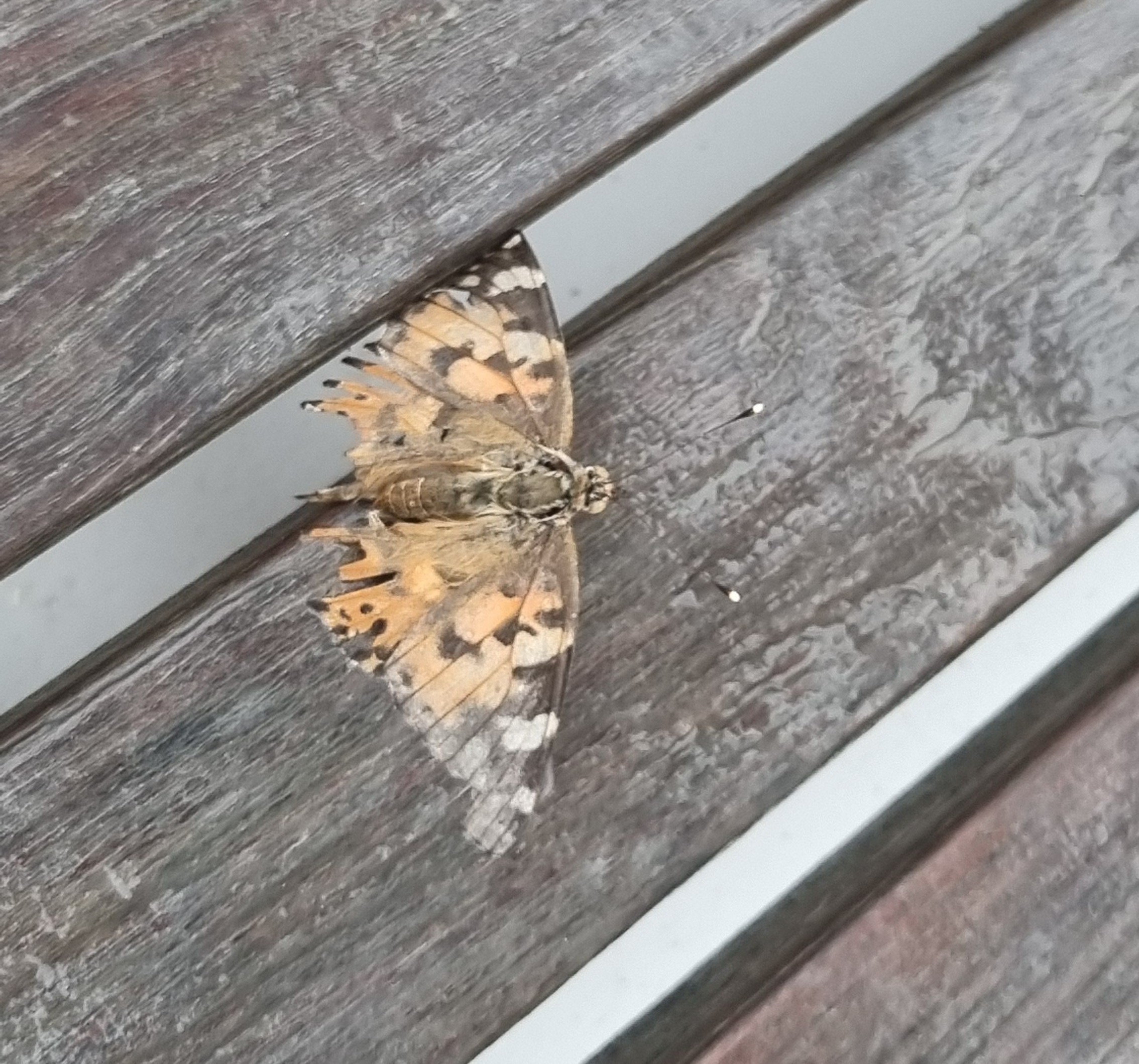
This painted lady butterfly takes a break on UtPåTur before resuming its migration
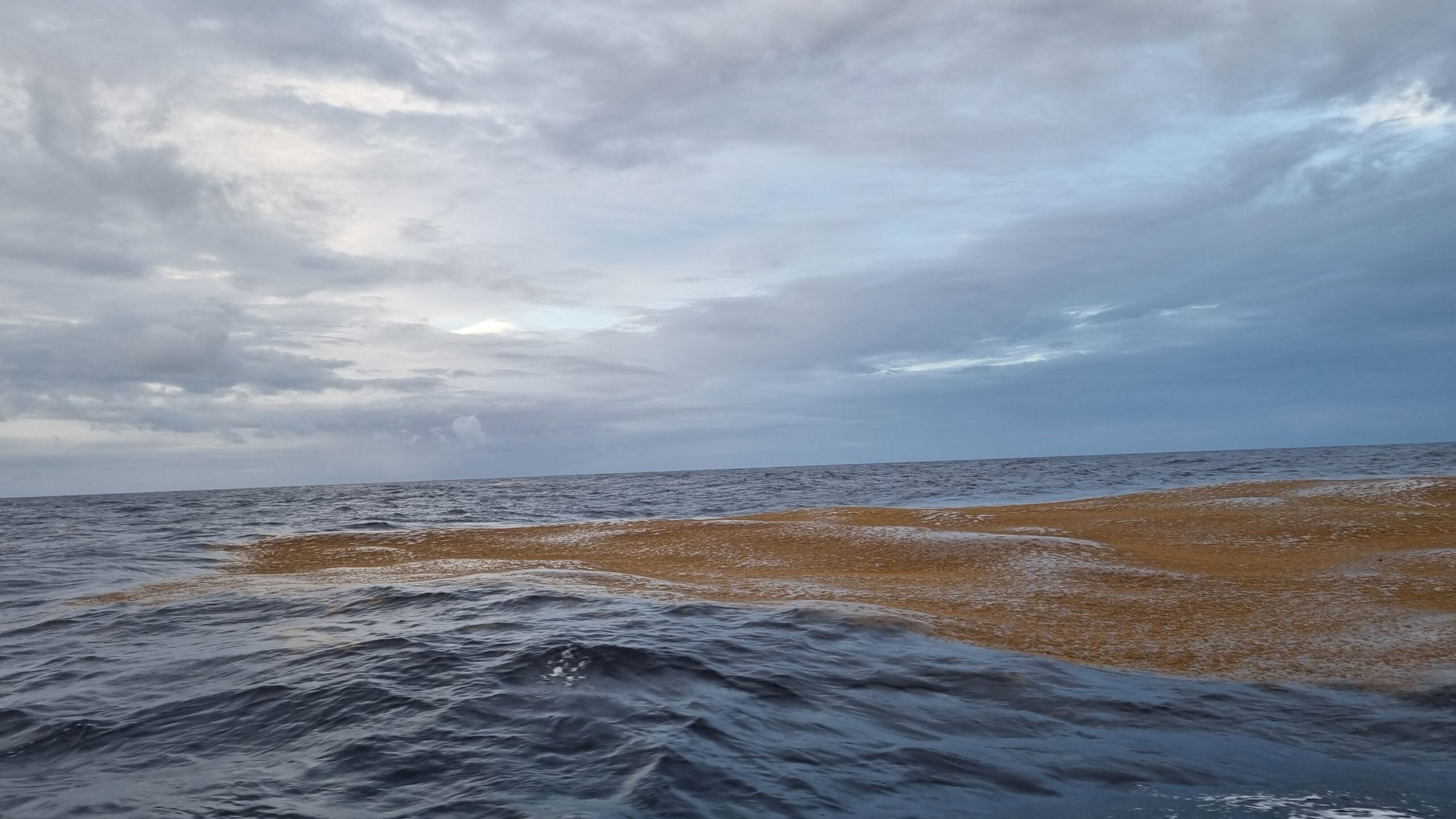
Field of sargassum in the doldrums
Dawn breaks over a whole new world: a uniformly grey, rainy sky, a sea bristling with short, confused wavelets beneath a surface otherwise slick from the total absence of wind, regularly choked with vast fields of sargassum weed and a depressing amount of plastic waste. Only the flying fish and the brown boobies remain to remind us of the world before, on the other side of this Doldrums barrier…
Day 7: Wind S-SE Force 0-4, moderate to rough seas (106 NM)
We are not out of the Doldrums just yet. No, we still have to continue long hours under motor in a battered sea that kills the boat’s speed, all while fighting a strong head current (nearly 2 knots).
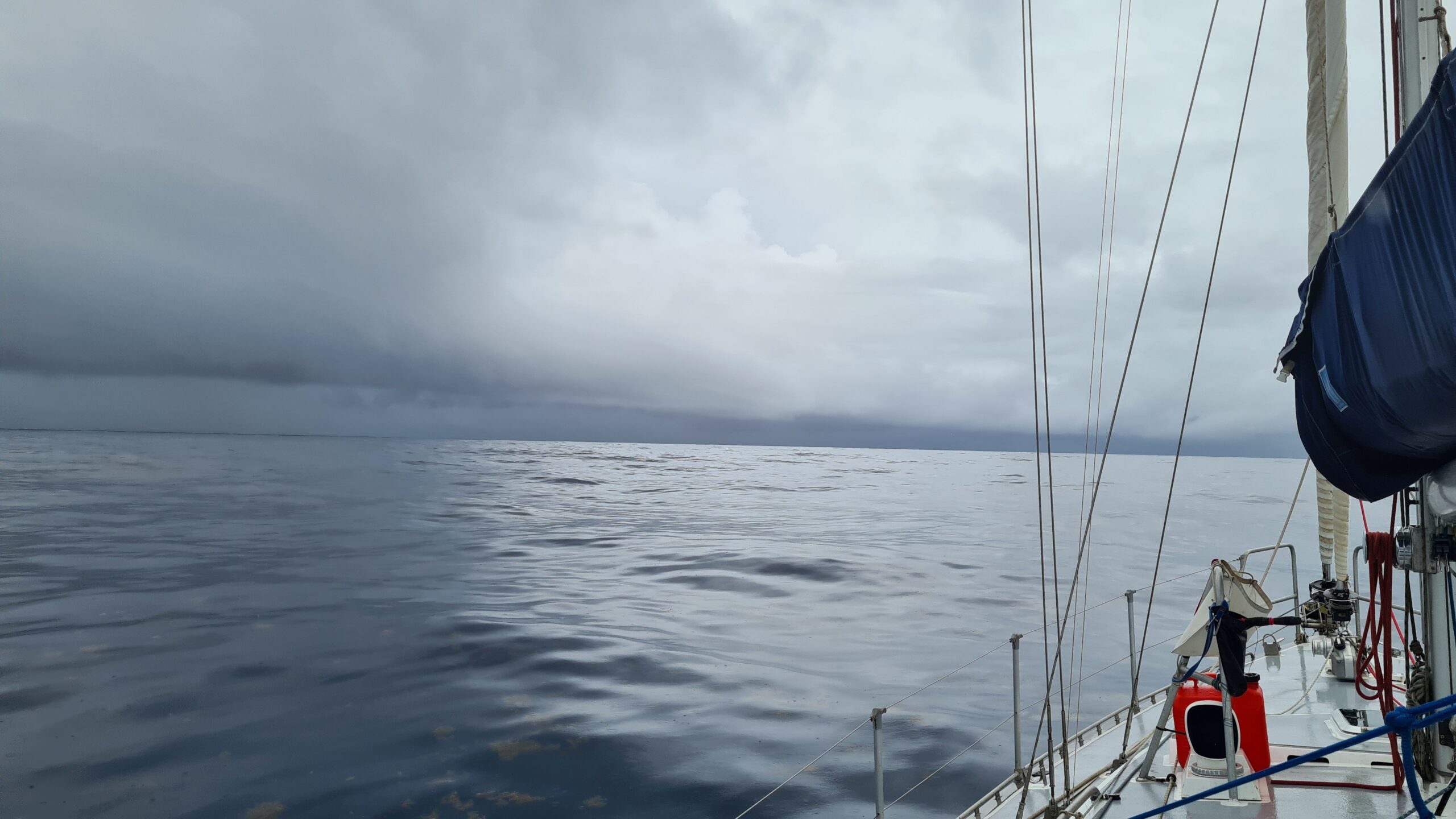
Flat calm and squally conditions this morning…
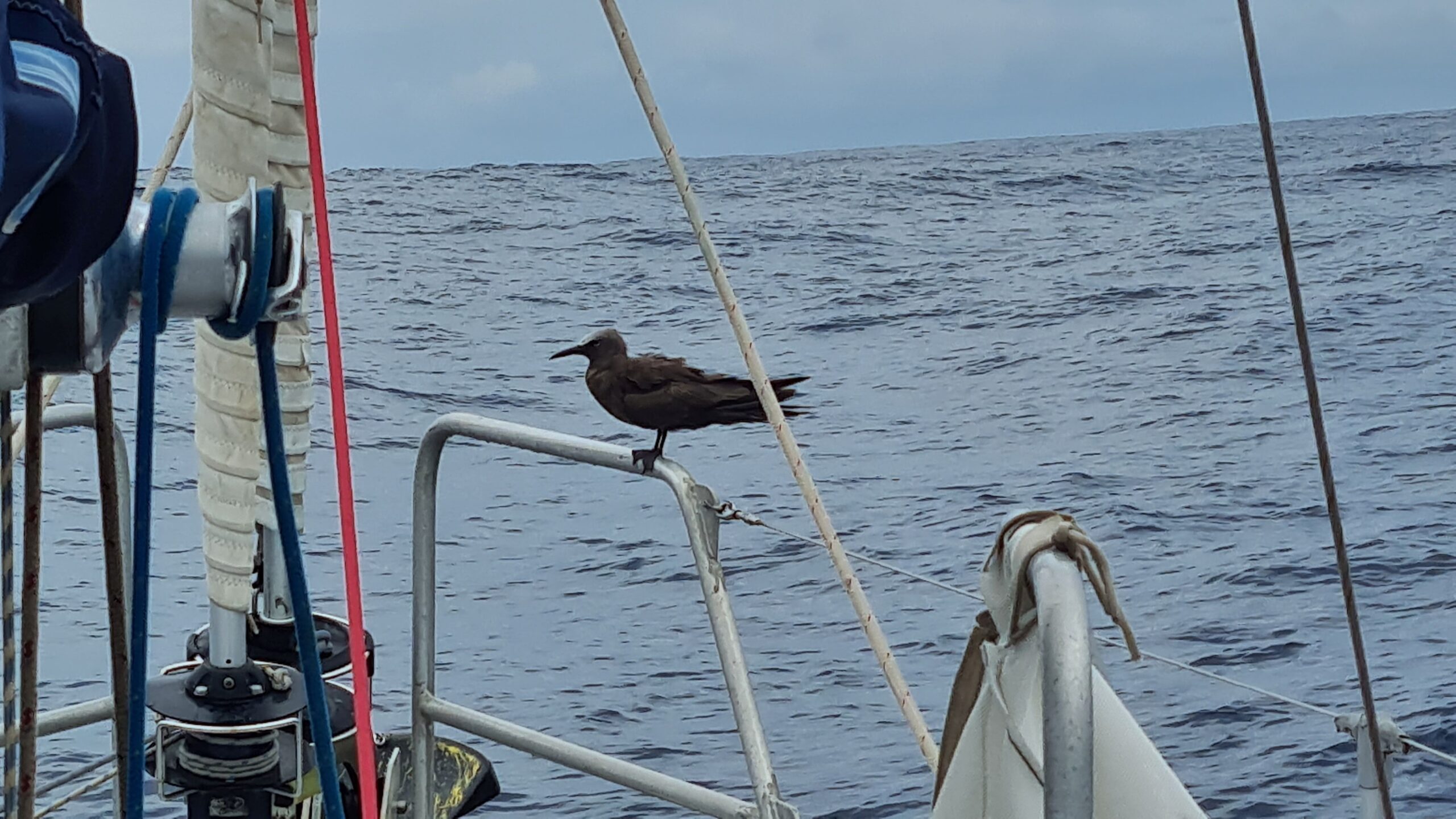
Our Brown Noddy, only staying for a few minutes
New world, new birds! Today, a Brown Noddy—a tropical cousin of the tern—comes to perch for a few moments on the bowsprit… before finding it far too unstable!
It is only around 4:00 pm, a full 24 hours after starting the engine, that we catch enough breeze to shut it down. All in all, we will have had a relatively easy and short passage through the Doldrums, especially for the season. The wind first picks up from the South, and we tack to the East, then it settles into the South-East, allowing us to tack back and resume our heading South. The second leg of this crossing has begun!
On the menu today:
Lunch: Gnocchi with pesto and cheese, followed by an apple and mango.
Dinner: Instant sweet potato mash with ham, followed by an orange.
We are under sail, to be sure, but the true wind is still quite weak and the squalls are numerous. We have lost count of how many times we reefed and shook out the reefs through that night.
By dawn, the wind establishes itself from the South-East at a steady 20 knots. The sky clears of cumulonimbus clouds, leaving the arena open to friendly little cumulus clouds against a bright blue backdrop, entirely free of Saharan dust. This time, we have truly found the trade winds!
Day 8: Wind SE Force 4-5, moderate to rough seas (117 NM)
It took us several hours to get re-accustomed to life close-hauled. The roar of the wind, the boat heeling over at 15°, the repeated slamming against the waves (really not great for our Mast of Damocles…), the constant physical effort required just to move around or even stand upright on board… ah, downwind sailing was definitely more comfortable!
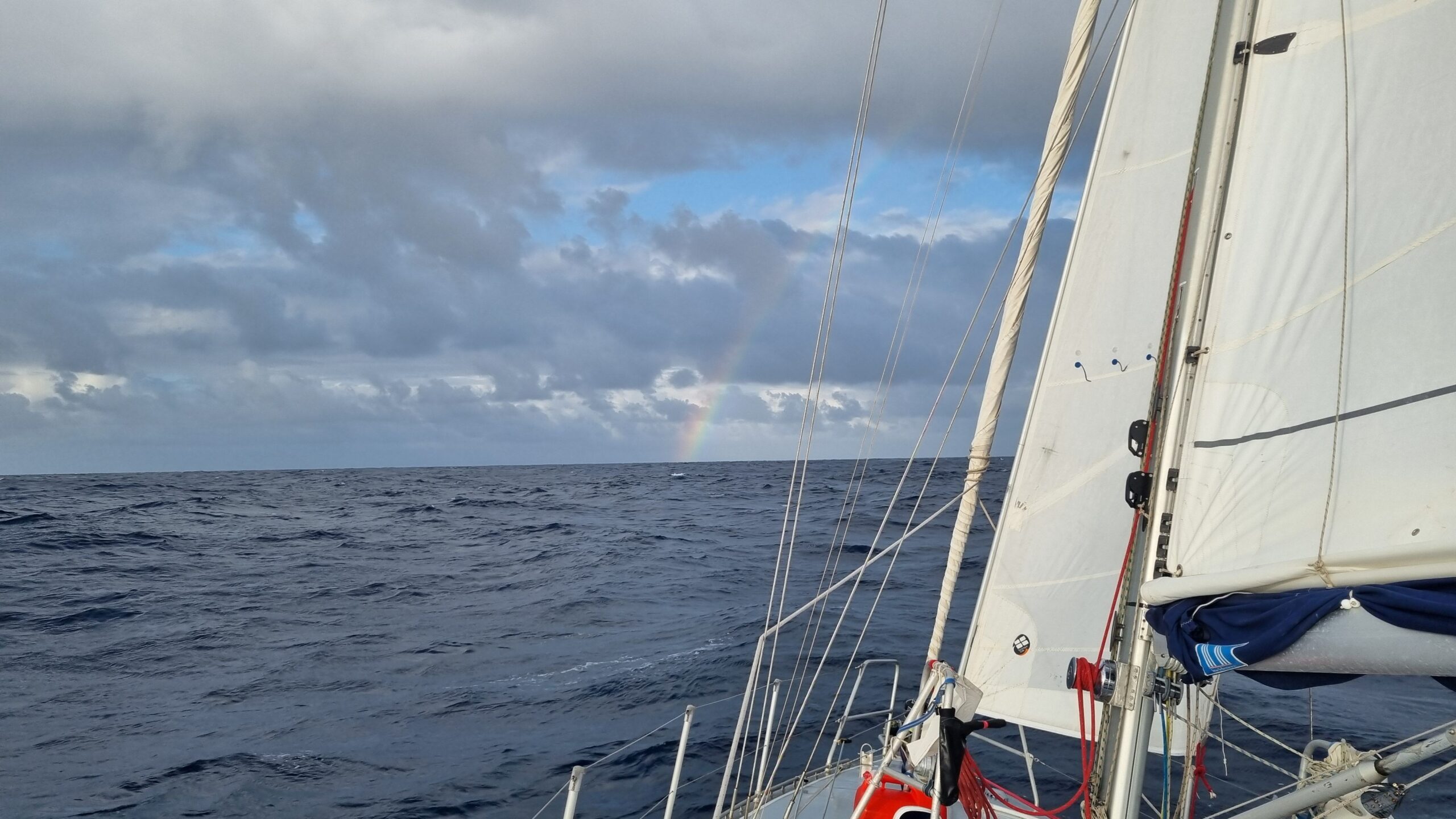
No more fast-running downwind, now we’re battling close to the wind…
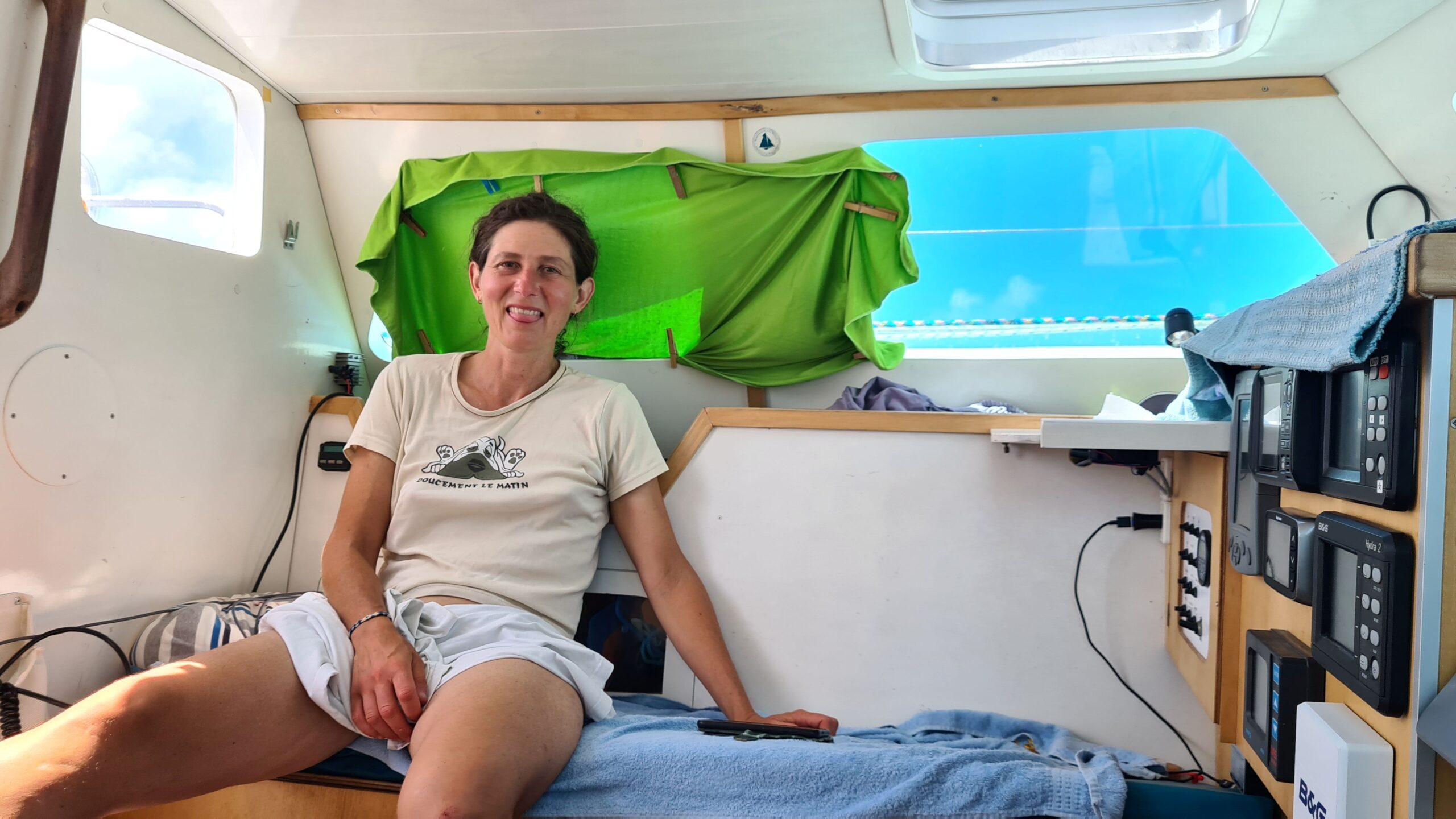
The heat is almost unbearable so close to the equator
Worse still, it is stiflingly hot. The headwind no longer blows into the cabin through the companionway doors, and as for opening a side hatch to ventilate—given the waves sweeping the deck—it is a high-risk gamble! The sea must be pushing 30°C, because the temperature below decks refuses to drop any lower, hitting 40°C during the day in the pilot house.
At least the weather is beautiful, and honestly, the best place to be is outside in the full breeze! We take advantage of it to do a bit of boat work: replacing a soft shackle at the clew of the mainsail, and making a few improvements to our reefing line blocks.
On the menu today:
Lunch: Ham and cheese tortillas with peppers and radishes, followed by yoghurt and bananas (yes, the ones bought green are starting to ripen).
Dinner: Cabbage, aubergine, and egg tian, followed by an apple.
The night will be stunning, with a little less wind and a cloudless, star-filled sky…
Day 9: Wind SE Force 2-7, rough seas (120 NM)
No two days are alike out here. In the morning, our bright blue sky covers over with heavy black clouds, and the first squall in a very long series dumps itself on us. We go from full mainsail and genoa to a triple-reefed main and staysail in a matter of minutes. The wind spikes to 30 knots as the cloud approaches, drops to around 20 knots during the torrential downpour phase, before vanishing completely as the system moves off. We bob around helplessly in a grey, windless vacuum until the next squall arrives. The entire cycle repeats roughly every half hour. The afternoon is an endless chore of reefing in and out, and we are starting to get seriously exhausted.
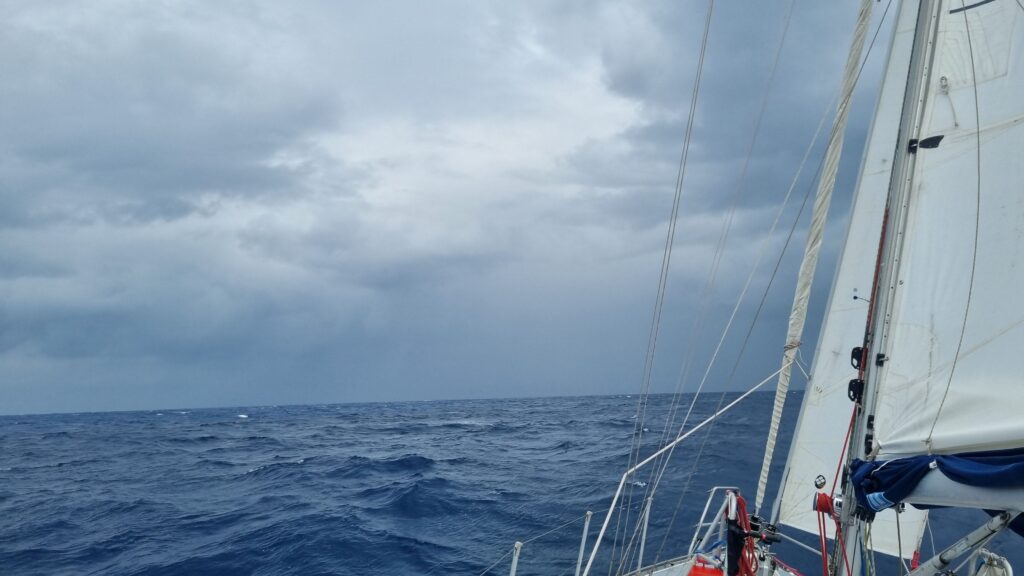
Squall approaching, it’s time to reduce the sails…
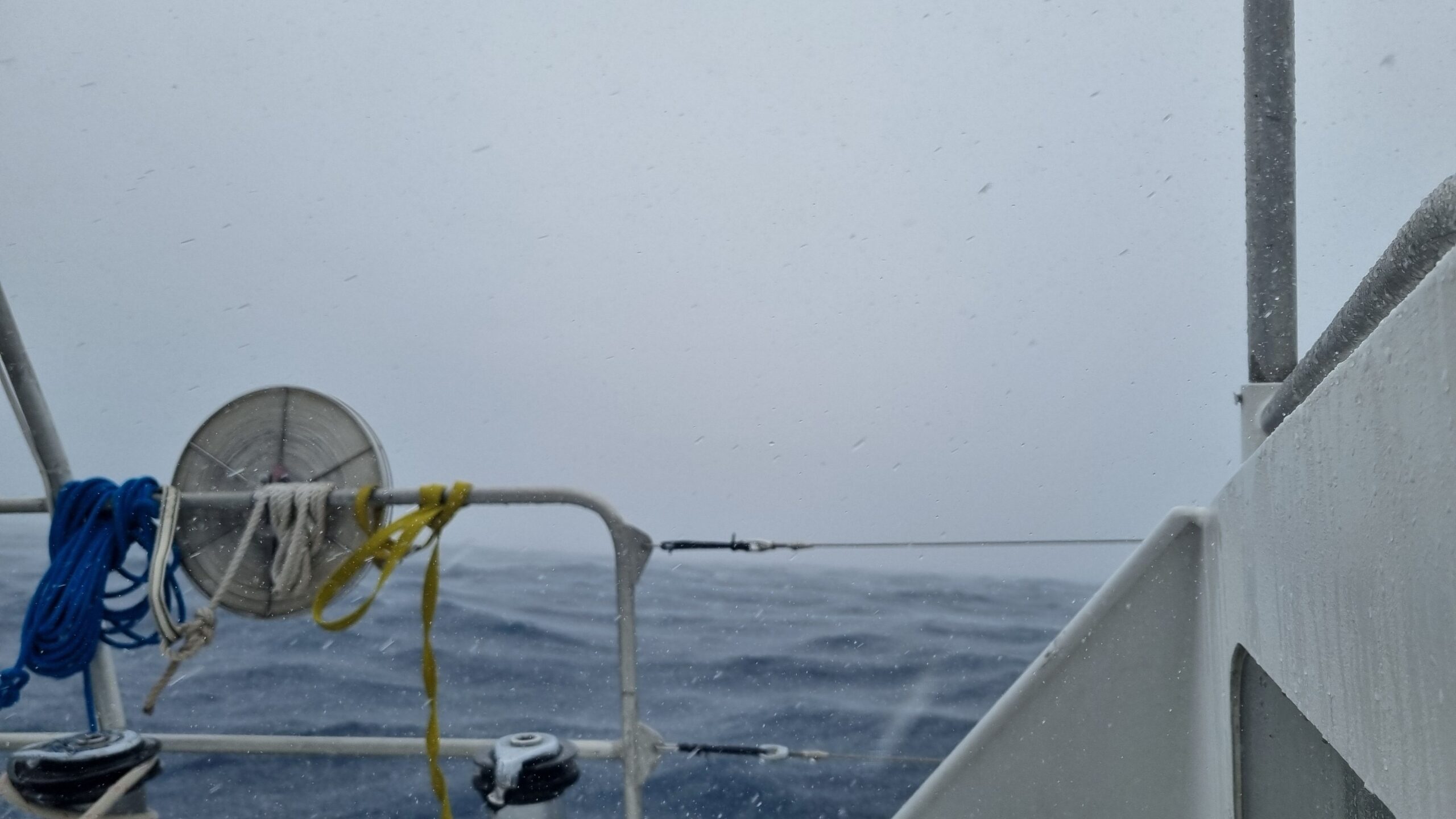
Inside the squall, often windy, always rainy!
On the menu today:
Lunch: Pan-fried sweet potatoes, carrots, onions, and surimi (yes, an ambitious combo, but we had to finish the surimi), followed by an orange.
Dinner: Instant Chinese noodles in instant soup (the definitive “difficult day” menu), followed by yoghurt and an apple.
The squalls space out a bit as night falls, though it will still be marked by an active radar watch and sleep periods broken up by sail changes. It is during one of these middle-of-the-night wake-up calls that Laure, eyes still blurry with sleep, is violently ambushed in the cockpit by a huge flying fish that strikes her squarely in the chest! Talk about a wake-up call! Above all, it is thoroughly slimy and incredibly stinky; there is nothing for it but to go scrub down and change T-shirts…
The squalls are spacing out a bit in the morning
By the end of the night, the circus calms down and the trades steadily reclaim their territory. We will see on the weather files the next morning that we slipped just ahead of a nasty tropical wave. We only caught the edge of it, and that was more than enough!
Day 10: Wind SE Force 4-6, moderate to rough seas (171 NM)
20–25 knots: the South-East trades are well and truly here! Since leaving Cape Verde, we have deliberately held a heading due South, anticipating the Equatorial Current which sets westwards at a speed of 2 to 3 knots. If we had taken the direct route, we could not have countered the westward drift of the current while fighting the South-East trades, and we would have ended up in French Guiana! This is why, since exiting the Doldrums, we have been pinched close-hauled against the wind.
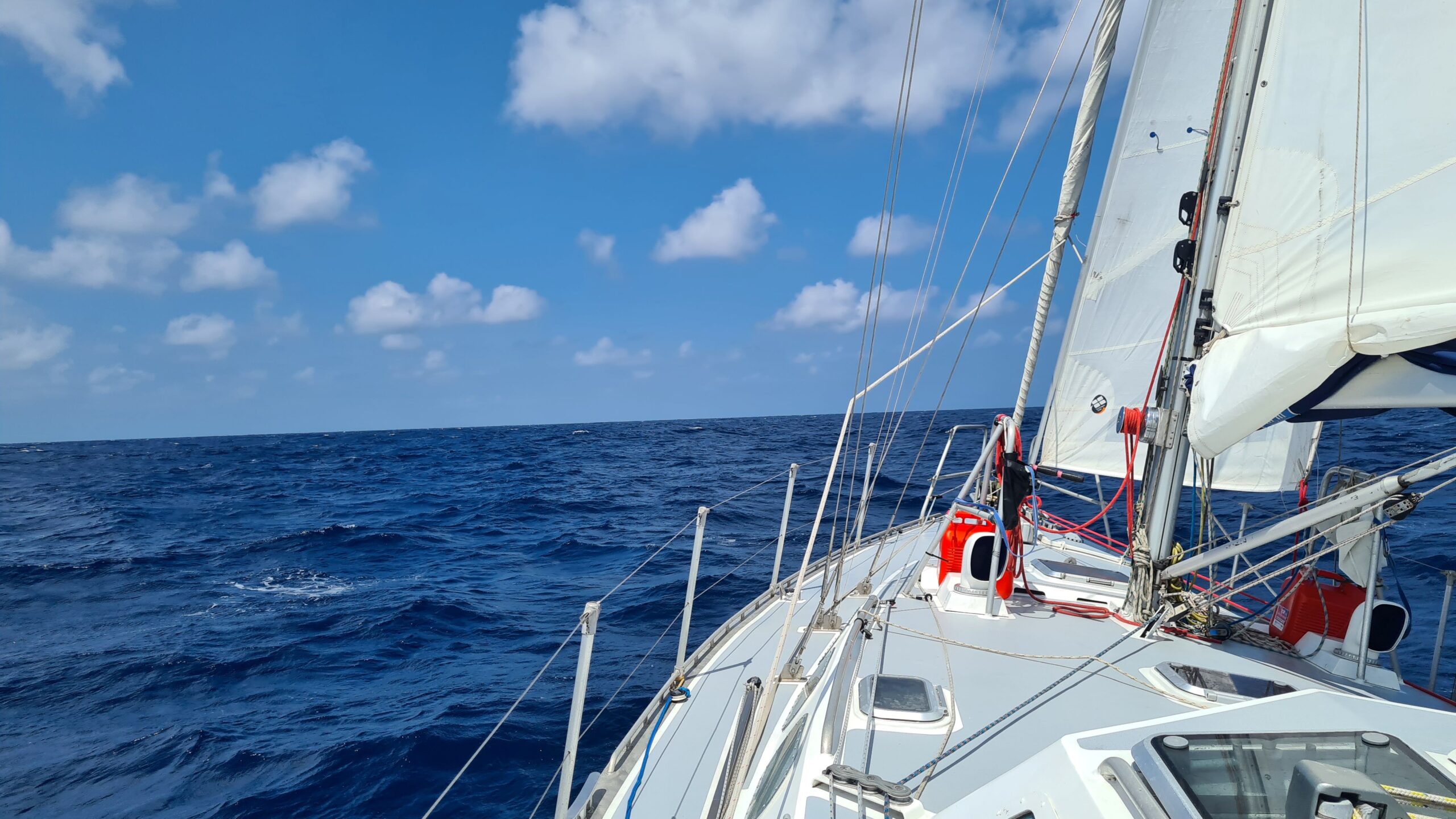
Still beating, but under the sun it’s bearable!
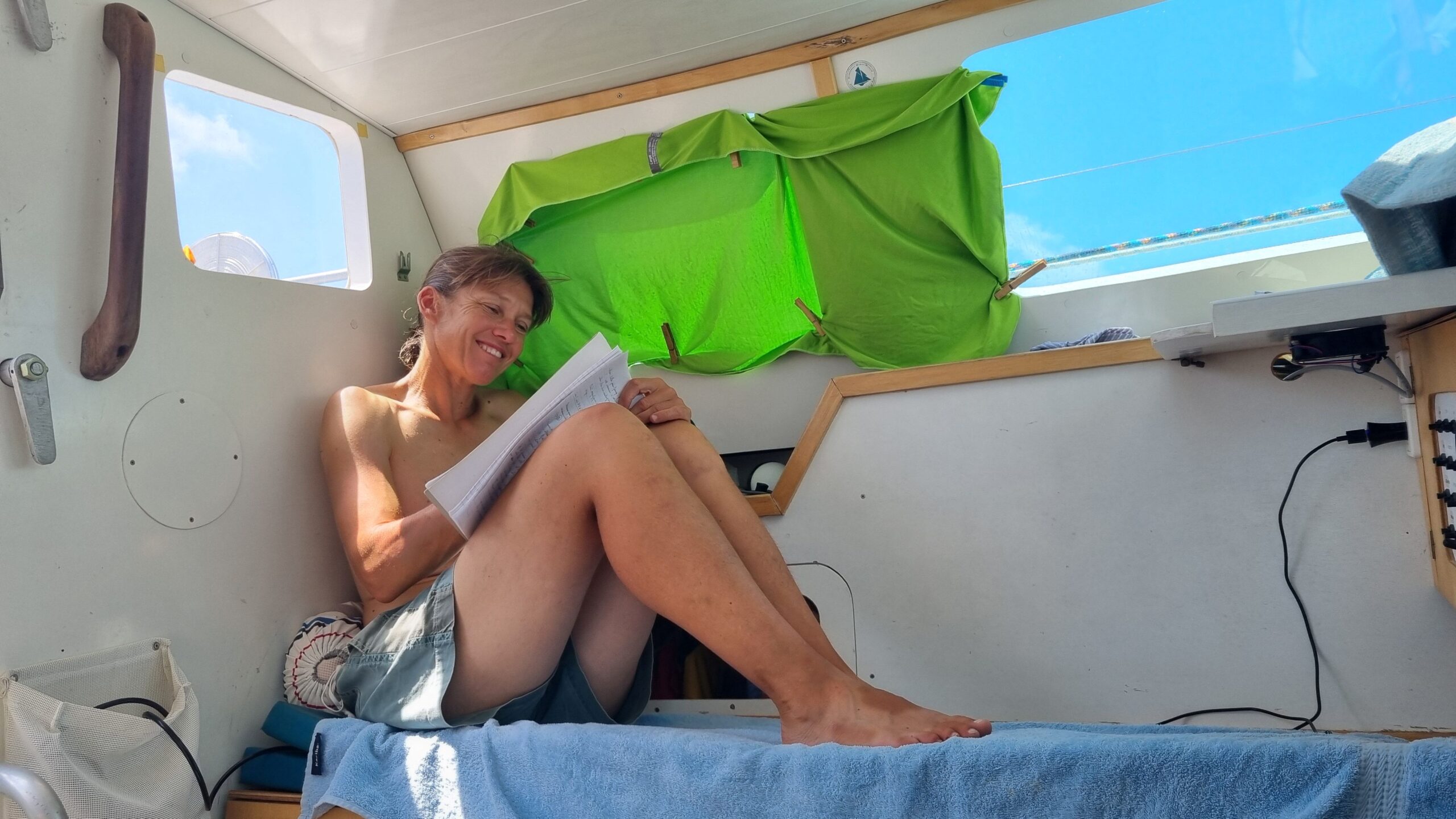
Writing in the heat
We are now right in the thick of this famous current, and we finally allow ourselves to bear away to take a direct course toward the island of Fernando de Noronha. We go from tight close-hauled to a free crack-off, then onto a beam reach, which massively improves life on board: we heel less, slam less, and above all, we are flying toward the goal at 6–8 knots, which is brilliant for morale!
On the menu today:
Lunch: Pan-fried cabbage with Cape Verdean sausages, followed by Santo Antão cheese and melon.
Dinner: Couscous, cucumber, tomato, radish, ham, and Santo Antão cheese salad, followed by a banana.
Tonight is the big night. The festivities are opened by the Southern Cross appearing to us for the very first time at twilight. Then the GPS begins counting down the minutes of latitude: 00°00.2 N, 00°00.1 N, steady now… at 03:38 UTC, UtPåTur crosses the Equator!
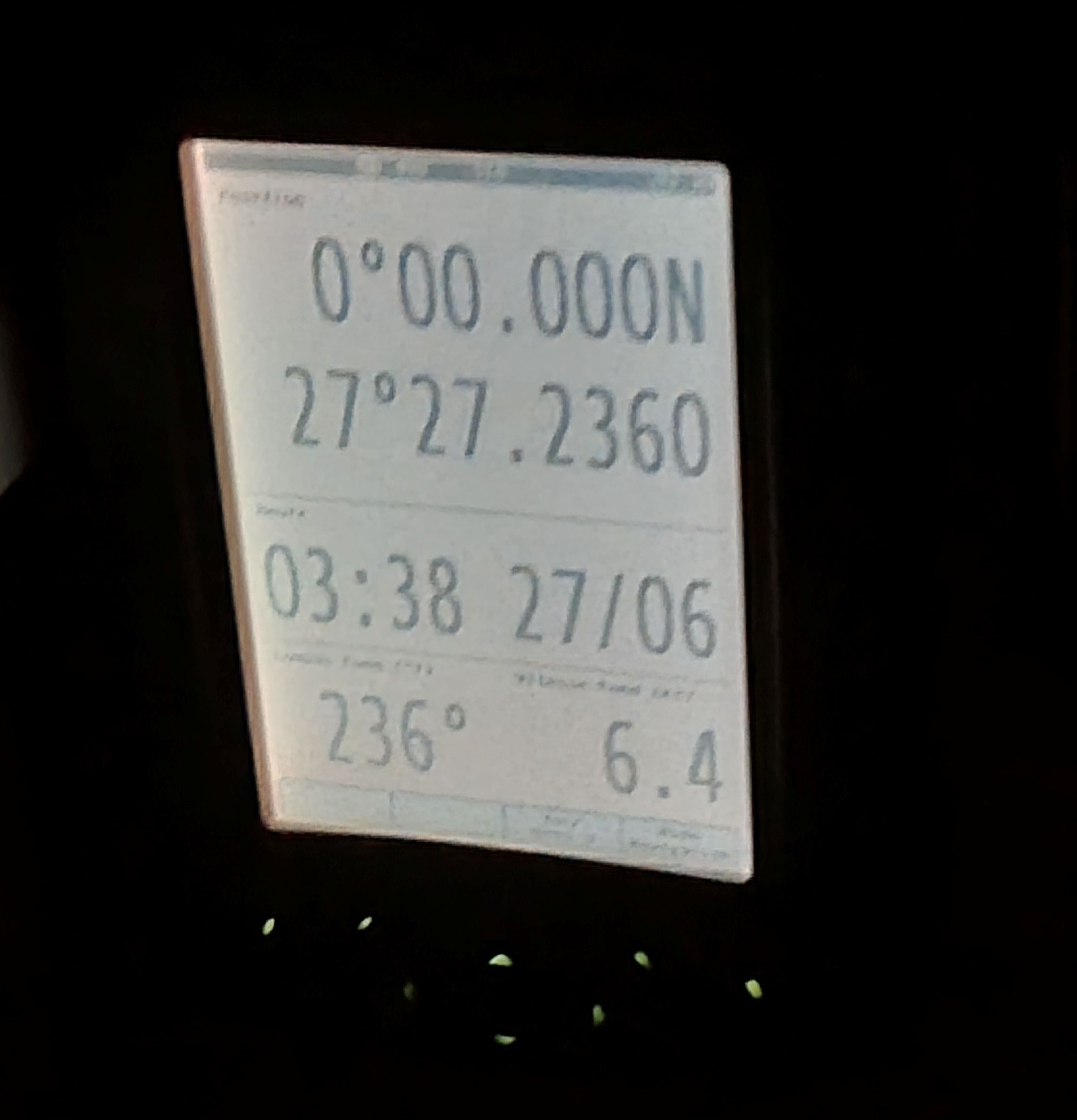
Crossing the Line !!
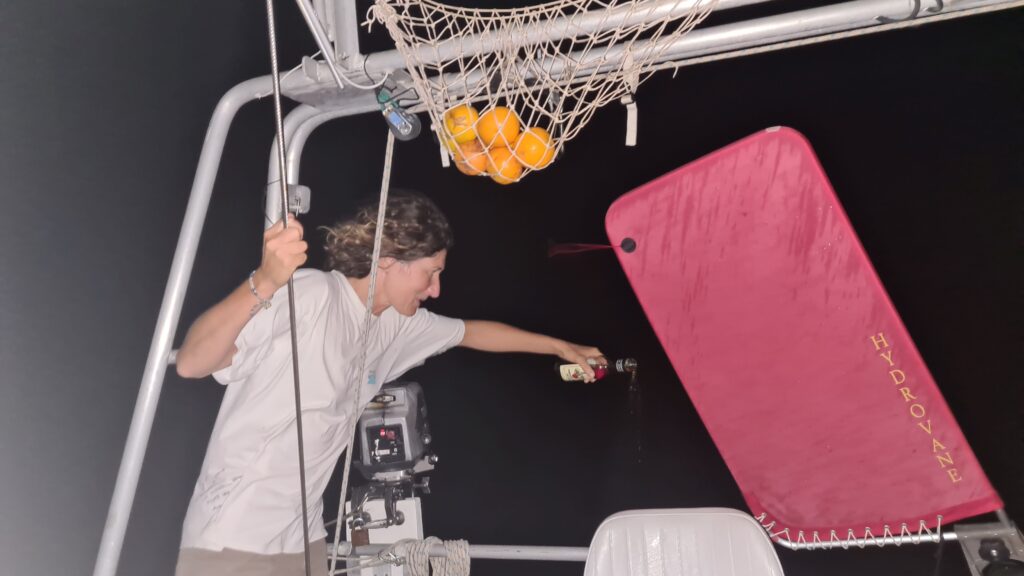
Offerings to Neptune and the boat, as tradition dictates!
This is our first time crossing the Line, and as tradition dictates, we thank the boat and Neptune for all our wonderful past voyages—with a splash of Bornholm bitter brought from the Baltic Sea—before encouraging them to look kindly on our future ones—with a proper nip of Brazilian cachaça.
00°00.1 S, here we officially are: the Southern Hemisphere! To be perfectly honest, we already felt like we were in the Southern Hemisphere since exiting the Doldrums—a weather boundary far more tangible than a number on a screen. Once out of the Doldrums, the trades changed sides, the boreal summer sun (culminating at 23°N) now appears squarely to our north, and we were already on the other side of something. But this time we are properly south of the big Line, which means… it’s winter! Apparently…
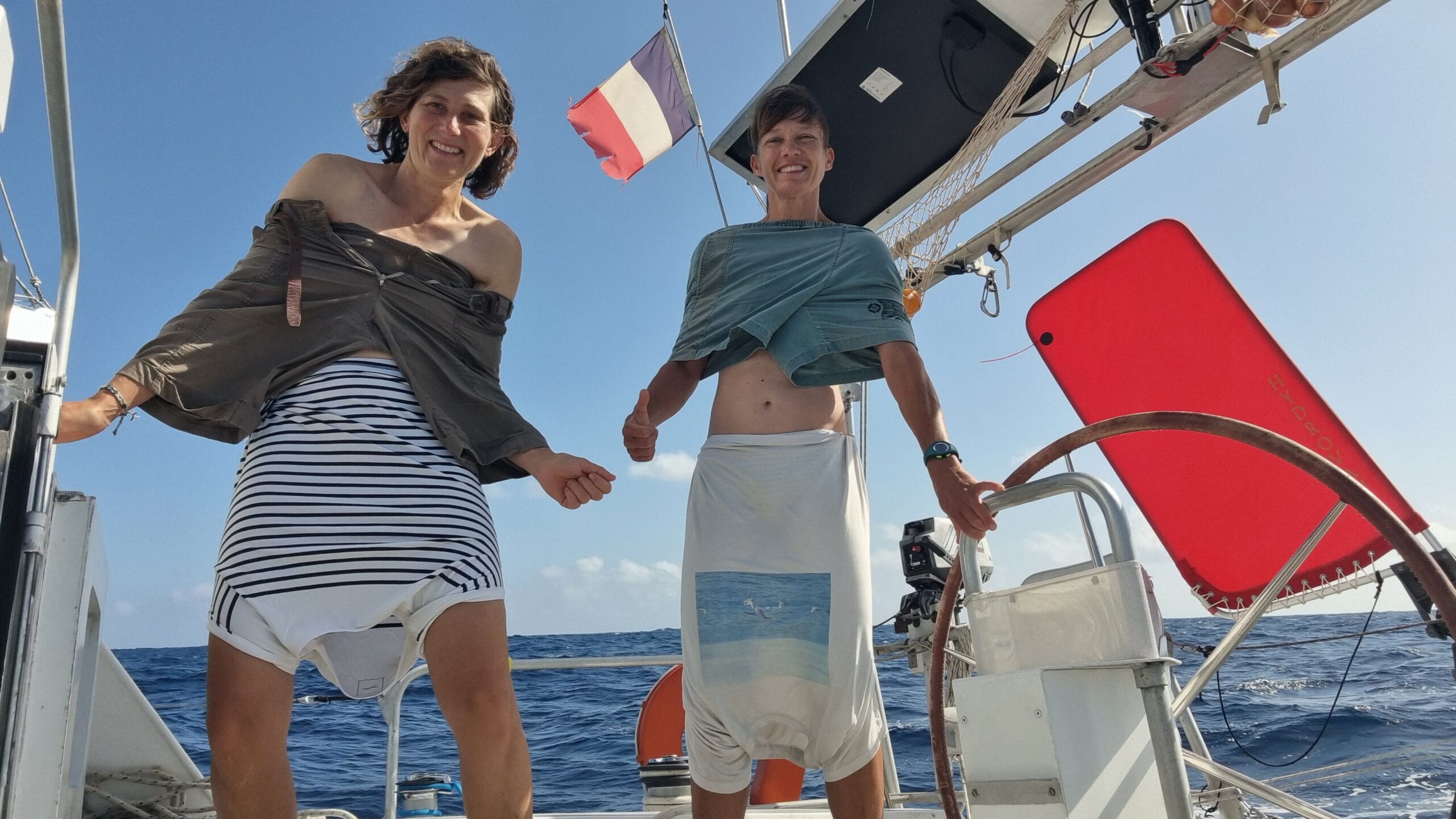
Everything is upside-down in the Southern hemisphere
Day 11: Wind E Force 3-4, moderate to rough seas (142 NM)
A fast day on a broad reach in moderate trades; the miles are melting away and we fall into the classic trap of thinking about the arrival… As a result, our morale is indexed to the boat’s speed and heading, leaving us quickly frustrated and tired. After all these offshore crossings, you’d think we’d have learned by now!
On the menu today:
Lunch: Cheese, Hénaff pâté, sweetcorn, and radish tortillas, followed by yoghurt and a banana.
Dinner: Sweet potatoes with fried eggs, followed by mango and an orange.
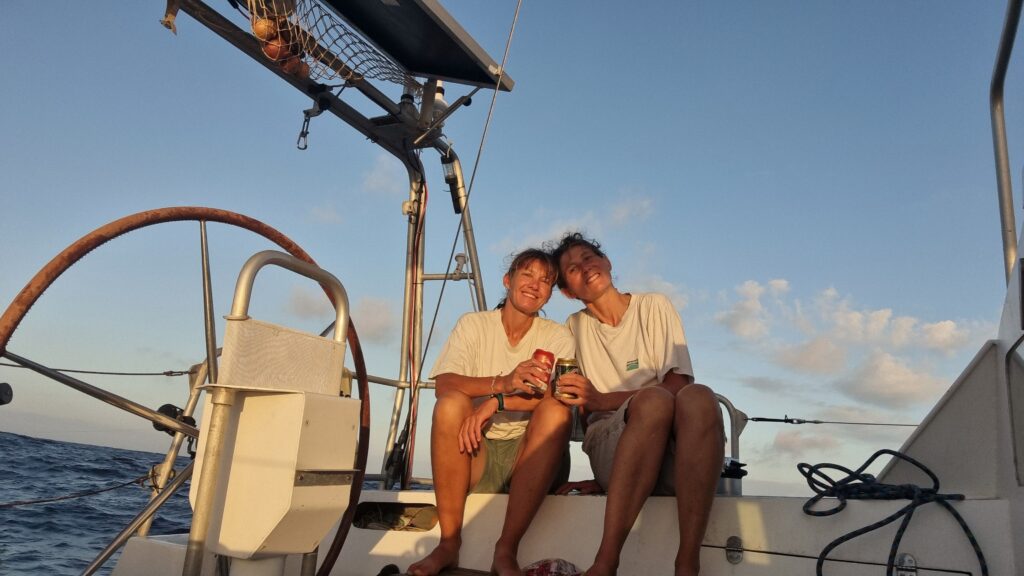
… and a small drink to keep spirits up!
Our mood does not improve as dusk settled: the wind freshened but turned East-North-East, putting us dead downwind! To make matters worse, a head current slowed us down significantly and knocked us off the direct track. We try poling out the genoa, but it is a sketchy operation with the squalls around, forcing a choice between heading or comfort. Needless to say, we do not sleep much…
Day 12: Wind ENE Force 5-6, rough seas (150 NM)
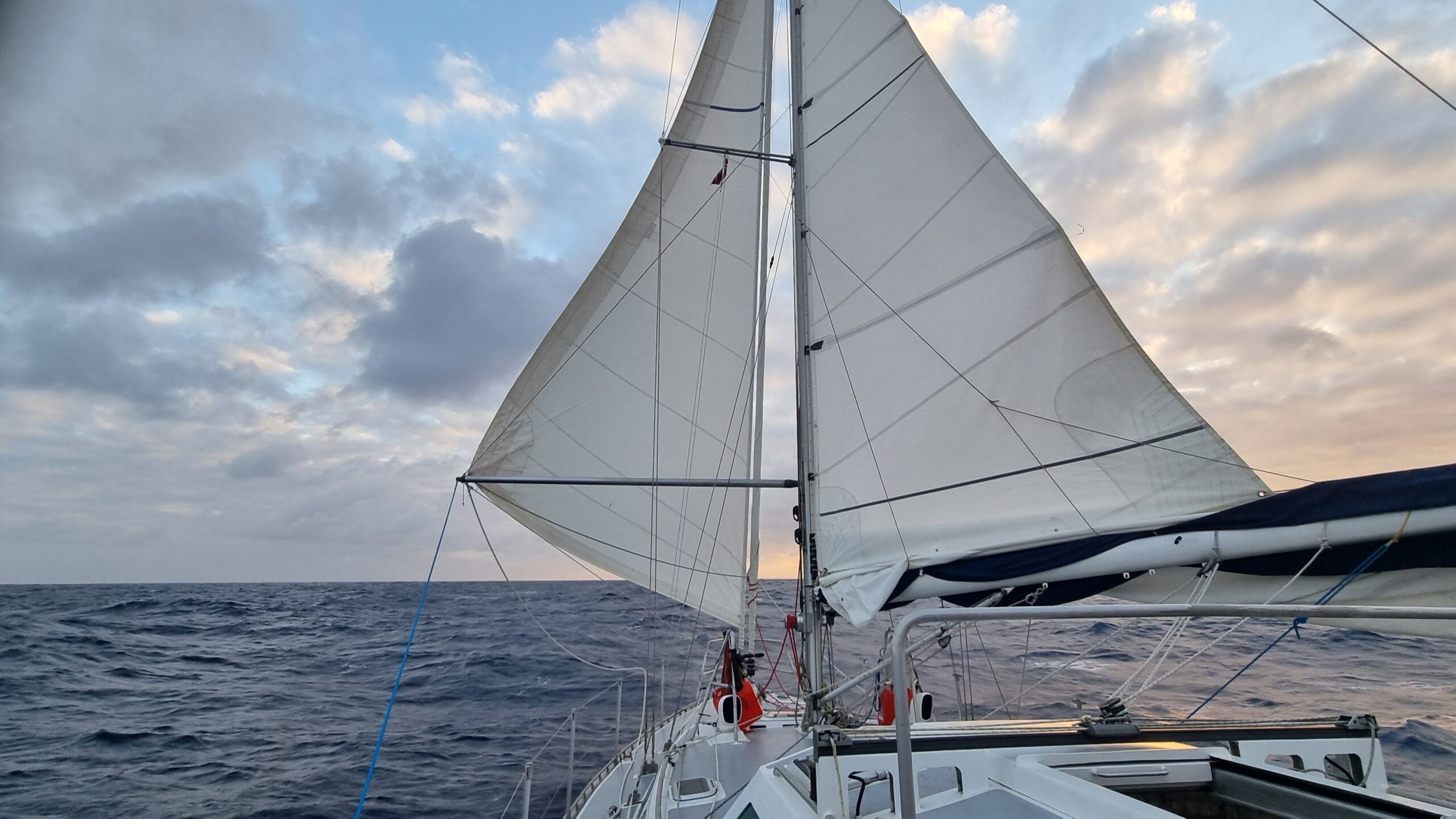
Finally, we had another day of downwind sailing in the trade winds!
The situation sorts itself out around midday, when we pole out the genoa again, paired with a triple-reefed mainsail, meaning we only have to roll in a bit of genoa when squalls hit. Much better, and we are aiming straight for the finish line! A Brazilian fishing boat—only 16 metres long—popping up on the AIS is our very first sign of approaching land…
On the menu today:
Lunch: Pasta with tinned tuna, tomatoes, and Santo Antão cheese, followed by melon.
Dinner: Pan-fried cabbage, potatoes, and Cape Verdean sausages (a proper hearty dish for the season—we are in winter, remember!), followed by the last of the bananas.
With the darkness arrive the Brown Noddies. Already last night, we had served as a dormitory for a lost couple. Tonight, there are about a dozen who have elected UtPåTur as their personal roost. There is plenty of squawking as they squabble to find and defend the best spot. The radar dome is clearly the gold-standard plot, ahead of the solar panels, the outboard motor, and the stern anchor strap. We shudder every time they drift near the wind generator… which indeed sadly will end badly for one of them, cutting its wing. It leaves with the others at 06:30 sharp, but likely won’t make it very far, poor thing… The brand-new blades of the wind generator, however, are fine.
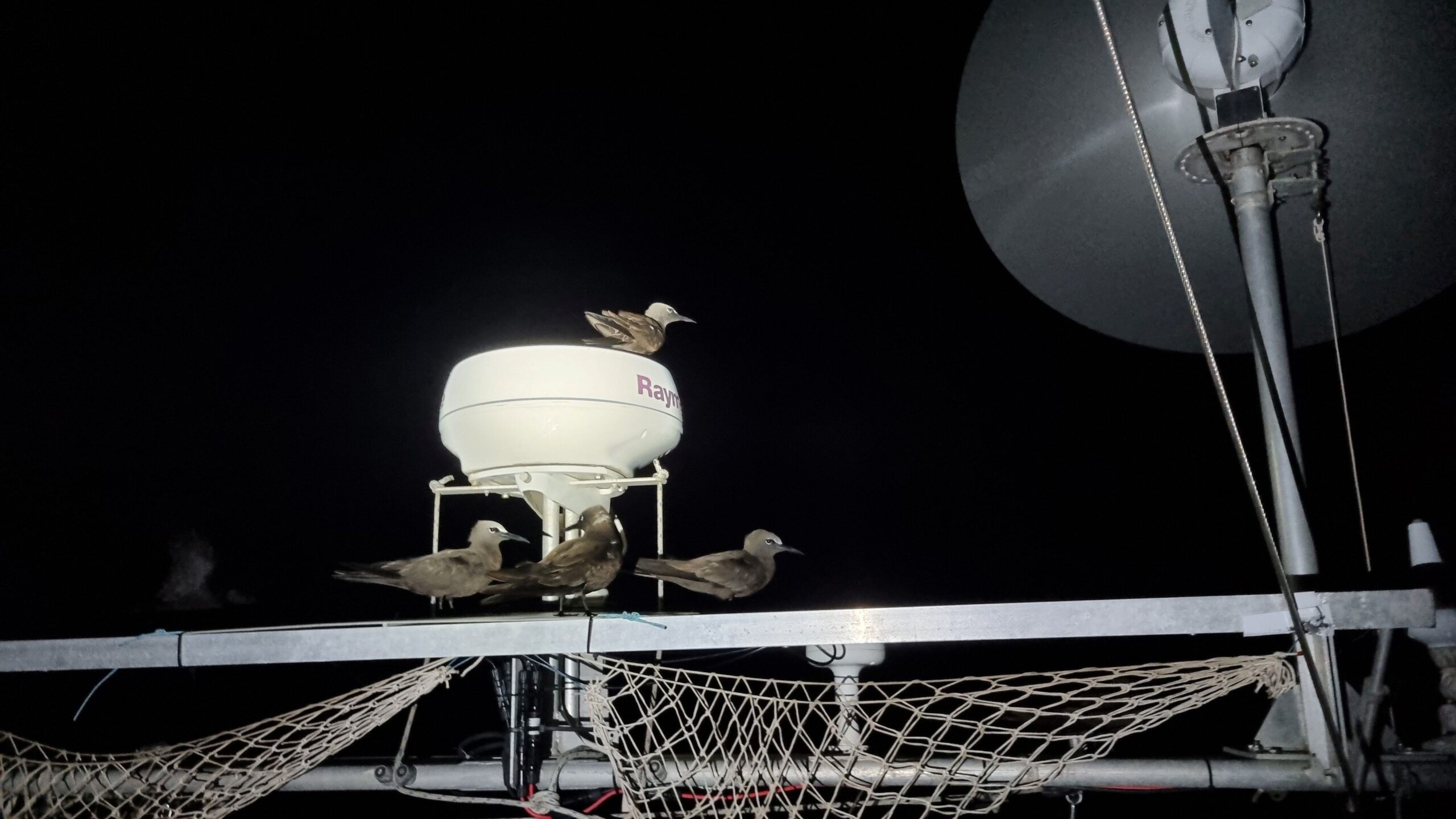
Intense neighborhood disputes among the Brown Noddies!
Day 13: Wind ENE Force 5-6, rough seas (22 NM)
Red-footed boobies flying around
We are moving fast. Sailing dead downwind then on a broad reach, well-assisted by the current which sets westwards again, we make 8 knots toward the island of Fernando de Noronha. About the same size as Groix or Jeløya, this little speck of Brazil in the middle of the Atlantic is a national park famous for its rich environment. And indeed, birds are everywhere. Red-footed boobies arrive first, drawn by our flying fish. Then a frigatebird comes to hover over us—now that’s exotic! A delicate white tern concludes the welcoming committee.
We have been scanning the horizon for land since morning—the privilege of a daylight arrival. We finally sight the island from 20 miles out! It grows quickly, its contours sharpening until we can distinguish the Morro do Pico, the incredibly distinct, tall, narrow volcanic pinnacle.
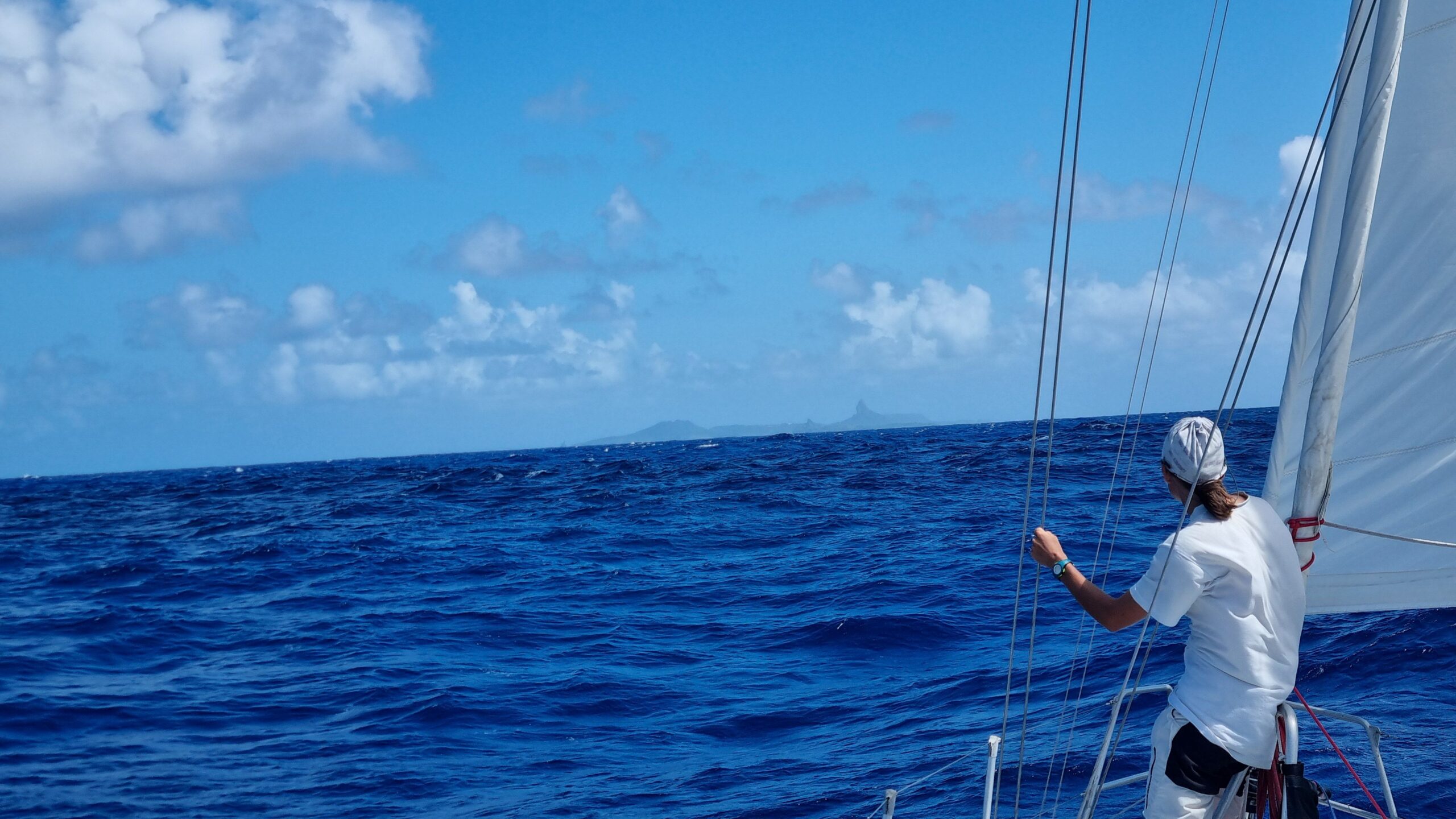
LAND AHOY !!!
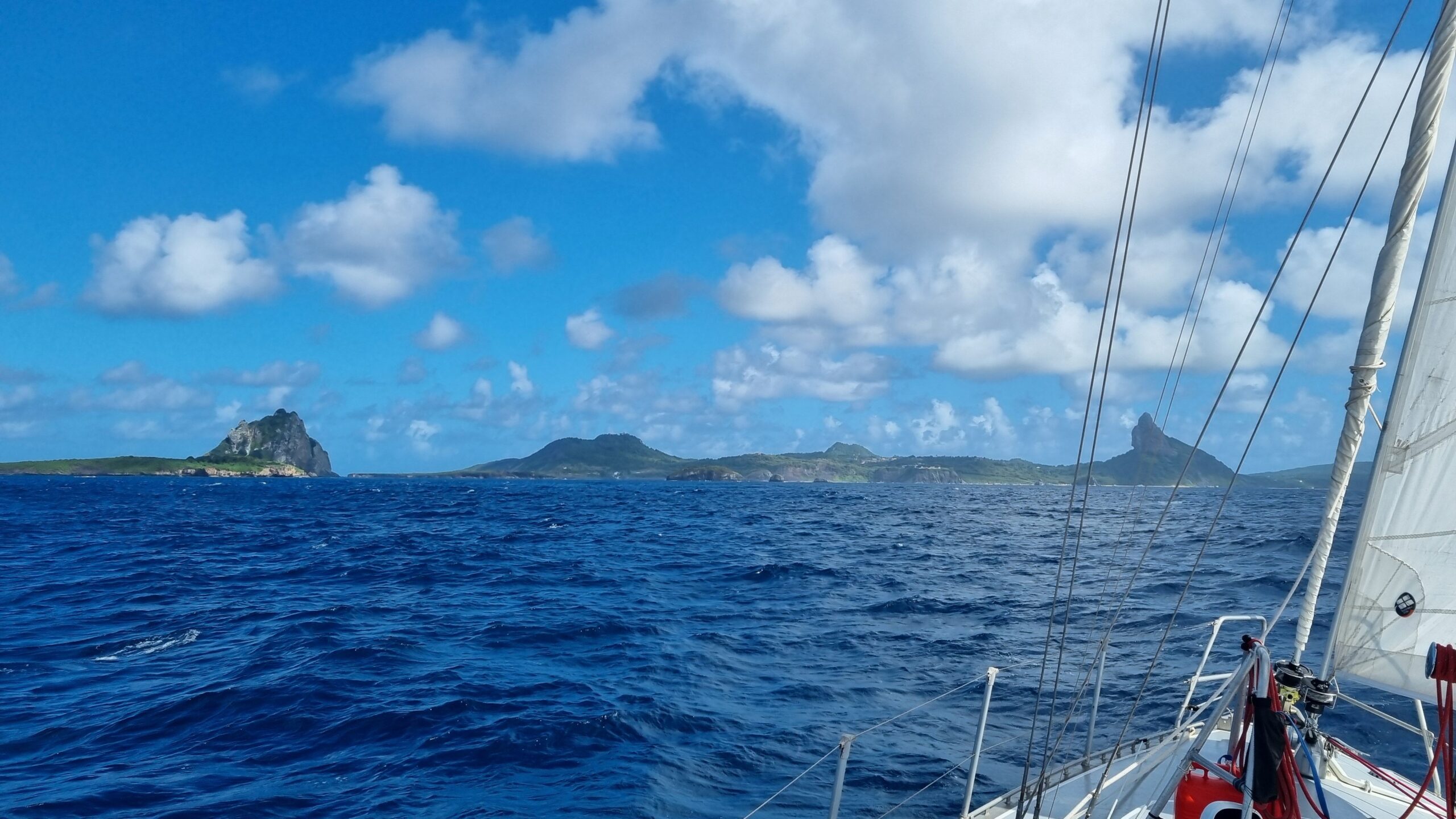
All our senses now perceive the presence of land
Then the colours appear: it is unbelievably green! Such lush vegetation! What a contrast to Cape… Verde, which ironically was so utterly arid (at least in summer). Finally, as we cruise past the first islets, the scents of land reach us. It smells exactly like a well-watered aquarium—rich, damp humus.
We arrive at the anchorage, which is cluttered with tour boats on mooring buoys in over 25 metres of water. However, Marc, a French-Brazilian we met in Mindelo, had recommended that we push right up to the beach. He even sent us the coordinates of his last anchorage on the island. Armed with his notes, we pluck up the courage to thread our way between the moorings and drop anchor in 10 metres of water, right next to the stone pier protecting the landing quay.
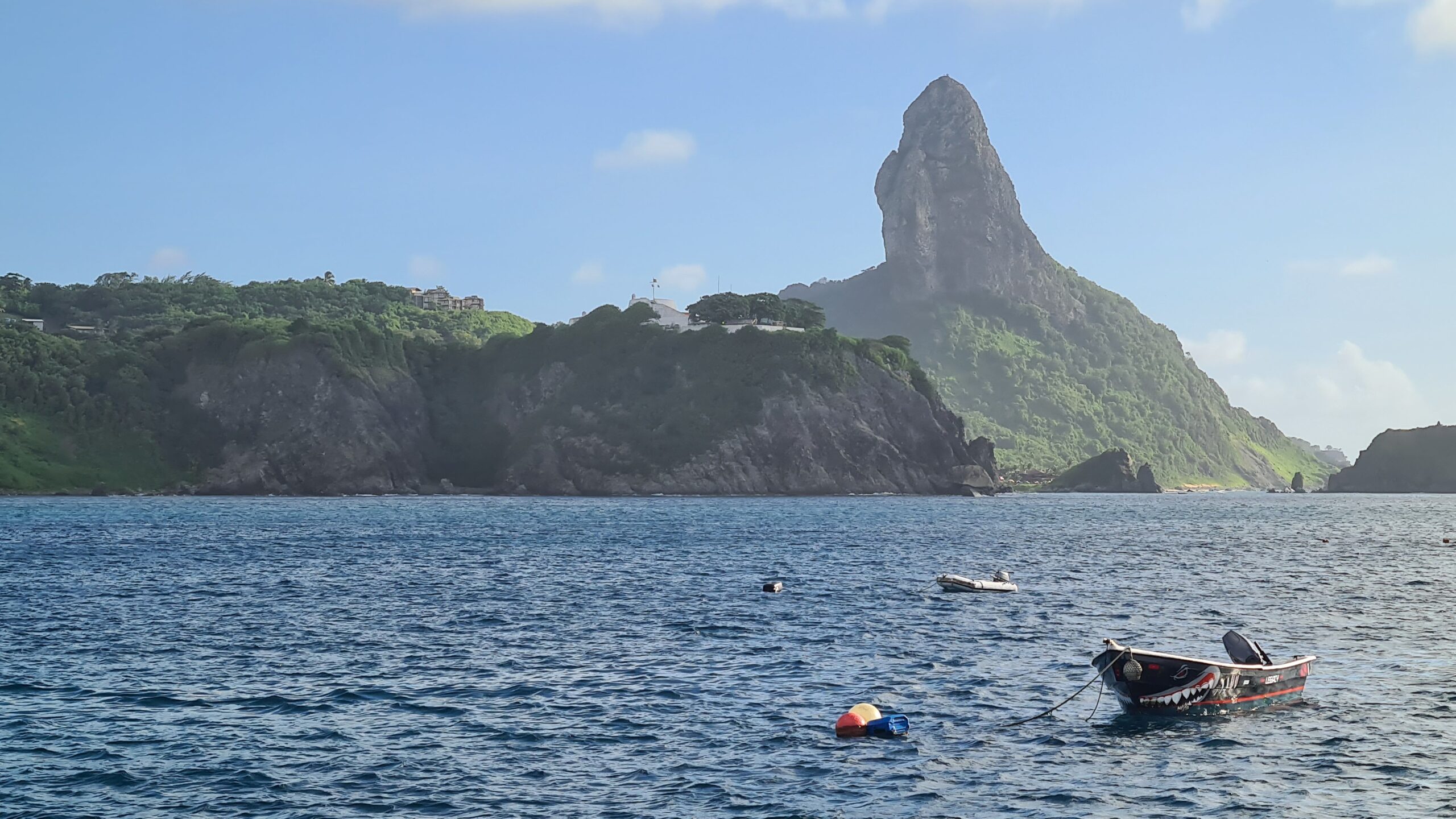
Anchored at Fernando de Noronha
The anchor falls into beautiful white sand. The crystal-clear water is not even too turpid in spite of the swell—which is notoriously heavy at this anchorage. The green volcanic peaks beaten by offshore waves and circled by frigatebirds frame the landscape beautifully, while the sound system at the beach bar is pumping out a 90dB mix of hip-hop and a football match… Oh, make that 120dB—Brazil must have just scored!
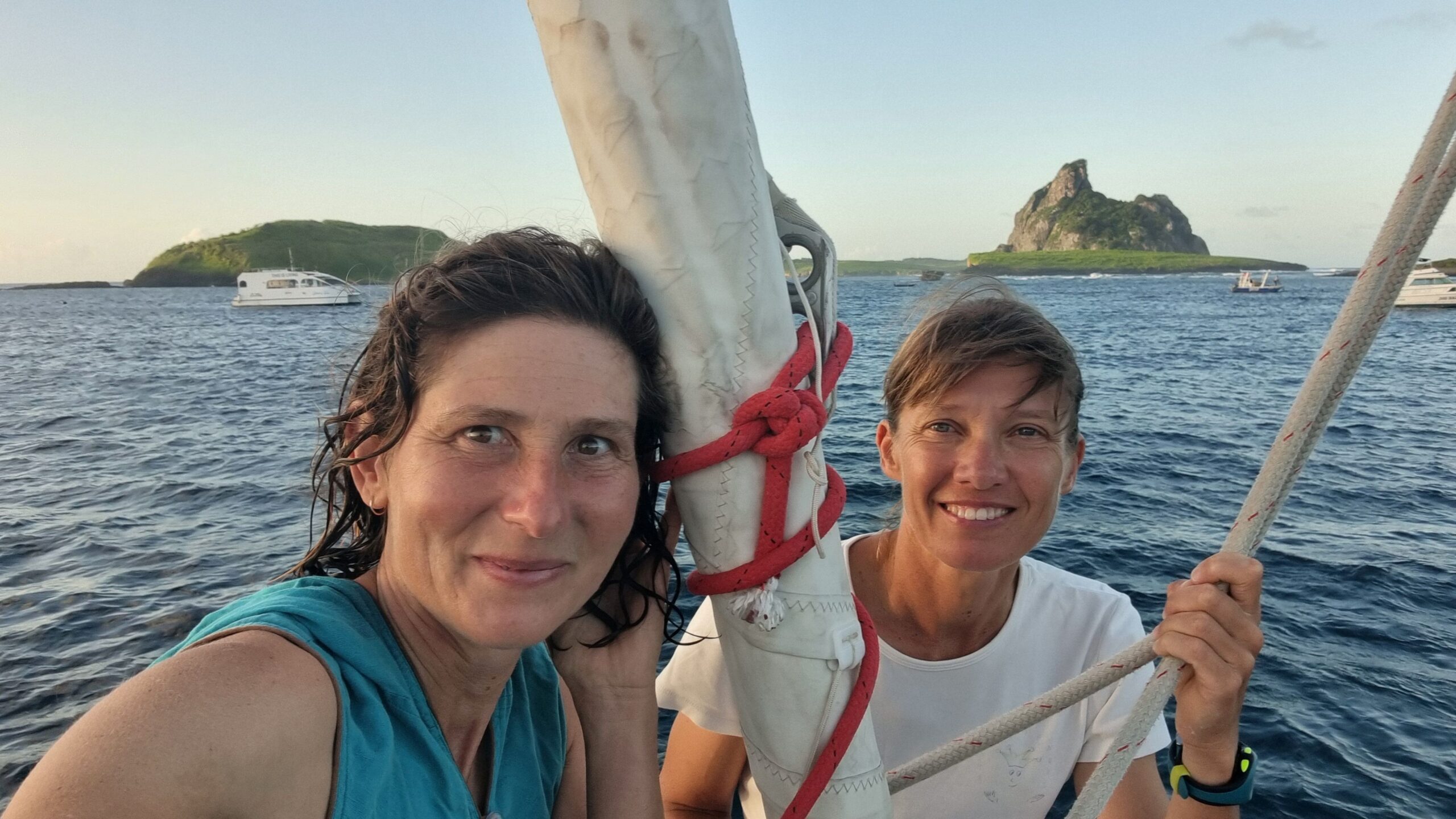
We made it !!
12 days and 4 hours: that is the time it took us to cross from Mindelo to this gorgeous little South Atlantic island. We will begin exploring tomorrow; for now, we dive with sheer delight into this incredibly pure water to finally cool down! Mind you, everything is relative—it is 28°C… but how hard it is to crawl back out! We would still be floating there if it weren’t for the blissful prospect of a long night’s sleep, completely clean, in a perfectly flat bed. The ultimate reward after a successful crossing…
 PDF
Many congratulations again on a safe crossing, especially your first of the Equator 🥳 I can’t help feeling you play down the challenging conditions just a tad, but maybe you just have so much experience it doesn’t faze you 😊 I love the menu notes, and that you managed to eat fresh ingredients all the way. And the upside down photo was delightful: so glad you managed to maintain your sense of humour 😂
Enjoy Brazil: I can’t wait to explore it vicariously with you xx